
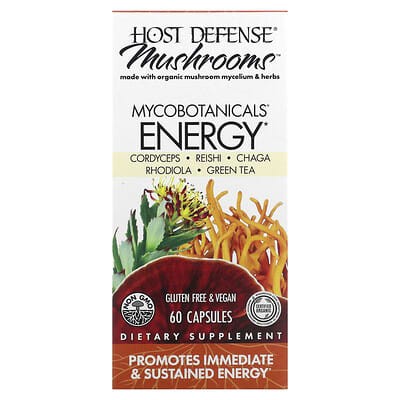

$27.71 $0.92 per serving


Product analysis
Energy may offer some help with stress-related fatigue through rhodiola, although findings depend on the preparation and setting. The unspecified plant forms make it harder to compare with preparations that have supporting evidence.
AI assessment of the formula, label and price. How scoring works
Nutrient Quality20
The plant and mushroom forms are not clearly specified in the main declarations. That limits a precise judgment of the preparations and their form-related quality.
Ingredient Transparency63
All ingredient amounts are stated, making serving comparisons easier. Forms are omitted from the main declarations, leaving the exact preparations unclear.
Value For Money29
The serving is relatively costly by the cordyceps, rhodiola and eleuthero comparisons. Unresolved values for the other ingredients leave no clear case for the full mix’s value.
Customer Satisfaction76
Customer feedback is strongly positive across hundreds of ratings. The review base gives a useful picture of satisfaction, without confirming health effects.
Product Focus49
Stress-related fatigue is the clearest possible use, with limited preparation-specific support from rhodiola. The broader mood, cognition and longevity goals remain uncertain.
- Format
Capsule - Container
- 60 Capsule(s)
- Per serving
- $0.92
- Customer rating
- 4.6 · 533 ratings
Goals

Impact
Moderate effect

Impact
Moderate effect

Impact
Lower effect

Impact
Lower effect
Cordyceps · 200 mgCordyceps · 200 mgCordyceps · 200 mgEleuthero · 100 mgEleuthero · 100 mg
Eleuthero Not classified
No linked studies yet.


Impact
High effect
Eleuthero · 100 mg
Ingredients
| Ingredient | Amount per serving | Score |
|---|---|---|
Cordyceps | 200 mg | |
Reishi | 200 mg | |
Green Tea (Camellia sinensis) leaf extract | 200 mg | |
Rhodiola (Rhodiola rosea) root extract | 200 mg | |
Chaga | 100 mg | |
Eleuthero | 100 mg |
Rhodiola · 200 mg OverallScore63
The serving provides 200 mg of Rhodiola rosea root extract. The whole-product price is relatively high for the stated amount of rhodiola. The rosavin and salidroside percentages are unknown.
How this ingredient is rated
Composition and Label Disclosure47
The species is Rhodiola rosea. The rosavin and salidroside percentages are unknown.
Declared Rhodiola Marker Profile
The rosavin and salidroside percentages are unknown.
Rhodiola Species Detail
The species is Rhodiola rosea.
Composition and Label Disclosure100
The amount is stated for the serving. No flagged flow agents or artificial additives are recorded; this does not establish purity.
Rhodiola Amount Disclosure
The serving contains 200 mg of rhodiola.
Other Ingredients Disclosure
No flagged flow agents or artificial additives are recorded; this does not establish purity.
Commercial Price and Usability20
The whole-product price is relatively high for the stated amount of rhodiola.
Cost per 200 mg Declared Rhodiola
The whole-product price is relatively high for the stated amount of rhodiola.
Eleuthero · 100 mg OverallScore60
Each serving provides 100 mg of Eleuthero Root at a high cost per serving. The eleutheroside content is not specified in the available information.
How this ingredient is rated
Composition and Label Disclosure40
The root is the named plant part. The eleutheroside content is not specified in the available information.
Eleutheroside Marker Disclosure
The eleutheroside content is not specified in the available information.
Target Plant-Part Identification
The root is the named plant part.
Composition and Label Disclosure100
The serving amount is stated as 100 mg.
Eleuthero Amount Disclosure
The serving amount is stated as 100 mg.
Commercial Price and Usability20
The cost per serving is high.
Selected-Serving Price Comparison
The cost per serving is high.
Cordyceps · 200 mg OverallScore46
200 mg of cordyceps per serving comes at a higher serving cost. A species and a quality claim are recorded, though their details aren’t specified here. No marker amounts are available, so the content of key compounds is unclear.
How this ingredient is rated
Composition and Label Disclosure0
No polysaccharide or other marker amount is available, so the content of key compounds is unclear.
Named Marker Disclosure
No polysaccharide or other marker amount is available, so the content of key compounds is unclear.
Composition and Label Disclosure100
A species and a quality claim are recorded, though their details aren’t specified here.
Species and Label Claim Disclosure
A species and a quality claim are recorded, though their details aren’t specified here.
Commercial Price and Usability30
The cost per serving is higher.
Selected-Serving Price Comparison
The cost per serving is higher.
Alternative products
Report alternatives
Sources
Published studies used for the product analysis and the top-ranked studies for each ingredient and goal.
- Dose-Response Effects of Short-Term Rhodiola rosea (Golden Root Extract) Supplementation on Anaerobic Exercise Performance and Cognitive Function in Resistance-Trained Athletes: A Randomized, Crossover, Double-Blind, and Placebo-Controlled Study.
- A combination of green tea, rhodiola, magnesium and B vitamins modulates brain activity and protects against the effects of induced social stress in healthy volunteers.
- Rosenroot (Rhodiola rosea): traditional use, chemical composition, pharmacology and clinical efficacy.
- Rhodiola rosea in stress induced fatigue--a double blind cross-over study of a standardized extract SHR-5 with a repeated low-dose regimen on the mental performance of healthy physicians during night duty.
- Effects of a Rhodiola rosea extract on mental resource allocation and attention: An event-related potential dual task study.
- No benefit adding eleutherococcus senticosus to stress management training in stress-related fatigue/weakness, impaired work or concentration, a randomized controlled study.
- Safety and efficacy of cognitive training plus epigallocatechin-3-gallate in young adults with Down's syndrome (TESDAD): a double-blind, randomised, placebo-controlled, phase 2 trial.
- Association between tea consumption and risk of cognitive disorders: A dose-response meta-analysis of observational studies.
- Investigating the Impact of Tea Consumption on Cognitive Function and Exploring Tea-Genetic Interactions in Older Adults Aged 65-105 Years: Findings from the 2002-2018 CLHLS Data.
- Consumption of green tea, but not black tea or coffee, is associated with reduced risk of cognitive decline.
- Green Tea Consumption and the Risk of Incident Dementia in Elderly Japanese: The Ohsaki Cohort 2006 Study.
- Evidence-based efficacy of adaptogens in fatigue, and molecular mechanisms related to their stress-protective activity.
- Central additive effect of Ginkgo biloba and Rhodiola rosea on psychomotor vigilance task and short-term working memory accuracy.
- Clinical evidence for the adaptogenic effects of Withania somnifera and Rhodiola rosea - A systematic review with molecular interpretation of psychometric outcomes.
- A randomised, double-blind, placebo-controlled, parallel-group study of the standardised extract shr-5 of the roots of Rhodiola rosea in the treatment of subjects with stress-related fatigue.
- Effects of fungal supplementation on endurance, immune function, and hematological profiles in adult athletes: a systematic review and meta-analysis
- Effect of Cs-4 (Cordyceps sinensis) on exercise performance in healthy older subjects: a double-blind, placebo-controlled trial
- Randomized controlled trial of Siberian ginseng for chronic fatigue.
- The effect of eight weeks of supplementation with Eleutherococcus senticosus on endurance capacity and metabolism in human
- The Effect of Short-Term Rhodiola rosea Supplementation on Simulated Game Time, Perceived Fatigue, and Performance in Basketball Players.