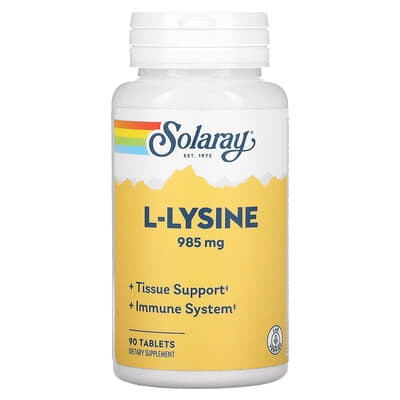
L-Lysine 985 mg

L-Lysine 985 mg

Solaray4.9 (1,884 ratings)
Format:Tablet Quantity: 90 Tablet(s) · 30 servings
Goals
$12.39 $0.41 per serving

About this product

Vitamin C and zinc provide clearer nutritional support than an expectation of extra benefit from lysine. The serving supplies 1,000 mg vitamin C and 25 mg zinc, supporting normal collagen and immune functions when intake is low. Lysine at 985 mg supplies a protein building block but does not establish an independent hair, skin or nail benefit.

The zinc amount is shared across amino acid chelate, citrate and picolinate descriptions. Their proportions are undisclosed, and the repeated entries should not be read as a 75 mg zinc total. The broad chelate description also leaves part of the source detail uncertain.

The serving cost is reasonable for zinc and lysine, with more moderate value for vitamin C. Ascorbic acid is unbuffered, while copper content is not established and leaves mineral balance uncertain. Extra hormone, bone or cosmetic benefits are not established in people who already meet nutrient needs.

Who is it for
  • Adults who specifically want lysine together with vitamin C and zinc rather than lysine alone.
Best for
  • Combined vitamin C and zinc nutrition when intake is low and lysine is separately desired.

Pros

  • The main nutrient and lysine amounts are disclosed.
  • The serving offers reasonable value for zinc and lysine.
  • Lysine hydrochloride and the vitamin C source are identified.

Cons

  • Zinc source proportions are not disclosed.
  • Part of the zinc source uses a broad amino acid chelate description.
  • Vitamin C is unbuffered ascorbic acid.
  • Isolated lysine does not establish extra hair, skin or collagen benefits.
  • Copper content is not established.

Warnings

  • The 25 mg zinc serving needs to be counted with dietary zinc and other supplements before combining products, because the adult daily upper limit is 40 mg.


Product analysis

63 out of 100

L-Lysine 985 mg combines lysine with nutrients that support normal immunity and collagen formation when intake is low. Zinc may also help hair shedding linked to low zinc intake, while a separate hair benefit from lysine remains uncertain.

AI assessment of the formula, label and price. How scoring works

Nutrient Quality43

Several ingredient forms are identified, but their absorption cannot be compared completely. The zinc sources differ in quality and have unknown proportions, limiting a precise assessment of the mixture.

Ingredient Transparency74

The ingredient amounts and most forms are disclosed, helping compare the serving. The relative amounts of the zinc sources remain unspecified.

Value For Money53

The lysine and zinc amounts offer moderate value. Vitamin C also falls in the middle of its cost comparison, while vitamin B6’s value remains uncertain.

Customer Satisfaction89

Customer feedback is strongly positive across a substantial number of ratings. The feedback describes satisfaction and does not establish effectiveness.

Product Focus74

Lysine is combined with nutrients relevant to several health goals, making the formula broader than its name suggests. The clearest benefits relate to normal nutrient functions when intake is inadequate.

Format
Tablet
Container
90 Tablet(s)
Per serving
$0.41
Customer rating
4.9 · 1,884 ratings
Report analysis

Goals

Everyday Health
Impact
High effect
A- Ingredient FitB+ PathwaysB- EvidenceA+ Formulation Logic
Zinc · 25 mgVitamin C · 1000 mg

Vitamin C and zinc supply nutrients relevant to immune and antioxidant functions, while B6 contributes to metabolism and blood formation. These nutritional contributions may help fill low intakes. The supplied information does not establish a broad general-health benefit from lysine or additional benefit from these nutrients once intake is adequate.

How this product is rated for Everyday Health

Ingredient fit85

Relevant nutrients contribute to this goal, while other actives add no established general-health contribution in the supplied findings. The counted ingredients reach their saved amount comparisons; these comparisons do not establish added benefit above nutritional adequacy.
Goal fit
Relevant nutrients contribute to this goal, while other actives add no established general-health contribution in the supplied findings.
Dose adequacy
The counted ingredients reach their saved amount comparisons; these comparisons do not establish added benefit above nutritional adequacy.

Pathways80

The strongest saved contribution concerns antioxidant and immune defence, reflecting the relevant nutrient amounts rather than a guaranteed health outcome. Two areas contribute meaningfully in the saved findings, reflecting the mix of relevant nutrients.
Depth
The strongest saved contribution concerns antioxidant and immune defence, reflecting the relevant nutrient amounts rather than a guaranteed health outcome.
Breadth
Two areas contribute meaningfully in the saved findings, reflecting the mix of relevant nutrients.

Evidence74

Vitamin C leads the saved evidence finding; its supported role here is conditional nutrient availability rather than additional benefit above adequate intake.
Evidence strength
Vitamin C leads the saved evidence finding; its supported role here is conditional nutrient availability rather than additional benefit above adequate intake.
Studied preparation
The counted preparations satisfy the saved preparation check; this does not establish superiority of their forms or delivery methods.

Formulation logic100

The counted ingredients can contribute independently or have the partners required by the supplied findings. No configured ingredient conflict was identified in the supplied findings.
Partner coverage
The counted ingredients can contribute independently or have the partners required by the supplied findings.
Conflicts
No configured ingredient conflict was identified in the supplied findings.
Effective doses
All ingredients counted in this check meet its minimum amount criterion; that criterion does not prove a clinically effective dose.
Study evidence
Vitamin C Supportive 56 studies
Zinc Supportive 60 studies
Immunity
Impact
Highest effect
A- Ingredient FitB+ PathwaysA+ EvidenceA+ Formulation Logic
Vitamin C · 1000 mgZinc · 25 mg

Vitamin C can modestly shorten colds with regular use, while zinc supports normal immune-cell function and vitamin B6 contributes when intake is low. Lysine also receives a saved contribution, but its cited recurrent-herpes findings involve a different endpoint and regimen. They do not establish broad respiratory protection from this serving.

How this product is rated for Immunity

Ingredient fit86

Vitamin C contributes to the supplied ingredient findings. The contributing amounts meet the supplied comparisons to differing degrees.
Goal fit
The formula is focused on the contributing ingredients, though they may also serve other purposes.
Dose adequacy
The contributing amounts provide a partial overall match to the supplied comparisons; this does not measure the probability of benefit.

Pathways80

The strongest supplied connection is to innate immune cell activity. This describes the ingredients' assigned roles rather than an observed clinical outcome.
Depth
The strongest assigned connection is to innate immune cell activity, rather than a demonstrated change in infection outcomes.
Breadth
The supplied findings meaningfully cover two immune areas.

Evidence100

Vitamin C leads the supplied evidence finding. Established nutrient roles and limited cold-duration findings do not establish general infection prevention.
Evidence strength
Vitamin C leads the evidence finding, with benefits bounded by its nutritional role or regular-use context.
Studied preparation
The contributing forms pass the supplied preparation check; no additional clinical advantage from a particular form is established.

Formulation logic100

The contributing ingredients have no missing required partner, and no listed formulation conflict was triggered.
Partner coverage
The contributing ingredients can act independently, so no missing required partner reduces their contribution.
Conflicts
No listed formulation conflict was triggered by the supplied facts.
Effective doses
All contributing ingredients meet the supplied minimum amount comparison; this is not proof of a clinically effective regimen.
Study evidence
Lysine Supportive 2 studies
Vitamin C Supportive 53 studies
Zinc Supportive 73 studies
Skin Health
Impact
High effect
A Ingredient FitF PathwaysA+ EvidenceA+ Formulation Logic
Zinc · 25 mgVitamin C · 1000 mg

Vitamin C supports collagen formation and wound healing when intake is low, while zinc and vitamin B6 have deficiency-related skin roles. Lysine is a collagen building block, but this does not establish isolated lysine as a skin intervention. The saved result recognized the amounts but found only limited collagen-related coverage. The combination does not establish added collagen or skin benefits with adequate nutrition.

How this product is rated for Skin Health

Ingredient fit91

Relevant nutrients and lysine give the formula a substantial skin connection.
Goal fit
Relevant nutrients and lysine give the formula a substantial skin connection.
Dose adequacy
The contributing amounts met the saved criteria.

Pathways8

Limited collagen-related coverage did not reach the saved breadth criterion.
Depth
Limited collagen-related coverage did not reach the saved breadth criterion.
Breadth
Limited collagen-related coverage did not reach the saved breadth criterion.

Evidence97

Vitamin C drove the saved evidence finding; its clearest practical skin role concerns low intake.
Evidence strength
Vitamin C drove the saved evidence finding; its clearest practical skin role concerns low intake.
Studied preparation
Lysine lacked studied-preparation recognition; a collagen building-block role does not establish an isolated lysine skin intervention.

Formulation logic100

No required partner was missing and no listed conflict was matched. The contributing ingredients met the saved minimum amount criterion.
Partner coverage
No contributing ingredient lacked a required partner; this does not establish extra benefit from combining ingredients.
Conflicts
No listed ingredient conflict was matched in the saved result.
Effective doses
The contributing ingredients met the saved minimum amount criterion; this is not proof of a clinically effective skin dose.
Study evidence
Vitamin C Supportive 53 studies
Zinc Supportive 66 studies
Bone Health
Impact
Highest effect
A- Ingredient FitC PathwaysA+ EvidenceA+ Formulation Logic
Lysine · 985 mgZinc · 25 mgVitamin C · 1000 mg

Vitamin C supports formation of the collagen framework in bone, with a clear nutritional role when intake is inadequate. Zinc participates in bone-cell processes, but extra supplementation has no established routine bone-density or fracture benefit in adequately nourished adults. Lysine is a collagen precursor, yet isolated lysine cannot inherit findings for specific collagen peptides. Vitamin B6 also lacks an established independent skeletal benefit from its homocysteine-related role.

How this product is rated for Bone Health

Ingredient fit89

All four credited ingredients have declared amounts that meet the saved inclusion threshold, without establishing clinical benefit.
Goal fit
The identified ingredients are focused on bone-related nutritional roles, although the product is also linked to other goals.
Dose adequacy
All four credited ingredients have declared amounts that meet the saved inclusion threshold, without establishing clinical benefit.

Pathways60

The strongest saved area is collagen matrix formation, with coverage of collagen matrix processes.
Depth
Collagen matrix formation is the strongest area in the saved findings.
Breadth
The saved findings cover collagen matrix processes. Other bone processes receive less or no contribution.

Evidence98

Zinc leads the saved evidence finding; this does not establish additional benefit when nutritional needs are already met.
Evidence strength
Zinc leads the saved evidence finding; this does not establish additional benefit when nutritional needs are already met.
Studied preparation
The saved findings recognize the included preparations, without proving that this formula reproduces clinical bone outcomes.

Formulation logic100

The included ingredients either work independently under the supplied comparison or have their specified partner. No ingredient conflict was identified by the supplied checks.
Partner coverage
The included ingredients either work independently under the supplied comparison or have their specified partner.
Conflicts
No ingredient conflict was identified by the supplied checks.
Effective doses
All credited ingredients meet the saved amount threshold; this threshold is not a proven effective clinical dose.
Study evidence
Lysine Supportive 2 studies
Vitamin C Supportive 46 studies
Zinc Supportive 33 studies
Impact
Moderate effect
B Ingredient FitC PathwaysC EvidenceA+ Formulation Logic

Vitamin C at 1000 mg supports normal collagen formation, and zinc at 25 mg supports nail-matrix cell growth. Zinc is most relevant when nutritional intake is inadequate; these nutrient functions alone do not establish stronger nails in well-nourished adults.

How this product is rated for Nail Health

Ingredient fit77

The assessment identifies 2 relevant ingredients, alongside 2 other actives. The product is linked to 9 goals. The saved amount assessment is fully aligned with its ingredient benchmarks.
Goal fit
The assessment identifies 2 relevant ingredients, alongside 2 other actives. The product is linked to 9 goals.
Dose adequacy
The saved amount assessment is fully aligned with its ingredient benchmarks. Undisclosed amounts add no support.

Pathways60

The strongest saved coverage is in silicon and matrix cross-linking. 1 of 2 target areas reaches the saved coverage threshold: silicon and matrix cross-linking. Structural protein supply has no coverage.
Depth
The strongest saved coverage is in silicon and matrix cross-linking. This describes ingredient roles, not measured nail improvement.
Breadth
1 of 2 target areas reaches the saved coverage threshold: silicon and matrix cross-linking. Structural protein supply has no coverage.

Evidence62

Vitamin C provides the strongest saved evidence contribution at an amount counted by the assessment. Nail-specific benefits still depend on the limits of the supplied evidence. The counted preparations match the saved research criteria.
Evidence strength
Vitamin C provides the strongest saved evidence contribution at an amount counted by the assessment. Nail-specific benefits still depend on the limits of the supplied evidence.
Studied preparation
The counted preparations match the saved research criteria.

Formulation logic100

The counted ingredients can contribute independently or have their required partner present. 2 of 2 counted ingredients reach the saved minimum amount benchmark. No configured conflict was found.
Partner coverage
The counted ingredients can contribute independently or have their required partner present.
Conflicts
No configured ingredient conflict was found in the saved assessment.
Effective doses
2 of 2 counted ingredients reach the saved minimum amount benchmark.
Study evidence
Vitamin C Supportive 1 study
Zinc No effect 1 study
Impact
Highest effect
A Ingredient FitB+ PathwaysA+ EvidenceA+ Formulation Logic
Zinc · 25 mgLysine · 985 mgVitamin C · 1000 mg

Zinc can support hair when low zinc intake or deficiency contributes to diffuse shedding; extra zinc does not establish regrowth when intake is adequate. Lysine supplies a protein building block, but selected combination regimens do not establish an independent routine hair benefit.

How this product is rated for Hair Health

Ingredient fit91

The relevant declarations provide relatively focused nutritional coverage for hair, with the amount findings reflecting the individual ingredients.
Goal fit
The relevant ingredients dominate the formula, giving it a focused nutritional connection to hair.
Dose adequacy
Most known amounts make substantial contributions, although coverage varies between ingredients.

Pathways80

The ingredients connect to selected hair-related processes, without demonstrating regrowth through those mechanisms.
Depth
The main connection is to follicle antioxidant protection, which does not itself establish improved hair growth.
Breadth
The ingredients cover two hair-related processes, with limited coverage elsewhere.

Evidence98

The strongest evidence contribution and preparation matches describe different aspects of the ingredients; neither guarantees hair improvement.
Evidence strength
Zinc supplies the strongest evidence contribution, subject to the ingredient’s specific limitations.
Studied preparation
Eligible declarations are recognized as studied forms; this does not establish hair regrowth in people with adequate nutrient intake.

Formulation logic100

The formula has no matched missing partner or listed conflict. The amount findings distinguish meaningful declarations from small or unresolved quantities.
Partner coverage
No required ingredient partner is missing from the supplied findings.
Conflicts
No listed ingredient conflict was matched; this finding does not establish the absence of every possible interaction.
Effective doses
The ingredients counted here clear the minimum comparison amount; that threshold is not a proven effective hair-growth dose.
Study evidence
Lysine Supportive 1 study
Zinc Supportive 22 studies

Ingredients

IngredientAmount per servingScore
Calories
5 NP
Vitamin C (Ascorbic Acid)
1000 mg 58
Vitamin B6 (Pyridoxine Hydrochloride)
10 mg
Zinc (Zinc Amino Acid Chelate, Zinc Citrate, Zinc Picolinate)
25 mg 60
L-Lysine (L-Lysine Hydrochloride)
985 mg 77
Adults 18–50
Report overview
D+ Active Ingredient Quality & BioavailabilityC+ Dose, Safety & Label TransparencyC Value
+1
Each serving provides 25 mg zinc from an amino acid chelate, citrate and picolinate. The amounts from each form are unknown, as is the copper amount.
How this ingredient is rated

Active Ingredient Quality & Bioavailability52

The zinc sources are zinc amino acid chelate, zinc citrate and zinc picolinate, with their individual proportions unknown.
Zinc Form Bioavailability
Zinc comes from zinc amino acid chelate, zinc citrate and zinc picolinate. The individual proportions are unknown, and the forms are assessed differently for absorption.

Dose, Safety & Label Transparency67

The label states 25 mg zinc per serving. Copper is unknown, leaving the zinc-to-copper balance unassessed.
Elemental Dose Transparency
The label states 25 mg elemental zinc and names the source forms.
Zinc Dosage Safety & Effectiveness
25 mg zinc per serving is viewed favorably in the evaluation.
Zinc-to-Copper Mineral Balance
The copper amount is unknown, so a zinc-to-copper ratio cannot be determined.

Value60

A whole-product serving costs about $0.41.
Price Per Serving Efficiency
A whole-product serving costs about $0.41.
B- Active Ingredient Quality & BioavailabilityA Dose, Safety & Label TransparencyC Value
A serving lists 985 mg of lysine from L-lysine hydrochloride. The whole product costs about $0.42 per gram of lysine.
How this ingredient is rated

Active Ingredient Quality & Bioavailability72

L-lysine hydrochloride is the stated source. No specific grade or sourcing claim is identified in the available evaluation.
Lysine Chemical Form & Sourcing
L-lysine hydrochloride is the stated source.
Purity and Grade Signals
No specific grade or sourcing claim is identified in the available evaluation.

Dose, Safety & Label Transparency90

The serving lists 985 mg of lysine. The evaluation identifies a common excipient without naming it.
Lysine Dose by Declared Basis
The declared lysine amount is 985 mg per serving.
Clean Label & Additives
The evaluation identifies a common excipient without naming it.

Value60

The whole-product price works out to about $0.42 per gram of lysine.
Price Per 1000mg of Lysine
The whole-product price works out to about $0.42 per gram of lysine.
F Active Ingredient Quality & BioavailabilityA Dose, Safety & Label TransparencyD+ Value
A serving supplies 1,000 mg of vitamin C as ascorbic acid. Based on the whole-product serving price, that works out to about $0.41 per gram of vitamin C.
How this ingredient is rated

Active Ingredient Quality & Bioavailability30

Ascorbic acid is the named source. The available facts do not establish a specific degree of buffering.
Vitamin C Chemical Form & Delivery System
The vitamin C source is ascorbic acid, with no advanced delivery claim recorded.
Gastric Comfort & pH Balance
The source is ascorbic acid; the available facts do not establish a specific degree of buffering.

Dose, Safety & Label Transparency91

A serving provides 1,000 mg of vitamin C and identifies its source. The evaluation found no flagged additives.
Optimal Dosage Targeting
A serving contains 1,000 mg of vitamin C.
Purity & Excipient Quality
Standard excipients are recorded; no lower-scoring additives were identified in the evaluation.
Mineral & Source Transparency
The 1,000 mg vitamin C amount and its ascorbic acid source are recorded; a matching mineral amount is not applicable.

Value50

The whole-product serving price works out to about $0.41 per gram of vitamin C.
Price per Gram of Vitamin C
The whole-product serving price works out to about $0.41 per gram of vitamin C.
Report alternatives

Sources

Published studies used for the product analysis and the top-ranked studies for each ingredient and goal.

  1. Amino Acid Intakes Are Associated With Bone Mineral Density and Prevalence of Low Bone Mass in Women: Evidence From Discordant Monozygotic Twins.
    Jennings A; MacGregor A; Spector T; Cassidy A · Journal of bone and mineral research : the official journal of the American Society for Bone and Mineral Research · 2016
    Cross-sectional study135 participantsBone Health forLysine
  2. Dietary L-lysine and calcium metabolism in humans.
    Civitelli R; Villareal DT; Agnusdei D; Nardi P; Avioli LV; Gennari C · Nutrition (Burbank, Los Angeles County, Calif.) · 1993
    Clinical trial75 participantsBone Health forLysine
  3. The Effects of the AGE Inhibitor Pyridoxamine on Bone in Older Women With Type 2 Diabetes: A Randomized Clinical Trial.
    Brossfield AV; McMahon DJ; Fernando J; Omeragic B; Majeed R; Agarwal S; Sroga GE; Wang B; Vashishth D; Rubin MR · The Journal of clinical endocrinology and metabolism · 2025
    Randomized trial55 participantsBone Health forVitamin B6
  4. Dietary B vitamin intake and risk of hip fracture: the Singapore Chinese Health Study.
    Dai Z; Wang R; Ang LW; Yuan JM; Koh WP · Osteoporosis international : a journal established as result of cooperation between the European Foundation for Osteoporosis and the National Osteoporosis Foundation of the USA · 2014
    Cohort study63,257 participantsBone Health forVitamin B6
  5. Hip fracture patients may be vitamin B6 deficient. Controlled study of serum pyridoxal-5'-phosphate.
    Reynolds TM; Marshall PD; Brain AM · Acta orthopaedica Scandinavica · 1993
    Case-control study103 participantsBone Health forVitamin B6
  6. Degree of mineralization-related collagen crosslinking in the femoral neck cancellous bone in cases of hip fracture and controls.
    Saito M; Fujii K; Marumo K · Calcified tissue international · 2006
    Case-control study50 participantsBone Health forVitamin B6
  7. Adequate Intake and Supplementation of B Vitamins, in Particular Folic Acid, can Play a Protective Role in Bone Health.
    Rondanelli M; Tartara A; Fossari F; Vecchio V; Faliva MA; Naso M; Perna S; Nichetti M; Peroni G · Current aging science · 2022
    Narrative review35,298 participants29 studies pooledBone Health forVitamin B6
  8. Can Dietary Intake of Vitamin C-Oriented Foods Reduce the Risk of Osteoporosis, Fracture, and BMD Loss? Systematic Review With Meta-Analyses of Recent Studies.
    Zeng LF; Luo MH; Liang GH; Yang WY; Xiao X; Wei X; Yu J; Guo D; Chen HY; Pan JK; Huang HT; Liu Q; Guan ZT; Han YH; Zhao D; Zhao JL; Hou SR; Wu M; Lin JT; Li JH; Liang WX; Ou AH; Wang Q; Li ZP; Liu J · Frontiers in endocrinology · 2020
    Meta-analysis19,484 participants17 studies pooledBone Health forVitamin C
  9. Dietary vitamin C intake and the risk of hip fracture: a dose-response meta-analysis.
    Sun Y; Liu C; Bo Y; You J; Zhu Y; Duan D; Cui H; Lu Q · Osteoporosis international : a journal established as result of cooperation between the European Foundation for Osteoporosis and the National Osteoporosis Foundation of the USA · 2019
    Meta-analysis6 studies pooledBone Health forVitamin C
  10. Smoking, antioxidant vitamins, and the risk of hip fracture.
    Melhus H; Michaëlsson K; Holmberg L; Wolk A; Ljunghall S · Journal of bone and mineral research : the official journal of the American Society for Bone and Mineral Research · 1999
    Cohort study66,651 participantsBone Health forVitamin C
  11. Micronutrients and the risk of hip fracture: Case-control study.
    Torbergsen AC; Watne LO; Wyller TB; Frihagen F; Strømsøe K; Bøhmer T; Mowe M · Clinical nutrition (Edinburgh, Scotland) · 2018
    Case-control study189 participantsBone Health forVitamin C
  12. Favorable effect of dietary vitamin C on bone mineral density in postmenopausal women (KNHANES IV, 2009): discrepancies regarding skeletal sites, age, and vitamin D status.
    Kim YA; Kim KM; Lim S; Choi SH; Moon JH; Kim JH; Kim SW; Jang HC; Shin CS · Osteoporosis international : a journal established as result of cooperation between the European Foundation for Osteoporosis and the National Osteoporosis Foundation of the USA · 2016
    Cross-sectional study1,196 participantsBone Health forVitamin C
  13. Increased incidence of fractures in middle-aged and elderly men with low intakes of phosphorus and zinc.
    Elmståhl S; Gullberg B; Janzon L; Johnell O; Elmståhl B · Osteoporosis international : a journal established as result of cooperation between the European Foundation for Osteoporosis and the National Osteoporosis Foundation of the USA · 1999
    Cohort study6,576 participantsBone Health forZinc
  14. Zinc Supplementation Increases Procollagen Type 1 Amino-Terminal Propeptide in Premenarcheal Girls: A Randomized Controlled Trial.
    Berger PK; Pollock NK; Laing EM; Chertin V; Bernard PJ; Grider A; Shapses SA; Ding KH; Isales CM; Lewis RD · The Journal of nutrition · 2016
    Randomized trial147 participantsBone Health forZinc
  15. Randomized controlled trial of prenatal zinc supplementation and fetal bone growth.
    Merialdi M; Caulfield LE; Zavaleta N; Figueroa A; Costigan KA; Dominici F; Dipietro JA · The American journal of clinical nutrition · 2004
    Randomized trial242 participantsBone Health forZinc
  16. The effects of zinc supplementation on serum zinc, alkaline phosphatase activity and fracture healing of bones.
    Sadighi A; Roshan MM; Moradi A; Ostadrahimi A · Saudi medical journal · 2009
    Randomized trial60 participantsBone Health forZinc
  17. Is Zinc an Important Trace Element on Bone-Related Diseases and Complications? A Meta-analysis and Systematic Review from Serum Level, Dietary Intake, and Supplementation Aspects.
    Ceylan MN; Akdas S; Yazihan N · Biological trace element research · 2021
    Meta-analysis40 studies pooledBone Health forZinc
  18. Dietary intake and blood concentrations of antioxidants and the risk of cardiovascular disease, total cancer, and all-cause mortality: a systematic review and dose-response meta-analysis of prospective studies.
    Aune D; Keum N; Giovannucci E; Fadnes LT; Boffetta P; Greenwood DC; Tonstad S; Vatten LJ; Riboli E; Norat T · The American journal of clinical nutrition · 2019
    Meta-analysis69 studies pooledEveryday Health forVitamin C
  19. Scientific Opinion on the substantiation of a health claim related to vitamin C and increasing non haem iron absorption pursuant to Article 14 of Regulation (EC) No 1924/2006.
    EFSA Panel on Dietetic Products, Nutrition and Allergies (NDA) · EFSA journal. European Food Safety Authority · 2026
    Guideline / consensusEveryday Health forVitamin C
  20. Vitamin C Depletion and All-Cause Mortality in Renal Transplant Recipients.
    Sotomayor CG; Eisenga MF; Gomes Neto AW; Ozyilmaz A; Gans ROB; Jong WHA; Zelle DM; Berger SP; Gaillard CAJM; Navis GJ; Bakker SJ · Nutrients · 2018
    Cohort study598 participantsEveryday Health forVitamin C