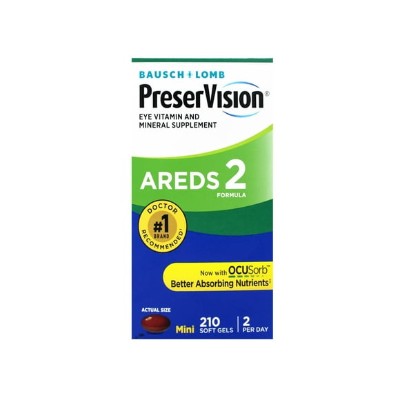
PreserVision AREDS 2 Formula

PreserVision AREDS 2 Formula

Bausch & Lomb4.9 (5,848 ratings)
Format:Softgel Quantity: 210 Softgel(s) · 210 servings
Goals
$40.97 $0.19 per serving

About this product

The formula is tightly centered on eye support, pairing lutein and zeaxanthin with vitamin C, vitamin E, zinc, and copper. Its eye-health findings were favorable, and the ingredient list avoids the scattered extras seen in broad multivitamins.

Label transparency is uneven: all amounts are shown, but only one ingredient form is disclosed on the presented panel. Available findings identified basic ascorbic acid, synthetic dl-alpha-tocopheryl acetate, and zinc oxide, which weakened form-quality assessments despite the purposeful dose pattern.

The formula is better viewed as a specialized eye-health product than as an everyday multivitamin. The high zinc and vitamin E amounts make professional guidance sensible, particularly for long-term use or when combined with other supplements.

Who is it for
  • Adults seeking a focused AREDS 2-style eye-support formula
  • People advised to use a specialized eye nutrient combination
  • Users who prefer a compact formula rather than a broad multivitamin
Best for
  • Targeted eye-health support
  • Combining lutein and zeaxanthin with zinc and antioxidant vitamins
  • People using the formula under eye-care guidance

Pros

  • Includes 10 mg lutein and 2 mg zeaxanthin
  • Keeps the ingredient list focused on eye-related nutrients
  • Provides copper alongside the high zinc amount
  • All active amounts are disclosed
  • Strong consumer satisfaction data were supplied

Cons

  • Most ingredient forms are not disclosed on the main panel
  • Available findings identified zinc oxide and synthetic vitamin E
  • Vitamin E form and value findings were weak
  • The formula is not broad enough to replace a general multivitamin
  • Eye-goal analysis did not count the assessed zeaxanthin amount in one dose calculation

Warnings

  • The label lists 80 mg zinc, a high amount that should not be combined casually with other zinc products and is best used with professional guidance.
  • Vitamin E at 400 IU may increase bleeding concerns for people using anticoagulant or antiplatelet medicines.
  • Because the formula is designed for a specific eye-health use, confirm that the dose pattern fits your eye-care plan rather than taking it as a general wellness supplement.

Product analysis

53 out of 100

PreserVision AREDS 2 Formula offers eye-focused nutrients whose clearest evidence concerns selected age-related eye conditions. Most ingredient forms are unspecified, making the formula harder to compare with alternatives.

AI assessment of the formula, label and price. How scoring works

Nutrient Quality23

Most forms are not clearly disclosed, limiting a confident comparison of absorption quality. Naming a source for zeaxanthin alone does not resolve the wider uncertainty.

Ingredient Transparency67

All ingredient amounts are stated, making serving comparisons easier. Almost all specific forms are unspecified, limiting comparison of the sources used.

Value For Money50

Value is mixed, with favorable serving costs for zinc and copper but weak value for vitamin C. The synthetic vitamin E and missing carotenoid comparisons limit the wider value case.

Customer Satisfaction94

Customer feedback is very positive. Thousands of reviews provide a substantial picture of buyer satisfaction.

Product Focus60

Eye nutrition is the clearest purpose, with the strongest relevant evidence applying to selected age-related eye conditions. Copper helps balance zinc, while the broader health uses do not establish general vision improvement.

Format
Softgel
Container
210 Softgel(s)
Per serving
$0.19
Customer rating
4.9 · 5,848 ratings
Report analysis

Goals

Impact
High effect
B- Ingredient FitC PathwaysA+ EvidenceA+ Formulation Logic
Zinc · 80 mgVitamin E · 400 IUVitamin C · 500 mgCopper · 2 mg

Declared lutein connects to macular pigment and light filtering, but generic carotenoid or source mass cannot be treated as equivalent active lutein. Zinc and antioxidant vitamins have evidence within a defined AREDS regimen for selected macular-degeneration populations, rather than general vision improvement. Copper’s AREDS role is to counterbalance high-dose zinc, rather than independently improve vision.

How this product is rated for Eye Health

Ingredient fit71

The relevant declarations provide mixed nutritional coverage for vision, with the amount findings reflecting the individual ingredients.
Goal fit
The formula includes relevant nutritional ingredients alongside ingredients serving other purposes.
Dose adequacy
Partial or unresolved amounts limit how much the relevant ingredients contribute.

Pathways60

The ingredients connect to selected vision-related processes, without demonstrating vision improvement through those mechanisms.
Depth
The main connection is to photoreceptor structure and visual cycle, which does not itself establish improved hair growth.
Breadth
Coverage is concentrated in one vision-related process.

Evidence100

The strongest evidence contribution and preparation matches describe different aspects of the ingredients; neither guarantees vision improvement.
Evidence strength
carotenoids supplies the strongest evidence contribution, subject to the ingredient’s specific limitations.
Studied preparation
Eligible declarations are recognized as studied forms; this does not establish improved vision in people with adequate nutrient intake.

Formulation logic95

The formula has no matched missing partner or listed conflict. The amount findings distinguish meaningful declarations from small or unresolved quantities.
Partner coverage
No required ingredient partner is missing from the supplied findings.
Conflicts
No listed ingredient conflict was matched; this finding does not establish the absence of every possible interaction.
Effective doses
Vitamin E does not clear the minimum amount threshold, limiting its contribution.
Study evidence
Copper Supportive 7 studies
Vitamin C Disputed 24 studies
Vitamin E Disputed 35 studies
Zinc Supportive 39 studies
Impact
Moderate effect
D Ingredient FitF PathwaysA- EvidenceA Formulation Logic
Vitamin E · 400 IUVitamin C · 500 mg

Zinc may help with inflammation linked to low zinc levels. Getting enough matters because a shortage can increase the production of inflammatory signals. Taking extra zinc when you already get enough has no clear added benefit for this goal. Vitamin C has a narrower connection to changes in an inflammation marker, rather than a dependable broad anti-inflammatory effect.

How this product is rated for Inflammation

Ingredient fit48

Zinc and Vitamin C are relevant to this goal, with benefits limited by ingredient-specific context. Some usable amounts remain unresolved.
Goal fit
Zinc and Vitamin C are relevant to this goal, with benefits limited by ingredient-specific context.
Dose adequacy
The selected serving declares Zinc 40 mg, Vitamin C 250 mg. Some amounts remain unresolved.

Pathways9

The ingredients relate most closely to oxidative stress, which is connected with inflammation. These roles do not guarantee symptom relief.
Depth
The ingredients relate most closely to oxidative stress, which is connected with inflammation.
Breadth
These connections describe possible biological roles, rather than confirming a broad reduction in inflammation.

Evidence87

Vitamin C has a limited connection to changes in inflammation markers, rather than a dependable broad benefit. The identified ingredient forms provide relevant context, though form alone cannot guarantee a benefit.
Evidence strength
Vitamin C has a limited connection to changes in inflammation markers, rather than a dependable broad benefit.
Studied preparation
The identified ingredient forms provide relevant context, though form alone cannot guarantee a benefit.

Formulation logic92

No additional partner is identified as necessary for the relevant ingredients. No particular ingredient conflict is identified.
Partner coverage
No additional partner is identified as necessary for the relevant ingredients.
Conflicts
No particular ingredient conflict is identified.
Effective doses
Vitamin E has an unresolved usable amount or a smaller reference comparison than the other relevant ingredients.
Study evidence
Vitamin C Supportive 50 studies
Vitamin E Supportive 20 studies
Zinc Supportive 64 studies
Everyday Health
Impact
High effect
C Ingredient FitC- PathwaysB- EvidenceA+ Formulation Logic
Zinc · 80 mgVitamin C · 500 mg

Vitamin C and zinc contribute to normal immune and antioxidant functions and may help fill dietary gaps. Their presence does not establish enhanced immunity above adequate intake or prevention of chronic disease. The saved calculation gives zinc a stronger amount-based contribution than vitamin C. Copper is present, and the supplied checks found no matching formulation conflict.

How this product is rated for Everyday Health

Ingredient fit61

The main nutritional contributions come from Vitamin C, Zinc. Amounts and unresolved nutrient declarations determine how much each contributes.
Goal fit
Vitamin C, Zinc provide the main relevant nutrient contributions; other actives do not establish broader routine health benefits.
Dose adequacy
The nutrient amounts provide uneven contributions; smaller or unresolved amounts limit the saved findings.

Pathways57

The strongest supported area is antioxidant and immune defence. The other represented functions depend on the nutrients and amounts supplied.
Depth
The strongest contribution is in antioxidant and immune defence. This describes nutrient roles, not a proven improvement in health outcomes.
Breadth
The supported functions are immune and antioxidant functions.

Evidence74

The supplied context supports nutritional roles, especially when intake is low. It does not establish extra health benefits above adequate intake.
Evidence strength
The relevant nutrients have supported nutritional roles; extra benefit in adults with adequate intake is not established.
Studied preparation
The saved findings accept the relevant preparations, without establishing superiority of their forms or delivery methods.

Formulation logic100

The relevant nutrients can contribute independently, and no matching conflict was found. Meeting the saved amount comparison does not establish a clinical benefit.
Partner coverage
The relevant nutrients can contribute independently or have their required partner present; this does not establish added benefit from combining them.
Conflicts
No matching conflict was found in the supplied checks; this is not a general safety conclusion.
Effective doses
The relevant ingredients meet the saved amount comparison, which does not prove an effective clinical dose.
Study evidence
Vitamin C Supportive 56 studies
Zinc Supportive 60 studies
Immunity
Impact
High effect
C Ingredient FitB+ PathwaysA+ EvidenceA Formulation Logic
Vitamin C · 500 mgZinc · 80 mg

Zinc supports normal immune-cell function, and copper helps restore immune processes impaired by deficiency. Vitamin C contributes to immune-cell function and has modest regular-use cold-duration evidence, though this serving is below the higher comparison exposures. Vitamin E activity is unresolved and its supplied evidence does not establish additional routine benefit. These ingredients do not establish infection prevention.

How this product is rated for Immunity

Ingredient fit62

Vitamin C connects the formula to immunity. Amounts provide uneven support against the supplied comparisons; smaller or unresolved quantities limit some contributions.
Goal fit
Relevant immune nutrients are included within a broader formula with other active ingredients.
Dose adequacy
Amounts provide uneven support against the supplied comparisons; smaller or unresolved quantities limit some contributions.

Pathways80

The strongest saved finding concerns lymphocyte function and immune regulation.
Depth
The strongest saved finding concerns lymphocyte function and immune regulation.
Breadth
The broader saved findings cover innate immune cell activity, lymphocyte function and immune regulation.

Evidence100

Vitamin C provides the strongest saved evidence finding. Nutritional function or modest regular-use symptom support does not establish general infection prevention.
Evidence strength
Vitamin C drives the strongest saved evidence finding; the practical support remains bounded by its specific nutritional or regular-use role.
Studied preparation
The saved finding accepts the declared forms without establishing that they outperform other forms.

Formulation logic94

No unmet ingredient partner or configured conflict was identified. Some contributors fall below the saved minimum amount criterion or have unresolved amounts.
Partner coverage
The included ingredients have no unmet partner requirement in the supplied findings.
Conflicts
No configured ingredient conflict was identified in the supplied findings.
Effective doses
Some contributors fall below the saved minimum amount criterion or have unresolved amounts.
Study evidence
Vitamin C Supportive 53 studies
Vitamin E Supportive 21 studies
Zinc Supportive 73 studies
Skin Health
Impact
High effect
B- Ingredient FitF PathwaysA+ EvidenceA+ Formulation Logic
Zinc · 80 mgVitamin C · 500 mgCopper · 2 mgVitamin E · 400 IU

Vitamin C and zinc help maintain skin and wound healing when intake is low, while copper is needed for connective-tissue enzymes. Their normal roles do not prove added cosmetic benefit when intake is adequate. The declared lutein supplies a partial UV-related exposure comparison, supported by small skin trials. The vitamin E amount is unresolved, limiting its saved amount finding.

How this product is rated for Skin Health

Ingredient fit72

Several skin-related nutrients are counted within the formula. The known nutrient amounts contribute partially; unresolved vitamin E limit the amount finding.
Goal fit
Several skin-related nutrients are counted within the formula.
Dose adequacy
The known nutrient amounts contribute partially; unresolved vitamin E limit the amount finding.

Pathways18

The saved collagen-matrix finding is partial, with no skin aspect reaching the coverage criterion.
Depth
The collagen-matrix aspect receives a partial finding from the counted nutrients.
Breadth
No skin aspect reaches the saved coverage criterion.

Evidence100

Vitamin C leads the saved evidence finding through its established nutritional role. The counted nutrient preparations pass the saved check, without proving cosmetic efficacy or superiority of their forms.
Evidence strength
Vitamin C leads the saved evidence finding through its established nutritional role.
Studied preparation
The counted nutrient preparations pass the saved check, without proving cosmetic efficacy or superiority of their forms.

Formulation logic95

No missing required partner or specified conflict was identified. Some counted ingredients have unresolved or insufficient amounts, while the remaining counted ingredients meet the saved minimum.
Partner coverage
The counted ingredients have no missing required partner; this does not establish an added combination benefit.
Conflicts
No specified ingredient conflict was identified in the supplied facts.
Effective doses
Some counted ingredients have unresolved or insufficient amounts, while the remaining counted ingredients meet the saved minimum.
Study evidence
Copper Supportive 16 studies
Vitamin C Supportive 53 studies
Vitamin E Supportive 38 studies
Zinc Supportive 66 studies
Impact
Moderate effect
C Ingredient FitF PathwaysB EvidenceA Formulation Logic

Vitamin C supports collagen formation, while lutein has limited findings for skin hydration and responses to UV exposure when used with zeaxanthin. The 5 mg lutein serving is below the 10 mg amount in the supplied skin research, and eye-health combination findings do not imply broad anti-aging effects.

How this product is rated for Longevity

Ingredient fit65

4 assessed ingredients relate to healthy aging, alongside 1 other active ingredients (Copper). The product’s broader uses also affect its focus. The assessed amounts provide limited support relative to the saved comparison amounts; any undisclosed amount cannot add dose support.
Goal fit
4 assessed ingredients relate to healthy aging, alongside 1 other active ingredients (Copper). The product’s broader uses also affect its focus.
Dose adequacy
The assessed amounts provide limited support relative to the saved comparison amounts; any undisclosed amount cannot add dose support.

Pathways4

The strongest saved support concerns antioxidant defence, with limited coverage. No assessed function reaches the saved level for broad coverage.
Depth
The strongest saved support concerns antioxidant defence, with limited coverage.
Breadth
No assessed function reaches the saved level for broad coverage.

Evidence78

Vitamin C supplies the strongest saved evidence contribution at an assessed amount. The support remains subject to that ingredient’s preparation and population limits. The assessed ingredients at meaningful amounts match the preparations accepted in the saved assessment.
Evidence strength
Vitamin C supplies the strongest saved evidence contribution at an assessed amount. The support remains subject to that ingredient’s preparation and population limits.
Studied preparation
The assessed ingredients at meaningful amounts match the preparations accepted in the saved assessment.

Formulation logic94

The assessed ingredients can contribute independently or have their required partner present. No configured ingredient conflict was identified in the supplied assessment. 3 of 4 assessed ingredients reach the saved minimum for a meaningful amount; Vitamin E falls below it.
Partner coverage
The assessed ingredients can contribute independently or have their required partner present.
Conflicts
No configured ingredient conflict was identified in the supplied assessment.
Effective doses
3 of 4 assessed ingredients reach the saved minimum for a meaningful amount; Vitamin E falls below it.
Study evidence
Vitamin C Supportive 30 studies
Vitamin E Supportive 19 studies
Zinc Supportive 10 studies

Ingredients

IngredientAmount per servingScore
Calories
10 Calorie(s)
Total Fat
0.5 Gram(s)
Vitamin C
500 mg 32
Vitamin E
400 IU 34
Zinc
80 mg 56
Copper
2 mg 50
Lutein
10 mg
Zeaxanthin (Paprika)
2 mg
Adults 18–50
Report overview
Vitamin C · 500 mg OverallScore32
F Active Ingredient Quality & BioavailabilityD- Dose, Safety & Label TransparencyF Value
The serving lists 250 mg of vitamin C from ascorbic acid. Based on the whole-product price, that works out to about $0.78 per gram of vitamin C.
How this ingredient is rated

Active Ingredient Quality & Bioavailability30

Ascorbic acid is the identified vitamin C source; the available facts do not establish buffering.
Vitamin C Chemical Form & Delivery System
Ascorbic acid is identified in the other-ingredient list as the vitamin C source.
Gastric Comfort & pH Balance
Ascorbic acid is an acidic form; the available information does not establish buffering or a stomach-friendly claim.

Dose, Safety & Label Transparency40

The vitamin C amount is stated, and the other-ingredient review flags artificial colors.
Optimal Dosage Targeting
The stated serving provides 250 mg of vitamin C.
Purity & Excipient Quality
The evaluation flags artificial colors in the product.
Mineral & Source Transparency
The 250 mg vitamin C amount and ascorbic acid source are identified; an associated mineral amount is not applicable.

Value20

The stated vitamin C amount and whole-product price allow a cost comparison.
Price per Gram of Vitamin C
The whole-product price corresponds to about $0.78 per gram of vitamin C.
Zinc · 80 mg OverallScore56
F Active Ingredient Quality & BioavailabilityB Dose, Safety & Label TransparencyB+ Value
The serving supplies 40 mg of zinc as oxide, reaching the adult upper intake limit. Zinc from food or other products adds to that total.
How this ingredient is rated

Active Ingredient Quality & Bioavailability20

Zinc Oxide is the named zinc form.
Zinc Form Bioavailability
Zinc Oxide is the named zinc form.

Dose, Safety & Label Transparency79

A serving reaches the adult upper intake limit for zinc, so zinc from food and other products also counts. The serving also supplies copper.
Elemental Dose Transparency
The serving specifies 40 mg of elemental zinc and names the source.
Zinc Dosage Safety & Effectiveness
A serving reaches the adult upper intake limit for zinc, so zinc from food and other products also counts.
Zinc-to-Copper Mineral Balance
The serving also has 1 mg copper; the zinc-to-copper ratio is high under the evaluation’s criteria. Those criteria are provisional.

Value80

The whole-product serving costs about $0.20, a relatively low price in this comparison.
Price Per Serving Efficiency
The whole-product serving costs about $0.20, a relatively low price in this comparison.
Copper · 2 mg OverallScore50
F Active Ingredient Quality & BioavailabilityB- Dose, Safety & Label TransparencyB+ Value
Each serving contains 1 mg of copper and 40 mg of zinc, a ratio outside the balance favored in the evaluation. Cupric oxide is listed separately among the other ingredients, but its contribution to the copper amount is unknown.
How this ingredient is rated

Active Ingredient Quality & Bioavailability15

The main copper listing does not name a source; cupric oxide appears separately among other ingredients, with its contribution unknown.
Copper Form Bioavailability
Cupric oxide is listed among other ingredients and is poorly absorbed, but its contribution to the copper amount is unknown.
Elemental Copper Labeling Clarity
The copper amount is given, while cupric oxide is named separately among other ingredients.

Dose, Safety & Label Transparency71

The serving provides 1 mg of copper and 40 mg of zinc; their 40:1 ratio is outside the balance favored by the evaluation.
Copper Dosage Safety & Efficacy
The serving provides 1 mg of copper, an amount the evaluation regards favorably.
Zinc-to-Copper Balance
The serving has 40 mg zinc and 1 mg copper, a 40:1 zinc-to-copper ratio outside the balance favored by the evaluation.

Value80

A whole-product serving costs about $0.20; that price includes the other ingredients.
Price Per Serving Efficiency
A whole-product serving costs about $0.20; that price includes the other ingredients.
Report alternatives

Sources

Published studies used for the product analysis and the top-ranked studies for each ingredient and goal.


  1. Vitamin C may reduce troponin and CKMB levels after PCI and CABG: a meta-analysis.
    Rozemeijer S; Hemilä H; van Baaren M; de Man AME · BMC cardiovascular disorders · 2023
    Meta-analysis872 participants7 studies pooledCardiovascular Support forVitamin C
  2. Vitamin C improves endothelium-dependent vasodilation by restoring nitric oxide activity in essential hypertension.
    Taddei S; Virdis A; Ghiadoni L; Magagna A; Salvetti A · Circulation · 1998
    Clinical trial49 participantsCardiovascular Support forVitamin C
  3. Vitamin C supplementation improves blood pressure and oxidative stress after acute exercise in patients with poorly controlled type 2 diabetes mellitus: A randomized, placebo-controlled, cross-over study.
    Boonthongkaew C; Tong-Un T; Kanpetta Y; Chaungchot N; Leelayuwat C; Leelayuwat N · The Chinese journal of physiology · 2021
    Randomized trial24 participantsCardiovascular Support forVitamin C
  4. Vascular benefits of vitamin C supplementation against fine particulate air pollution in healthy adults: A double-blind randomised crossover trial.
    Ren J; Liang J; Wang J; Yin B; Zhang F; Li X; Zhu S; Tian H; Cui Q; Song J; Liu G; Ling W; Ma Y · Ecotoxicology and environmental safety · 2022
    Randomized trial58 participantsCardiovascular Support forVitamin C
  5. Ascorbic acid reduces blood pressure and arterial stiffness in type 2 diabetes.
    Mullan BA; Young IS; Fee H; McCance DR · Hypertension (Dallas, Tex. : 1979) · 2003
    Randomized trial30 participantsCardiovascular Support forVitamin C
  6. Supplementation with vitamin E alone is associated with reduced myocardial infarction: a meta-analysis.
    Loffredo L; Perri L; Di Castelnuovo A; Iacoviello L; De Gaetano G; Violi F · Nutrition, metabolism, and cardiovascular diseases : NMCD · 2016
    Meta-analysis16 studies pooledCardiovascular Support forVitamin E
  7. Vitamin E ameliorates blood cholesterol level and alters gut microbiota composition: A randomized controlled trial.
    Chen B; Li Y; Li Z; Hu X; Zhen H; Chen H; Nie C; Hou Y; Zhu S; Xiao L; Li T · Nutrition, metabolism, and cardiovascular diseases : NMCD · 2025
    Randomized trial90 participantsCardiovascular Support forVitamin E
  8. Effects of long-term vitamin E supplementation on cardiovascular events and cancer: a randomized controlled trial.
    Lonn E; Bosch J; Yusuf S; Sheridan P; Pogue J; Arnold JM; Ross C; Arnold A; Sleight P; Probstfield J; Dagenais GR; HOPE and HOPE-TOO Trial Investigators · JAMA · 2005
    Randomized trial9,541 participantsCardiovascular Support forVitamin E
  9. Independent and combined associations of dietary antioxidant exposure with all-cause and cause-specific mortality in the general population.
    Liu Z; He Z; Xing Y · Journal of nutritional science · 2026
    Cohort study34,955 participantsCardiovascular Support forVitamin E
  10. Tocotrienol rich fraction supplementation improved lipid profile and oxidative status in healthy older adults: A randomized controlled study.
    Chin SF; Ibahim J; Makpol S; Abdul Hamid NA; Abdul Latiff A; Zakaria Z; Mazlan M; Mohd Yusof YA; Abdul Karim A; Wan Ngah WZ · Nutrition & metabolism · 2011
    Randomized trial62 participantsCardiovascular Support forVitamin E
  11. Dietary intake and blood concentrations of antioxidants and the risk of cardiovascular disease, total cancer, and all-cause mortality: a systematic review and dose-response meta-analysis of prospective studies.
    Aune D; Keum N; Giovannucci E; Fadnes LT; Boffetta P; Greenwood DC; Tonstad S; Vatten LJ; Riboli E; Norat T · The American journal of clinical nutrition · 2019
    Meta-analysis69 studies pooledEveryday Health forVitamin C
  12. Scientific Opinion on the substantiation of a health claim related to vitamin C and increasing non haem iron absorption pursuant to Article 14 of Regulation (EC) No 1924/2006.
    EFSA Panel on Dietetic Products, Nutrition and Allergies (NDA) · EFSA journal. European Food Safety Authority · 2026
    Guideline / consensusEveryday Health forVitamin C
  13. Vitamin C Depletion and All-Cause Mortality in Renal Transplant Recipients.
    Sotomayor CG; Eisenga MF; Gomes Neto AW; Ozyilmaz A; Gans ROB; Jong WHA; Zelle DM; Berger SP; Gaillard CAJM; Navis GJ; Bakker SJ · Nutrients · 2018
    Cohort study598 participantsEveryday Health forVitamin C
  14. Associations of Serum Biomarkers of Fruit and Vegetable Intake With the Risk of Cause-Specific Mortality and All-Cause Mortality: A National Prospective Cohort Study.
    Pu L; Zhang R; Wang X; Zhao T; Sun H; Han L · Frontiers in nutrition · 2022
    Cohort study12,530 participantsEveryday Health forVitamin C
  15. Relation between plasma ascorbic acid and mortality in men and women in EPIC-Norfolk prospective study: a prospective population study. European Prospective Investigation into Cancer and Nutrition.
    Khaw KT; Bingham S; Welch A; Luben R; Wareham N; Oakes S; Day N · Lancet (London, England) · 2001
    Cohort study19,496 participantsEveryday Health forVitamin C
  16. Effectiveness of sodium bicarbonate and zinc chloride mouthwashes in the treatment of oral mucositis and quality of life in patients with cancer under chemotherapy.
    Mohammadi F; Oshvandi K; Kamallan SR; Khazaei S; Ranjbar H; Ahmadi-Motamayel F; Gillespie M; Jenabi E; Vafaei SY · Nursing open · 2022
    Randomized trial144 participantsEveryday Health forZinc
  17. Zinc supplementation in young children with acute diarrhea in India.
    Sazawal S; Black RE; Bhan MK; Bhandari N; Sinha A; Jalla S · The New England journal of medicine · 1995
    Randomized trial937 participantsEveryday Health forZinc
  18. Associations of mortality with ocular disorders and an intervention of high-dose antioxidants and zinc in the Age-Related Eye Disease Study: AREDS Report No. 13.
    Clemons TE; Kurinij N; Sperduto RD; AREDS Research Group · Archives of ophthalmology (Chicago, Ill. : 1960) · 2004
    Randomized trial4,753 participantsEveryday Health forZinc
  19. Effects of zinc and probiotic co-supplementation on inflammation, gastrointestinal symptoms, quality of life, and mood in irritable bowel syndrome patients.
    Rezazadegan M; Soheilipour M; Amani R · Scientific reports · 2026
    Randomized trial84 participantsEveryday Health forZinc
  20. Effect of zinc sulfate supplementation on premenstrual syndrome and health-related quality of life: Clinical randomized controlled trial.
    Siahbazi S; Behboudi-Gandevani S; Moghaddam-Banaem L; Montazeri A · The journal of obstetrics and gynaecology research · 2018
    Randomized trial142 participantsEveryday Health forZinc