


Vitamin D Supportive
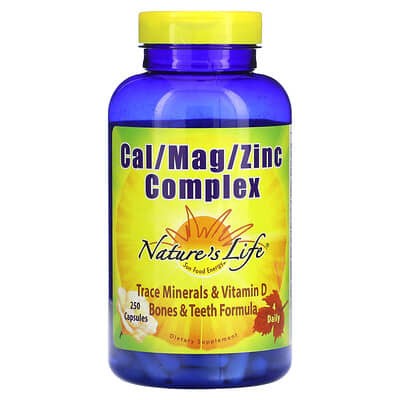
$24.09 $0.38 per serving
Product analysis
Nature’s Life Cal/Mag/Zinc Complex is designed for bone and muscle support, with 1,000 mg calcium, 500 mg magnesium and 15 mg zinc in four capsules. Vitamin D helps calcium absorption, but the label also states 100 mg of boron, which exceeds the supplied adult upper limit of 20 mg; verify that amount with the manufacturer before choosing it.
AI assessment of the formula, label and price. How scoring works
Nutrient Quality59
The formula contains vitamin D3 and useful zinc forms, though the calcium and magnesium combine forms with differing absorption potential. Without individual proportions it is hard to know how much comes from the more favorable forms.
Ingredient Transparency76
The quantities and most ingredient forms are listed. Separate proportions of the mixed mineral sources and other applicable composition details are not disclosed.
Value For Money59
The calcium quantity offers especially favorable value, while magnesium, zinc and copper are closer to typical value. Boron is inexpensive by amount, but its unusually high declared dose is a safety concern rather than a reason to choose it.
Customer Satisfaction74
The product averages 4.8 out of 5 from 115 ratings. Customer feedback is strongly positive.
Product Focus53
The formula’s clearest fit is bone and general mineral nutrition, but its nutrients contribute to many other functions. Those broad nutritional roles do not establish equally strong targeted benefits for all suggested uses.
- Format
Capsule - Container
- 250 Capsule(s)
- Per serving
- $0.38
- Customer rating
- 4.8 · 115 ratings
Goals

Impact
High effect
Vitamin D · 400 IUMagnesium · 500 mg
Cal/Mag/Zinc Complex offers conditional stress support, mainly from magnesium. Its 500 mg of elemental magnesium relates to calming support in low-magnesium or selected clinical settings; a larger amount does not establish more relief.
Magnesium Supportive
Zinc Supportive

Impact
High effect
Magnesium · 500 mgZinc · 15 mgVitamin D · 400 IU
Cal/Mag/Zinc Complex provides targeted nutritional support through 15 mg of zinc, which contributes to normal immune-cell function. Copper at 1 mg helps fill a dietary gap that can impair immune cells when deficient. Vitamin D3 at 10 mcg adds normal immune-function support, while the 500 mg magnesium declaration has no established routine immunity benefit in the supplied evidence.
Vitamin D Supportive
Zinc Supportive
Magnesium Supportive



Impact
Highest effect
Magnesium · 500 mgCalcium · 1000 mgVitamin D · 400 IUCopper · 1 mgBoron · 100 mgZinc · 15 mg
Cal/Mag/Zinc Complex provides substantial bone-mineral nutrition, but the declared 100 mg boron amount needs verification before choosing it because suitability at that exposure is unassessed. Calcium at 1,000 mg supplies bone mineral, and magnesium at 500 mg supports normal bone metabolism. Vitamin D3 at 10 mcg helps the body absorb calcium.
Vitamin D Supportive
Calcium Supportive
Magnesium Supportive
Zinc Supportive
Copper Disputed
Boron Supportive
Ingredients
| Ingredient | Amount per serving | Score |
|---|---|---|
Vitamin D (Cholecalciferol, Vitamin D3) | 400 IU | |
Calcium (Calcium Carbonate, Calcium Citrate Malate) | 1000 mg | |
Magnesium (Magnesium Citrate, Magnesium Oxide) | 500 mg | |
Zinc (Zinc Citrate, Zinc Picolinate) | 15 mg | |
Copper (Copper Citrate, Copper Gluconate) | 1 mg | |
Boron (Boron Citrate) | 100 mg | |
Bamboo (Silica) | 30 mg | |
Glutamic Acid Hydrochloride | 5 mg |
Zinc (Zinc Citrate, Zinc Picolinate) · 15 mg OverallScore82
Nature's Life Cal/Mag/Zinc Complex provides 15 mg zinc per serving; it uses zinc citrate and zinc picolinate. The amount is consistent with a maintenance dose. The serving also has 1 mg copper, giving a zinc-to-copper ratio of 15.0:1. Its zinc comparison price is moderate at $0.25 per 10 mg of zinc; a serving of the full formula costs $0.38.
Copper (Copper Citrate, Copper Gluconate) · 1 mg OverallScore69
Nature's Life Cal/Mag/Zinc Complex provides 1 mg of copper per serving, which is clearly stated. The label names Copper Citrate and Copper Gluconate, without specifying each form’s share. Copper citrate is an organic form. Each serving also contains 15 mg of zinc; zinc can interfere with copper. The comparison cost is moderate at $0.39 per serving and per 1 mg of copper; the serving price covers the full formula.
Nature's Life Cal/Mag/Zinc Complex provides 1000 mg of calcium per serving, a large amount in one serving; it uses Calcium Carbonate, Calcium Citrate Malate, Calcium Citrate. The proportions of the sources are not disclosed. A flow agent is listed. The price is low at $0.039 per 100 mg of calcium; the full formula costs $0.39 per serving.
Alternative products
Report alternatives
Sources
Published studies used for the product analysis and the top-ranked studies for each ingredient and goal.
- [Comparative study of the urinary excretion of boron, calcium, magnesium and phosphorus in postmenopausal women with and without osteoporosis].
- Effect of dietary boron on mineral, estrogen, and testosterone metabolism in postmenopausal women.
- The relationship between boron and magnesium status and bone mineral density in the human: a review.
- Effects of boron supplementation on bone mineral density and dietary, blood, and urinary calcium, phosphorus, magnesium, and boron in female athletes.
- Metabolic responses of postmenopausal women to supplemental dietary boron and aluminum during usual and low magnesium intake: boron, calcium, and magnesium absorption and retention and blood mineral concentrations
- What is the impact of daily oral supplementation of vitamin D3 (cholecalciferol) plus calcium on the incidence of hip fracture in older people? A systematic review and meta-analysis.
- Calcium supplementation prevents seasonal bone loss and changes in biochemical markers of bone turnover in elderly New England women: a randomized placebo-controlled trial.
- The effects of calcium supplementation (milk powder or tablets) and exercise on bone density in postmenopausal women.
- The efficacy of calcium supplementation alone in elderly Thai women over a 2-year period: a randomized controlled trial.
- Calcium-enriched foods and bone mass growth in prepubertal girls: a randomized, double-blind, placebo-controlled trial.
- The Association between Dietary and Circulating Copper Levels and Osteoporosis: a Scoping Review.
- Association between dietary copper, iron, zinc, selenium intake and osteopenia or osteoporosis in elderly hypertensive patients: a retrospective cohort study.
- Associations of dietary copper intake with total bone mineral density and lumbar spine bone mineral density in American adults.
- The association between dietary mineral intake and bone mineral density: a cross-sectional study.
- Association between dietary copper intake and bone mineral density in children and adolescents aged 8-19 years: A cross-sectional study.
- Association between Serum Magnesium and Fractures: A Systematic Review and Meta-Analysis of Observational Studies.
- Bioabsorbable Magnesium-Based Materials Potential and Safety in Bone Surgery: A Systematic Review.
- Vascularized bone grafting fixed by biodegradable magnesium screw for treating osteonecrosis of the femoral head.
- An update on magnesium and bone health.
- Sex-specific differences in the association of magnesium intake with femoral neck bone mineral density among older adults.