



Magnesium Supportive
$0.00 $0.00 per serving
Product analysis
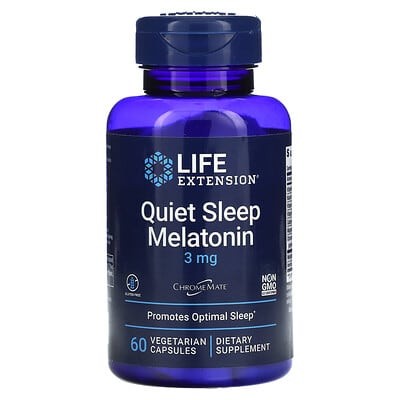
Life Extension Quiet Sleep Melatonin 3 mg is intended to support sleep timing and help with falling asleep, with 3 mg of melatonin in one vegetarian capsule. Its 120 mg of magnesium provides nutritional support, but it is magnesium oxide, a less readily absorbed form with limited evidence of additional sleep benefit.
AI assessment of the formula, label and price. How scoring works
Nutrient Quality52
The active form of B6, clearly identified niacin form and chromium polynicotinate are favorable features of the supporting nutrient blend. Magnesium oxide has limited absorption potential, and the melatonin form is not specified.
Ingredient Transparency73
All nine ingredient amounts are listed and most nutrient forms are identified. The proportions of the mixed-source ingredients are not disclosed.
Value For Money66
The melatonin provides reasonable value, and several of the supporting minerals and B vitamins compare favorably with similar products. Vitamin C is relatively expensive for the amount provided.
Customer Satisfaction78
The average rating of 4.59 out of 5 is favorable. The 923 ratings provide substantial customer feedback.
Product Focus72
Melatonin gives the formula a clear sleep-related use, with supporting nutritional benefits from the other ingredients. The wider benefits are more conditional than the direct sleep-timing role.
- Format
Capsule - Container
- 60 Capsule(s)
- Also available
 Quiet Sleep Melatonin 5 mg$12.83
- Customer rating
- 4.6 · 923 ratings
Goals
Impact
Highest effect
Vitamin B12 · 100 mcgMagnesium · 120 mgVitamin C · 220 mg
Quiet Sleep Melatonin 3 mg is a sleep-focused option with useful nutritional support rather than a broad everyday-health supplement. Melatonin at 3 mg serves the narrower role of sleep timing. Niacin at 73.5 mg supports normal energy metabolism, while vitamin B6 at 10 mg and vitamin B12 at 100 mcg support blood formation. Magnesium at 120 mg adds a modest contribution toward dietary needs.
Melatonin Supportive
Vitamin B12 Adverse
Vitamin C Supportive

Impact
High effect
Magnesium · 120 mgMelatonin · 3 mg
Quiet Sleep Melatonin 3 mg is led by melatonin for sleep timing and falling asleep. The 3 mg serving supports the body’s sleep-timing signal. Its 120 mg of magnesium is a smaller supporting component, with limited sleep-quality evidence that does not establish an immediate sleep-inducing effect.
Melatonin Supportive
Magnesium Supportive
Vitamin B6 Disputed

Impact
High effect
Magnesium · 120 mgVitamin B12 · 100 mcgVitamin B6 · 10 mgVitamin C · 220 mg
Quiet Sleep Melatonin 3 mg is better aligned with sleep-associated stress than general daytime relief. Its 3 mg melatonin provides the sleep-related contribution, while 120 mg magnesium adds modest nutritional support for calming nerve function.
Melatonin Supportive
Magnesium Supportive
Vitamin C Supportive
Vitamin B6 Supportive
Vitamin B12 Mixed

Impact
High effect
Vitamin B12 · 100 mcgVitamin B6 · 10 mgMagnesium · 120 mg
Quiet Sleep Melatonin 3 mg has a narrow sleep-related and nutritional fit for brain health. Melatonin at 3 mg supports sleep timing, with usefulness depending on when and why it is taken. Magnesium at 120 mg and vitamin B6 at 10 mg support normal nerve function and nutritional needs, with extra cognitive benefit dependent on more than their presence in the formula.
Magnesium Supportive
Vitamin B12 Supportive
Melatonin Supportive
Vitamin B6 Supportive

Impact
High effect
Magnesium · 120 mgVitamin C · 220 mg
Quiet Sleep Melatonin 3 mg has a limited fit for immunity, with its useful nutritional role centered on filling B-vitamin gaps. Its 10 mg vitamin B6 and 100 mcg vitamin B12 support immune-cell function when intake is inadequate. The 3 mg melatonin is a sleep-oriented ingredient whose sleep effect does not establish an additional immune benefit.
Vitamin C Supportive
Melatonin Supportive
Magnesium Supportive
Ingredients
| Ingredient | Amount per serving | Score |
|---|---|---|
Vitamin C (Ascorbic Acid, Niacinamide Ascorbate) | 220 mg | |
Niacin (Niacinamide Ascorbate) | 73.5 mg NE | |
Vitamin B6 (Pyridoxal 5-Phosphate) | 10 mg | |
Vitamin B12 (Methylcobalamin) | 100 mcg | |
Calcium (Calcium Carbonate, Calcium Citrate) | 48 mg | |
Magnesium (Magnesium Oxide) | 120 mg | |
Chromium (ChromeMate Chromium Polynicotinate) | 50 mcg | |
Melatonin | 3 mg | |
Inositol | 100 mg |
Melatonin · 3 mg OverallScore52
Life Extension Quiet Sleep Melatonin 3 mg offers moderate value for melatonin at $0.16 per serving and per 3 mg of melatonin. Each labeled serving provides 3 mg in a vegetarian capsule. No independent purity verification claim is available, so label accuracy is uncertain.
Vitamin B12 (Methylcobalamin) · 100 mcg OverallScore65
Life Extension Quiet Sleep Melatonin 3 mg provides 100 mcg of B12 in the bioactive form methylcobalamin. 100 mcg is oriented toward basic maintenance rather than higher needs. At $1.63 per 1,000 mcg of B12, the price is moderate value. The full formula costs $0.16 per serving.
Alternative products
Report alternatives
Sources
Published studies used for the product analysis and the top-ranked studies for each ingredient and goal.
- Antenatal magnesium sulfate and neuroprotection.
- No. 376-Magnesium Sulphate for Fetal Neuroprotection.
- Magnesium Sulfate Before Preterm Birth for Neuroprotection: An Updated Cochrane Systematic Review.
- Magnesium sulphate for fetal neuroprotection at imminent risk for preterm delivery: a systematic review with meta-analysis and trial sequential analysis.
- Magnesium sulfate and fetal neuroprotection: overview of clinical evidence.
- Comparative Efficacy, Tolerability, and Acceptability of Donanemab, Lecanemab, Aducanumab, Melatonin, and Aerobic Exercise for a Short Time on Cognitive Function in Mild Cognitive Impairment and Mild Alzheimer's Disease: A Systematic Review and Network Meta-Analysis.
- Melatonin for sleep and cognitive outcomes in older adults with cognitive impairment: a meta-analysis of randomised controlled trials.
- Add-on prolonged-release melatonin for cognitive function and sleep in mild to moderate Alzheimer's disease: a 6-month, randomized, placebo-controlled, multicenter trial.
- Early Oral Melatonin Supplementation Supports White Matter Maturation in Preterm Infants: Neuroprotective Insights of an Antioxidant Molecule.
- Efficacy and Safety of Melatonin in Migraine Prophylaxis: A Systematic Review and Meta-Analysis of Randomized Controlled Trials.
- Relationship between vitamin B12 levels and motor development: A systematic review.
- Vitamin B12 supplementation improves cognitive function in middle aged and elderly patients with cognitive impairment.
- Structural and Functional Brain Changes Associated with Vitamin B12 Deficiency using Magnetic Resonance Imaging: A Systematic Review and Meta-analysis.
- Maternal vitamin B12, vitamin D, and folic acid status during pregnancy and child neurodevelopment: a systematic review.
- Higher vitamin B12 from mid- to late life is related to slower rates of cognitive decline.
- Vitamin B12, B6, or Folate and Cognitive Function in Community-Dwelling Older Adults: A Systematic Review and Meta-Analysis.
- Relationship between serum pyridoxal 5'-phosphate concentration and cognitive function in older Japanese.
- A randomized, controlled trial to evaluate the efficacy of pyridoxine and ascorbic acid on cognitive function and quality of life in post-menopausal women.
- Lower Plasma Vitamin B-6 is Associated with 2-Year Cognitive Decline in the Boston Puerto Rican Health Study.
- Are Dietary Supplements and Nutraceuticals Effective for Musculoskeletal Health and Cognitive Function? A Scoping Review.