
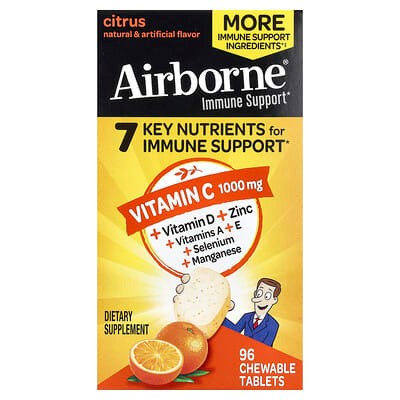

$16.31 $0.67 per serving


Product analysis
Airborne Original Citrus offers vitamin C-led nutritional support for normal immune function. Its unnamed blend and missing mixture proportions make the extra ingredients harder to compare.
AI assessment of the formula, label and price. How scoring works
Nutrient Quality39
The formula uses synthetic vitamin E, while manganese has a clearly identified source with favorable form findings. Several other source comparisons remain uncertain, so those details do not settle the quality of the whole blend.
Ingredient Transparency72
The listed amounts help compare the main nutrients. Missing vitamin C and magnesium source proportions and an undisclosed blend breakdown leave parts of the mixture unclear.
Value For Money32
Vitamin A, vitamin C and vitamin E provide limited value at the cost of a full serving. Manganese compares more moderately, while several other nutrient contributions cannot be judged reliably.
Customer Satisfaction92
Customer ratings indicate very favorable satisfaction. The very large review pool gives a broad picture of buyer opinion.
Product Focus35
Vitamin C provides the clearest link to immune and antioxidant nutrition. The unnamed blend makes the wider purpose harder to judge, and added amounts do not establish extra benefit with adequate intake.
- Format
Tablet - Container
- 96 Tablet(s)
- Per serving
- $0.67
- Also available
 Airborne Original Berry$14.98
- Customer rating
- 4.7 · 25,421 ratings
Goals

Impact
High effect
Magnesium · 40 mgVitamin C · 1000 mgZinc · 8 mgVitamin A · 2000 IUSelenium · 15 mcg
Vitamin C provides the main supported contribution, with modest cold-duration support tied to regular use rather than infection prevention. Zinc adds a partial nutritional contribution to normal immune function when intake is low. Echinacea has an unresolved amount, vitamin A and E amounts remain unknown, and ginger presence is unconfirmed. These uncertainties limit the amount finding despite the substantial vitamin C declaration.
How this product is rated for Immunity
Ingredient fit62
Unresolved amounts for Echinacea, Ginger, Vitamin A limit the amount finding alongside partial contributions from known amounts.
Goal fit
Vitamin C contributes to the identified immune-related area, while other actives and links to additional goals make the formula less focused.
Dose adequacy
Unresolved amounts for Echinacea, Ginger, Vitamin A limit the amount finding alongside partial contributions from known amounts.
Pathways60
The identified contributions cover innate immune cell activity.
Depth
The strongest identified coverage is in innate immune cell activity.
Breadth
The identified coverage extends to innate immune cell activity.
Evidence100
Vitamin C has modest regular-use cold-duration support, without establishing general prevention or treatment of an existing cold.
Evidence strength
Vitamin C has modest regular-use cold-duration support, without establishing general prevention or treatment of an existing cold.
Studied preparation
The saved preparation finding accepts the counted forms; no superiority for a particular form or delivery method follows.
Formulation logic88
Unresolved Echinacea, Ginger, Vitamin A amounts prevent all included ingredients from reaching the saved minimum amount criterion.
Partner coverage
Each counted ingredient works alone or has its required partner; this does not establish added clinical benefit from combining them.
Conflicts
No configured ingredient conflict was triggered by the supplied facts.
Effective doses
Unresolved Echinacea, Ginger, Vitamin A amounts prevent all included ingredients from reaching the saved minimum amount criterion.

Impact
High effect
Magnesium · 40 mgSelenium · 15 mcgZinc · 8 mgVitamin C · 1000 mg
The B vitamins provide nutrients used in everyday metabolism, while folate contributes to the nutrients involved in blood formation. Vitamin C adds to nutritional antioxidant support. These contributions are most useful when dietary intake falls short; larger amounts do not establish better energy or disease prevention, and the different forms receive no demonstrated superiority.
How this product is rated for Everyday Health
Ingredient fit78
The declared nutrients provide the product’s connection to general health. Amount coverage is partial in the saved finding.
Goal fit
The nutritional ingredients provide the main connection to this goal, although the product is linked to other health aims.
Dose adequacy
The counted amounts provide partial coverage of the saved reference range; this does not measure clinical benefit or nutrient absorption.
Pathways58
The strongest connection is antioxidant and immune defence. The broader findings also reflect the functional areas identified by the individual rules.
Depth
The strongest recorded connection is antioxidant and immune defence, with partial coverage in the saved findings.
Breadth
The recorded findings cover antioxidant and immune defence. Other general-health functions receive less or no coverage.
Evidence74
Vitamin C leads the saved evidence finding. Nutritional availability when intake is low is distinct from proven improvement above adequacy.
Evidence strength
Vitamin C leads the saved evidence finding; the supplied context supports conditional nutrient availability, rather than extra benefit above adequacy.
Studied preparation
The counted preparations receive full recognition in the saved finding, without establishing superiority for their chemical forms or delivery methods.
Formulation logic100
No missing partner or listed conflict reduced the counted contributions. The amount threshold applies only to the ingredients retained in the saved finding.
Partner coverage
No missing partner reduced the counted ingredients’ contributions; this finding does not establish synergy.
Conflicts
No listed formulation conflict was triggered.
Effective doses
All counted ingredients meet the saved amount threshold; smaller excluded amounts are distinct from proven ineffectiveness.

Impact
High effect
Vitamin E · 30 IUVitamin C · 1000 mg
Vitamin C contributes antioxidant activity, but its inflammation findings depend on baseline context. A large trial was null overall, with a CRP reduction confined to people starting with elevated CRP. That subgroup result does not establish a routine anti-inflammatory effect, and buffered forms do not establish an extra advantage. Zinc and magnesium may help low-status inflammation when an intake gap is corrected.
How this product is rated for Inflammation
Ingredient fit59
Vitamin C provides the main relevant connection. The amount findings are partial rather than a confirmed clinical dose.
Goal fit
Vitamin C supplies the main relevant ingredient connection.
Dose adequacy
Known eligible amounts receive partial comparison recognition; unresolved amounts cannot establish an additional dose contribution.
Pathways55
The strongest retained connection concerns oxidative and mitochondrial stress; this identifies a pathway link rather than proven clinical relief.
Depth
The strongest retained connection concerns oxidative and mitochondrial stress; this identifies a pathway link rather than proven clinical relief.
Breadth
One pathway reaches the saved coverage threshold; broader coverage is not established.
Evidence87
Vitamin C provides the strongest retained evidence connection, with the population and outcome limitations described above.
Evidence strength
Vitamin C provides the strongest retained evidence connection, with the population and outcome limitations described above.
Studied preparation
Eligible material meets the saved preparation criteria; this does not establish clinical benefit from the exact product.
Formulation logic92
No unmet required partner or configured conflict was identified. An unresolved amount limits the amount findings.
Partner coverage
No unmet required partner was identified for the retained ingredients; their combination does not establish extra benefit.
Conflicts
No configured ingredient conflict was identified in the supplied findings.
Effective doses
Vitamin E has an unresolved amount and falls below the saved amount threshold; the other eligible ingredients meet it.

Impact
Moderate effect
Zinc · 8 mgVitamin C · 1000 mgSelenium · 15 mcgVitamin E · 30 IU
Vitamin C supports normal collagen formation, and zinc contributes to normal skin repair. Added vitamin C does not necessarily improve the appearance of adequately nourished skin, and the combination does not establish sun protection.
How this product is rated for Skin Health
Ingredient fit61
The saved assessment identifies 4 skin-relevant ingredients alongside ingredients serving other goals. Amounts provide partial support in the saved assessment; low or unresolved quantities limit the contribution.
Goal fit
The saved assessment identifies 4 skin-relevant ingredients alongside ingredients serving other goals.
Dose adequacy
Amounts provide partial support in the saved assessment; low or unresolved quantities limit the contribution.
Pathways0
No specific skin mechanism has a substantial saved contribution. The saved findings do not show broad coverage across the main skin mechanisms.
Depth
No specific skin mechanism has a substantial saved contribution.
Breadth
The saved findings do not show broad coverage across the main skin mechanisms.
Evidence100
Vitamin C provides the strongest evidence connection in the saved assessment; normal nutrient roles and specific trial outcomes remain distinct. The saved assessment recognizes 2 ingredients with amounts and preparations matching its comparison criteria.
Evidence strength
Vitamin C provides the strongest evidence connection in the saved assessment; normal nutrient roles and specific trial outcomes remain distinct.
Studied preparation
The saved assessment recognizes 2 ingredients with amounts and preparations matching its comparison criteria.
Formulation logic88
The assessed ingredients can contribute independently or have their required partner present. No ingredient conflict was identified in the saved assessment. 2 of 4 credited ingredients meet the saved minimum amount criterion; below it: Vitamin A, Vitamin E.
Partner coverage
The assessed ingredients can contribute independently or have their required partner present.
Conflicts
No ingredient conflict was identified in the saved assessment.
Effective doses
2 of 4 credited ingredients meet the saved minimum amount criterion; below it: Vitamin A, Vitamin E.
Ingredients
| Ingredient | Amount per serving | Score |
|---|---|---|
Calories | 15 Calorie(s) | |
Total Carbohydrates | 4 Gram(s) | |
Vitamin A (Retinyl Acetate) | 2000 IU | |
Vitamin C (Ascorbic Acid, Sodium Ascorbate) | 1000 mg | |
Vitamin E (DL-Alpha-Tocopheryl Acetate) | 30 IU | |
Magnesium (Magnesium Oxide, Magnesium Sulfate) | 40 mg | |
Zinc (Zinc Sulfate) | 8 mg | |
Selenium (Selenium Amino Acid Chelate) | 15 mcg | |
Manganese (Manganese Gluconate) | 3 mg | |
Sodium (Sodium Ascorbate) | 45 mg | |
Proprietary Herbal Blend | 350 mg |
Manganese (Manganese Gluconate) · 3 mg OverallScore76
A serving provides 3 mg of manganese as manganese gluconate. The amount fits nutritional maintenance, though it is less focused on targeted bone support.
How this ingredient is rated
Active Ingredient Quality & Bioavailability80
Manganese Gluconate is an organic salt with good solubility.
Manganese Chemical Form
Manganese Gluconate is an organic salt with good solubility.
Dose, Safety & Label Transparency86
The stated 3 mg per serving fits nutritional maintenance.
Manganese Dosage Efficacy & Safety
The 3 mg per serving fits nutritional maintenance but is less focused on targeted bone support.
Elemental Weight Disclosure
The label states both the 3 mg manganese amount and its source.
Value50
At about $0.68 per whole-product serving, the price is in the middle of the collection.
Price per Serving vs. Median
At about $0.68 per whole-product serving, the price is in the middle of the collection.
Vitamin A (Retinyl Acetate) · 2000 IU OverallScore36
The serving supplies 2,000 IU of vitamin A as retinyl acetate, a preformed type. The body regulates preformed vitamin A less tightly than carotenoids, and the whole-product price works out to about $1.70 per 5,000 IU.
How this ingredient is rated
Active Ingredient Quality & Bioavailability30
Retinyl Acetate is preformed vitamin A, which is less tightly regulated by the body than provitamin A carotenoids.
Vitamin A Chemical Form & Source
Retinyl Acetate is preformed vitamin A, a form with greater potential for excess than provitamin A carotenoids.
Dose, Safety & Label Transparency49
The recorded serving amount is 2,000 IU; retinyl acetate is the named source.
Dosage Efficacy & Safety Thresholds
The recorded vitamin A amount is 2,000 IU per serving.
Label Transparency of Specific Forms
The saved facts name retinyl acetate but do not provide an explicit source percentage.
Value20
At the recorded vitamin A amount, the whole-product price works out to about $1.70 per 5,000 IU.
Price per 5,000 IU Dose
At the recorded vitamin A amount, the whole-product price works out to about $1.70 per 5,000 IU.
Vitamin C (Ascorbic Acid, Sodium Ascorbate) · 1000 mg OverallScore69
Each serving provides 1000 mg of vitamin C as sodium ascorbate, a buffered mineral form. The whole-product price works out to about $0.68 per gram of vitamin C.
How this ingredient is rated
Active Ingredient Quality & Bioavailability83
Sodium Ascorbate supplies vitamin C in a buffered mineral form.
Vitamin C Chemical Form & Delivery System
Vitamin C is supplied as sodium ascorbate, a mineral ascorbate.
Gastric Comfort & pH Balance
Sodium Ascorbate is a buffered mineral form.
Dose, Safety & Label Transparency79
The serving provides 1000 mg of vitamin C. A sweetener or added sugar is recorded in the saved ingredients.
Optimal Dosage Targeting
The serving provides 1000 mg of vitamin C.
Purity & Excipient Quality
The saved ingredient facts record a sweetener or added sugar; its specific type is not identified in the saved facts.
Mineral & Source Transparency
Vitamin C and sodium amounts are recorded separately; the mineral amount need not all come from the ascorbate.
Value20
The whole-product serving price works out to about $0.68 per gram of vitamin C.
Price per Gram of Vitamin C
The whole-product serving price works out to about $0.68 per gram of vitamin C.
Alternative products
Report alternatives
Sources
Published studies used for the product analysis and the top-ranked studies for each ingredient and goal.
- Perioperative systemic magnesium to minimize postoperative pain: a meta-analysis of randomized controlled trials.
- Long-term outcome after intravenous magnesium sulphate in suspected acute myocardial infarction: the second Leicester Intravenous Magnesium Intervention Trial (LIMIT-2).
- Association of magnesium sulfate use with mortality in critically ill patients with sepsis: a retrospective propensity score-matched cohort study.
- Hypomagnesemia and Mortality in Incident Hemodialysis Patients.
- The effects of magnesium supplementation on abnormal uterine bleeding, alopecia, quality of life, and acne in women with polycystic ovary syndrome: a randomized clinical trial.
- Associations of selenium status with all-cause and cause-specific mortality: a systematic review and meta-analysis of cohort studies.
- Dietary Antioxidants, Circulating Antioxidant Concentrations, Total Antioxidant Capacity, and Risk of All-Cause Mortality: A Systematic Review and Dose-Response Meta-Analysis of Prospective Observational Studies.
- The efficacy and safety of selenium supplementation versus placebo in the treatment of Graves' orbitopathy: A systematic review and meta-analysis of randomised controlled trials.
- Associations of plasma metal concentrations with the risks of all-cause and cardiovascular disease mortality in Chinese adults.
- Updates on clinical studies of selenium supplementation in radiotherapy.
- Dietary intake and blood concentrations of antioxidants and the risk of cardiovascular disease, total cancer, and all-cause mortality: a systematic review and dose-response meta-analysis of prospective studies.
- Scientific Opinion on the substantiation of a health claim related to vitamin C and increasing non haem iron absorption pursuant to Article 14 of Regulation (EC) No 1924/2006.
- Vitamin C Depletion and All-Cause Mortality in Renal Transplant Recipients.
- Associations of Serum Biomarkers of Fruit and Vegetable Intake With the Risk of Cause-Specific Mortality and All-Cause Mortality: A National Prospective Cohort Study.
- Relation between plasma ascorbic acid and mortality in men and women in EPIC-Norfolk prospective study: a prospective population study. European Prospective Investigation into Cancer and Nutrition.
- Effectiveness of sodium bicarbonate and zinc chloride mouthwashes in the treatment of oral mucositis and quality of life in patients with cancer under chemotherapy.
- Zinc supplementation in young children with acute diarrhea in India.
- Associations of mortality with ocular disorders and an intervention of high-dose antioxidants and zinc in the Age-Related Eye Disease Study: AREDS Report No. 13.
- Effects of zinc and probiotic co-supplementation on inflammation, gastrointestinal symptoms, quality of life, and mood in irritable bowel syndrome patients.
- Effect of zinc sulfate supplementation on premenstrual syndrome and health-related quality of life: Clinical randomized controlled trial.