
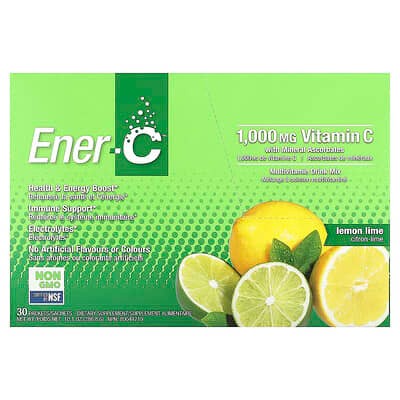

$12.19 $0.42 per serving


Product analysis
Ener-C Lemon Lime provides vitamin C and B vitamins for nutritional support when intake is low. The broad nutrient list offers less direct support for a predictable energy boost.
AI assessment of the formula, label and price. How scoring works
Nutrient Quality28
Several vitamin forms are named, but much of the preparation quality remains uncertain. Most mineral forms are unspecified, and the vitamin E declaration lacks a natural or synthetic designation.
Ingredient Transparency75
Listed serving amounts are disclosed, making the basic nutrient quantities easier to compare. Most chemical forms remain unspecified, while some usable nutrient amounts are still unresolved.
Value For Money49
Potassium and iodine have favorable cost comparisons, while vitamin C and vitamin E are less compelling. Value is weak for vitamin A and uncertain for many other additions.
Customer Satisfaction82
Customer ratings indicate positive satisfaction. A substantial amount of feedback gives a useful picture of buyer experience.
Product Focus43
Vitamin C provides the clearest nutritional contribution, with B vitamins supporting normal metabolism. Small or unresolved amounts limit several other contributions, so the wider nutrient list does not establish extra energy or cosmetic benefits.
- Format
Powder - Container
- 30 Packet(s)
- Per serving
- $0.42
- Also available
 Ener-C Orange$16.64
- Customer rating
- 4.6 · 2,002 ratings
Goals

Impact
High effect
Magnesium · 60 mgVitamin C · 1000 mgZinc · 5 mgVitamin A · 2500 IU
Vitamin C contributes to normal immune-cell function and has limited regular-use support for modestly shorter colds, without proving infection prevention. B6 and B12 can help address dietary gaps that impair immune-cell function. Vitamin A and E amounts remain unresolved, while the small zinc and folate amounts did not contribute to the saved findings. One packet does not establish the repeated regimen used in research.
How this product is rated for Immunity
Ingredient fit52
Relevant ingredients contribute to the immune goal, while additional actives make the formula less focused on these functions.
Goal fit
Relevant ingredients contribute to the immune goal, while additional actives make the formula less focused on these functions.
Dose adequacy
The relevant amounts contribute partly to the saved comparisons, with unresolved quantities contributing less.
Pathways60
The strongest represented area is the activity of first-response immune cells. The saved findings are concentrated in one immune function, giving limited breadth.
Depth
The strongest represented area is the activity of first-response immune cells.
Breadth
The saved findings are concentrated in one immune function, giving limited breadth.
Evidence100
Vitamin C leads the saved evidence finding, with bounded regular-use cold-duration evidence rather than proven infection prevention.
Evidence strength
Vitamin C leads the saved evidence finding, with bounded regular-use cold-duration evidence rather than proven infection prevention.
Studied preparation
The counted preparations match the saved preparation finding; this does not establish superior benefit from particular forms or delivery.
Formulation logic90
The counted ingredients have their relevant partners or contribute independently, and no listed formulation conflict was triggered.
Partner coverage
The counted ingredients can contribute independently or have their relevant partners; an extra combined benefit is not established.
Conflicts
No listed formulation conflict was triggered; this does not establish safety of the whole product.
Effective doses
The unresolved Vitamin A, Vitamin E amounts fall below the saved minimum comparison; the other counted ingredients reach it.

Impact
Moderate effect
Zinc · 5 mgVitamin C · 1000 mgVitamin E · 15 IU
Vitamin C at 1,000 mg contributes to normal collagen formation, and vitamin B6 supports normal skin nutrition. A large vitamin C amount does not by itself establish extra cosmetic benefit, and the supplied evidence does not support treating it as sun protection.
How this product is rated for Skin Health
Ingredient fit50
The ingredient selection and declared amounts provide the skin-related fit described below.
Goal fit
Several ingredients relate to skin nutrition, alongside ingredients aimed at other health goals.
Dose adequacy
The assessed amounts provide a partial match to the saved comparison ranges.
Pathways0
The saved findings distinguish targeted skin mechanisms from general nutritional support.
Depth
No direct coverage was recorded for collagen structure, water binding, barrier lipids or light-related antioxidant defence.
Breadth
None of the assessed skin mechanisms reaches the saved threshold for substantial coverage.
Evidence100
The evidence depends on the specific ingredient, amount and preparation.
Evidence strength
Vitamin C provides the strongest evidence contribution in the saved assessment. Normal nutrient functions and preparation-specific findings should be distinguished from guaranteed cosmetic improvement.
Studied preparation
The saved assessment recognizes the forms of the ingredients meeting its amount threshold.
Formulation logic88
The saved findings cover ingredient partners, conflicts and the amounts that qualify.
Partner coverage
The assessed ingredients can contribute on their own or have their required partner present.
Conflicts
No ingredient conflicts were recorded in the saved assessment.
Effective doses
2 of 4 assessed ingredients meet the saved minimum amount threshold. Below it: Vitamin A, Vitamin E.

Impact
Moderate effect
Vitamin E · 15 IUVitamin C · 1000 mg
Vitamin C may lower C-reactive protein, a blood marker of inflammation, when that marker is already elevated. That doesn't mean it will broadly reduce inflammation for everyone or lead to noticeable symptom relief. Its antioxidant role helps explain the connection, but it doesn't by itself predict a benefit when nutrient intake and inflammation levels are already normal.
How this product is rated for Inflammation
Ingredient fit39
The serving declares 5 mg Zinc, 1000 mg Vitamin C, 60 mg Magnesium; these amounts alone do not establish a clinical anti-inflammatory effect.
Goal fit
Vitamin C provides the principal connection to this goal; its presence alone does not predict relief.
Dose adequacy
The serving declares 5 mg Zinc, 1000 mg Vitamin C, 60 mg Magnesium; these amounts alone do not establish a clinical anti-inflammatory effect.
Pathways55
The connection mainly concerns oxidative stress and related inflammatory markers, rather than demonstrated symptom relief.
Depth
The connection mainly concerns oxidative stress and related inflammatory markers, rather than demonstrated symptom relief.
Breadth
The ingredients do not demonstrate broad clinical effects across multiple inflammatory processes.
Evidence87
Vitamin C has a conditional connection to lower C-reactive protein when that inflammatory marker is already elevated.
Evidence strength
Vitamin C has a conditional connection to lower C-reactive protein when that inflammatory marker is already elevated.
Studied preparation
Identifiable ingredient preparations permit comparison without guaranteeing an anti-inflammatory benefit.
Formulation logic88
No particular conflict or missing required partner is identified. Combining the ingredients does not itself establish an added anti-inflammatory effect.
Partner coverage
No missing required partner is identified.
Conflicts
No particular ingredient conflict is identified.
Effective doses
Vitamin C has a declared amount, while vitamin E has no resolved mass-equivalent amount for comparison.

Impact
High effect
Folate · 40 mcgVitamin B12 · 25 mcgMagnesium · 60 mgZinc · 5 mgVitamin C · 1000 mg
Vitamin C contributes to antioxidant and immune functions, while niacin, pantothenic acid and vitamin B6 add nutritional support for metabolism. Iodine can help fill low intake needed for normal thyroid function. These nutrient contributions do not establish extra benefits when intake is adequate. Calcium is present without an established amount, limiting its contribution; magnesium, folate, B12 and zinc are below the saved contribution thresholds.
How this product is rated for Everyday Health
Ingredient fit80
The relevant nutrients provide a connection to general health, with the strength of their contribution depending on the declared amounts.
Goal fit
The relevant ingredients connect to general health, although the product is also linked to other goals.
Dose adequacy
Amounts vary: several nutrients contribute, while calcium lacks an established amount and some other nutrient amounts are small.
Pathways74
The supplied findings are strongest for antioxidant and immune defence. Breadth extends to one-carbon metabolism and blood formation, antioxidant and immune defence.
Depth
The strongest supplied connection is antioxidant and immune defence.
Breadth
The supplied findings cover one-carbon metabolism and blood formation, antioxidant and immune defence; other areas do not reach the saved breadth threshold.
Evidence74
The main support concerns nutrient availability when intake is low; normal nutrient roles do not establish extra benefit above adequacy.
Evidence strength
Vitamin C provides the strongest supplied evidence connection, primarily as nutritional support when intake is low.
Studied preparation
The relevant preparations meet the saved preparation check, without establishing superiority of a particular nutrient form.
Formulation logic96
No configured ingredient conflict was identified in the supplied findings. Calcium remains limited by an unresolved amount.
Partner coverage
The relevant ingredients can contribute independently or have their required partner; no additional combination benefit is established.
Conflicts
No configured ingredient conflict was identified in the supplied findings.
Effective doses
Most included ingredients meet the saved amount threshold; calcium does not because its amount is unresolved.

Impact
Moderate effect
Iodine · 150 mcgVitamin B5 · 2.5 mgMagnesium · 60 mgVitamin B12 · 25 mcgPotassium · 200 mg
Vitamin C, B6, B5 and niacin support normal nutrient functions relevant to fatigue, mainly when nutritional intake is inadequate. Potassium at 200 mg contributes electrolyte intake, but individual replacement needs are unknown. The small magnesium and folate amounts and undisclosed malic acid provide limited grounds for a separate fatigue effect.
How this product is rated for Energy
Ingredient fit67
The saved review finds relevant ingredients within a formula serving broader goals. Declared amounts provide substantial exposure compared with the saved reference amounts; undisclosed amounts contribute no exposure.
Goal fit
The saved review finds relevant ingredients within a formula serving broader goals.
Dose adequacy
Declared amounts provide substantial exposure compared with the saved reference amounts; undisclosed amounts contribute no exposure.
Pathways0
The strongest recorded area is none. No target area reaches the saved coverage threshold.
Depth
The strongest recorded area is none.
Breadth
No target area reaches the saved coverage threshold.
Evidence67
Potassium supplies the strongest saved evidence contribution at sufficient exposure; this does not predict personal benefit. The saved preparation check is incomplete for Iodine.
Evidence strength
Potassium supplies the strongest saved evidence contribution at sufficient exposure; this does not predict personal benefit.
Studied preparation
The saved preparation check is incomplete for Iodine.
Formulation logic100
The saved review records no missing required partner. No conflict was matched in the saved checks.
Partner coverage
The saved review records no missing required partner.
Conflicts
No conflict was matched in the saved checks.
Effective doses
6 of 6 contributing ingredients reach the saved minimum exposure threshold.
Vitamin B5 Not classified
No linked studies yet.

Impact
Moderate effect
Zinc · 5 mgVitamin E · 15 IUVitamin C · 1000 mgVitamin A · 2500 IU
Vitamin A is needed for the visual cycle, including seeing in dim light. Getting enough may help when deficiency causes night blindness, but taking more when you already have enough doesn't imply better eyesight. The available ingredient details don't resolve the vitamin A amount in this serving.
How this product is rated for Eye Health
Ingredient fit36
Vitamin A can help deficiency-related difficulty seeing in dim light.
Goal fit
Vitamin A can help deficiency-related difficulty seeing in dim light.
Dose adequacy
Zinc: 5 mg; Vitamin C: 1000 mg. Serving amounts alone do not predict better eyesight.
Pathways47
Vitamin A participates in the visual cycle; the benefit of additional intake depends on deficiency.
Depth
Vitamin A participates in the visual cycle; the benefit of additional intake depends on deficiency.
Breadth
The ingredients do not imply improvement across focusing, retinal function, circulation and other aspects of eyesight.
Evidence68
Vitamin A can help deficiency-related difficulty seeing in dim light. Normal nutrient roles are distinct from improving eyesight in an adequately nourished adult.
Evidence strength
Vitamin A can help deficiency-related difficulty seeing in dim light.
Studied preparation
The vitamin A amount is unresolved, so its contribution cannot be determined from a verified active quantity.
Formulation logic83
No particular ingredient conflict is identified. The combination cannot be assumed to reproduce a specific regimen for macular degeneration.
Partner coverage
Individual ingredient roles do not mean that this is the complete combination used for selected people with macular degeneration.
Conflicts
No particular ingredient conflict is identified for this goal.
Effective doses
Zinc: 5 mg; Vitamin C: 1000 mg. These are label-serving quantities, not a guarantee of visual benefit.
Ingredients
| Ingredient | Amount per serving | Score |
|---|---|---|
Calories | 25 {Calories} | |
Total Carbohydrates | 5 Gram(s) | |
Vitamin C (Mineral Ascorbate mix) | 1000 mg | |
Vitamin A (Vitamin A Acetate) | 2500 IU | |
Vitamin E (Alpha-Tocopheryl Acetate) | 15 IU | |
Vitamin B3 (Niacin) | 5 mg | |
Vitamin B6 (Pyridoxine) | 2 mg | |
Folate | 40 mcg | |
Vitamin B12 (Cyanocobalamin) | 25 mcg | |
Pantothenic Acid | 2.5 mg | |
Calcium | 50 NP | |
Phosphorus | 38 mg | |
Iodine | 150 mcg | |
Magnesium | 60 mg | |
Zinc | 5 mg | |
Manganese | 0.5 mg | |
Chromium | 12 mcg | |
Potassium | 200 mg |
Iodine · 150 mcg OverallScore80
Vitamin A (Vitamin A Acetate) · 2500 IU OverallScore49
Vitamin C (Mineral Ascorbate mix) · 1000 mg OverallScore71
Alternative products
Report alternatives
Sources
Published studies used for the product analysis and the top-ranked studies for each ingredient and goal.
- Association of radioactive iodine treatment with survivorship symptoms and primary care utilisation in women of reproductive age with thyroid cancer: a retrospective cohort study.
- Energy level and fatigue after surgery for thyroid cancer: A population-based study of patient-reported outcomes.
- Health-Related Quality of Life in Differentiated Thyroid Cancer Survivors: A Cross-Sectional Study From Turkey.
- Magnesium-L-threonate improves sleep quality and daytime functioning in adults with self-reported sleep problems: A randomized controlled trial.
- Total magnesium intake and risk of frailty in older women.
- Red blood cell magnesium and chronic fatigue syndrome.
- Exercise, magnesium and immune function.
- [Efficacy of potassium N-acetylaminosuccinate (Cogitum) in the treatment of asthenic syndrome: results of double-blind placebo-controlled trial].
- Human resting energy expenditure in relation to dietary potassium.
- A new perspective on vitamin B12 deficiency in rheumatology: a case-based review.
- Effects of Vitamin B12 Supplementation on Cognitive Function, Depressive Symptoms, and Fatigue: A Systematic Review, Meta-Analysis, and Meta-Regression.
- Patients' experiences with methylcobalamin injections in amyotrophic lateral sclerosis.
- Cobalamin deficiency: clinical picture and radiological findings.
- Vitamin B12 Deficiency: Common Questions and Answers.
- Intakes of Folate, Vitamin B6, and Vitamin B12 in Relation to All-Cause and Cause-Specific Mortality: A National Population-Based Cohort.
- The responsiveness of plasma homocysteine to small increases in dietary folic acid: a primary care study.
- Associations of Serum Folate and Homocysteine Concentrations with All-Cause, Cardiovascular Disease, and Cancer Mortality in Men and Women in Korea: the Cardiovascular Disease Association Study.
- The concept of folic acid supplementation and its role in prevention of neural tube defect among pregnant women: PRISMA.
- Systematic review of adverse health outcomes associated with high serum or red blood cell folate concentrations.
- Perioperative systemic magnesium to minimize postoperative pain: a meta-analysis of randomized controlled trials.