
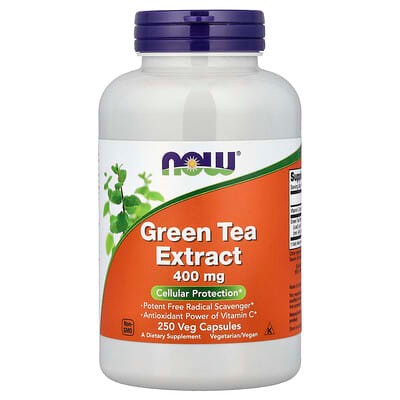

$16.20 $0.06 per serving


Product analysis
Green Tea Extract 400 mg offers green tea compounds with antioxidant activity and a possible small, temporary effect on energy use. Missing details about its key compounds make practical benefits difficult to predict.
AI assessment of the formula, label and price. How scoring works
Nutrient Quality40
Named vitamin C and green tea constituents do not establish ingredient quality. The unclear extract breakdown limits a meaningful comparison with other preparations.
Ingredient Transparency80
Ingredient amounts and named forms are stated. The green tea compound breakdown is missing, so the total extract amount cannot reveal the exact amounts of its key constituents.
Value For Money40
Value for money remains uncertain. The unclear amount of key green tea compounds prevents a useful cost comparison.
Customer Satisfaction89
Customer ratings are positive across a large review base. The broad feedback gives a clearer satisfaction picture without establishing health effects.
Product Focus72
Antioxidant activity is the main connection, with a possible small and temporary effect on energy use. Mixed skin findings and unclear compound amounts leave wider benefits uncertain.
- Format
Capsule - Container
- 250 Capsule(s)
- Per serving
- $0.06
- Also available
 Green Tea Extract 400 mg$7.60
- Customer rating
- 4.7 · 10,549 ratings
Goals

Impact
Moderate effect
Green Tea · 400 mg
Green tea's catechins and caffeine may produce a small, temporary increase in the energy your body uses. The extract here doesn't identify a specific EGCG preparation, and its caffeine is described only as an upper limit. That makes the size of any effect uncertain; the extract amount can't be treated as an exact catechin or caffeine amount. A temporary increase in energy use doesn't imply lasting fat loss.
How this product is rated for Metabolism Support
Ingredient fit66
Green tea is relevant to temporary energy use, but the extract identity and active amounts limit expectations.
Goal fit
Green tea have a connection to normal energy processes, with uncertain temporary effects on energy use.
Dose adequacy
The serving contains 400 mg green tea extract; this is extract mass, not an exact EGCG or caffeine amount.
Pathways13
The connection is mainly to temporary stimulation of energy use. Broad effects across several ways of increasing energy expenditure remain unclear.
Depth
Green tea relates mainly to temporary stimulation of energy use.
Breadth
Several distinct ways of increasing energy expenditure are not clearly supported for this extract.
Evidence23
The exact green tea preparation is unresolved, which limits how confidently its effects transfer to this serving.
Evidence strength
A small temporary effect on energy use is possible, but the effect beyond caffeine is uncertain.
Studied preparation
The precise green tea preparation is unresolved, so effects of a defined EGCG preparation cannot be assumed.
Formulation logic100
No particular ingredient conflict or missing required partner is identified.
Partner coverage
No missing required ingredient partner is identified.
Conflicts
No particular ingredient conflict is identified.
Effective doses
The 400 mg extract serving has a known material amount, while its exact EGCG and caffeine amounts remain unresolved.

Impact
High effect
Vitamin C · 60 mgGreen Tea · 400 mg
Green tea contributes the product's main connection to oxidative stress. The supplied evidence found most inflammatory markers unchanged, with a limited serum-amyloid signal in people with metabolic syndrome. Green tea extract receives a contribution in the saved findings, but its material amount does not establish an equivalent EGCG amount or a preparation-matched clinical benefit.
How this product is rated for Inflammation
Ingredient fit86
Green tea is the main relevant ingredient. The declared amount supports the saved contribution, subject to the ingredient’s specific evidence limits.
Goal fit
Green tea provides the main relevant ingredient focus, with a relatively focused formula.
Dose adequacy
The declared green tea material amount contributes in the saved findings, but does not establish an equivalent EGCG dose.
Pathways41
The contribution is concentrated in oxidative and mitochondrial stress, rather than broad coverage of the assessed inflammatory routes.
Depth
Green tea supplies the main contribution in oxidative and mitochondrial stress.
Breadth
Only oxidative and mitochondrial stress reaches the coverage threshold; the other assessed routes add no coverage.
Evidence73
Green tea supplies the evidence connection; the accepted preparation does not resolve the limited clinical findings or EGCG equivalence.
Evidence strength
Green tea leads the evidence finding, although most markers were unchanged in the supplied metabolic-syndrome trial.
Studied preparation
The saved findings accept the preparation, although the supplied science does not establish material-to-EGCG equivalence.
Formulation logic100
Green tea can contribute independently, with no configured ingredient conflict identified.
Partner coverage
Green tea can contribute without a required companion ingredient.
Conflicts
No configured ingredient conflict was identified in the supplied findings.
Effective doses
Green tea meets the amount threshold used for inclusion; this is not a proven effective clinical dose.

Impact
Highest effect
Green Tea · 400 mg
Green tea supplies compounds with antioxidant activity, which explains its connection to this goal. Human dietary-tea associations and laboratory EGCG mechanisms do not establish that this concentrated extract preserves age-related function or extends life. Vitamin C contributes to normal collagen formation, but its small amount does not make a meaningful contribution in the saved findings.
How this product is rated for Longevity
Ingredient fit94
Green Tea leads the recorded ingredient contribution. The serving supplies a substantial amount within the saved comparison.
Goal fit
Green Tea provides a focused connection to the goal's narrow outcomes.
Dose adequacy
The retained amounts are substantial within the saved comparison, without establishing a clinical anti-aging effect.
Pathways60
The recorded connection centers on antioxidant defence, with limited breadth. This does not establish slower whole-body aging.
Depth
The strongest recorded connection is to antioxidant defence; it does not establish slower biological aging.
Breadth
One process carries the main recorded contribution; broader coverage of aging-related processes is limited.
Evidence82
Green Tea leads the saved evidence findings, with important limits in the outcome, population or preparation studied.
Evidence strength
Green Tea leads the saved evidence findings, but its supplied human results do not establish broad anti-aging benefit.
Studied preparation
The saved findings recognize the contributing preparation; population, duration and clinical effects still depend on the specific study.
Formulation logic100
The retained ingredients have no missing configured partner or identified conflict.
Partner coverage
The retained contributions have no missing configured partner in the supplied findings.
Conflicts
No configured ingredient conflict was identified in the supplied calculation.
Effective doses
The retained contributions clear the saved amount threshold, which is not proof of a clinical anti-aging effect.

Impact
Highest effect
Vitamin C · 60 mgGreen Tea · 400 mg
Green tea has mixed oral evidence for UV-related skin responses. Generic extract mass does not establish the catechin exposure used in a trial, so the serving amount cannot establish equivalent skin effects.
How this product is rated for Skin Health
Ingredient fit86
The relevant connection is mainly nutritional support or limited surrogate evidence, rather than established cosmetic improvement.
Goal fit
The relevant connection is mainly nutritional support or limited surrogate evidence, rather than established cosmetic improvement.
Dose adequacy
The declared amounts support the saved exposure comparison; larger nutrient amounts do not establish extra benefit when intake is adequate.
Pathways52
The represented skin route has limited support from the supplied ingredients and amounts.
Depth
The represented skin route has limited support from the supplied ingredients and amounts.
Breadth
Coverage is limited to the skin routes represented by the supplied ingredients; it does not imply broad improvement.
Evidence89
Deficiency-related skin roles are clearer than added benefits in adequately nourished adults.
Evidence strength
Deficiency-related skin roles are clearer than added benefits in adequately nourished adults.
Studied preparation
The supplied preparation finding does not establish superiority of a nutrient form or equivalence to a different studied blend.
Formulation logic100
The supplied findings identify no required missing partner or specified conflict. Amount comparisons do not establish combination benefits.
Partner coverage
No missing required partner limits the eligible ingredients; no automatic combination benefit follows.
Conflicts
No specified ingredient conflict was identified in the supplied findings.
Effective doses
The included ingredients meet the supplied minimum exposure comparison; this is not a proven clinical benefit threshold.

Impact
High effect
Green Tea · 400 mg
Green tea supplies plant compounds associated with antioxidant activity, which alone does not establish improved cognitive performance. The 400 mg serving receives a partial contribution in the saved amount comparison. Green-tea mass cannot establish caffeine or theanine exposure, so their separate attention and executive-task findings cannot be assumed here.
How this product is rated for Cognitive Support
Ingredient fit72
The counted amounts provide a partial comparison with the reviewed exposures; lower amounts do not establish benefit below studied doses.
Goal fit
Relevant ingredients sit within a broader formula that also contains ingredients without an established contribution to this goal.
Dose adequacy
The counted amounts provide a partial comparison with the reviewed exposures; lower amounts do not establish benefit below studied doses.
Pathways51
The strongest represented area is oxidative and inflammatory processes; this describes the ingredient roles rather than a demonstrated cognitive effect.
Depth
The strongest represented area is oxidative and inflammatory processes; this describes the ingredient roles rather than a demonstrated cognitive effect.
Breadth
The represented areas are oxidative and inflammatory processes. Broader cognitive improvements do not follow automatically from those roles.
Evidence81
The saved preparation comparison is met for the counted ingredients; it does not establish benefits beyond their specific evidence.
Evidence strength
Green Tea provides the strongest represented evidence contribution, within the population and outcome limitations described for that ingredient.
Studied preparation
The saved preparation comparison is met for the counted ingredients; it does not establish benefits beyond their specific evidence.
Formulation logic100
No configured conflict was identified among the assessed ingredients; this does not assess every possible interaction.
Partner coverage
The counted ingredients have no unmet partner requirement in these findings; this does not demonstrate an added benefit from combining them.
Conflicts
No configured conflict was identified among the assessed ingredients; this does not assess every possible interaction.
Effective doses
The counted ingredients pass the saved minimum amount threshold; passing it does not prove efficacy at each serving amount.
Ingredients
| Ingredient | Amount per serving | Score |
|---|---|---|
Vitamin C (Ascorbic Acid) | 60 mg | |
Green Tea extract (Caffeine, Catechins) | 400 mg |
Green Tea (Caffeine, Catechins) · 400 mg OverallScore24
Each serving provides 400 mg of green tea leaf extract, but the amount of EGCG is not available in the saved facts. Caffeine is mentioned, though its amount is also unavailable.
How this ingredient is rated
Composition and Label Disclosure20
The serving contains 400 mg of green tea leaf extract; catechins are mentioned but their percentage is unavailable in the saved facts.
Declared Green Tea Marker Concentration
The serving contains 400 mg of green tea leaf extract; catechins are mentioned but their percentage is unavailable in the saved facts.
Composition and Label Disclosure40
The saved evaluation records caffeine information, but the caffeine amount and a whole-product caffeine-free claim are not established.
Whole-Product Caffeine Disclosure
The saved evaluation records caffeine information, but the caffeine amount and a whole-product caffeine-free claim are not established.
Commercial Price and Usability0
The saved EGCG amount is unavailable, so cost per amount of EGCG cannot be compared; the missing amount does not mean there is none.
Cost per 200 mg Declared EGCG
The saved EGCG amount is unavailable, so cost per amount of EGCG cannot be compared; the missing amount does not mean there is none.
Alternative products
Report alternatives
Sources
Published studies used for the product analysis and the top-ranked studies for each ingredient and goal.
- Safety and efficacy of cognitive training plus epigallocatechin-3-gallate in young adults with Down's syndrome (TESDAD): a double-blind, randomised, placebo-controlled, phase 2 trial.
- Association between tea consumption and risk of cognitive disorders: A dose-response meta-analysis of observational studies.
- Investigating the Impact of Tea Consumption on Cognitive Function and Exploring Tea-Genetic Interactions in Older Adults Aged 65-105 Years: Findings from the 2002-2018 CLHLS Data.
- Consumption of green tea, but not black tea or coffee, is associated with reduced risk of cognitive decline.
- Green Tea Consumption and the Risk of Incident Dementia in Elderly Japanese: The Ohsaki Cohort 2006 Study.
- The effects of green tea on acne vulgaris: A systematic review and meta-analysis of randomized clinical trials.
- Green Tea Catechin Association with Ultraviolet Radiation-Induced Erythema: A Systematic Review and Meta-Analysis.
- Efficacy of (-)-epigallocatechin gallate delivered by a new-type scaler tip during scaling and root planing on chronic periodontitis: a split-mouth, randomized clinical trial.
- Camellia Sinensis Mouthwashes in Oral Care: a Systematic Review.
- Skin photoprotection by green tea: antioxidant and immunomodulatory effects.
- Efficacy of Vitamin C as Glucocorticoid Substitute for Reducing Pain and Inflammation After Total Hip Arthroplasty: A Randomized Controlled Trial.
- The Impact of Vitamin C on Analgesic, Anti-inflammatory, and Hemostatic Outcomes After Total Hip and Knee Arthroplasty: A Systematic Review and Meta-Analysis.
- The impact of vitamin C supplementation on the perioperative outcomes after total hip and knee arthroplasty: a systematic review and meta-analysis.
- Therapeutic Impact of Ascorbic Acid on Oral and Periodontal Tissues: A Systematic Literature Review.
- Oral vitamin C administration reduces early recurrence rates after electrical cardioversion of persistent atrial fibrillation and attenuates associated inflammation.
- Green tea and coffee intake and risk of cognitive decline in older adults: the National Institute for Longevity Sciences, Longitudinal Study of Aging.
- Associations of green tea, coffee, and soft drink consumption with longitudinal changes in leukocyte telomere length.
- Can teatime increase one's lifetime?
- Influences of tea consumption on self-rated health and life satisfaction among older adults: Evidence from the CLHLS.
- Double-blinded, placebo-controlled trial of green tea extracts in the clinical and histologic appearance of photoaging skin.