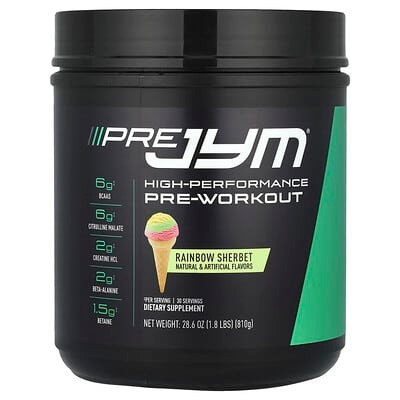
High-Performance Pre-Workout Rainbow Sherbet

High-Performance Pre-Workout Rainbow Sherbet

Pre JYM4.7 (842 ratings)
Format:Powder Quantity: 28 Ounce(s) · 30 servings
Goals
$39.99 $1.33 per serving

Product analysis

46 out of 100

High-Performance Pre-Workout Rainbow Sherbet may support short-term alertness and exercise performance, while beta-alanine’s benefit depends on repeated use over weeks. Most ingredient forms are undisclosed, making comparisons with the preparations behind those benefits harder.

AI assessment of the formula, label and price. How scoring works

Nutrient Quality22

Most forms are omitted, limiting comparison with preparations used for the reported benefits. The named botanical preparations do not resolve quality uncertainty across the full mixture.

Ingredient Transparency66

Amounts are disclosed, but only huperzine and black pepper preparations are identified. The missing forms make comparison with other workout formulas harder.

Value For Money36

Several priced components are costly for the amounts supplied. Missing comparisons for most ingredients leave the full blend’s value uncertain.

Customer Satisfaction79

Customer feedback is generally very positive, with a smaller review base than widely reviewed options. Satisfaction does not establish effectiveness or safety.

Product Focus48

Caffeine offers the clearest immediate support for alertness and exercise, while beta-alanine requires repeated use over weeks. The 300 mg caffeine serving may cause jitteriness or anxiety that works against focus.

Format
Powder
Container
28 Ounce(s)
Per serving
$1.33
Customer rating
4.7 · 842 ratings
Report analysis

Goals

Fitness
Impact
Highest effect
C+ Ingredient FitA+ PathwaysA- EvidenceA+ Formulation Logic
Creatine · 2 Gram(s)Beta-Alanine · 2 Gram(s)Caffeine · 300 mg

Caffeine can support acute exercise performance, most consistently endurance. Beta-alanine contributes toward repeated loading for intense efforts lasting about one to four minutes, while citrulline malate has mixed evidence for resistance repetitions. Taurine has a small running-specific signal, and betaine’s training evidence is mixed. Creatine HCl does not establish equivalence to monohydrate, and its presence does not confirm monohydrate’s benefits.

How this product is rated for Fitness

Ingredient fit69

Beta-Alanine anchors the saved findings. The formula’s other ingredients and differing amounts shape how focused it is on fitness.
Goal fit
Exercise-related ingredients sit within a broader formula, reducing the share concentrated on this goal.
Dose adequacy
Some ingredients meet their amount comparisons while others contribute only partly; serving amounts do not establish repeated study regimens.

Pathways100

The strongest connection concerns central drive and fatigue perception. Several exercise-related processes are represented.
Depth
The strongest saved connection concerns central drive and fatigue perception; this describes the ingredients’ coverage rather than a measured performance improvement.
Breadth
The main covered processes are muscle energy and buffering, central drive and fatigue perception, blood flow and nitric oxide. Coverage of the remaining processes is more limited.

Evidence88

Beta-alanine leads the saved evidence finding, with benefits tied to repeated loading and short, intense efforts. Some preparation declarations limit transfer from the studied evidence.
Evidence strength
Beta-alanine leads the saved evidence finding, with benefits tied to repeated loading and short, intense efforts.
Studied preparation
The saved preparation comparison is limited by Creatine, which does not establish the selected studied preparation.

Formulation logic100

No required partner is missing and the high-dose vitamin C condition does not apply. Counted ingredients meet the minimum amount comparison.
Partner coverage
The counted ingredients have no missing required partner under the supplied findings; this does not establish additional benefit from combining them.
Conflicts
The high-dose vitamin C condition is not triggered by the supplied facts; this limited check does not assess every possible interaction.
Effective doses
All counted ingredients meet the minimum amount comparison; this does not establish a clinically effective dose or completed study regimen.
Study evidence
Caffeine Supportive 255 studies
Citrulline Supportive 45 studies
Creatine Supportive 143 studies
Potassium No effect 7 studies
Sodium Supportive 96 studies
Taurine Supportive 21 studies
Impact
Highest effect
C+ Ingredient FitB+ PathwaysA EvidenceA+ Formulation Logic
Potassium · 61 mgCaffeine · 300 mgCreatine · 2 Gram(s)

Caffeine supports acute alertness and reduced sleepiness, while beta-alanine contributes toward repeated supplementation for high-intensity exercise fatigue resistance. Creatine HCl does not establish equivalence to the monohydrate preparation underlying the narrower exercise evidence. Citrulline malate has limited strength-endurance evidence, without establishing routine vitality or aerobic endurance. The other amino-acid contributions do not prove independent fatigue relief.

How this product is rated for Energy

Ingredient fit68

Caffeine contributes a relevant declared amount, with formula focus and serving quantity shaping the ingredient finding.
Goal fit
Relevant ingredients sit within a broader formula containing ingredients aimed at other goals.
Dose adequacy
The serving provides a partial match to the saved amount comparisons, which are not clinical benefit percentages.

Pathways80

The strongest assigned area is central alertness. The assigned association does not establish a clinical fatigue benefit.
Depth
The strongest assigned area is central alertness; this association does not establish a measured improvement in energy.
Breadth
Two energy areas reach the saved coverage target, with limited coverage elsewhere.

Evidence92

Caffeine leads the saved evidence finding. The supplied context limits expectations according to nutrient status, preparation and the population studied.
Evidence strength
Caffeine provides the leading evidence contribution; its nutritional-status, population and preparation limits still determine the benefit that can be described.
Studied preparation
Some included ingredients lack a matching studied preparation, limiting transfer of the clinical findings to their declared forms.

Formulation logic100

The included ingredients meet the saved minimum amount comparisons, with no missing partner or configured conflict. These findings do not establish a combined benefit or overall safety.
Partner coverage
No missing required partner limits the included ingredients; this does not establish added benefit from combining them.
Conflicts
No configured ingredient conflict was identified; this does not establish overall safety or cover every possible interaction.
Effective doses
The included ingredients meet the saved minimum amount comparison, which is not proof of a clinically effective personal fatigue dose.
Study evidence
Caffeine Supportive 68 studies
Creatine Supportive 49 studies
Potassium Supportive 2 studies
Valine Not classified

No linked studies yet.
Productivity Boost
Impact
Moderate effect
C- Ingredient FitC PathwaysC- EvidenceA Formulation Logic
Creatine · 2 Gram(s)Huperzine · 50 mcgAlpha-GPC · 150 mgCaffeine · 300 mg

Caffeine at 300 mg is the clearest link to short-term alertness and attention. Creatine relates to brain energy, while Alpha-GPC and huperzine relate to acetylcholine signalling, but their preparations and the tyrosine evidence limit confidence in broader work benefits. The caffeine amount also triggers the saved caution for a higher stimulant serving.

How this product is rated for Productivity Boost

Ingredient fit58

Only part of this broader formula aligns specifically with productivity support. The amounts provide partial alignment with the saved exposure comparison.
Goal fit
Only part of this broader formula aligns specifically with productivity support.
Dose adequacy
The amounts provide partial alignment with the saved exposure comparison.

Pathways60

The main saved contribution concerns alertness. One mechanism has meaningful coverage; the contribution is concentrated rather than broad.
Depth
The main saved contribution concerns alertness.
Breadth
One mechanism has meaningful coverage; the contribution is concentrated rather than broad.

Evidence58

Caffeine provides the strongest assessed evidence contribution at its amount. Caffeine matches the preparation criteria; Alpha-GPC, creatine, huperzine and tyrosine are not matched to studied preparations.
Evidence strength
Caffeine provides the strongest assessed evidence contribution at its amount.
Studied preparation
Caffeine matches the preparation criteria; Alpha-GPC, creatine, huperzine and tyrosine are not matched to studied preparations.

Formulation logic93

All 5 assessed ingredients meet the saved minimum amount comparison. The 300 mg caffeine serving triggers the saved higher-caffeine caution.
Partner coverage
The assessed ingredients work independently or have their required partner.
Conflicts
The 300 mg caffeine serving triggers the saved higher-caffeine caution.
Effective doses
All 5 assessed ingredients meet the saved minimum amount comparison.
Study evidence
Alpha-GPC Supportive 2 studies
Caffeine Supportive 108 studies
Creatine Supportive 16 studies
Metabolism Support
Impact
High effect
D+ Ingredient FitB PathwaysA EvidenceA+ Formulation Logic
Creatine · 2 Gram(s)Caffeine · 300 mg

Caffeine can produce a modest, short-lived rise in resting energy expenditure. This serving declares 300 mg of caffeine, but that does not establish sustained weight or fat loss. Taurine's supplied findings concern metabolic markers in adults with diabetes, rather than a demonstrated metabolism-rate increase in general users. Creatine's exercise-related findings also do not establish a stand-alone thermogenic effect.

How this product is rated for Metabolism Support

Ingredient fit55

Caffeine provides the direct thermogenic connection within a broader exercise or amino-acid formula. The declared caffeine amount is usable, while the other counted amounts have mixed matches to their saved references.
Goal fit
Caffeine provides the direct thermogenic connection within a broader exercise or amino-acid formula.
Dose adequacy
The declared caffeine amount is usable, while the other counted amounts have mixed matches to their saved references.

Pathways77

The saved findings concentrate on insulin-related metabolic processes, with a separate caffeine contribution to adrenergic drive. Insulin-related processes and adrenergic drive reach the saved threshold; other tracked pathways remain below it.
Depth
The saved findings concentrate on insulin-related metabolic processes, with a separate caffeine contribution to adrenergic drive.
Breadth
Insulin-related processes and adrenergic drive reach the saved threshold; other tracked pathways remain below it.

Evidence92

Taurine leads the saved evidence comparison, but diabetes-cohort biomarker findings do not establish thermogenesis.
Evidence strength
Taurine leads the saved evidence comparison, but diabetes-cohort biomarker findings do not establish thermogenesis.
Studied preparation
The counted preparations are accepted in the saved comparison; this does not establish a metabolism-rate benefit for the whole formula.

Formulation logic100

The supplied findings require no missing partner and apply no ingredient conflict.
Partner coverage
The counted ingredients work without an additional required partner under the supplied findings.
Conflicts
No configured ingredient conflict was applied.
Effective doses
All counted ingredients meet the saved amount threshold; that threshold is not a proven minimum dose for thermogenesis.
Study evidence
Caffeine Disputed 40 studies
Creatine Supportive 21 studies
Taurine Supportive 11 studies
Muscle Gain
Impact
High effect
B- Ingredient FitC PathwaysB- EvidenceA Formulation Logic
Creatine · 2 Gram(s)Caffeine · 300 mgBeta-Alanine · 2 Gram(s)

Creatine can support muscle energy and resistance-training adaptation with repeated use, although lean-mass changes can partly reflect water. Betaine has limited, inconsistent evidence for body-composition and muscle-size benefits. Caffeine can improve acute strength, power or endurance, but those effects do not establish lasting muscle growth. The 2000 mg creatine serving offers less exposure than the full comparison amount, and preparation identity matters.

How this product is rated for Muscle Gain

Ingredient fit72

Training-related ingredients sit within a broader formula containing other actives, limiting its specific focus on muscle gain. Several amounts provide partial exposure against the supplied comparisons; these comparisons do not establish a proven muscle-growth dose.
Goal fit
Training-related ingredients sit within a broader formula containing other actives, limiting its specific focus on muscle gain.
Dose adequacy
Several amounts provide partial exposure against the supplied comparisons; these comparisons do not establish a proven muscle-growth dose.

Pathways60

The strongest saved finding concerns training work capacity and recovery. Training-performance mechanisms do not by themselves establish lasting muscle growth.
Depth
The strongest saved finding concerns training work capacity and recovery.
Breadth
The broader saved findings concern training work capacity and recovery.

Evidence74

Caffeine drives the strongest saved finding, but its acute performance evidence does not establish sustained muscle growth.
Evidence strength
Caffeine drives the strongest saved finding, but its acute performance evidence does not establish sustained muscle growth.
Studied preparation
Some included material lacks a confirmed match to a studied preparation; a declared ingredient amount does not establish that equivalence.

Formulation logic93

The combination of creatine and at least 300 mg caffeine per serving triggered the supplied mild conflict finding; this does not prove a clinical interaction. The included contributors meet the supplied minimum amount criterion.
Partner coverage
The included ingredients have no unmet partner requirement in the supplied findings.
Conflicts
The combination of creatine and at least 300 mg caffeine per serving triggered the supplied mild conflict finding; this does not prove a clinical interaction.
Effective doses
The included contributors meet the saved minimum amount criterion; this does not establish clinical effectiveness.
Study evidence
Alpha-GPC Not classified 1 study
Caffeine Supportive 31 studies
Creatine Supportive 136 studies
Potassium Supportive 4 studies
Taurine Not classified

No linked studies yet.

Weight Loss
Impact
Moderate effect
D Ingredient FitD PathwaysC EvidenceA+ Formulation Logic
Creatine · 2 Gram(s)Caffeine · 300 mg

Caffeine at 300 mg relates mainly to a short-term increase in energy expenditure, with limited evidence that this leads to sustained weight loss. Creatine at 2 g relates more to exercise and body composition; lean-mass changes can include water and should not be read as fat loss.

How this product is rated for Weight Loss

Ingredient fit50

The relevant ingredients share the formula with ingredients directed at other goals. The assessed amounts provide a substantial but incomplete match to the saved comparisons.
Goal fit
The relevant ingredients share the formula with ingredients directed at other goals.
Dose adequacy
The assessed amounts provide a substantial but incomplete match to the saved comparisons.

Pathways48

The strongest saved connection is thermogenesis and energy expenditure, with moderate coverage. Heat production and energy expenditure are the one route reaching the saved coverage level.
Depth
The strongest saved connection is thermogenesis and energy expenditure, with moderate coverage.
Breadth
Heat production and energy expenditure are the one route reaching the saved coverage level.

Evidence62

Caffeine leads the saved evidence comparison at the assessed amount; this does not imply a large or sustained weight change. The assessed preparations match those recognized in the saved review.
Evidence strength
Caffeine leads the saved evidence comparison at the assessed amount; this does not imply a large or sustained weight change.
Studied preparation
The assessed preparations match those recognized in the saved review.

Formulation logic100

The assessed ingredients can work independently or have their relevant partner. No ingredient conflicts were recorded in the saved assessment. 2 of 2 assessed ingredients reach the saved amount threshold.
Partner coverage
The assessed ingredients can work independently or have their relevant partner.
Conflicts
No ingredient conflicts were recorded in the saved assessment.
Effective doses
2 of 2 assessed ingredients reach the saved amount threshold.
Study evidence
Caffeine Disputed 14 studies
Creatine No effect 27 studies

Ingredients

IngredientAmount per servingScore
Calories
80 Calorie(s)
Sodium
240 mg 66
Total Carbohydrates
3 Gram(s)
Calcium
52 mg
Potassium
61 mg
Creatine HCl
2 Gram(s)
Beta-Alanine
2 Gram(s)
Betaine
1.5 Gram(s)
Taurine
1 Gram(s)
Alpha-Glyceryl Phosphoryl Choline
150 mg 67
Citrulline Malate
6 Gram(s)
Beet root extract
500 mg
L-Leucine
3 Gram(s)
L-Isoleucine
1.5 Gram(s)
L-Valine
1.5 Gram(s)
L-Tyrosine
1.5 Gram(s)
Caffeine Anhydrous
300 mg 55
Huperzine A (Toothed Clubmoss aerial parts extract)
50 mcg 63
BioPerine (Black Pepper Fruit Extract)
5 mg
Adults 18–50 Women
Report overview
C Active Ingredient Quality & BioavailabilityA- Dose, Safety & Label TransparencyF Value
The serving lists 50 mcg of Huperzine A. The whole-product price works out to about $2.67 per 100 mcg of Huperzine A, which is relatively high.
How this ingredient is rated

Active Ingredient Quality & Bioavailability60

The saved facts identify Huperzia serrata extract, but do not establish its Huperzine A concentration.
Source and Standardization Clarity
A Huperzia serrata extract is identified; its standardization percentage is not established by the available facts.

Dose, Safety & Label Transparency88

The serving lists 50 mcg of Huperzine A. No specific cycling guidance is recorded in the saved facts.
Huperzine A Dosage Efficacy
The serving lists 50 mcg of Huperzine A.
Cycling Guidance and Transparency
The active amount is specified, but no specific cycling guidance is recorded in the saved facts.

Value20

The whole-product price works out to about $2.67 per 100 mcg of Huperzine A, which is relatively high.
Price per 100mcg of Huperzine A
Based on the whole-product price, 100 mcg of Huperzine A costs about $2.67, which is relatively high.
Caffeine · 300 mg OverallScore55
D- Active Ingredient Quality & BioavailabilityA Dose, Safety & Label TransparencyF Value
A serving contains 300 mg of caffeine, a strong amount. No listed secondary stimulants were identified in the saved ingredient panel.
How this ingredient is rated

Active Ingredient Quality & Bioavailability40

The evaluation records an identified caffeine form, but the saved form field does not name it.
Advanced Bioavailability and Release Profiles
The evaluation records an identified caffeine form, but the saved form field does not name it.

Dose, Safety & Label Transparency92

The amount is disclosed as 300 mg per serving, and the saved ingredient panel identifies no listed secondary stimulants.
Caffeine Dose Transparency
The caffeine amount is recorded as 300 mg per serving.
Dosage Efficacy and Safety Margin
A serving contains 300 mg of caffeine, a strong amount.
Secondary Stimulant Disclosure and Risk
No listed secondary stimulants were identified in the saved ingredient panel.

Value10

A whole-product serving costs about $1.33.
Price Per Serving vs. Collection Median
A whole-product serving costs about $1.33.
Sodium · 240 mg OverallScore66
D Active Ingredient Quality & BioavailabilityB Dose, Safety & Label TransparencyB+ Value
Each serving provides 240 mg sodium for athletic replenishment. Disodium Phosphate is listed separately, but its contribution to the sodium total is unknown.
How this ingredient is rated

Active Ingredient Quality & Bioavailability48

Disodium Phosphate is listed separately, but its share of the sodium amount is unknown.
Sodium Source Purity & Quality
Disodium Phosphate is listed separately; its contribution to the sodium total is unknown.
Bioavailability of Supporting Electrolytes
No potassium or magnesium form is identified in the evaluation’s specified form categories.
Trace Mineral Complex & Buffering Forms
No trace-mineral complex or sodium bicarbonate is identified in the evaluated facts.

Dose, Safety & Label Transparency77

A serving provides 240 mg sodium, and the available ingredient evidence identifies an artificial sweetener.
Sodium Dosage for Athletic Replenishment
A serving provides 240 mg sodium for athletic replenishment.
Ingredient Label Transparency
Sodium and potassium are individually listed at 240 mg and 61 mg per serving, respectively.
Artificial Color and Sweetener Disclosure
The available ingredient evidence identifies an artificial sweetener and an artificial color.

Value80

A whole-product serving costs about $1.33, around the collection’s typical serving price.
Price Per Serving vs. Collection Median
A whole-product serving costs about $1.33, around the collection’s typical serving price.
Report alternatives

Sources

Published studies used for the product analysis and the top-ranked studies for each ingredient and goal.

  1. Activity of Choline Alphoscerate on Adult-Onset Cognitive Dysfunctions: A Systematic Review and Meta-Analysis.
    Sagaro GG; Traini E; Amenta F · Journal of Alzheimer's disease : JAD · 2023
    Meta-analysis8 studies pooledBrain Health Cognitive Support forAlpha-GPC
  2. Comparative study of choline alfoscerate as a combination therapy with donepezil: A mixed double-blind randomized controlled and open-label observation trial.
    Lee W; Kim M · Medicine · 2024
    Randomized trial119 participantsBrain Health Cognitive Support forAlpha-GPC
  3. Effects of choline alfoscerate on cognitive function and quality of life in type 2 diabetes: A double-blind, randomized, placebo-controlled trial.
    Sohn M; Park YH; Lim S · Diabetes, obesity & metabolism · 2025
    Randomized trial36 participantsBrain Health Cognitive Support forAlpha-GPC
  4. Acute Alpha-Glycerylphosphorylcholine Supplementation Enhances Cognitive Performance in Healthy Men.
    Kerksick CM · Nutrients · 2024
    Randomized trial20 participantsBrain Health Mental Focus Productivity Boost forAlpha-GPC
  5. Cognitive improvement in mild to moderate Alzheimer's dementia after treatment with the acetylcholine precursor choline alfoscerate: a multicenter, double-blind, randomized, placebo-controlled trial.
    De Jesus Moreno Moreno M · Clinical therapeutics · 2003
    Randomized trial261 participantsBrain Health forAlpha-GPC
  6. Oral creatine monohydrate supplementation improves brain performance: a double-blind, placebo-controlled, cross-over trial.
    Rae C; Digney AL; McEwan SR; Bates TC · Proceedings. Biological sciences · 2003
    Randomized trial45 participantsBrain Health forCreatine
  7. Creatine in Huntington disease is safe, tolerable, bioavailable in brain and reduces serum 8OH2'dG.
    Hersch SM; Gevorkian S; Marder K; Moskowitz C; Feigin A; Cox M; Como P; Zimmerman C; Lin M; Zhang L; Ulug AM; Beal MF; Matson W; Bogdanov M; Ebbel E; Zaleta A; Kaneko Y; Jenkins B; Hevelone N; Zhang H; Yu H; Schoenfeld D; Ferrante R; Rosas HD · Neurology · 2006
    Randomized trial64 participantsBrain Health forCreatine
  8. Creatine supplementation and cognitive performance in elderly individuals.
    McMorris T; Mielcarz G; Harris RC; Swain JP; Howard A · Neuropsychology, development, and cognition. Section B, Aging, neuropsychology and cognition · 2008
    Randomized trial32 participantsBrain Health Productivity Boost forCreatine
  9. Effects of high-load, velocity-intentional variable resistance training combined with creatine supplementation on neuroplasticity, oxidative stress, inflammation, physical function, cognitive performance and quality of life in older adults: A randomized, double-blind, placebo-controlled trial.
    Fernandez-Garrido J; Martin EG; Saez-Berlanga A; Gargallo-Bayo P; Gene-Morales J; Alix-Fages C; Jiménez-Martínez P; Caballero O; Salvador-Palmer R; Colado JC · Experimental gerontology · 2026
    Randomized trial103 participantsBrain Health forCreatine
  10. Single-Dose Creatine Reduces Sleep Deprivation-Induced Deterioration in Cognitive Performance.
    Gordji-Nejad A; Matusch A; Hengstler L; Beer S; Kroll T; Klein S; Elmenhorst D; Bauer A; Drzezga A · Nutrients · 2026
    Randomized trial29 participantsBrain Health forCreatine
  11. Huperzine a in the treatment of Alzheimer's disease and vascular dementia: a meta-analysis.
    Xing SH; Zhu CX; Zhang R; An L · Evidence-based complementary and alternative medicine : eCAM · 2014
    Meta-analysis825 participants10 studies pooledBrain Health Cognitive Support forHuperzine
  12. [Clinical efficacy and safety of huperzine Alpha in treatment of mild to moderate Alzheimer disease, a placebo-controlled, double-blind, randomized trial].
    Zhang Z; Wang X; Chen Q; Shu L; Wang J; Shan G · Zhonghua yi xue za zhi · 2002
    Randomized trial202 participantsBrain Health Cognitive Support forHuperzine
  13. Huperzine A associated with improved early postoperative cognitive function after neurosurgery under general anesthesia: a randomized clinical trial.
    Zhang Z; Shen Y; Li J; Tang Y; Zhou P; Ying T; Mo R; Ru Z; Zhao G; Zhu J; Li S; Zhao H · International journal of surgery (London, England) · 2026
    Randomized trial123 participantsBrain Health Cognitive Support forHuperzine
  14. Treatment with Huperzine A improves cognition in vascular dementia patients.
    Xu ZQ; Liang XM; Juan-Wu; Zhang YF; Zhu CX; Jiang XJ · Cell biochemistry and biophysics · 2012
    Randomized trial78 participantsBrain Health forHuperzine
  15. Huperzine-A response to cognitive impairment and task switching deficits in patients with Alzheimer's disease.
    Gul A; Bakht J; Mehmood F · Journal of the Chinese Medical Association : JCMA · 2019
    Randomized trial100 participantsBrain Health forHuperzine
  16. Combined L-carnosine and L-tyrosine supplementation as an ergogenic strategy for physical and cognitive performance under fatigue in professional football players.
    Bilgin S; Bozyılan E; Buzdağlı Y; Karaç Öcal Y; Gürkan O; Toktaş S; İnan H; Egil İ; Yarayan YE · Frontiers in nutrition · 2026
    Randomized trial24 participantsBrain Health forTyrosine
  17. Effect of tyrosine supplementation on clinical and healthy populations under stress or cognitive demands--A review.
    Jongkees BJ; Hommel B; Kühn S; Colzato LS · Journal of psychiatric research · 2016
    Narrative reviewBrain Health forTyrosine
  18. Influence of nutritional tyrosine on cognition and functional connectivity in healthy old humans.
    Hensel C; Becker M; Düzel S; Demuth I; Norman K; Steinhagen-Thiessen E; Gallinat J; Lindenberger U; Kühn S · NeuroImage · 2019
    Cross-sectional study286 participantsBrain Health forTyrosine
  19. Dietary Tyrosine Intake (FFQ) Is Associated with Locus Coeruleus, Attention and Grey Matter Maintenance: An MRI Structural Study on 398 Healthy Individuals of the Berlin Aging Study-II.
    Plini ERG; Melnychuk MC; Harkin A; Dahl MJ; McAuslan M; Kühn S; Boyle RT; Whelan R; Andrews R; Düzel S; Drewelies J; Wagner GG; Lindenberger U; Norman K; Robertson IH; Dockree PM · The journal of nutrition, health & aging · 2023
    Cross-sectional study398 participantsBrain Health forTyrosine
  20. Baseline-dependent effect of dopamine's precursor L-tyrosine on working memory gating but not updating.
    Jongkees BJ · Cognitive, affective & behavioral neuroscience · 2021
    Randomized trial45 participantsBrain Health forTyrosine