
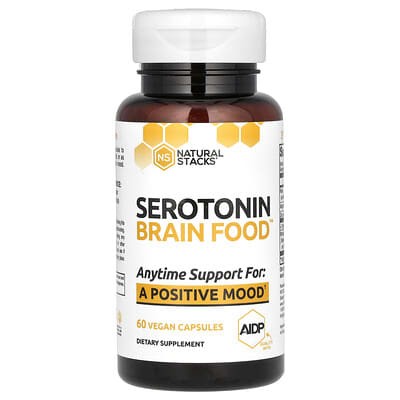

$39.95 $1.99 per serving


Product analysis
Serotonin Brain Food may support mental performance during stress-related fatigue, though the rhodiola preparation limits certainty. Activating rhodiola makes it less suited to bedtime use.
AI assessment of the formula, label and price. How scoring works
Nutrient Quality64
Zinc has a favorable form, and the rhodiola species is clearly identified. Niacin form details are incomplete, while magnesium quality and tryptophan form quality remain uncertain.
Ingredient Transparency74
Amounts and most forms are stated, making serving quantities clear. The proportions of the niacin-related sources and rhodiola components are not disclosed, and the tryptophan form is unspecified.
Value For Money29
Niacin, zinc and rhodiola offer weak value at the cost per serving. Magnesium and tryptophan value cannot be judged reliably.
Customer Satisfaction80
Customer ratings are very positive across several hundred ratings. The feedback is encouraging but provides a narrower picture than a large review base.
Product Focus64
Stress-related fatigue and nutritional support connect many of the intended uses, but routine mood or cognitive enhancement remains uncertain. Activating rhodiola also works against the formula’s bedtime sleep aim.
- Format
Capsule - Container
- 60 Capsule(s)
- Per serving
- $1.99
- Customer rating
- 4.7 · 798 ratings
Goals

Impact
High effect
Magnesium · 50 mgTryptophan · 1250 mg
Rhodiola may help stress-related fatigue, but the supplied preparation does not match the identified studied extract. Zinc has conditional relevance in low-zinc or clinical anxiety settings, rather than established broad stress relief. Tryptophan’s neurotransmitter role offers an indirect connection to mood without establishing an effect on everyday psychological stress.
How this product is rated for Stress Relief
Ingredient fit86
The active ingredients align with the stress-related nutritional or calming roles described in the supplied information.
Goal fit
The active ingredients align with the stress-related nutritional or calming roles described in the supplied information.
Dose adequacy
Declared amounts contribute unevenly; larger quantities do not establish stronger psychological stress relief.
Pathways79
The strongest represented area is mood and neurotransmitter synthesis, with effects still limited by the ingredients’ evidence.
Depth
The strongest represented area is mood and neurotransmitter synthesis, with effects still limited by the ingredients’ evidence.
Breadth
The principal represented areas are mood and neurotransmitter synthesis, neuroinflammation and resilience. This does not establish benefits across every aspect of stress.
Evidence63
Zinc may contribute in low-zinc or selected clinical anxiety settings; general stress relief is not established.
Evidence strength
Zinc may contribute in low-zinc or selected clinical anxiety settings; general stress relief is not established.
Studied preparation
Rhodiola does not match the specified studied preparation, limiting transfer of those findings.
Formulation logic100
The evaluated ingredients can contribute independently or have their specified accompanying nutrients represented.
Partner coverage
The evaluated ingredients can contribute independently or have their specified accompanying nutrients represented.
Conflicts
No specified ingredient conflict was found in the supplied combination.
Effective doses
The evaluated ingredients have sufficient amounts for their assigned roles, without establishing a clinically effective dose.
Tryptophan Not classified
No linked studies yet.

Impact
Highest effect
Magnesium · 50 mg
Niacin supports normal mood when severe deficiency contributes to apathy or depression. Rhodiola has stress-fatigue findings, while tryptophan supplies a serotonin precursor; neither establishes routine emotional improvement in healthy adults from these facts. Zinc evidence mainly concerns adjunct use in diagnosed depression. The small magnesium amount does not contribute to the saved result, and the declared amounts refer to the selected three-capsule serving.
How this product is rated for Mood Support
Ingredient fit87
The mood-related contribution comes from the relevant ingredients at their declared serving amounts, with the ingredient-specific limits described above.
Goal fit
The contributing ingredients are focused on mood-related roles, though the product may also serve other goals.
Dose adequacy
Amounts vary in their contribution; Magnesium fall below the saved contribution threshold.
Pathways51
The ingredients represent the areas described below; these are ingredient relationships rather than proof that every mechanism produces a mood benefit.
Depth
The strongest represented area is stress-hormone regulation, reflecting the ingredients and amounts retained in the saved findings.
Breadth
The saved findings cover stress-hormone regulation.
Evidence79
The retained evidence and preparation findings below must be interpreted alongside each ingredient’s direct mood outcomes and the populations studied.
Evidence strength
Rhodiola provides the strongest retained evidence contribution, with the population and outcome limits described for that ingredient.
Studied preparation
Preparation matching is incomplete for Tryptophan. Other retained preparations meet the saved matching check.
Formulation logic100
The supplied partner, conflict and minimum-amount checks are satisfied for the retained contributors, without establishing synergy or medication suitability.
Partner coverage
No contributing ingredient is missing a required partner in the supplied checks; this does not establish added benefit from combining ingredients.
Conflicts
No listed ingredient conflict was triggered by the supplied product facts; this check does not establish general medication compatibility.
Effective doses
All retained contributors meet the saved minimum amount threshold; that threshold is not a proven effective dose for improving mood.

Impact
Highest effect
Magnesium · 50 mgZinc · 20 mg
Niacin contributes to normal energy metabolism, and zinc supports normal immune function when intake is low. Rhodiola has mixed findings in stress-related fatigue, which do not establish routine benefit in unstressed adults or equivalence between extracts. Magnesium is present in a small amount that did not contribute to the saved findings.
How this product is rated for Everyday Health
Ingredient fit84
The formula's supported contribution comes from its relevant declared ingredients. Their amounts and the presence of other actives determine how concentrated that contribution is.
Goal fit
The relevant ingredients share the formula with ingredients whose broader general health contribution is not established here.
Dose adequacy
The relevant declared amounts reach the supplied comparison endpoints; this does not establish additional benefit above nutritional adequacy.
Pathways96
The strongest represented area is stress resilience and sleep, with partial coverage from the relevant ingredients. 3 areas reach substantial coverage, covering several aspects of the goal.
Depth
The strongest represented area is stress resilience and sleep, with partial coverage from the relevant ingredients.
Breadth
3 areas reach substantial coverage, covering several aspects of the goal.
Evidence90
The supplied findings support specific nutrient roles or narrower ingredient uses. Preparation matching does not by itself establish broad health benefit.
Evidence strength
Rhodiola provides the strongest supported contribution in the saved findings; nutrient availability or narrower findings do not prove broad health improvement.
Studied preparation
The relevant ingredients meet the supplied preparation criteria, without establishing superiority of every listed form.
Formulation logic100
The relevant ingredients have no unmet partner requirement and trigger none of the evaluated conflicts. Their declared amounts meet the supplied minimum comparison level.
Partner coverage
The relevant ingredients can contribute independently or have their required partner present; this does not establish added combination benefit.
Conflicts
None of the evaluated ingredient conflicts was triggered; this is not a comprehensive safety assessment.
Effective doses
The relevant amounts meet the supplied minimum comparison level, which is not a proven clinical response threshold.

Impact
High effect
Zinc · 20 mgMagnesium · 50 mg
Rhodiola has limited findings for mental fatigue under stress with specific extracts; unspecified preparations are not interchangeable with those tested.
How this product is rated for Productivity Boost
Ingredient fit73
The included amounts only partly match the supplied comparison range; this does not define a proven effective dose.
Goal fit
The formula includes several ingredients aimed at other purposes, giving it a broader focus than productivity.
Dose adequacy
The included amounts only partly match the supplied comparison range; this does not define a proven effective dose.
Pathways63
The strongest saved connection concerns brain-cell function; this does not establish improved work performance.
Depth
The strongest saved connection concerns brain-cell function; this does not establish improved work performance.
Breadth
Two mechanisms reach the supplied coverage threshold, while other productivity-related routes remain unrepresented.
Evidence82
Zinc receives emphasis in the saved findings, but its supplied clinical context does not establish routine productivity enhancement.
Evidence strength
Zinc receives emphasis in the saved findings, but its supplied clinical context does not establish routine productivity enhancement.
Studied preparation
Some included preparations do not match those studied, limiting transfer of the clinical findings.
Formulation logic100
No conflict was identified by the supplied checks. All retained ingredients pass the minimum amount comparison, which is not proof of an effective productivity dose.
Partner coverage
No required ingredient partner is missing in the supplied findings; this does not demonstrate added benefit from combining ingredients.
Conflicts
No conflict was identified by the supplied checks.
Effective doses
All retained ingredients pass the minimum amount comparison, which is not proof of an effective productivity dose.

Impact
Highest effect
Magnesium · 50 mg
Rhodiola has been studied for performance in stress-related fatigue. The supplied evidence concerns the specific SHR-5 preparation in diagnosed fatigue; generic rhodiola amounts do not establish the same effect or routine brain-health benefit. Niacin supports brain function when severe deficiency causes cognitive symptoms, while zinc has nutritional roles without proven enhancement at adequate intake. Tryptophan's serotonin precursor role does not establish memory improvement. Magnesium is below the amount counted.
How this product is rated for Brain Health
Ingredient fit90
Rhodiola and nutrients contribute; magnesium is too low to count.
Goal fit
Rhodiola and nutrients contribute; magnesium is too low to count.
Dose adequacy
The credited ingredients reach their saved amount benchmarks; magnesium does not reach the counted amount.
Pathways51
Stress and arousal regulation is the strongest represented area. Other areas have limited coverage.
Depth
Stress and arousal regulation is the strongest area in the saved findings; pathway mapping does not establish an improvement in cognition.
Breadth
Only stress and arousal regulation reaches the saved coverage threshold.
Evidence79
Rhodiola leads the saved evidence finding. Tryptophan lacks a recognized studied preparation.
Evidence strength
Rhodiola leads the saved evidence finding; its recognized role does not establish broad cognitive enhancement.
Studied preparation
Tryptophan lacks a recognized studied preparation.
Formulation logic100
No unmet partner requirement or configured conflict was found. All credited ingredients clear the amount threshold used for inclusion.
Partner coverage
Each credited ingredient works independently or has its required partner.
Conflicts
No configured conflict was matched among the evaluated combinations.
Effective doses
All credited ingredients clear the inclusion threshold; that threshold does not prove an effective clinical dose.
Tryptophan Not classified
No linked studies yet.

Impact
Moderate effect
Magnesium · 50 mg
Niacin helps meet nutritional needs that matter for normal cognition. Rhodiola has limited findings for mental performance under stress and fatigue, but benefits depend on the particular extract; a 400 mg declaration alone does not demonstrate the results of a specific preparation.
How this product is rated for Cognitive Support
Ingredient fit81
The saved findings reflect 4 relevant ingredients alongside 1 other actives, giving the formula a broader focus.
Goal fit
The saved assessment identifies 4 relevant ingredients and 1 actives directed elsewhere; its links to other goals also affect its focus.
Dose adequacy
The saved dose finding considers 3 ingredients and their declared amounts; smaller or unresolved amounts make a reduced contribution.
Pathways40
The strongest saved connection is stress and arousal regulation.
Depth
The strongest saved contribution concerns stress and arousal regulation.
Breadth
Only stress and arousal regulation reaches the saved coverage threshold.
Evidence48
Rhodiola leads the saved evidence finding. The supplied references keep cognitive claims limited to their studied circumstances.
Evidence strength
Rhodiola has the strongest saved evidence finding among ingredients meeting the minimum amount reference.
Studied preparation
The saved assessment records a preparation match for part of the formula, but not for rhodiola.
Formulation logic100
The saved checks find the required partners accounted for and no matched ingredient conflict.
Partner coverage
Each counted ingredient can contribute independently under the saved assessment or has its required partner.
Conflicts
No configured ingredient conflict is recorded.
Effective doses
3 of 3 counted ingredients meet the saved minimum amount threshold.
Ingredients
| Ingredient | Amount per serving | Score |
|---|---|---|
Niacin (L-Tryptophan, Niacinamide) | 171 mg | |
Magnesium (Magnesium Glycinate) | 50 mg | |
Zinc (Zinc Glycinate) | 20 mg | |
L-Tryptophan | 1250 mg | |
Rhodiola rosea (root) extract (Salidrosides, total Rosavins) | 400 mg |
Zinc (Zinc Glycinate) · 20 mg OverallScore70
Each serving provides 20 mg of zinc as zinc bisglycinate, a form with relatively high assessed bioavailability. The copper amount is unknown, and a whole-product serving costs about $2.00.
How this ingredient is rated
Active Ingredient Quality & Bioavailability100
Zinc Bisglycinate is the zinc form used; the evaluation considers its bioavailability relatively high.
Zinc Form Bioavailability
Zinc Bisglycinate is the zinc form used; the evaluation considers its bioavailability relatively high.
Dose, Safety & Label Transparency61
The serving lists 20 mg of elemental zinc. The copper amount is unknown, so the zinc-to-copper balance cannot be assessed.
Elemental Dose Transparency
The elemental zinc amount is stated as 20 mg per serving, along with its source form.
Zinc Dosage Safety & Effectiveness
The serving provides 20 mg of zinc, an amount the evaluation considers suitable for maintenance.
Zinc-to-Copper Mineral Balance
The copper amount is unknown, so the zinc-to-copper ratio cannot be assessed.
Value30
A whole-product serving costs about $2.00, a relatively high price in the evaluation.
Price Per Serving Efficiency
A whole-product serving costs about $2.00, a relatively high price in the evaluation.
Rhodiola (Salidrosides, total Rosavins) · 400 mg OverallScore71
A serving lists 400 mg of Rhodiola rosea root extract. The source is described as 3% rosavins; a salidroside percentage is unavailable in the saved facts.
How this ingredient is rated
Composition and Label Disclosure68
The source is identified as Rhodiola rosea. The source is described as 3% rosavins; a salidroside percentage is unavailable in the saved facts.
Declared Rhodiola Marker Profile
The source is described as 3% rosavins; a salidroside percentage is unavailable in the saved facts.
Rhodiola Species Detail
The source is identified as Rhodiola rosea.
Composition and Label Disclosure100
The serving lists 400 mg of rhodiola. No configured flow-agent or artificial-additive flag is recorded in the saved facts.
Rhodiola Amount Disclosure
The stated rhodiola amount is 400 mg per serving.
Other Ingredients Disclosure
No configured flow-agent or artificial-additive flag is recorded in the saved facts.
Commercial Price and Usability20
The whole-product price works out to about $1.00 per 200 mg of declared rhodiola.
Cost per 200 mg Declared Rhodiola
The whole-product price works out to about $1.00 per 200 mg of declared rhodiola.
Niacin (L-Tryptophan, Niacinamide) · 171 mg OverallScore51
Each serving provides 171 mg of niacin. Niacinamide is one identified form, while another is unknown and their proportions are unavailable.
How this ingredient is rated
Active Ingredient Quality & Bioavailability61
Niacinamide is one identified form; another source remains unknown in the saved facts.
Niacin Form & Goal Alignment
Niacinamide fits the general context in the evaluation, while the unknown source cannot be assessed in the same way.
Precursor Source Quality
Niacinamide is a standard form, but the other source is unknown in the saved facts.
Dose, Safety & Label Transparency56
The serving provides 171 mg of niacin; niacinamide is identified, but the remaining source is unknown.
Clarity of Chemical Form
The total amount and niacinamide form are recorded, but the remaining form and component proportions are unknown.
Form-Specific Dosage Efficacy
The serving provides 171 mg of niacin across sources, but the unknown form limits a complete form-specific assessment.
Flush Risk & Safety Labeling
Niacinamide generally does not cause the typical niacin flush; the unknown source limits assessment of the full mixture.
Value20
The whole-product serving costs about $2.00.
Price Per Effective Serving
The whole-product serving costs about $2.00.
Alternative products
Report alternatives
Sources
Published studies used for the product analysis and the top-ranked studies for each ingredient and goal.
- Antenatal magnesium sulfate and neuroprotection.
- No. 376-Magnesium Sulphate for Fetal Neuroprotection.
- Magnesium Sulfate Before Preterm Birth for Neuroprotection: An Updated Cochrane Systematic Review.
- Magnesium sulphate for fetal neuroprotection at imminent risk for preterm delivery: a systematic review with meta-analysis and trial sequential analysis.
- Magnesium sulfate and fetal neuroprotection: overview of clinical evidence.
- Dose-Response Effects of Short-Term Rhodiola rosea (Golden Root Extract) Supplementation on Anaerobic Exercise Performance and Cognitive Function in Resistance-Trained Athletes: A Randomized, Crossover, Double-Blind, and Placebo-Controlled Study.
- A combination of green tea, rhodiola, magnesium and B vitamins modulates brain activity and protects against the effects of induced social stress in healthy volunteers.
- Rosenroot (Rhodiola rosea): traditional use, chemical composition, pharmacology and clinical efficacy.
- Rhodiola rosea in stress induced fatigue--a double blind cross-over study of a standardized extract SHR-5 with a repeated low-dose regimen on the mental performance of healthy physicians during night duty.
- Effects of a Rhodiola rosea extract on mental resource allocation and attention: An event-related potential dual task study.
- Efficacy of Zinc Supplement in Minimal hepatic Encephalopathy: A prospective, Randomized Controlled Study (Zinc-MHE Trial).
- A preliminary report: effects of zinc and micronutrient repletion on growth and neuropsychological function of urban Chinese children.
- Association between zinc deficiency and cognitive decline in community-dwelling older adults.
- Zinc status, psychological and nutritional assessment in old people recruited in five European countries: Zincage study.
- Zinc alleviates stroke development through autophagy-mediated modulation of immune microenvironment.
- Magnesium sulphate for women at risk of preterm birth for neuroprotection of the fetus.
- Effects of magnesium valproate adjuvant therapy on patients with dementia: A systematic review and meta-analysis.
- Effects of magnesium supplementation on serum brain-derived neurotrophic factor levels and cognitive function in patients undergoing fluoxetine therapy for depression.
- Magnesium-L-threonate improves sleep quality and daytime functioning in adults with self-reported sleep problems: A randomized controlled trial.
- Could intraoperative magnesium sulphate protect against postoperative cognitive dysfunction?