
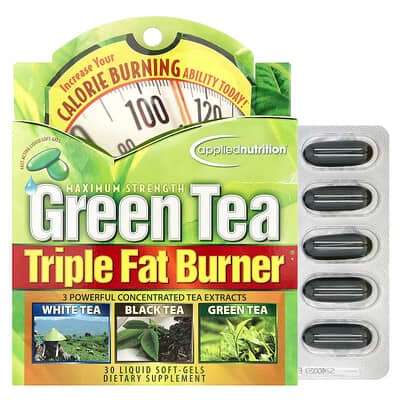
Green Tea Triple Fat Burner

Goals
$11.99 $0.79 per serving


Product analysis
Green Tea Triple Fat Burner combines tea extracts, caffeine and vitamins for people seeking those ingredients in one supplement. Several individual contributions are costly at the full serving price.
AI assessment of the formula, label and price. How scoring works
Nutrient Quality43
Natural-form vitamin E and clearly identified niacinamide are favorable features. Quality remains uncertain for much of the tea and vitamin mixture, and folate and caffeine forms are unspecified.
Ingredient Transparency93
All ingredient amounts and most forms are disclosed. Folate and caffeine lack specific form details, leaving those preparations less clear.
Value For Money34
Green tea, niacin and folate offer limited value at the full serving cost. Several other contributions remain uncertain, making value for the complete combination difficult to establish.
Customer Satisfaction75
Customer ratings are positive. The large number of ratings gives a broad picture of satisfaction.
Product Focus64
The combination brings tea ingredients, caffeine and vitamins into one serving. Its many ingredients and broad range of intended uses make it less concentrated on a single purpose.
- Format
Softgel - Container
- 30 Softgel(s)
- Per serving
- $0.79
- Customer rating
- 4.4 · 1,150 ratings
Goals

Impact
High effect
Niacin · 20 mgVitamin B12 · 6 mcgVitamin B6 · 2 mgGreen Tea · 200 mgCaffeine · 160 mg

Impact
Highest effect
Vitamin B12 · 6 mcgCaffeine · 160 mg

Impact
Moderate effect
Green Tea · 200 mgCaffeine · 160 mg

Impact
High effect
Vitamin B12 · 6 mcgVitamin B12 · 6 mcgVitamin B6 · 2 mgCaffeine · 160 mg

Impact
High effect
Folate · 400 mcgVitamin B6 · 2 mgVitamin B12 · 6 mcgCaffeine · 160 mg


Impact
Moderate effect
Folate · 400 mcgVitamin B12 · 6 mcgGreen Tea · 200 mg
Ingredients
| Ingredient | Amount per serving | Score |
|---|---|---|
Vitamin C (Ascorbic Acid) | 140 mg | |
Vitamin E (D-Alpha-Tocopherol) | 15 IU | |
Niacin (Niacinamide) | 20 mg | |
Vitamin B6 (Pyridoxine Hydrochloride) | 2 mg | |
Folic Acid | 400 mcg | |
Vitamin B12 (Cyanocobalamin) | 6 mcg | |
Black (Orange Pekoe) Tea extract (EGCG) | 200 mg | |
Green Tea extract (EGCG) | 200 mg | |
White Tea extract (EGCG) | 200 mg | |
Caffeine | 160 mg | |
Citrus (Citrus spp.) Bioflavonoids | 3 mg |
Green Tea (EGCG) · 200 mg OverallScore61
The serving lists 200 mg of green tea leaf extract. The declared concentrations are 50% EGCG. A 160 mg caffeine amount is recorded, but the whole-product total is unclear. The whole-product cost per 200 mg of disclosed EGCG is relatively high.
How this ingredient is rated
Composition and Label Disclosure100
The declared concentrations are 50% EGCG.
Declared Green Tea Marker Concentration
The declared concentrations are 50% EGCG.
Composition and Label Disclosure40
A 160 mg caffeine amount is recorded, but the whole-product total is unclear.
Whole-Product Caffeine Disclosure
A 160 mg caffeine amount is recorded, but the whole-product total is unclear.
Commercial Price and Usability25
The whole-product cost per 200 mg of disclosed EGCG is relatively high.
Cost per 200 mg Declared EGCG
The whole-product cost per 200 mg of disclosed EGCG is relatively high.
Caffeine · 160 mg OverallScore64
A serving supplies 160 mg of caffeine at a high cost per serving. The amount is clearly stated. The caffeine form or source is not specified in the available information. No listed secondary stimulants appear on the ingredient panel.
How this ingredient is rated
Active Ingredient Quality & Bioavailability40
The caffeine form or source is not specified in the available information.
Advanced Bioavailability and Release Profiles
The caffeine form or source is not specified in the available information.
Dose, Safety & Label Transparency100
The serving provides 160 mg of caffeine, a moderate amount. No listed secondary stimulants appear on the ingredient panel.
Caffeine Dose Transparency
The total caffeine amount is stated as 160 mg per serving.
Dosage Efficacy and Safety Margin
At 160 mg per serving, the caffeine amount is moderate.
Secondary Stimulant Disclosure and Risk
No listed secondary stimulants appear on the ingredient panel.
Value40
The cost per serving is high.
Price Per Serving vs. Collection Median
The cost per serving is high.
Niacin (Niacinamide) · 20 mg OverallScore65
A serving provides 20 mg of niacin, and the cost per serving is high. It uses niacinamide. Niacinamide is generally a non-flushing form.
How this ingredient is rated
Active Ingredient Quality & Bioavailability86
Niacinamide is the stated source of vitamin B3.
Niacin Form & Goal Alignment
Niacinamide is a form used for general vitamin B3 support.
Precursor Source Quality
The source is niacinamide, a standard form of vitamin B3.
Dose, Safety & Label Transparency67
The serving contains 20 mg of niacin. The chemical form is stated.
Clarity of Chemical Form
The niacin is disclosed as niacinamide.
Form-Specific Dosage Efficacy
The serving provides 20 mg of niacin.
Flush Risk & Safety Labeling
Niacinamide is generally non-flushing; no separate no-flush claim is stated.
Value20
The cost per serving is high.
Price Per Effective Serving
The cost per serving is high.
Alternative products
Report alternatives
Sources
Published studies used for the product analysis and the top-ranked studies for each ingredient and goal.
- Cognitive and mood improvements of caffeine in habitual consumers and habitual non-consumers of caffeine.
- Caffeine-containing energy drink improves physical performance of elite rugby players during a simulated match.
- Differential cognitive effects of energy drink ingredients: caffeine, taurine, and glucose.
- Does Single or Combined Caffeine and Taurine Supplementation Improve Athletic and Cognitive Performance without Affecting Fatigue Level in Elite Boxers? A Double-Blind, Placebo-Controlled Study.
- Trait Energy and Fatigue Modify the Effects of Caffeine on Mood, Cognitive and Fine-Motor Task Performance: A Post-Hoc Study.
- A new perspective on vitamin B12 deficiency in rheumatology: a case-based review.
- Effects of Vitamin B12 Supplementation on Cognitive Function, Depressive Symptoms, and Fatigue: A Systematic Review, Meta-Analysis, and Meta-Regression.
- Patients' experiences with methylcobalamin injections in amyotrophic lateral sclerosis.
- Cobalamin deficiency: clinical picture and radiological findings.
- Vitamin B12 Deficiency: Common Questions and Answers.
- Effect of caffeine ingestion on cycling performance: a systematic review and meta-analysis.
- Effects of Caffeine Intake on Endurance Running Performance and Time to Exhaustion: A Systematic Review and Meta-Analysis.
- Acute Effects of Caffeine Supplementation on Movement Velocity in Resistance Exercise: A Systematic Review and Meta-analysis.
- Sex Differences in the Ergogenic Response of Acute Caffeine Intake on Muscular Strength, Power and Endurance Performance in Resistance-Trained Individuals: A Randomized Controlled Trial.
- Can I Have My Coffee and Drink It? A Systematic Review and Meta-analysis to Determine Whether Habitual Caffeine Consumption Affects the Ergogenic Effect of Caffeine.
- Inter-individual variability in redox and performance responses after antioxidant supplementation: A randomized double blind crossover study.
- Antioxidant supplementation, redox deficiencies and exercise performance: A falsification design.
- A significant relationship between plasma vitamin C concentration and physical performance among Japanese elderly women.
- Low vitamin C values are linked with decreased physical performance and increased oxidative stress: reversal by vitamin C supplementation.
- Low dietary vitamin C intake is associated with low muscle strength among elderly Korean women.