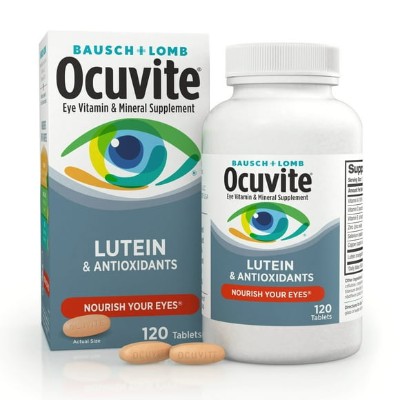
Ocuvite Lutein & Antioxidants

Ocuvite Lutein & Antioxidants

Bausch & Lomb4.7 (395 ratings)
Format:Tablet Quantity: 120 Tablet(s) · 120 servings
Goals
$13.88 $0.11 per serving

About this product

Eye-related nutrient support is more credible than a promise of better everyday vision. Zinc and vitamins C and E connect the formula to ingredients used in a defined eye-health combination, but their presence does not show that this formula reproduces that regimen. Lutein is only 2 mg, below the supplied threshold for a meaningful macular-pigment contribution.

Mineral quality is the main formulation weakness. Zinc oxide and cupric oxide have poor absorption potential, despite clear disclosure of all active amounts and forms. Copper is present at 2 mg alongside 40 mg zinc, but its inclusion alone does not establish an ideal balance.

The low serving cost supports value for the zinc and copper contribution. Vitamin C, zinc and selenium also supply normal nutrient functions, with the clearest relevance when intake is inadequate. Those roles do not establish added hair growth, cosmetic improvement or a faster metabolism in people whose nutritional needs are met.

Who is it for
  • Adults comparing eye-related nutrient combinations who will check the precise formula against their needs
Best for
  • Filling selected antioxidant and mineral intake gaps

Pros

  • All active nutrient amounts and sources are disclosed
  • Copper is explicitly included alongside zinc
  • Low serving cost supports the mineral contribution's value

Cons

  • Lutein exposure is below the supplied meaningful-contribution threshold
  • Zinc oxide and cupric oxide have poor absorption potential
  • The formula is not established as equivalent to a defined eye-health regimen
  • Broader hair and metabolism claims exceed the supported nutrient roles

Warnings

  • The 40 mg zinc serving reaches the adult upper intake level before zinc from food or other supplements is included.


Product analysis

64 out of 100

Ocuvite Lutein & Antioxidants provides nutrients involved in normal immune function and skin repair, particularly when dietary intake falls short. Some of its mineral forms are less favorable for absorption, which limits the appeal of the nutrient mix.

AI assessment of the formula, label and price. How scoring works

Nutrient Quality27

The mineral forms are the main quality limitation, particularly the copper and zinc oxides. The absorption quality of the remaining ingredients is less certain.

Ingredient Transparency100

All seven ingredient amounts and forms are stated. That detail makes it easier to compare both serving sizes and the types of nutrients used.

Value For Money61

The serving cost is favorable for zinc and copper and more moderate for selenium. Value is less certain for the vitamins and lutein, so those minerals provide the clearest price advantage.

Customer Satisfaction76

Customer ratings are very positive. Feedback comes from 395 ratings, giving a moderate picture of satisfaction.

Product Focus82

The formula covers related nutritional roles in immunity, eyes and skin. Benefits are clearest when intake is low, and the mix does not establish general vision improvement.

Format
Tablet
Container
120 Tablet(s)
Per serving
$0.11
Customer rating
4.7 · 395 ratings
Report analysis

Goals

Immunity
Impact
Highest effect
B Ingredient FitA+ PathwaysA+ EvidenceA+ Formulation Logic
Vitamin C · 200 mgZinc · 40 mgVitamin A · 300 mcgSelenium · 55 mcg

Zinc supports normal immune-cell regulation, while selenium contributes to normal immune function and antioxidant processes. Vitamin A helps maintain protective barriers, and vitamin C supports immune-cell activity with modest cold-duration evidence from regular use. Copper can help maintain immune responses when intake is low. Vitamin E has mixed respiratory findings that do not establish routine benefit in adequately nourished adults.

How this product is rated for Immunity

Ingredient fit76

The relevant ingredients have a connection to immune support, with the strength of their amount findings varying by nutrient.
Goal fit
The formula includes relevant immune ingredients alongside ingredients aimed at other uses, which makes its immune focus less concentrated.
Dose adequacy
The declared amounts provide partial coverage of the saved comparisons; unresolved amounts cannot establish a contribution.

Pathways100

The strongest saved connection is lymphocyte function and immune regulation.
Depth
The strongest saved connection is lymphocyte function and immune regulation.
Breadth
The saved findings cover several immune areas, with the extent varying between barrier protection, immune-cell activity, immune regulation and antioxidant balance.

Evidence100

The main support concerns normal nutrient functions, with any respiratory benefit limited to the specific evidence described above.
Evidence strength
Zinc leads the saved evidence finding; normal immune function does not itself establish infection prevention.
Studied preparation
The saved findings accept the relevant preparations; this does not imply that one nutrient form gives greater immune benefit.

Formulation logic100

The recognized ingredients meet the partner checks, and no configured conflict was found. Amount uncertainties still limit ingredients whose quantities are unresolved.
Partner coverage
The recognized ingredients do not require an additional partner for the roles considered here.
Conflicts
No configured ingredient conflict was identified from the available facts; this does not establish overall safety.
Effective doses
The recognized ingredients reach the saved amount threshold; that threshold is a comparison point, not proof of clinical effectiveness.
Study evidence
Selenium Mixed 37 studies
Vitamin A Supportive 107 studies
Vitamin C Supportive 53 studies
Vitamin E Supportive 21 studies
Zinc Supportive 73 studies
Impact
Highest effect
B+ Ingredient FitB+ PathwaysA- EvidenceA+ Formulation Logic
Zinc · 40 mgVitamin E · 27 mgVitamin C · 200 mgCopper · 2 mgVitamin A · 300 mcg

Zinc and vitamins C and E connect this formula to the defined AREDS combination studied in selected people with age-related macular degeneration. Their inclusion does not establish that this formula reproduces that regimen or improves vision generally. Copper counterbalances high-dose zinc in that regimen. The 2 mg lutein per serving falls below the saved amount threshold, so no macular-pigment contribution is assigned.

How this product is rated for Eye Health

Ingredient fit83

The formula’s relevant ingredients give a focused connection to vision support, with serving amounts determining how much each contributes.
Goal fit
The relevant ingredient selection is focused on this goal, while its other linked uses broaden the overall focus.
Dose adequacy
The recorded amounts give partial or uneven support, with unresolved amounts contributing no dose support.

Pathways80

The strongest assigned connection is photoreceptor structure and visual cycle, a narrower finding than improvement in overall vision.
Depth
The strongest assigned connection is photoreceptor structure and visual cycle, a narrower finding than improvement in overall vision.
Breadth
The findings cover both antioxidant defense and a second visual mechanism, while other aspects remain less supported.

Evidence88

Copper anchors this finding, with the limits of its studied population and intervention still applying.
Evidence strength
Copper anchors this finding, with the limits of its studied population and intervention still applying.
Studied preparation
The evaluated preparations match the saved criteria, without extending combination or disease-cohort evidence to routine vision improvement.

Formulation logic100

No conflict is identified by the evaluated rules. Partner requirements are satisfied, with amounts varying in their relevance.
Partner coverage
The evaluated ingredients work alone or have the required partner; no extra benefit from combining them is established.
Conflicts
No conflict is identified by the evaluated rules.
Effective doses
The counted ingredients meet the configured inclusion threshold, which does not establish a proven effective daily regimen.
Study evidence
Copper Supportive 7 studies
Selenium Supportive 15 studies
Vitamin A Supportive 65 studies
Vitamin C Disputed 24 studies
Vitamin E Disputed 35 studies
Zinc Supportive 39 studies
Everyday Health
Impact
High effect
B- Ingredient FitC PathwaysB+ EvidenceA+ Formulation Logic
Selenium · 55 mcgZinc · 40 mgVitamin C · 200 mg

Zinc and selenium contribute to normal immune and antioxidant functions when intake is low. Selenium's normal enzyme roles do not establish added benefit for adults with adequate intake. Vitamin C is present but did not receive a separate contribution at the supplied amount. The saved findings are concentrated in this nutritional area rather than broad general health coverage.

How this product is rated for Everyday Health

Ingredient fit72

Relevant ingredients share the formula with other actives, making its general health focus less concentrated.
Goal fit
Relevant ingredients share the formula with other actives, making its general health focus less concentrated.
Dose adequacy
The retained amounts vary; Vitamin C do not reach the saved amount requirement.

Pathways60

The strongest retained area is antioxidant and immune defence. This describes nutritional coverage rather than a measured health outcome.
Depth
The strongest retained area is antioxidant and immune defence. This describes nutritional coverage rather than a measured health outcome.
Breadth
One area has substantial retained coverage, so the contribution is focused rather than comprehensive.

Evidence82

Selenium leads the saved evidence finding; its normal nutritional role does not establish extra benefit when intake is adequate.
Evidence strength
Selenium leads the saved evidence finding; its normal nutritional role does not establish extra benefit when intake is adequate.
Studied preparation
The retained preparations match the saved comparison; this does not establish superiority over other forms.

Formulation logic100

The retained ingredients can contribute independently or have their required partner present; this does not establish an added combination benefit.
Partner coverage
The retained ingredients can contribute independently or have their required partner present; this does not establish an added combination benefit.
Conflicts
No configured ingredient conflict was matched in the saved findings.
Effective doses
All counted ingredients meet the saved amount requirement, which is a comparison criterion rather than proof of clinical benefit.
Study evidence
Selenium Supportive 70 studies
Vitamin C Supportive 56 studies
Zinc Supportive 60 studies
Skin Health
Impact
Highest effect
B+ Ingredient FitC- PathwaysA+ EvidenceA+ Formulation Logic
Zinc · 40 mgVitamin C · 200 mgCopper · 2 mgSelenium · 55 mcgVitamin E · 27 mg

Vitamin C and zinc support normal skin repair when intake is low. Copper is needed for connective-tissue enzymes, without establishing an added cosmetic effect when intake is adequate. Vitamin A nutrition and oral selenium or vitamin E do not establish prescription-retinoid effects or routine UV protection.

How this product is rated for Skin Health

Ingredient fit81

The formula contains counted skin-related nutrients, with low amounts limiting some extras. Copper and zinc reach their saved plateaus, while vitamin C and selenium contribute partially.
Goal fit
The formula contains counted skin-related nutrients, with low amounts limiting some extras.
Dose adequacy
Copper and zinc reach their saved plateaus, while vitamin C and selenium contribute partially.

Pathways56

The saved findings concentrate on the collagen-matrix aspect.
Depth
Copper and other counted nutrients drive the strongest saved collagen-matrix finding.
Breadth
Only the collagen-matrix aspect meets the saved coverage criterion.

Evidence100

Vitamin C leads the saved evidence finding through its established nutritional role. The counted nutrient preparations pass the saved check without proof of cosmetic efficacy or superiority of their forms.
Evidence strength
Vitamin C leads the saved evidence finding through its established nutritional role.
Studied preparation
The counted nutrient preparations pass the saved check without proof of cosmetic efficacy or superiority of their forms.

Formulation logic100

No missing required partner or specified conflict was identified. All counted ingredients meet the saved minimum amount criterion; this does not establish visible skin improvement.
Partner coverage
The counted ingredients have no missing required partner; this does not establish an added combination benefit.
Conflicts
No specified ingredient conflict was identified in the supplied facts.
Effective doses
All counted ingredients meet the saved minimum amount criterion; this does not establish visible skin improvement.
Study evidence
Copper Supportive 16 studies
Selenium Supportive 22 studies
Vitamin A Supportive 106 studies
Vitamin C Supportive 53 studies
Vitamin E Supportive 38 studies
Zinc Supportive 66 studies

Ingredients

IngredientAmount per servingScore
Vitamin A (Beta-Carotene)
300 mcg
Vitamin C (Ascorbic Acid)
200 mg
Vitamin E (DL-Alpha-Tocopheryl Acetate)
27 mg
Zinc (Zinc Oxide)
40 mg 60
Selenium (Sodium Selenate)
55 mcg 53
Copper (Cupric Oxide)
2 mg 66
Lutein (Marigold flower extract)
2 mg
Adults 18–50
Report overview
F Active Ingredient Quality & BioavailabilityA Dose, Safety & Label TransparencyB+ Value
Each serving provides 40 mg zinc at a fairly low cost per serving. It uses Zinc Oxide; a substantial amount. The serving also contains 2 mg copper, giving a zinc-to-copper ratio of about 20:1.
How this ingredient is rated

Active Ingredient Quality & Bioavailability20

The zinc comes from Zinc Oxide.
Zinc Form Bioavailability
Zinc Oxide is the stated zinc form.

Dose, Safety & Label Transparency91

The label states the zinc amount and source. The serving also contains 2 mg copper, giving a zinc-to-copper ratio of about 20:1.
Elemental Dose Transparency
The label states 40 mg elemental zinc and names its source.
Zinc Dosage Safety & Effectiveness
The 40 mg serving is a substantial amount.
Zinc-to-Copper Mineral Balance
The serving also contains 2 mg copper, giving a zinc-to-copper ratio of about 20:1.

Value80

The cost per labeled serving is fairly low.
Price Per Serving Efficiency
The cost per labeled serving is fairly low.
F Active Ingredient Quality & BioavailabilityA- Dose, Safety & Label TransparencyA+ Value
Each serving provides 2 mg of copper, with a low product cost per serving. It names Cupric Oxide as the copper source. Cupric oxide has poor bioavailability in humans.
How this ingredient is rated

Active Ingredient Quality & Bioavailability30

It names Cupric Oxide as the copper source.
Copper Form Bioavailability
Cupric oxide has poor bioavailability in humans.
Elemental Copper Labeling Clarity
The copper entry names Cupric Oxide and states the amount.

Dose, Safety & Label Transparency85

Each labeled serving provides 2 mg of copper. The serving also has 40 mg of zinc, a zinc-to-copper ratio of about 20 to 1.
Copper Dosage Safety & Efficacy
Each labeled serving provides 2 mg of copper.
Zinc-to-Copper Balance
The serving also has 40 mg of zinc, a zinc-to-copper ratio of about 20 to 1.

Value100

The product cost per serving is low.
Price Per Serving Efficiency
The product cost per serving is low.
F Active Ingredient Quality & BioavailabilityB- Dose, Safety & Label TransparencyC Value
Each serving provides 55 mcg of selenium, a modest amount, with a moderate product cost per 200 mcg. The selenium is listed as Sodium Selenate.
How this ingredient is rated

Active Ingredient Quality & Bioavailability32

The selenium is listed as Sodium Selenate.
Selenium Chemical Form
Sodium selenate is an inorganic form with lower cellular retention than organic forms.
Form Transparency & Isomer Specificity
The label names sodium selenate as the selenium form.

Dose, Safety & Label Transparency70

A serving provides 55 mcg, a modest amount. It leaves room below the 400 mcg upper intake level for selenium from food.
Dosage Efficacy Sweet Spot
The 55 mcg serving is a modest amount.
Safety Margin & UL Adherence
At 55 mcg per serving, it leaves room below the 400 mcg upper intake level for selenium from food.

Value60

The product's cost per 200 mcg of selenium is moderate.
Price per 200 mcg Serving
The product's cost per 200 mcg of selenium is moderate.
Report alternatives

Sources

Published studies used for the product analysis and the top-ranked studies for each ingredient and goal.

  1. Associations of selenium status with all-cause and cause-specific mortality: a systematic review and meta-analysis of cohort studies.
    Cui Z; Xie R; Lu X; Schomburg L; Brenner H; Schöttker B · Redox biology · 2025
    Meta-analysis95 participants20 studies pooledEveryday Health forSelenium
  2. Dietary Antioxidants, Circulating Antioxidant Concentrations, Total Antioxidant Capacity, and Risk of All-Cause Mortality: A Systematic Review and Dose-Response Meta-Analysis of Prospective Observational Studies.
    Jayedi A; Rashidy-Pour A; Parohan M; Zargar MS; Shab-Bidar S · Advances in nutrition (Bethesda, Md.) · 2019
    Meta-analysis507,251 participants41 studies pooledEveryday Health forSelenium
  3. The efficacy and safety of selenium supplementation versus placebo in the treatment of Graves' orbitopathy: A systematic review and meta-analysis of randomised controlled trials.
    Sharabati I; Qafesha RM; Hindawi MD; Amro S; Ayesh BM · Clinical endocrinology · 2024
    Meta-analysis4 studies pooledEveryday Health Eye Health forSelenium
  4. Associations of plasma metal concentrations with the risks of all-cause and cardiovascular disease mortality in Chinese adults.
    Shi L; Yuan Y; Xiao Y; Long P; Li W; Yu Y; Liu Y; Liu K; Wang H; Zhou L; Yang H; Li X; He M; Wu T · Environment international · 2021
    Cohort study6,155 participantsEveryday Health forSelenium
  5. Updates on clinical studies of selenium supplementation in radiotherapy.
    Puspitasari IM; Abdulah R; Yamazaki C; Kameo S; Nakano T; Koyama H · Radiation oncology (London, England) · 2015
    Systematic review16 studies pooledEveryday Health forSelenium
  6. Dietary intake and blood concentrations of antioxidants and the risk of cardiovascular disease, total cancer, and all-cause mortality: a systematic review and dose-response meta-analysis of prospective studies.
    Aune D; Keum N; Giovannucci E; Fadnes LT; Boffetta P; Greenwood DC; Tonstad S; Vatten LJ; Riboli E; Norat T · The American journal of clinical nutrition · 2019
    Meta-analysis69 studies pooledEveryday Health forVitamin C
  7. Scientific Opinion on the substantiation of a health claim related to vitamin C and increasing non haem iron absorption pursuant to Article 14 of Regulation (EC) No 1924/2006.
    EFSA Panel on Dietetic Products, Nutrition and Allergies (NDA) · EFSA journal. European Food Safety Authority · 2026
    Guideline / consensusEveryday Health forVitamin C
  8. Vitamin C Depletion and All-Cause Mortality in Renal Transplant Recipients.
    Sotomayor CG; Eisenga MF; Gomes Neto AW; Ozyilmaz A; Gans ROB; Jong WHA; Zelle DM; Berger SP; Gaillard CAJM; Navis GJ; Bakker SJ · Nutrients · 2018
    Cohort study598 participantsEveryday Health forVitamin C
  9. Associations of Serum Biomarkers of Fruit and Vegetable Intake With the Risk of Cause-Specific Mortality and All-Cause Mortality: A National Prospective Cohort Study.
    Pu L; Zhang R; Wang X; Zhao T; Sun H; Han L · Frontiers in nutrition · 2022
    Cohort study12,530 participantsEveryday Health forVitamin C
  10. Relation between plasma ascorbic acid and mortality in men and women in EPIC-Norfolk prospective study: a prospective population study. European Prospective Investigation into Cancer and Nutrition.
    Khaw KT; Bingham S; Welch A; Luben R; Wareham N; Oakes S; Day N · Lancet (London, England) · 2001
    Cohort study19,496 participantsEveryday Health forVitamin C
  11. Effectiveness of sodium bicarbonate and zinc chloride mouthwashes in the treatment of oral mucositis and quality of life in patients with cancer under chemotherapy.
    Mohammadi F; Oshvandi K; Kamallan SR; Khazaei S; Ranjbar H; Ahmadi-Motamayel F; Gillespie M; Jenabi E; Vafaei SY · Nursing open · 2022
    Randomized trial144 participantsEveryday Health forZinc
  12. Zinc supplementation in young children with acute diarrhea in India.
    Sazawal S; Black RE; Bhan MK; Bhandari N; Sinha A; Jalla S · The New England journal of medicine · 1995
    Randomized trial937 participantsEveryday Health forZinc
  13. Associations of mortality with ocular disorders and an intervention of high-dose antioxidants and zinc in the Age-Related Eye Disease Study: AREDS Report No. 13.
    Clemons TE; Kurinij N; Sperduto RD; AREDS Research Group · Archives of ophthalmology (Chicago, Ill. : 1960) · 2004
    Randomized trial4,753 participantsEveryday Health forZinc
  14. Effects of zinc and probiotic co-supplementation on inflammation, gastrointestinal symptoms, quality of life, and mood in irritable bowel syndrome patients.
    Rezazadegan M; Soheilipour M; Amani R · Scientific reports · 2026
    Randomized trial84 participantsEveryday Health forZinc
  15. Effect of zinc sulfate supplementation on premenstrual syndrome and health-related quality of life: Clinical randomized controlled trial.
    Siahbazi S; Behboudi-Gandevani S; Moghaddam-Banaem L; Montazeri A · The journal of obstetrics and gynaecology research · 2018
    Randomized trial142 participantsEveryday Health forZinc
  16. What did we learn in 35 years of research on nutrition and supplements for age-related macular degeneration: a systematic review.
    Pameijer EM; Heus P; Damen JAA; Spijker R; Hooft L; Ringens PJ; Imhof SM; van Leeuwen R · Acta ophthalmologica · 2023
    Systematic review27 studies pooledEye Health forCopper
  17. Dietary Nutrient Intake and Progression to Late Age-Related Macular Degeneration in the Age-Related Eye Disease Studies 1 and 2.
    Agrón E; Mares J; Clemons TE; Swaroop A; Chew EY; Keenan TDL; AREDS and AREDS2 Research Groups · Ophthalmology · 2021
    Cohort study8,242 participantsEye Health forCopper
  18. Association between late age-related macular degeneration and dietary intake of copper, iron, zinc and selenium: a 2005-2008 NHANES cross-sectional observational study.
    Lu Y; Li C; Liu Y; Wu T; Lu P · BMC ophthalmology · 2025
    Observational study4,996 participantsEye Health forCopper
  19. Associations between dietary nutrient intake and the risk of multiple age-related ocular diseases: evidence from longitudinal analysis.
    Yang Y; Zou H · The journal of nutrition, health & aging · 2026
    Cohort study103,192 participantsEye Health forCopper
  20. Dietary habits and dietary nutrient intake in patients with age-related macular degeneration: A case-control study.
    Šalková Kráľová J; Kolář P; Kapounová Z; Veselý P; Derflerová Brázdová Z · Central European journal of public health · 2023
    Case-control study151 participantsEye Health forCopper

