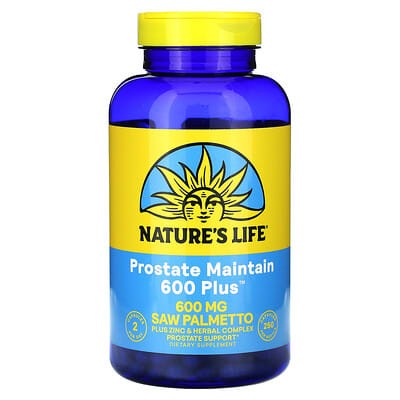
Prostate 600+

Prostate 600+

Nature's Life4.6 (786 ratings)
Format:Capsule Quantity: 250 Capsule(s) · 125 servings
Goals

About this product

The formula combines 15 mg zinc, 1 mg copper and 5 mg vitamin B6 with saw palmetto and several other prostate-oriented ingredients. Its clearest nutritional role is supporting normal zinc and copper status, while any testosterone or hair benefit remains most relevant when low zinc intake is involved.

The 15 mg zinc dose sits in a practical maintenance range, and the label identifies zinc picolinate and copper gluconate. Saw palmetto is listed at 600 mg from the berry, but no fatty-acid concentration is stated, so it cannot be matched confidently to more specific preparations.

Several supporting ingredients are present in smaller amounts, while a 30 mg herbal component is described only as Traditional Herbal Support. That incomplete disclosure limits a clear assessment of the botanical side of the formula even though the main mineral amounts are transparent.

Who is it for
  • Adults looking for a prostate-oriented mineral and botanical blend
  • People who want zinc paired with copper
  • Users comfortable with a formula whose herbal standardization is incomplete
Best for
  • Maintenance-level zinc and copper support
  • Broad prostate-oriented supplementation
  • People who prefer a large-count capsule bottle

Pros

  • Provides 15 mg zinc with 1 mg copper
  • Identifies zinc picolinate and copper gluconate
  • States a 600 mg saw palmetto berry amount
  • Includes vitamin B6 and amino acids alongside the botanicals

Cons

  • Saw palmetto fatty-acid concentration is not disclosed
  • The 30 mg Traditional Herbal Support component is not defined
  • Evidence for hair or testosterone support is conditional on nutrient status
  • Broad formula makes individual ingredient contributions harder to judge

Warnings

  • The saw palmetto amount is stated, but its fatty-acid concentration is unknown; people seeking a specific standardized preparation cannot confirm that from this label.


Product analysis

57 out of 100

Prostate 600+ combines zinc, B6 and copper with botanicals, offering nutritional support when intake is low. Its plant blends are not fully explained, making it harder to judge how closely they match preparations used for particular benefits.

AI assessment of the formula, label and price. How scoring works

Nutrient Quality54

Zinc picolinate is a favorable choice for absorption, while copper gluconate has less of a form advantage. Several botanical preparations are unclear, so confidence in their quality remains limited.

Ingredient Transparency68

All ingredient amounts are stated, but several forms are missing. The blends lack an individual breakdown, which makes their contents harder to compare.

Value For Money53

Value is mixed, with copper comparing more favorably on cost than zinc. The value of the remaining ingredients is too uncertain to justify a firm conclusion about the whole formula.

Customer Satisfaction77

Customer feedback is generally favorable. A moderate number of ratings provides some perspective, without proving health benefits.

Product Focus36

The formula combines nutritional support with several botanicals across immune, hair and hormone-related goals. Its breadth makes it less focused, and the benefits described largely depend on low nutrient intake or particular plant preparations.

Format
Capsule
Container
250 Capsule(s)
Per serving
$0.30
Customer rating
4.6 · 786 ratings
Report analysis

Goals

Impact
High effect
B- Ingredient FitF PathwaysA EvidenceA+ Formulation Logic
Zinc · 15 mg

Zinc can help when low intake contributes to diffuse shedding. Saw palmetto has limited, preparation-specific evidence for androgen-related thinning, but this berry material is not established as equivalent to the studied extracts. Copper contributes to normal pigmentation and connective-tissue biology; those roles do not establish routine hair regrowth.

How this product is rated for Hair Health

Ingredient fit71

The formula's hair relevance and amount support depend on the counted ingredients and their nutritional or preparation limits.
Goal fit
Relevant ingredients share the formula with other actives, making its overall focus broader than hair health.
Dose adequacy
The counted ingredients only partly meet the saved amount comparisons; small or unresolved amounts limit their contribution.

Pathways16

The recorded mechanism coverage is selective and does not by itself establish hair regrowth.
Depth
Androgen-related signalling is the strongest represented mechanism, although generic botanical preparations limit clinical interpretation.
Breadth
None of the evaluated hair mechanisms reached the saved coverage threshold.

Evidence92

The saved evidence comparison reflects the counted ingredients; nutritional conditions and preparation differences determine what hair benefits can be expected.
Evidence strength
Zinc provides the strongest counted evidence comparison, with benefits limited by the ingredient-specific nutritional or preparation context.
Studied preparation
Some counted materials lack a match to the studied preparations; Saw Palmetto limit that match.

Formulation logic100

The counted ingredients satisfy the saved partner and conflict checks, with amount limitations described below.
Partner coverage
The counted ingredients have no unmet partner requirement in the supplied findings.
Conflicts
No configured ingredient conflict was identified; this finding does not establish overall safety.
Effective doses
All counted ingredients meet the saved minimum amount comparison, which is not a proven clinical effectiveness threshold.
Study evidence
Copper Adverse 4 studies
Zinc Supportive 22 studies
Immunity
Impact
High effect
C Ingredient FitD- PathwaysA+ EvidenceA+ Formulation Logic
Zinc · 15 mg

Zinc, Copper, Vitamin B6 supply nutrients needed for normal immune-cell function, with usefulness mainly when intake is low. Cold-treatment findings from early, repeated zinc lozenges cannot be transferred to a generic single serving.

How this product is rated for Immunity

Ingredient fit64

Zinc, Copper, Vitamin B6 provide the main immune-related focus, alongside other actives with less direct relevance. The included amounts make a partial contribution to the saved comparison; smaller or unresolved quantities limit the overall contribution.
Goal fit
Zinc, Copper, Vitamin B6 provide the main immune-related focus, alongside other actives with less direct relevance.
Dose adequacy
The included amounts make a partial contribution to the saved comparison; smaller or unresolved quantities limit the overall contribution.

Pathways40

The strongest area is lymphocyte function and immune regulation, with partial coverage from the relevant ingredients.
Depth
The strongest area is lymphocyte function and immune regulation, with partial coverage from the relevant ingredients.
Breadth
The areas reaching the saved coverage threshold are lymphocyte function and immune regulation.

Evidence100

Zinc leads the saved evidence comparison; its nutritional role does not establish extra infection prevention.
Evidence strength
Zinc leads the saved evidence comparison; its nutritional role does not establish extra infection prevention.
Studied preparation
The eligible preparations match those accepted in the saved findings, without implying superior forms or broader clinical benefits.

Formulation logic100

None of the evaluated ingredient conflicts was triggered. The relevant ingredients can contribute independently or have their required partner present; no extra combined effect is established.
Partner coverage
The relevant ingredients can contribute independently or have their required partner present; no extra combined effect is established.
Conflicts
None of the evaluated ingredient conflicts was triggered.
Effective doses
All included ingredients meet the saved minimum amount comparison; this is not itself a clinically proven effectiveness threshold.
Study evidence
Zinc Supportive 73 studies
Everyday Health
Impact
High effect
C Ingredient FitD- PathwaysB- EvidenceA+ Formulation Logic
Zinc · 15 mg

Vitamin B6 supplies nutrients used in normal metabolism. Zinc offers nutritional support for normal antioxidant or immune functions when intake is low. Amounts above nutritional adequacy do not establish additional general-health benefit.

How this product is rated for Everyday Health

Ingredient fit63

Vitamin B6 and Zinc connects this product to routine nutrient provision. Its practical value depends on filling dietary gaps.
Goal fit
Nutritional support shares the formula with ingredients aimed at other goals, reducing its focus on routine nutrient provision.
Dose adequacy
The relevant amounts make a partial nutritional contribution against the supplied amount references, rather than covering every included nutrient equally.

Pathways43

Nutrient roles in one-carbon metabolism and blood formation are the strongest represented aspect. The overall range of represented roles remains narrow.
Depth
Nutrient roles in one-carbon metabolism and blood formation are the strongest represented aspect.
Breadth
The represented roles include one-carbon metabolism and blood formation, with breadth determined by the supplied amounts.

Evidence72

Zinc is the main contributor to the saved evidence finding. The supplied evidence supports nutritional usefulness when intake is low, without establishing extra benefit in adequately nourished adults.
Evidence strength
Zinc leads the saved evidence finding; its relevance is nutritional support when intake is low, without established benefit above adequacy.
Studied preparation
The included nutrient declarations satisfy the supplied preparation checks, without evidence that a particular form or delivery method provides greater general-health benefit.

Formulation logic100

The supplied checks identify no missing required partner or configured conflict. Included nutrient amounts meet the comparison threshold.
Partner coverage
No required nutrient partner is missing under the supplied checks; co-presence does not establish added benefit from the combination.
Conflicts
No configured ingredient conflict was identified in the supplied checks.
Effective doses
The included contributions meet the supplied amount threshold, which describes nutrient availability rather than a proven health-outcome dose.
Study evidence
Zinc Supportive 60 studies
Impact
Moderate effect
D+ Ingredient FitF PathwaysA- EvidenceA+ Formulation Logic
Zinc · 15 mg

Zinc may help restore testosterone if low zinc is contributing to low levels. That is different from increasing testosterone when you already get enough zinc. Vitamin B6 is an enzyme cofactor, but its presence doesn’t show that it independently raises testosterone.

How this product is rated for Testosterone Support

Ingredient fit51

Nutritional or hormone-related ingredient roles provide a connection, with important limits on routine testosterone benefits.
Goal fit
The blend includes ingredients with nutritional or hormone-related connections alongside other actives without a clear independent testosterone benefit.
Dose adequacy
The declared amounts vary in how closely they match ingredient-specific comparison amounts; those amounts are not proven testosterone-raising doses.

Pathways2

The strongest connection concerns free-testosterone availability, but the nutrient roles do not show a reliable hormone increase in everyday use.
Depth
The strongest connection concerns free-testosterone availability, but the nutrient roles do not show a reliable hormone increase in everyday use.
Breadth
The ingredients do not provide broad contributions across the named hormone mechanisms.

Evidence89

Zinc is most relevant when a shortage contributes to low testosterone; benefit above adequate intake is unclear.
Evidence strength
Zinc is most relevant when a shortage contributes to low testosterone; benefit above adequate intake is unclear.
Studied preparation
The relevant forms match the saved ingredient context, but that match does not guarantee a testosterone increase.

Formulation logic100

No missing required partner or matching ingredient conflict is identified; amount comparisons do not guarantee hormone changes.
Partner coverage
No missing required ingredient partner is identified; combining the ingredients does not imply an extra hormone benefit.
Conflicts
No matching ingredient conflict is identified in the available product facts.
Effective doses
The relevant amounts reach the saved comparison threshold, which is not a proven hormone-raising dose.
Study evidence
Zinc Disputed 7 studies

Ingredients

IngredientAmount per servingScore
Total Carbohydrates
1 Gram(s)
Dietary Fiber
1 Gram(s)
Vitamin B6 (Pyridoxine Hydrochloride)
5 mg
Zinc (Zinc Picolinate)
15 mg 88
Copper (Copper Gluconate)
1 mg 74
Saw Palmetto Berry (berry oil)
600 mg 10
Pumpkin
50 mg
Pygeum Bark Extract (Total Sterols)
10 mg
Active Aminos (Glycine, L-Alanine, L-Glutamic Acid)
195 mg
Traditional Herbal Support
30 mg
Men 18–50 Vegetarian
Report overview
A+ Active Ingredient Quality & BioavailabilityA Dose, Safety & Label TransparencyC Value
The serving provides 15 mg of zinc as zinc picolinate. It also provides 1 mg copper per serving.
How this ingredient is rated

Active Ingredient Quality & Bioavailability100

Zinc picolinate is a form considered readily absorbed.
Zinc Form Bioavailability
The zinc is supplied as picolinate, a form the assessment views favorably for absorption.

Dose, Safety & Label Transparency91

The serving provides 15 mg of zinc; the copper amount is also known.
Elemental Dose Transparency
The zinc amount is stated as 15 mg per serving, and its source is identified.
Zinc Dosage Safety & Effectiveness
15 mg is a moderate amount of zinc per serving.
Zinc-to-Copper Mineral Balance
The serving has 15 mg zinc and 1 mg copper, a zinc-to-copper ratio of 15:1.

Value60

The whole-product serving costs about $0.31.
Price Per Serving Efficiency
The price is about $0.31 per whole-product serving.
C- Active Ingredient Quality & BioavailabilityA- Dose, Safety & Label TransparencyB+ Value
Two capsules provide 1 mg of copper as copper gluconate. The 15:1 zinc-to-copper ratio fits the balance used for this comparison.
How this ingredient is rated

Active Ingredient Quality & Bioavailability58

The serving provides 1 mg of copper as gluconate, a common organic form.
Copper Form Bioavailability
Copper gluconate is a common organic form.
Elemental Copper Labeling Clarity
The saved facts identify 1 mg of copper and name gluconate as its source.

Dose, Safety & Label Transparency86

The serving provides 1 mg of copper. The 15 mg of zinc and 1 mg of copper make a 15:1 ratio, which fits the balance used in this comparison.
Copper Dosage Safety & Efficacy
The serving provides 1 mg of copper.
Zinc-to-Copper Balance
The 15 mg of zinc and 1 mg of copper make a 15:1 ratio, which fits the balance used in this comparison.

Value80

At about $0.31 per whole-product serving, the price is moderate in this comparison. The serving includes 1 mg of copper.
Price Per Serving Efficiency
At about $0.31 per whole-product serving, the price is moderate in this comparison. The serving includes 1 mg of copper.
F Composition And Label DisclosureF Composition And Label Disclosure
Each serving lists 600 mg of saw palmetto. The fatty-acid percentage is not recorded in the supplied facts, limiting comparisons of composition.
How this ingredient is rated

Composition and Label Disclosure0

The saved facts do not specify the preparation or a fatty-acid percentage.
Marker and Preparation Disclosure
The supplied facts do not give a fatty-acid percentage for the saw palmetto.

Composition and Label Disclosure20

The saw palmetto amount is recorded for the serving, while fatty-acid content is unknown.
Amount and Label Disclosure
A serving lists 600 mg of saw palmetto; no fatty-acid percentage is recorded.

Commercial Price and Usability

No price assessment is available for saw palmetto.
Report alternatives

Sources

Published studies used for the product analysis and the top-ranked studies for each ingredient and goal.

  1. Effectiveness of sodium bicarbonate and zinc chloride mouthwashes in the treatment of oral mucositis and quality of life in patients with cancer under chemotherapy.
    Mohammadi F; Oshvandi K; Kamallan SR; Khazaei S; Ranjbar H; Ahmadi-Motamayel F; Gillespie M; Jenabi E; Vafaei SY · Nursing open · 2022
    Randomized trial144 participantsEveryday Health forZinc
  2. Zinc supplementation in young children with acute diarrhea in India.
    Sazawal S; Black RE; Bhan MK; Bhandari N; Sinha A; Jalla S · The New England journal of medicine · 1995
    Randomized trial937 participantsEveryday Health forZinc
  3. Associations of mortality with ocular disorders and an intervention of high-dose antioxidants and zinc in the Age-Related Eye Disease Study: AREDS Report No. 13.
    Clemons TE; Kurinij N; Sperduto RD; AREDS Research Group · Archives of ophthalmology (Chicago, Ill. : 1960) · 2004
    Randomized trial4,753 participantsEveryday Health forZinc
  4. Effects of zinc and probiotic co-supplementation on inflammation, gastrointestinal symptoms, quality of life, and mood in irritable bowel syndrome patients.
    Rezazadegan M; Soheilipour M; Amani R · Scientific reports · 2026
    Randomized trial84 participantsEveryday Health forZinc
  5. Effect of zinc sulfate supplementation on premenstrual syndrome and health-related quality of life: Clinical randomized controlled trial.
    Siahbazi S; Behboudi-Gandevani S; Moghaddam-Banaem L; Montazeri A · The journal of obstetrics and gynaecology research · 2018
    Randomized trial142 participantsEveryday Health forZinc
  6. Menkes disease and response to copper histidine: An Indian case series.
    Yoganathan S; Sudhakar SV; Arunachal G; Thomas M; Subramanian A; George R; Danda S · Annals of Indian Academy of Neurology · 2022
    Case series4 participantsHair Health forCopper
  7. Trace element levels in alopecia areata.
    Bhat YJ; Manzoor S; Khan AR; Qayoom S · Indian journal of dermatology, venereology and leprology · 2009
    Case-control study100 participantsHair Health forCopper
  8. UV damage to hair and the effect of antioxidants and metal chelators.
    Millington KR; Marsh JM · International journal of cosmetic science · 2021
    In vitro / ex vivo studyHair Health forCopper
  9. Preserving fibre health: reducing oxidative stress throughout the life of the hair fibre.
    Marsh JM; Davis MG; Lucas RL; Reilman R; Styczynski PB; Li C; Mamak M; McComb DW; Williams RE; Godfrey S; Navqi KR; Chechik V · International journal of cosmetic science · 2016
    In vitro / ex vivo studyHair Health forCopper
  10. The Safety and Efficacy of a Proprietary Bioactive Fatty Acids Extract From Saw Palmetto (Serenoa repens) for Promoting Hair Growth and Reducing Hair Loss in Adults With Self-Perceived Thinning Hair: 90-Day Results.
    Ablon G · Journal of cosmetic dermatology · 2025
    Randomized trial60 participantsHair Health forSaw Palmetto
  11. Effects of dietary supplements on androgenetic alopecia: a systematic review and network meta-analysis.
    Zhou L; Zhu W; Chen Y · Frontiers in nutrition · 2026
    Meta-analysis1,658 participants19 studies pooledHair Health forSaw Palmetto
  12. The Safety and Efficacy of a Novel Saw Palmetto (Serenoa repens) Extract for Promoting Hair Growth in Adults With Self-Perceived Thinning Hair: 180-Day Results.
    Ablon G · Journal of cosmetic dermatology · 2026
    Randomized trial60 participantsHair Health forSaw Palmetto
  13. Beyond Minoxidil: Off-Label Therapies for Male Androgenetic Alopecia-A Systematic Review with Network Meta-Analyses.
    Gupta AK; Compton SAH; Liddy A; Talukder M; Wang T; Bamimore MA · Medicina (Kaunas, Lithuania) · 2026
    Meta-analysis50 participants23 studies pooledHair Health forSaw Palmetto
  14. Comparitive effectiveness of finasteride vs Serenoa repens in male androgenetic alopecia: a two-year study.
    Rossi A; Mari E; Scarno M; Garelli V; Maxia C; Scali E; Iorio A; Carlesimo M · International journal of immunopathology and pharmacology · 2013
    Non-randomized trial100 participantsHair Health forSaw Palmetto
  15. The effects of minoxidil, 1% pyrithione zinc and a combination of both on hair density: a randomized controlled trial.
    Berger RS; Fu JL; Smiles KA; Turner CB; Schnell BM; Werchowski KM; Lammers KM · The British journal of dermatology · 2003
    Randomized trial200 participantsHair Health forZinc
  16. Incubatory environment of the scalp impacts pre-emergent hair to affect post-emergent hair cuticle integrity.
    Schwartz JR; Henry JP; Kerr KM; Flagler MJ; Page SH; Redman-Furey N · Journal of cosmetic dermatology · 2018
    Randomized trialHair Health forZinc
  17. A comparison of hair quality and cosmetic acceptance following the use of two anti-dandruff shampoos.
    Draelos ZD; Kenneally DC; Hodges LT; Billhimer W; Copas M; Margraf C · The journal of investigative dermatology. Symposium proceedings · 2006
    Randomized trial40 participantsHair Health forZinc
  18. BMI and levels of zinc, copper in hair, serum and urine of Turkish male patients with androgenetic alopecia.
    Ozturk P; Kurutas E; Ataseven A; Dokur N; Gumusalan Y; Gorur A; Tamer L; Inaloz S · Journal of trace elements in medicine and biology : organ of the Society for Minerals and Trace Elements (GMS) · 2015
    Case-control study216 participantsHair Health forZinc
  19. Analysis of serum zinc and copper concentrations in hair loss.
    Kil MS; Kim CW; Kim SS · Annals of dermatology · 2013
    Case-control study342 participantsHair Health forZinc
  20. Nutrient supplementation for prevention of viral respiratory tract infections in healthy subjects: A systematic review and meta-analysis.
    Vlieg-Boerstra B; de Jong N; Meyer R; Agostoni C; De Cosmi V; Grimshaw K; Milani GP; Muraro A; Oude Elberink H; Pali-Schöll I; Roduit C; Sasaki M; Skypala I; Sokolowska M; van Splunter M; Untersmayr E; Venter C; O'Mahony L; Nwaru BI · Allergy · 2022
    Meta-analysis199,055 participants115 studies pooledImmunity forZinc

