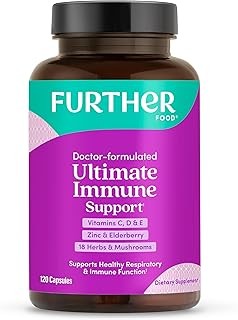
Ultimate Immune Support

Ultimate Immune Support

Further Food4.5 (483 ratings)
Format:Capsule Quantity: 120 Capsule(s) · 30 servings
Goals
$18.99 $0.63 per serving

About this product

The clearest support comes from vitamins and minerals needed for normal immune function. Vitamin C at 500 mg, zinc at 23 mg, vitamin D at 50 mcg and selenium at 55 mcg can help fill dietary gaps, but larger intake does not establish stronger immune function when needs are already met.

Zinc gluconate is a favorable named form, while vitamin C is acidic ascorbic acid without a buffering claim. Copper is present at 0.4 mg, a small contribution relative to the zinc amount; that fact alone does not establish a harmful mineral balance. The formula therefore deserves a check against other supplements rather than being added automatically to an existing nutrient routine.

The botanical additions are harder to assess than the nutrients. Astragalus has a stated amount but no clear source preparation, elderberry lacks complete botanical identification, and the named blends do not reveal individual components or proportions. Those gaps weaken the case for paying extra for the herbs and mushrooms rather than choosing a simpler nutrient supplement.

Who is it for
  • Adults seeking combined immune-related nutrients and willing to accept incomplete information about the botanical blends.
Best for
  • Filling identified gaps in nutrients involved in normal immune and antioxidant functions.

Pros

  • The main vitamin and mineral amounts and forms are disclosed.
  • Zinc gluconate has favorable absorption potential.
  • Vitamin C, zinc, selenium and vitamin D provide clear nutritional roles.

Cons

  • Named blend totals do not establish their individual ingredients or doses.
  • Astragalus preparation and elderberry botanical details are incomplete.
  • Individual vitamin C and mineral contributions are relatively costly.
  • The herbs' contribution is less clear than the central nutrient contribution.

Warnings

  • The 500 mg vitamin C uses unbuffered ascorbic acid; people sensitive to acidic supplements may prefer a different preparation.
  • Vitamin D at 50 mcg and zinc at 23 mg add substantial amounts to an existing supplement routine; review combined intake before adding separate vitamin D or zinc.


Product analysis

48 out of 100

Ultimate Immune Support combines nutrients that support normal immune function, with the clearest usefulness when intake is low. Undisclosed blend contents and missing herbal-form details make the full formula harder to judge.

AI assessment of the formula, label and price. How scoring works

Nutrient Quality42

Zinc has a favorable named form, while the other nutrient forms offer less certainty about quality. Several herbs lack form details, and the blend does not identify its components.

Ingredient Transparency68

The listed ingredient amounts are disclosed, but several herbal forms are missing. The blend also leaves its individual contents undisclosed, preventing a full comparison of the formula.

Value For Money33

The cost is high for the vitamin C, zinc and especially selenium provided. Value for the remaining ingredients is uncertain, so the broad ingredient list does not establish good value.

Customer Satisfaction73

Customer ratings are positive across hundreds of reviews. The feedback suggests favorable satisfaction, without showing that the full formula delivers its intended health benefits.

Product Focus32

The clearest purpose is nutritional immune support, especially when intake is low. Wider skin, hair and hormone benefits depend on nutritional needs, while undisclosed blend contents make the complete formula uncertain.

Format
Capsule
Container
120 Capsule(s)
Per serving
$0.63
Customer rating
4.5 · 483 ratings
Report analysis

Goals

Immunity
Impact
Highest effect
B- Ingredient FitA+ PathwaysA+ EvidenceA+ Formulation Logic
Vitamin C · 500 mgZinc · 23 mgVitamin A · 450 mcg RAEVitamin D · 50 mcgSelenium · 55 mcgEuropean Elder · 100 mg

Vitamins A and D, zinc, selenium and copper provide nutrients relevant to barriers and normal immune-cell function. Vitamin C adds modest regular-use cold-duration support rather than infection prevention. Vitamin E is counted in the saved result, but mixed respiratory-outcome evidence limits expectations of additional protection in well-nourished adults.

How this product is rated for Immunity

Ingredient fit74

Zinc, Selenium, Vitamin A provide the focused contribution to immunity here. The relevant amounts provide uneven contributions relative to the supplied comparisons; smaller amounts limit some contributions.
Goal fit
Zinc, Selenium, Vitamin A provide the focused contribution to immunity here.
Dose adequacy
The relevant amounts provide uneven contributions relative to the supplied comparisons; smaller amounts limit some contributions.

Pathways100

The strongest contribution concerns lymphocyte function and immune regulation, based on the relevant ingredients and their amounts. Four immune-related areas reach the supplied breadth comparison.
Depth
The strongest contribution concerns lymphocyte function and immune regulation, based on the relevant ingredients and their amounts.
Breadth
Four immune-related areas reach the supplied breadth comparison.

Evidence100

Vitamin C has the strongest supported contribution here, with modest regular-use cold-duration evidence rather than infection prevention.
Evidence strength
Vitamin C has the strongest supported contribution here, with modest regular-use cold-duration evidence rather than infection prevention.
Studied preparation
The counted preparations meet the supplied preparation comparison, without establishing superior effects from their forms or delivery methods.

Formulation logic100

The counted ingredients can contribute independently or have the partners required by the supplied findings. No configured ingredient conflict was identified from the supplied facts.
Partner coverage
The counted ingredients can contribute independently or have the partners required by the supplied findings.
Conflicts
No configured ingredient conflict was identified from the supplied facts.
Effective doses
The counted ingredients all meet the minimum amount comparison; this does not establish infection-prevention or treatment doses.
Study evidence
Astragalus Supportive 16 studies
Selenium Mixed 37 studies
Vitamin A Supportive 107 studies
Vitamin C Supportive 53 studies
Vitamin D Supportive 85 studies
Vitamin E Supportive 21 studies
Zinc Supportive 73 studies
Everyday Health
Impact
High effect
C+ Ingredient FitB+ PathwaysB+ EvidenceA+ Formulation Logic
Vitamin D · 50 mcgSelenium · 55 mcgZinc · 23 mgVitamin C · 500 mg

Vitamin C, Zinc, Selenium supply nutrients involved in normal immune and antioxidant functions. Vitamin D contributes to mineral nutrition and bone maintenance. The nutritional contributions are most useful when intake is low; extra benefit with adequate intake is not established.

How this product is rated for Everyday Health

Ingredient fit67

Vitamin D and the other relevant nutrients provide the main connection to general health. Additional actives make the formula less focused on this goal.
Goal fit
Relevant nutrients contribute to general health, alongside other actives with less direct support for this goal.
Dose adequacy
The relevant amounts provide partial nutritional contributions relative to the saved comparison amounts.

Pathways80

The strongest area is antioxidant and immune defence. Contributions also reach the saved coverage level across bone and mineral metabolism, antioxidant and immune defence.
Depth
The strongest supported area is antioxidant and immune defence, through the relevant nutrient contributions.
Breadth
The supported areas reaching the saved coverage level are bone and mineral metabolism, antioxidant and immune defence.

Evidence82

Vitamin D provides the strongest supported contribution. The supplied context limits routine expectations to filling nutritional gaps rather than improving outcomes in adequately nourished adults.
Evidence strength
Vitamin D provides the strongest supported contribution here; usefulness remains conditional on the relevant nutritional or population context.
Studied preparation
The relevant preparations match those recognized by the saved findings; this does not establish superiority of a form or delivery method.

Formulation logic100

The relevant ingredients can contribute independently, and no configured conflict was found. Their presence together does not establish an added combination benefit.
Partner coverage
The relevant ingredients can contribute independently or have their required partners present; no extra combination benefit is established.
Conflicts
No configured ingredient conflict was identified in the supplied findings.
Effective doses
All ingredients retained for contribution meet the saved amount threshold; that threshold does not prove a clinical benefit.
Study evidence
Selenium Supportive 70 studies
Vitamin C Supportive 56 studies
Vitamin D Supportive 115 studies
Zinc Supportive 60 studies
Impact
High effect
C Ingredient FitB PathwaysA EvidenceA+ Formulation Logic
Vitamin D · 50 mcgVitamin E · 15 mgVitamin C · 500 mg

Vitamin C and selenium support antioxidant defenses, while zinc can address inflammation associated with low zinc status. Vitamin C's relevant CRP finding was limited to people with elevated baseline CRP; vitamin D's biomarker findings were inconsistent and included a temporary CRP change. Ginger, garlic and green tea have unresolved imported presence and amounts, so they add no established contribution here. Vitamin E is below the amount counted.

How this product is rated for Inflammation

Ingredient fit64

Four nutrients contribute within a broader formula; unresolved botanical facts limit additional conclusions.
Goal fit
Four nutrients contribute within a broader formula; unresolved botanical facts limit additional conclusions.
Dose adequacy
Nutrient amounts receive differing recognition; vitamin E is below the counted amount and botanical doses remain unresolved.

Pathways77

Inflammatory gene signaling is the main area represented. Oxidative stress also reaches the saved coverage threshold.
Depth
Inflammatory gene signaling is the strongest area in the saved findings; this mapping does not establish a clinical effect.
Breadth
Inflammatory signaling and oxidative stress reach the saved coverage threshold; fatty-acid and enzyme pathways do not.

Evidence93

Vitamin D leads the saved evidence finding. The preparation is recognized, while the clinical limitations described above still apply.
Evidence strength
Vitamin D leads the saved evidence finding; this does not establish routine clinical anti-inflammatory benefit.
Studied preparation
The saved findings recognize the preparations of all credited ingredients; this does not establish equivalence for every clinical outcome.

Formulation logic100

The credited ingredients have no unmet partner requirement or matched conflict in the saved findings. Their amounts clear the threshold used for inclusion.
Partner coverage
Each credited ingredient can contribute independently or has its required partner.
Conflicts
No configured conflict was matched; this is limited to the combinations evaluated.
Effective doses
All credited ingredients clear the amount threshold used for inclusion; this is not proof of an effective clinical dose.
Study evidence
Selenium Supportive 34 studies
Vitamin C Supportive 50 studies
Vitamin D Supportive 101 studies
Vitamin E Supportive 20 studies
Zinc Supportive 64 studies
Impact
Moderate effect
C Ingredient FitF PathwaysA EvidenceA+ Formulation Logic
Zinc · 23 mgVitamin D · 50 mcg

Zinc may help restore testosterone when low zinc is contributing to low levels. That benefit concerns correcting a deficiency, and taking extra zinc when you already get enough hasn't been shown to raise testosterone.

How this product is rated for Testosterone Support

Ingredient fit64

Zinc is most relevant when low zinc contributes to low testosterone. The benefit should not be extended to people who already get enough zinc.
Goal fit
Zinc is most relevant when low zinc contributes to low testosterone.
Dose adequacy
Zinc 23 mg per label serving; the additional declared amounts don't predict a hormone increase.

Pathways10

Correcting low zinc may help hormone function; broad testosterone enhancement in nutrient-replete users remains uncertain.
Depth
Zinc is relevant to testosterone when deficiency affects hormone function.
Breadth
The ingredients do not demonstrate a broad testosterone-raising effect beyond the possible relevance of correcting low zinc.

Evidence93

Zinc is most relevant when low zinc contributes to low testosterone.
Evidence strength
Zinc is most relevant when low zinc contributes to low testosterone.
Studied preparation
The ingredient forms have relevant hormone context, but that does not guarantee a testosterone increase in everyday use.

Formulation logic100

No particular ingredient conflict is identified. No required ingredient partner is missing.
Partner coverage
No required ingredient partner is missing; this does not imply an added benefit from combining ingredients.
Conflicts
No particular ingredient conflict is identified.
Effective doses
The declared amounts allow ingredient comparisons, but do not establish a testosterone-raising dose for the combination.
Study evidence
Selenium No effect 16 studies
Vitamin D Supportive 56 studies
Vitamin E Disputed 3 studies
Zinc Disputed 7 studies
Skin Health
Impact
High effect
C+ Ingredient FitF PathwaysA+ EvidenceA+ Formulation Logic
Zinc · 23 mgVitamin C · 500 mgCopper · 0.4 mgSelenium · 55 mcgVitamin E · 15 mg

Vitamin C and zinc support normal repair when intake is low. Vitamin A is needed for normal skin development, but its nutritional role does not reproduce prescription-retinoid effects. Added nutrients have no established cosmetic benefit once needs are met. The green-tea record remains unresolved, while copper and vitamin E are below the saved minimum amount criterion.

How this product is rated for Skin Health

Ingredient fit67

The formula contains several counted skin-related nutrients alongside broader ingredients. Vitamin C and zinc reach their saved plateaus; other counted nutrients contribute partially.
Goal fit
The formula contains several counted skin-related nutrients alongside broader ingredients.
Dose adequacy
Vitamin C and zinc reach their saved plateaus; other counted nutrients contribute partially.

Pathways12

The saved collagen and UV-related findings are partial, with no skin aspect meeting the coverage criterion.
Depth
The strongest saved collagen-matrix finding is limited by the counted amounts.
Breadth
No skin aspect meets the saved coverage criterion.

Evidence100

Vitamin C leads the saved evidence finding through its established nutritional role. The counted nutrient preparations pass the saved check without proof of cosmetic efficacy or superiority of their forms.
Evidence strength
Vitamin C leads the saved evidence finding through its established nutritional role.
Studied preparation
The counted nutrient preparations pass the saved check without proof of cosmetic efficacy or superiority of their forms.

Formulation logic100

No missing required partner or specified conflict was identified. All counted ingredients meet the saved minimum amount criterion; this does not establish visible skin improvement.
Partner coverage
The counted ingredients have no missing required partner; this does not establish an added combination benefit.
Conflicts
No specified ingredient conflict was identified in the supplied facts.
Effective doses
All counted ingredients meet the saved minimum amount criterion; this does not establish visible skin improvement.
Study evidence
Copper Supportive 16 studies
Selenium Supportive 22 studies
Vitamin A Supportive 106 studies
Vitamin C Supportive 53 studies
Vitamin E Supportive 38 studies
Zinc Supportive 66 studies
Hair Health
Impact
High effect
B- Ingredient FitC PathwaysA+ EvidenceA+ Formulation Logic
Vitamin D · 50 mcgZinc · 23 mgVitamin C · 500 mg

Zinc can help address shedding caused by inadequate zinc intake. The remaining nutrient functions do not establish routine hair growth. The saved findings mainly recognize nutrient amounts and antioxidant-related coverage, whose practical benefit remains dependent on the specific nutritional circumstances.

How this product is rated for Hair Health

Ingredient fit71

The formula contains recognized hair-related ingredients, but their practical relevance depends on nutritional need and usable amounts. Recognized hair-related ingredients sit alongside ingredients serving other purposes, so the formula has a broader focus.
Goal fit
Recognized hair-related ingredients sit alongside ingredients serving other purposes, so the formula has a broader focus.
Dose adequacy
The saved findings recognize the declared amounts, with differing contributions across the ingredients; this does not establish an effective hair-treatment dose.

Pathways60

Antioxidant-related nutrient coverage is the strongest finding, but normal antioxidant functions do not establish hair regrowth. Meaningful coverage centers on antioxidant-related functions, with limited coverage of the other hair pathways.
Depth
Antioxidant-related nutrient coverage is the strongest finding, but normal antioxidant functions do not establish hair regrowth.
Breadth
Meaningful coverage centers on antioxidant-related functions, with limited coverage of the other hair pathways.

Evidence98

Zinc is the leading recognized ingredient; its practical hair benefit is relevant to deficiency-related shedding, rather than routine regrowth. Preparation matching does not establish a trial of the complete product.
Evidence strength
Zinc is the leading recognized ingredient; its practical hair benefit is relevant to deficiency-related shedding, rather than routine regrowth.
Studied preparation
Recognized preparations meet the saved comparison criteria, which does not establish a hair-growth trial of this complete formula.

Formulation logic100

The recognized ingredients have no missing required partner or configured conflict. All recognized ingredients meet the saved amount criterion; that criterion is not proof of a clinically effective hair dose.
Partner coverage
No required partner is missing among the recognized ingredients; this does not establish extra benefit from combining them.
Conflicts
No configured ingredient conflict was identified in the supplied findings.
Effective doses
All recognized ingredients meet the saved amount criterion; that criterion is not proof of a clinically effective hair dose.
Study evidence
Copper Adverse 4 studies
Selenium Disputed 7 studies
Vitamin A Disputed 13 studies
Vitamin D Disputed 34 studies
Vitamin E No effect 3 studies
Zinc Supportive 22 studies
Impact
High effect
C Ingredient FitC- PathwaysB+ EvidenceA+ Formulation Logic
Zinc · 23 mgVitamin E · 15 mgVitamin C · 500 mgCopper · 0.4 mgVitamin A · 450 mcg RAE

Vitamin A supports the visual cycle and can help restore dark adaptation when intake is deficient. Vitamin C and vitamin E have evidence mainly within a defined combination for selected people with age-related macular degeneration, rather than routine vision improvement.

How this product is rated for Eye Health

Ingredient fit64

The formula includes eye-related nutrients alongside broader ingredients. Lower or unresolved amounts limit how much targeted visual-performance support can be described.
Goal fit
Eye-related nutrients sit within a broader formula with ingredients aimed at other goals.
Dose adequacy
The relevant amounts provide uneven support against the supplied amount references, with lower or unresolved declarations limiting the overall finding.

Pathways55

Antioxidant nutrition is the strongest represented aspect. Other visual functions have more limited support from the supplied ingredients and amounts.
Depth
The strongest represented aspect is retinal and lens antioxidant nutrition, rather than demonstrated improvement in eyesight.
Breadth
Support is concentrated in antioxidant nutrition, with limited representation of macular-pigment, focusing and other visual functions.

Evidence84

The saved findings favor familiar nutrients, but their clinical roles depend on deficiency or specific combinations and populations. Targeted visual-performance claims remain limited.
Evidence strength
Zinc leads the saved finding; its clinical vision evidence concerns a defined combination and selected AMD populations.
Studied preparation
The included forms satisfy the saved preparation checks; this does not transfer combination or disease-population outcomes to routine vision improvement.

Formulation logic100

The supplied partner and conflict checks identify no missing required partner or configured conflict. Amount thresholds describe the comparison and do not establish effective vision doses.
Partner coverage
No required partner is missing under the supplied formulation checks; this does not demonstrate added benefit from combining these ingredients.
Conflicts
No configured ingredient conflict was identified in the supplied checks.
Effective doses
All included contributions meet the saved amount threshold, which is a comparison reference rather than a proven effective vision dose.
Study evidence
Copper Supportive 7 studies
Selenium Supportive 15 studies
Vitamin A Supportive 65 studies
Vitamin C Disputed 24 studies
Vitamin D Disputed 35 studies
Vitamin E Disputed 35 studies
Zinc Supportive 39 studies

Ingredients

IngredientAmount per servingScore
Vitamin A (Beta-Carotene)
450 mcg RAE
Vitamin C (Ascorbic Acid)
500 mg 52
Vitamin D (Cholecalciferol)
50 mcg
Vitamin E (D-Alpha-Tocopheryl)
15 mg
Zinc (Zinc Gluconate)
23 mg 67
Selenium (Selenomethionine)
55 mcg 51
Copper (Copper Gluconate)
0.4 mg
Astragalus
200 mg 100
Echinacea angustifolia
100 mg
European Elder Berry
100 mg 85
Andrographis
100 mg
Super Herbs Blend
380 mg
Power Mushroom Blend
300 mg
Vibrant Flavonoid Blend
200 mg
Traditional Respiratory Blend
200 mg
Adults 18–50
Report overview
B+ Active Ingredient Quality & BioavailabilityB- Dose, Safety & Label TransparencyF Value
Zinc gluconate supplies a clearly stated 23 mg per serving. The accompanying 0.4 mg copper leaves zinc relatively prominent in the mineral balance, and the whole product costs about $0.63 per serving.
How this ingredient is rated

Active Ingredient Quality & Bioavailability80

Gluconate is the clearly identified zinc source.
Zinc Form Bioavailability
Zinc gluconate is identified, making the source clear for comparison.

Dose, Safety & Label Transparency73

The zinc amount is clear, but zinc is relatively prominent compared with the accompanying copper.
Elemental Dose Transparency
The label identifies 23 mg elemental zinc per serving and names its source.
Zinc Dosage Safety & Effectiveness
23 mg provides a moderate zinc amount per serving.
Zinc-to-Copper Mineral Balance
23 mg zinc accompanies 0.4 mg copper, giving a zinc-heavy 57.5:1 ratio.

Value30

The whole-product cost is about $0.63 per labeled serving.
Price Per Serving Efficiency
About $0.63 per labeled serving covers the whole product; it is not a price for zinc alone.
F Active Ingredient Quality & BioavailabilityA Dose, Safety & Label TransparencyF Value
D+ Active Ingredient Quality & BioavailabilityB- Dose, Safety & Label TransparencyF Value
Report alternatives

Sources

Published studies used for the product analysis and the top-ranked studies for each ingredient and goal.

  1. Elderberry Supplementation Reduces Cold Duration and Symptoms in Air-Travellers: A Randomized, Double-Blind Placebo-Controlled Clinical Trial.
    Tiralongo E; Wee SS; Lea RA · Nutrients · 2016
    Randomized trial312 participantsEveryday Health Immunity forEuropean Elder
  2. COVID-19: Is There Evidence for the Use of Herbal Medicines as Adjuvant Symptomatic Therapy?
    Silveira D; Prieto-Garcia JM; Boylan F; Estrada O; Fonseca-Bazzo YM; Jamal CM; Magalhães PO; Pereira EO; Tomczyk M; Heinrich M · Frontiers in pharmacology · 2023
    Narrative reviewEveryday Health forEuropean Elder
  3. Associations of selenium status with all-cause and cause-specific mortality: a systematic review and meta-analysis of cohort studies.
    Cui Z; Xie R; Lu X; Schomburg L; Brenner H; Schöttker B · Redox biology · 2025
    Meta-analysis95 participants20 studies pooledEveryday Health forSelenium
  4. Dietary Antioxidants, Circulating Antioxidant Concentrations, Total Antioxidant Capacity, and Risk of All-Cause Mortality: A Systematic Review and Dose-Response Meta-Analysis of Prospective Observational Studies.
    Jayedi A; Rashidy-Pour A; Parohan M; Zargar MS; Shab-Bidar S · Advances in nutrition (Bethesda, Md.) · 2019
    Meta-analysis507,251 participants41 studies pooledEveryday Health forSelenium
  5. The efficacy and safety of selenium supplementation versus placebo in the treatment of Graves' orbitopathy: A systematic review and meta-analysis of randomised controlled trials.
    Sharabati I; Qafesha RM; Hindawi MD; Amro S; Ayesh BM · Clinical endocrinology · 2024
    Meta-analysis4 studies pooledEveryday Health Eye Health forSelenium
  6. Associations of plasma metal concentrations with the risks of all-cause and cardiovascular disease mortality in Chinese adults.
    Shi L; Yuan Y; Xiao Y; Long P; Li W; Yu Y; Liu Y; Liu K; Wang H; Zhou L; Yang H; Li X; He M; Wu T · Environment international · 2021
    Cohort study6,155 participantsEveryday Health forSelenium
  7. Updates on clinical studies of selenium supplementation in radiotherapy.
    Puspitasari IM; Abdulah R; Yamazaki C; Kameo S; Nakano T; Koyama H · Radiation oncology (London, England) · 2015
    Systematic review16 studies pooledEveryday Health forSelenium
  8. Dietary intake and blood concentrations of antioxidants and the risk of cardiovascular disease, total cancer, and all-cause mortality: a systematic review and dose-response meta-analysis of prospective studies.
    Aune D; Keum N; Giovannucci E; Fadnes LT; Boffetta P; Greenwood DC; Tonstad S; Vatten LJ; Riboli E; Norat T · The American journal of clinical nutrition · 2019
    Meta-analysis69 studies pooledEveryday Health forVitamin C
  9. Scientific Opinion on the substantiation of a health claim related to vitamin C and increasing non haem iron absorption pursuant to Article 14 of Regulation (EC) No 1924/2006.
    EFSA Panel on Dietetic Products, Nutrition and Allergies (NDA) · EFSA journal. European Food Safety Authority · 2026
    Guideline / consensusEveryday Health forVitamin C
  10. Vitamin C Depletion and All-Cause Mortality in Renal Transplant Recipients.
    Sotomayor CG; Eisenga MF; Gomes Neto AW; Ozyilmaz A; Gans ROB; Jong WHA; Zelle DM; Berger SP; Gaillard CAJM; Navis GJ; Bakker SJ · Nutrients · 2018
    Cohort study598 participantsEveryday Health forVitamin C
  11. Associations of Serum Biomarkers of Fruit and Vegetable Intake With the Risk of Cause-Specific Mortality and All-Cause Mortality: A National Prospective Cohort Study.
    Pu L; Zhang R; Wang X; Zhao T; Sun H; Han L · Frontiers in nutrition · 2022
    Cohort study12,530 participantsEveryday Health forVitamin C
  12. Relation between plasma ascorbic acid and mortality in men and women in EPIC-Norfolk prospective study: a prospective population study. European Prospective Investigation into Cancer and Nutrition.
    Khaw KT; Bingham S; Welch A; Luben R; Wareham N; Oakes S; Day N · Lancet (London, England) · 2001
    Cohort study19,496 participantsEveryday Health forVitamin C
  13. Vitamin D supplementation for prevention of mortality in adults.
    Bjelakovic G; Gluud LL; Nikolova D; Whitfield K; Wetterslev J; Simonetti RG; Bjelakovic M; Gluud C · The Cochrane database of systematic reviews · 2014
    Meta-analysis95,286 participants159 studies pooledEveryday Health forVitamin D
  14. Effect of vitamin D on gastrointestinal symptoms and health-related quality of life in irritable bowel syndrome patients: a randomized double-blind clinical trial.
    Abbasnezhad A; Amani R; Hajiani E; Alavinejad P; Cheraghian B; Ghadiri A · Neurogastroenterology and motility · 2018
    Randomized trial90 participantsEveryday Health forVitamin D
  15. The impact of vitamin D administration on mortality in COVID-19 patients: a systematic review and meta-analysis of randomized controlled trials.
    Kow CS; Ramachandram DS; Hasan SS; Wong Z; Thiruchelvam K · Inflammopharmacology · 2024
    Meta-analysis2,495 participants19 studies pooledEveryday Health forVitamin D
  16. Vitamin D Status and Mortality: A Systematic Review of Observational Studies.
    Heath AK; Kim IY; Hodge AM; English DR; Muller DC · International journal of environmental research and public health · 2019
    Systematic review84 studies pooledEveryday Health forVitamin D
  17. Meta-analysis of long-term vitamin D supplementation on overall mortality.
    Zheng Y; Zhu J; Zhou M; Cui L; Yao W; Liu Y · PloS one · 2014
    Meta-analysis42 studies pooledEveryday Health forVitamin D
  18. Effectiveness of sodium bicarbonate and zinc chloride mouthwashes in the treatment of oral mucositis and quality of life in patients with cancer under chemotherapy.
    Mohammadi F; Oshvandi K; Kamallan SR; Khazaei S; Ranjbar H; Ahmadi-Motamayel F; Gillespie M; Jenabi E; Vafaei SY · Nursing open · 2022
    Randomized trial144 participantsEveryday Health forZinc
  19. Zinc supplementation in young children with acute diarrhea in India.
    Sazawal S; Black RE; Bhan MK; Bhandari N; Sinha A; Jalla S · The New England journal of medicine · 1995
    Randomized trial937 participantsEveryday Health forZinc
  20. Associations of mortality with ocular disorders and an intervention of high-dose antioxidants and zinc in the Age-Related Eye Disease Study: AREDS Report No. 13.
    Clemons TE; Kurinij N; Sperduto RD; AREDS Research Group · Archives of ophthalmology (Chicago, Ill. : 1960) · 2004
    Randomized trial4,753 participantsEveryday Health forZinc