
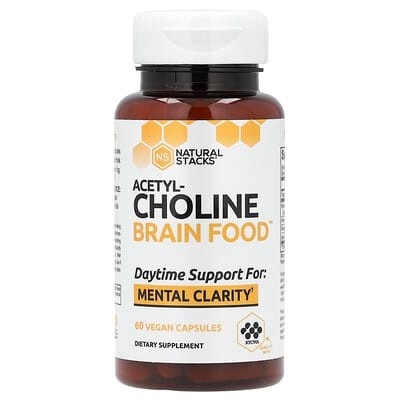

$39.95 $1.99 per serving


Product analysis
Acetyl-Choline Brain Food provides B vitamins that help the body use food for energy, especially when intake is low. Its acetyl L-carnitine and alpha-GPC offer weak value, making the combination expensive for those ingredients.
AI assessment of the formula, label and price. How scoring works
Nutrient Quality56
The B-vitamin forms are clearly identified, providing the strongest basis for judging ingredient quality. Quality advantages for the other ingredients remain uncertain.
Ingredient Transparency85
All ingredient amounts are stated, making the serving clear. Two ingredient forms remain unspecified, limiting more detailed comparisons.
Value For Money21
Acetyl L-carnitine and alpha-GPC are expensive for the amounts supplied. The B vitamins do not provide a strong value offset.
Customer Satisfaction72
Customer ratings are strongly positive. The size of the review pool affects how settled that picture is, and ratings do not establish effectiveness.
Product Focus71
The strongest support is for normal energy metabolism through the B vitamins. The small acetyl L-carnitine serving does not establish the fatigue benefits seen in the particular older-adult setting described.
- Format
Capsule - Container
- 60 Capsule(s)
- Per serving
- $1.99
- Customer rating
- 4.6 · 230 ratings
Goals

Impact
High effect
Vitamin B5 · 287 mgThiamin · 64 mgAcetyl L-Carnitine · 319 mg
Thiamin and vitamin B5 support normal use of food for energy, with fatigue benefits tied to correcting low intake rather than extra energy after adequacy. Acetyl L-carnitine has limited clinical fatigue evidence in adults over 70. Its 319 mg in the assessed three-capsule serving does not establish equivalence to that clinical use.
How this product is rated for Energy
Ingredient fit76
The formula includes ingredients connected with energy alongside ingredients used for other purposes. The assessed amounts provide partial coverage of the saved references, with some ingredients contributing less than others.
Goal fit
The formula includes ingredients connected with energy alongside ingredients used for other purposes.
Dose adequacy
The assessed amounts provide partial coverage of the saved references, with some ingredients contributing less than others.
Pathways13
Mitochondrial energy production is the main covered mechanism, with partial coverage from the assessed ingredients.
Depth
Mitochondrial energy production is the main covered mechanism, with partial coverage from the assessed ingredients.
Breadth
No direct mechanism reaches the coverage threshold.
Evidence95
Acetyl L-carnitine evidence is limited to selected clinical fatigue populations; the saved preparation finding does not remove that distinction.
Evidence strength
Acetyl L-Carnitine provides the strongest assessed evidence connection; the population and intended use still limit what benefits can be expected.
Studied preparation
The assessed preparations meet the saved study criteria, without establishing identical effects in every population or regimen.
Formulation logic100
No missing partner or configured conflict was identified. The assessed ingredients meet the saved minimum amount check.
Partner coverage
The assessed ingredients do not depend on a missing partner for their assigned contribution.
Conflicts
No configured ingredient conflict was found in the supplied facts.
Effective doses
All ingredients included in this amount check clear its minimum comparison threshold; that threshold does not itself prove a noticeable benefit.
Vitamin B5 Not classified
No linked studies yet.
Ingredients
| Ingredient | Amount per serving | Score |
|---|---|---|
Thiamine (Thiamine Hydrochloride) | 64 mg | |
Pantothenic Acid (D-Calcium Pantothenate) | 287 mg | |
White Peony root extract (Paeoniflorin) | 383 mg | |
Acetyl-L-Carnitine HCl | 319 mg | |
Alpha-Glycerophosphocholine | 192 mg |
Thiamin (Thiamine Hydrochloride) · 64 mg OverallScore76
Each serving provides 64 mg of thiamin, but the cost relative to that amount is high. It uses thiamine hydrochloride. The listed amount is clear.
How this ingredient is rated
Active Ingredient Quality & Bioavailability70
It uses thiamine hydrochloride, a standard water-soluble form. No configured artificial colors or sweeteners are listed.
Thiamin Chemical Form
It uses thiamine hydrochloride, a standard water-soluble form.
Excipient Purity
No configured artificial colors or sweeteners are listed.
Dose, Safety & Label Transparency100
Each serving supplies 64 mg of thiamin. The amount is clearly stated.
Thiamin Dosage Potency
Each serving supplies 64 mg of thiamin.
Label Transparency & Proprietary Blends
The label states the thiamin amount and source.
Value40
The cost is high relative to the declared thiamin amount; the full serving price may overstate the cost attributable to thiamin.
Price per Declared Dose
The cost is high relative to the declared thiamin amount; the full serving price may overstate the cost attributable to thiamin.
Vitamin B5 (D-Calcium Pantothenate) · 287 mg OverallScore75
Each serving provides 287 mg of vitamin B5, with a high cost relative to the amount. It uses calcium d-pantothenate.
How this ingredient is rated
Active Ingredient Quality & Bioavailability90
The B5 comes from calcium d-pantothenate, a stable salt form.
Vitamin B5 Chemical Form
The B5 comes from calcium d-pantothenate, a stable salt form.
Dose, Safety & Label Transparency88
Each serving supplies 287 mg of vitamin B5. The source is named.
Dosage Potency and Efficacy
Each serving supplies 287 mg of vitamin B5.
Label Transparency & Source Clarity
The B5 amount and its calcium d-pantothenate source are listed.
Value20
The cost relative to the B5 amount is high.
Price per 500mg Vitamin B5
The cost relative to the B5 amount is high.
Acetyl L-Carnitine · 319 mg OverallScore69
Each serving provides 319 mg of acetyl L-carnitine HCl, a modest amount. The whole-product price works out to about $3.13 per 500 mg of acetyl L-carnitine, a relatively high cost for this ingredient.
How this ingredient is rated
Active Ingredient Quality & Bioavailability94
Acetyl L-carnitine is the only carnitine form identified in the available facts. The available facts identify the HCl form and record a purity or manufacturing claim; the claim has not been independently verified.
ALCAR vs. Standard Carnitine Form
Acetyl L-carnitine is the only carnitine form identified in the available facts.
Advanced Sourcing and Salt Specificity
The available facts identify the HCl form and record a purity or manufacturing claim; the claim has not been independently verified.
Dose, Safety & Label Transparency79
Each serving contains 319 mg of acetyl L-carnitine, with its amount individually disclosed.
Clinical Dosage Efficacy
A serving provides 319 mg of acetyl L-carnitine, a modest amount.
Label Transparency and Proprietary Blends
The 319 mg amount of acetyl L-carnitine per serving is individually disclosed.
Value0
The whole-product price works out to about $3.13 per 500 mg of acetyl L-carnitine, a relatively high cost for this ingredient.
Price per 500mg Acetyl L-Carnitine
The whole-product price works out to about $3.13 per 500 mg of acetyl L-carnitine, a relatively high cost for this ingredient.
Alternative products
Report alternatives
Sources
Published studies used for the product analysis and the top-ranked studies for each ingredient and goal.
- Oral acetyl-L-carnitine therapy reduces fatigue in overt hepatic encephalopathy: a randomized, double-blind, placebo-controlled study.
- The supplementation of acetyl-L-carnitine decreases fatigue and increases quality of life in patients with hepatitis C treated with pegylated interferon-α 2b plus ribavirin.
- Acetyl-L-carnitine reduces depression and improves quality of life in patients with minimal hepatic encephalopathy.
- A prospective study to evaluate the efficacy and safety of oral acetyl-L-carnitine for the treatment of chemotherapy-induced peripheral neuropathy.
- Metabolomic biomarkers for (R, S)-ketamine and (S)-ketamine in treatment-resistant depression and healthy controls: A systematic review.
- Influence of thiamin supplementation on the health and general well-being of an elderly Irish population with marginal thiamin deficiency.
- Randomised clinical trial: high-dose oral thiamine versus placebo for chronic fatigue in patients with quiescent inflammatory bowel disease.
- Dietary reference values for thiamin.
- Effects of thiamine supplementation on exercise-induced fatigue.
- Long-term maintenance treatment with 300 mg thiamine for fatigue in patients with inflammatory bowel disease: results from an open-label extension of the TARIF study.