
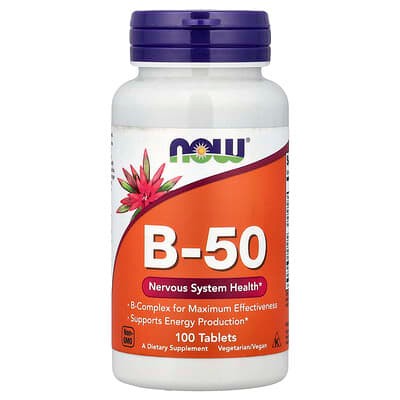

$11.60 $0.11 per serving


Product analysis
B-50 supplies B vitamins that support normal use of food for energy, especially when intake is low. Some ingredient forms are omitted, making the exact preparations harder to compare.
AI assessment of the formula, label and price. How scoring works
Nutrient Quality58
Several B-vitamin forms are clearly identified, and calcium pantothenate is a favorable feature. Ordinary riboflavin is less favored, while the quality of some other ingredients remains uncertain.
Ingredient Transparency86
All ingredient amounts are listed, making quantities straightforward to check. Several forms are omitted, so the exact preparations are not fully clear.
Value For Money58
The serving cost is favorable for riboflavin and B6, but less appealing for B5 and thiamin. The remaining ingredients offer mixed or uncertain value.
Customer Satisfaction88
Customer feedback is highly positive across thousands of ratings. The large response count gives a broad picture of satisfaction.
Product Focus66
The clearest role is helping meet B-vitamin needs for normal energy use. Extra energy or a faster metabolism is not established when intake is already adequate.
- Format
Tablet - Container
- 100 Tablet(s)
- Per serving
- $0.11
- Also available
 B-50$25.50
- Customer rating
- 4.7 · 4,754 ratings
Goals

Impact
High effect
Vitamin B5 · 50 mgRiboflavin · 50 mgThiamin · 50 mgVitamin B12 · 50 mcg
B vitamins help the body use food for energy, while folate and B12 support normal blood formation. Their contribution to tiredness is most relevant when intake is low or a deficiency is corrected; larger amounts do not establish extra energy when intake is adequate. B12 is present but its amount is below the saved inclusion requirement.
How this product is rated for Energy
Ingredient fit88
The relevant connection comes from Vitamin B2 (Riboflavin), Vitamin B1 (Thiamin), Vitamin B5, Folate, Vitamin B6, Niacin. The amounts offer different levels of support in the saved findings.
Goal fit
Relevant energy ingredients appear alongside ingredients aimed at other purposes, so the formulation has a broader focus.
Dose adequacy
The included amounts receive partial support against the saved amount references, without defining a proven fatigue-treatment dose.
Pathways0
The saved findings concern nutrient sufficiency rather than coverage of the configured alertness, muscle-energy, cellular-energy, stress-fatigue or blood-flow pathways.
Depth
No configured energy pathway receives coverage; nutrient-related contributions are considered separately.
Breadth
No configured pathway reaches the saved coverage requirement.
Evidence78
The strongest included evidence contribution comes from Vitamin B2 (Riboflavin). Studied-preparation matching does not remove the ingredient-specific limits on fatigue benefits.
Evidence strength
Vitamin B2 (Riboflavin) provides the strongest included evidence contribution; its population and deficiency limitations still determine the benefit that can be expected.
Studied preparation
The included amounts meet the saved studied-preparation check, without establishing that the finished product itself was tested.
Formulation logic100
The included ingredients meet the saved minimum amount requirement without a missing required partner or matched conflict.
Partner coverage
The included ingredients do not lack a required partner in the saved findings; this does not imply an added combination benefit.
Conflicts
No configured ingredient conflict was matched in the supplied facts.
Effective doses
All counted ingredients meet the saved minimum amount requirement; this is distinct from a proven effective fatigue-treatment dose.
Vitamin B5 Not classified
No linked studies yet.

Impact
High effect
Biotin · 50 mcgNiacin · 50 mgVitamin B12 · 50 mcgRiboflavin · 50 mgThiamin · 50 mgVitamin B5 · 50 mgVitamin B6 · 50 mg
B vitamins support the normal processes that turn food into usable energy. Their physiological roles and serving amounts do not establish a faster resting metabolic rate when intake is adequate. The supplied evidence therefore supports normal nutrient function rather than a demonstrated increase in whole-body energy expenditure.
How this product is rated for Metabolism Support
Ingredient fit81
The contributing amounts meet part of the saved comparison range, without establishing a proven thermogenic dose.
Goal fit
The formula combines ingredients connected to metabolism with other actives, reducing its specific focus on energy expenditure.
Dose adequacy
The contributing amounts meet part of the saved comparison range, without establishing a proven thermogenic dose.
Pathways0
No contribution is established across the assessed energy-expenditure pathways.
Depth
No contribution is established across the assessed energy-expenditure pathways.
Breadth
No assessed pathway reaches the saved coverage threshold, leaving broad energy-expenditure support unestablished.
Evidence100
Vitamin B1 (Thiamin) leads the saved evidence finding; its normal metabolic or biomarker roles do not establish a routine rise in energy expenditure.
Evidence strength
Vitamin B1 (Thiamin) leads the saved evidence finding; its normal metabolic or biomarker roles do not establish a routine rise in energy expenditure.
Studied preparation
The contributing forms meet the saved preparation criteria; this does not transfer findings from other outcomes into a thermogenic benefit.
Formulation logic100
The contributing ingredients have no missing required partners or configured conflicts. Their amounts meet the saved minimum comparison threshold.
Partner coverage
No required partner is missing among contributing ingredients; this does not establish added thermogenesis from combining them.
Conflicts
No configured ingredient conflict was identified in the supplied calculation.
Effective doses
All contributing ingredients meet the saved minimum amount threshold; this comparison threshold is not proof of a clinical thermogenic effect.
Ingredients
| Ingredient | Amount per serving | Score |
|---|---|---|
Thiamine (Thiamine Hydrochloride) | 50 mg | |
Riboflavin | 50 mg | |
Niacin (Niacinamide) | 50 mg | |
Vitamin B6 (Pyridoxine Hydrochloride) | 50 mg | |
Folate | 667 mcg DFE | |
Vitamin B12 (Cyanocobalamin) | 50 mcg | |
Biotin | 50 mcg | |
Pantothenic Acid (Calcium Pantothenate) | 50 mg | |
Choline (Choline Bitartrate) | 50 mg | |
PABA | 50 mg | |
Inositol | 50 mg |
PABA · 50 mg OverallScore87
A serving provides 50 mg of PABA. At the whole-product price, that works out to about $0.23 per 100 mg of PABA.
How this ingredient is rated
Active Ingredient Quality & Bioavailability80
PABA is identified by name; the saved facts do not record a pharmaceutical grade or purity designation.
PABA Source & Grade
PABA is identified by name; the saved facts do not record a pharmaceutical grade or purity designation.
Dose, Safety & Label Transparency95
A serving provides 50 mg of PABA.
PABA Dosage Alignment
The evaluation places 50 mg per serving in its B-complex amount category.
Label Disclosure Clarity
The saved facts record a separate amount of 50 mg PABA per serving.
Additive and Excipient Quality
The recorded ingredients show none of the evaluated artificial dyes, titanium dioxide or hydrogenated oils.
Value85
At the whole-product price, that works out to about $0.23 per 100 mg of PABA.
Price per 100mg PABA
At the whole-product price, that works out to about $0.23 per 100 mg of PABA.
Vitamin B6 (Pyridoxine Hydrochloride) · 50 mg OverallScore75
The 50 mg of vitamin B6 per serving comes at a low cost per amount of B6. It uses pyridoxine hydrochloride. The amount exceeds the European adult daily upper limit, before food or other supplements are counted.
How this ingredient is rated
Ingredient Form & Label Quality100
The B6 comes from pyridoxine hydrochloride. The listed ingredients show no artificial dyes, titanium dioxide, hydrogenated oils or talc.
Vitamin B6 Form Identification
The B6 comes from pyridoxine hydrochloride.
Clean Label and Excipient Purity
The listed ingredients show no artificial dyes, titanium dioxide, hydrogenated oils or talc.
Dose, Safety & Label Transparency37
The serving provides 50 mg of B6, above the European adult daily upper limit; total intake can also include food and other supplements.
Vitamin B6 Dose & Safety Policy
The serving provides 50 mg of B6, above the European adult daily upper limit; total intake can also include food and other supplements.
Label Transparency
The B6 source is named as pyridoxine hydrochloride.
Value100
The cost per amount of B6 is low.
Vitamin B6 Price Efficiency
The cost per amount of B6 is low.
Niacin (Niacinamide) · 50 mg OverallScore73
Each serving provides 50 mg of niacin. The cost per serving is moderate. The form is Niacinamide.
How this ingredient is rated
Active Ingredient Quality & Bioavailability86
The form is Niacinamide.
Niacin Form & Goal Alignment
The form is Niacinamide.
Precursor Source Quality
The named form is Niacinamide.
Dose, Safety & Label Transparency67
Each serving provides 50 mg of niacin. A flush-free claim is not recorded.
Clarity of Chemical Form
The form is Niacinamide.
Form-Specific Dosage Efficacy
Each serving provides 50 mg of niacin.
Flush Risk & Safety Labeling
A flush-free claim is not recorded.
Value60
The cost per serving is moderate.
Price Per Effective Serving
The cost per serving is moderate.
Alternative products
Report alternatives
Sources
Published studies used for the product analysis and the top-ranked studies for each ingredient and goal.
- Physicochemical properties of and volatile compounds in riboflavin fortified cloudy apple juice; study of its effect on job fatigue among Egyptian construction workers.
- Vitamin B status in patients with chronic fatigue syndrome.
- B-vitamins, related vitamers, and metabolites in patients with quiescent inflammatory bowel disease and chronic fatigue treated with high dose oral thiamine.
- Metabolic features of chronic fatigue syndrome.
- Effectiveness of Riboflavin in Inherited Metabolic Diseases: A Systematic Review
- Influence of thiamin supplementation on the health and general well-being of an elderly Irish population with marginal thiamin deficiency.
- Randomised clinical trial: high-dose oral thiamine versus placebo for chronic fatigue in patients with quiescent inflammatory bowel disease.
- Dietary reference values for thiamin.
- Effects of thiamine supplementation on exercise-induced fatigue.
- Long-term maintenance treatment with 300 mg thiamine for fatigue in patients with inflammatory bowel disease: results from an open-label extension of the TARIF study.
- A new perspective on vitamin B12 deficiency in rheumatology: a case-based review.
- Effects of Vitamin B12 Supplementation on Cognitive Function, Depressive Symptoms, and Fatigue: A Systematic Review, Meta-Analysis, and Meta-Regression.
- Patients' experiences with methylcobalamin injections in amyotrophic lateral sclerosis.
- Cobalamin deficiency: clinical picture and radiological findings.
- Vitamin B12 Deficiency: Common Questions and Answers.
- Biotin and contribution to normal energy-yielding metabolism: evaluation of a health claim pursuant to Article 14 of Regulation (EC) No 1924/2006.
- Pregnancy and lactation alter biomarkers of biotin metabolism in women consuming a controlled diet.
- Survey of the effect of biotin on glycemic control and plasma lipid concentrations in type 1 diabetic patients in kermanshah in iran (2008-2009)
- Chromium picolinate and biotin combination improves glucose metabolism in treated, uncontrolled overweight to obese patients with type 2 diabetes
- Biotin supplementation reduces plasma triacylglycerol and VLDL in type 2 diabetic patients and in nondiabetic subjects with hypertriglyceridemia