
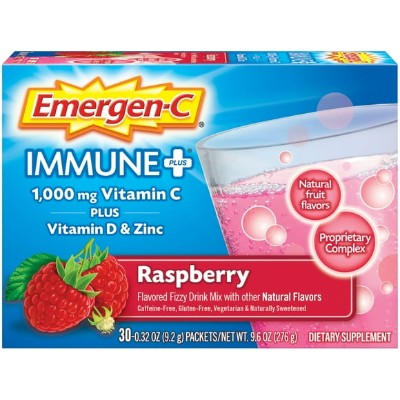

$21.30 $0.71 per serving

Product analysis
Immune+ Raspberry provides vitamins and minerals for normal immune function and energy use when dietary intake is low. Unnamed blend components make the contribution of its added extras harder to judge.
AI assessment of the formula, label and price. How scoring works
Nutrient Quality39
Many ingredient forms are named, but a special quality or absorption advantage is uncertain. The potassium mixture includes forms with differing quality and undisclosed proportions.
Ingredient Transparency76
Amounts and most ingredient forms are stated. Missing blend details and mixture proportions make precise comparisons difficult.
Value For Money41
Value varies across the formula, with a favorable serving-price comparison for potassium but relatively costly vitamin C. The value contributed by many other ingredients remains uncertain.
Customer Satisfaction85
Customer feedback is positive across several thousand ratings. That provides a broad picture of satisfaction without demonstrating stronger immunity.
Product Focus18
The nutrient mixture has a nutritional basis for immune support and normal energy use. Its unnamed extras do not establish a more predictable immune benefit.
- Format
Powder - Container
- 30 Packet(s)
- Per serving
- $0.71
- Also available
 Immune+ Raspberry$39.40
- Customer rating
- 4.5 · 8,709 ratings
Goals

Impact
High effect
Magnesium · 53 mgVitamin C · 1000 mgZinc · 10 mgVitamin D · 25 mcg
Vitamin C contributes to normal immune-cell function and has limited regular-use support for modestly shorter colds. Zinc and vitamin D provide nutrients used in normal immune regulation, while B6, B12 and folate can help fill dietary gaps that impair immune-cell function. Arabinogalactan is present, but its individual amount and exact ResistAid identity are unresolved, so the preparation-specific respiratory findings cannot be transferred to it.
How this product is rated for Immunity
Ingredient fit61
Relevant ingredients contribute to the immune goal, while additional actives make the formula less focused on these functions.
Goal fit
Relevant ingredients contribute to the immune goal, while additional actives make the formula less focused on these functions.
Dose adequacy
The relevant amounts contribute partly to the saved comparisons, with unresolved quantities contributing less.
Pathways80
The strongest represented area is the activity of first-response immune cells. The saved findings extend across two immune functions, with the remaining areas less represented.
Depth
The strongest represented area is the activity of first-response immune cells.
Breadth
The saved findings extend across two immune functions, with the remaining areas less represented.
Evidence100
Vitamin C leads the saved evidence finding, with bounded regular-use cold-duration evidence rather than proven infection prevention.
Evidence strength
Vitamin C leads the saved evidence finding, with bounded regular-use cold-duration evidence rather than proven infection prevention.
Studied preparation
The counted preparations match the saved preparation finding; this does not establish superior benefit from particular forms or delivery.
Formulation logic96
The counted ingredients have their relevant partners or contribute independently, and no listed formulation conflict was triggered.
Partner coverage
The counted ingredients can contribute independently or have their relevant partners; an extra combined benefit is not established.
Conflicts
No listed formulation conflict was triggered; this does not establish safety of the whole product.
Effective doses
The unresolved Arabinogalactan amounts fall below the saved minimum comparison; the other counted ingredients reach it.

Impact
Highest effect
Folate · 167 mcg DFEVitamin B12 · 25 mcgVitamin D · 25 mcgMagnesium · 53 mgZinc · 10 mgVitamin C · 1000 mg
B vitamins support normal energy metabolism, and folate with B12 contributes to blood formation and one-carbon metabolism. Vitamin C and zinc provide nutritional support for antioxidant and immune functions. Vitamin D contributes to bone and mineral functions, although that route has lower saved coverage. These are contributions to filling dietary gaps, without established extra benefit when intake is already adequate.
How this product is rated for Everyday Health
Ingredient fit74
The contributing nutrients are focused on general health, with partial amount coverage.
Goal fit
The contributing nutrients are focused on general health, with partial amount coverage.
Dose adequacy
The serving supplies varied nutrient quantities, covering only part of the saved overall amount comparison.
Pathways100
Antioxidant and immune defence is the strongest saved route. Energy metabolism, blood formation, and antioxidant and immune defence meet the saved coverage threshold.
Depth
Antioxidant and immune defence reaches full saved coverage.
Breadth
Energy metabolism, blood formation, and antioxidant and immune defence meet the saved coverage threshold.
Evidence82
Folate leads the saved evidence comparison. The relevant support concerns nutritional availability when intake is low, rather than proven extra benefit above adequacy.
Evidence strength
Folate leads the comparison; this does not establish disease prevention or a benefit probability.
Studied preparation
All ingredients meeting the saved amount threshold also meet its studied-preparation criterion; no superior nutrient form is established.
Formulation logic100
All contributing ingredients meet the saved minimum amount criterion, without missing partners or matched configured conflicts.
Partner coverage
No contributing ingredient lacks a required partner.
Conflicts
No configured ingredient conflict was matched.
Effective doses
All contributing ingredients meet the saved amount threshold; it does not establish an individual requirement or clinical benefit.

Impact
High effect
Vitamin D · 25 mcgVitamin C · 1000 mg
Vitamin C contributes antioxidant activity, but its inflammation findings depend on baseline context. A large trial was null overall, with a CRP reduction confined to people starting with elevated CRP. That subgroup result does not establish a routine anti-inflammatory effect, and buffered forms do not establish an extra advantage. Zinc and magnesium may help low-status inflammation when an intake gap is corrected. Vitamin D has mixed and sometimes transient inflammatory-marker findings.
How this product is rated for Inflammation
Ingredient fit52
Vitamin C provides the main relevant connection. The amount findings are partial rather than a confirmed clinical dose.
Goal fit
Vitamin C supplies the main relevant ingredient connection.
Dose adequacy
Known eligible amounts receive partial comparison recognition; unresolved amounts cannot establish an additional dose contribution.
Pathways55
The strongest retained connection concerns oxidative and mitochondrial stress; this identifies a pathway link rather than proven clinical relief.
Depth
The strongest retained connection concerns oxidative and mitochondrial stress; this identifies a pathway link rather than proven clinical relief.
Breadth
One pathway reaches the saved coverage threshold; broader coverage is not established.
Evidence93
Vitamin D supplies the strongest retained evidence connection, although sustained inflammatory benefit remains unestablished.
Evidence strength
Vitamin D supplies the strongest retained evidence connection, although sustained inflammatory benefit remains unestablished.
Studied preparation
Eligible material meets the saved preparation criteria; this does not establish clinical benefit from the exact product.
Formulation logic100
No unmet required partner or configured conflict was identified. Meeting amount criteria does not establish added benefit from combining ingredients.
Partner coverage
No unmet required partner was identified for the retained ingredients; their combination does not establish extra benefit.
Conflicts
No configured ingredient conflict was identified in the supplied findings.
Effective doses
Eligible ingredients meet the saved amount threshold; this is not proof of an effective treatment dose.

Impact
Moderate effect
Zinc · 10 mgVitamin C · 1000 mg
Vitamin C supports normal collagen formation and wound healing. Added vitamin C is most useful for skin when intake is inadequate; larger amounts do not reliably improve already well-nourished skin. Zinc at 10 mg and B6 add nutritional support for normal skin maintenance; the other B-vitamin amounts contribute more modestly.
How this product is rated for Skin Health
Ingredient fit56
Relevant nutrients support normal skin functions, with varying emphasis on skin compared with other goals. The ingredients counted for amount coverage provide partial support against their saved references.
Goal fit
Relevant nutrients support normal skin functions, with varying emphasis on skin compared with other goals.
Dose adequacy
The ingredients counted for amount coverage provide partial support against their saved references.
Pathways0
The saved findings concern nutrient sufficiency, with no substantial direct coverage of skin structure, hydration, barrier lipids or antioxidant routes.
Depth
The saved findings concern nutrient sufficiency, with no substantial direct coverage of skin structure, hydration, barrier lipids or antioxidant routes.
Breadth
No skin route reaches the saved level for broad coverage.
Evidence100
The evidence mainly supports normal nutrient functions and correcting inadequate intake; added cosmetic benefit in well-nourished people is less certain.
Evidence strength
Vitamin C supplies the strongest saved evidence among the assessed ingredients. The evidence mainly supports normal nutrient functions and correcting inadequate intake; added cosmetic benefit in well-nourished people is less certain.
Studied preparation
The preparations counted at useful amounts are recognized in the saved review.
Formulation logic100
The assessed ingredients have no missing required partner or configured ingredient conflict.
Partner coverage
The assessed ingredients work independently or have their required partner.
Conflicts
No configured ingredient conflict was found in the supplied facts.
Effective doses
All ingredients counted for this finding meet the saved minimum amount.

Impact
Moderate effect
Zinc · 10 mgVitamin C · 1000 mg
Riboflavin matters most here when intake is low, because a shortage can cause eye problems. Prolonged severe deficiency can also contribute to cataracts. Correcting that problem differs from expecting better vision when you already get enough. Other nutrients in the mixture don't make routine visual improvement a predictable result.
How this product is rated for Eye Health
Ingredient fit52
Low riboflavin can cause eye problems, so correcting low intake is distinct from improving already adequate vision.
Goal fit
Low riboflavin can cause eye problems, so correcting low intake is distinct from improving already adequate vision.
Dose adequacy
The serving supplies 10 mg of zinc; that amount alone doesn't predict improved vision.
Pathways47
The ingredient connection with eye function does not mean standalone supplementation improves everyday vision.
Depth
The ingredient connection with eye function does not mean standalone supplementation improves everyday vision.
Breadth
The mixture does not demonstrate broad improvements across several aspects of everyday vision.
Evidence68
Low riboflavin can cause eye problems, so correcting low intake is distinct from improving already adequate vision. The result depends on the ingredient and the circumstances of use.
Evidence strength
Low riboflavin can cause eye problems, so correcting low intake is distinct from improving already adequate vision.
Studied preparation
The declared nutrient form identifies the ingredient, without guaranteeing the benefits of a complete disease-specific combination.
Formulation logic100
The individual ingredients have no identified missing partner or particular conflict.
Partner coverage
No required ingredient partner is missing for the individual contribution described here.
Conflicts
No particular ingredient conflict is identified here.
Effective doses
The serving supplies 10 mg of zinc; that amount alone doesn't predict improved vision.

Impact
Moderate effect
Magnesium · 53 mgVitamin B12 · 25 mcgVitamin B6 · 10 mgFolate · 167 mcg DFEVitamin D · 25 mcg
Vitamin B6, folate and vitamin B12 participate in normal homocysteine metabolism. Lowering this blood marker has not generally translated into fewer major heart events.
Potassium at 200 mg and magnesium at 53 mg add limited support for electrolyte and blood-vessel function, with effects depending on overall intake and baseline blood pressure.
How this product is rated for Heart Health
Ingredient fit55
Heart-related ingredients sit alongside ingredients aimed at other health goals. The assessed amounts provide partial and uneven coverage of the saved comparison references.
Goal fit
Heart-related ingredients sit alongside ingredients aimed at other health goals.
Dose adequacy
The assessed amounts provide partial and uneven coverage of the saved comparison references.
Pathways19
The strongest assessed connection is to homocysteine metabolism, a marker-related function rather than a demonstrated reduction in heart events. The saved findings show limited coverage across the assessed heart-related processes.
Depth
The strongest assessed connection is to homocysteine metabolism, a marker-related function rather than a demonstrated reduction in heart events.
Breadth
The saved findings show limited coverage across the assessed heart-related processes.
Evidence87
Vitamin B6 provides the strongest evidence contribution among the assessed ingredients, within the supplied evidence's limits. The assessed ingredients match the preparation categories used in the saved review.
Evidence strength
Vitamin B6 provides the strongest evidence contribution among the assessed ingredients, within the supplied evidence's limits.
Studied preparation
The assessed ingredients match the preparation categories used in the saved review.
Formulation logic100
The assessed ingredients can contribute individually or have their required companion present. No configured ingredient conflict was identified in the supplied assessment. All ingredients counted in this finding meet the saved minimum amount threshold.
Partner coverage
The assessed ingredients can contribute individually or have their required companion present.
Conflicts
No configured ingredient conflict was identified in the supplied assessment.
Effective doses
All ingredients counted in this finding meet the saved minimum amount threshold.
Ingredients
| Ingredient | Amount per serving | Score |
|---|---|---|
Calories | 35 Calorie(s) | |
Total Carbohydrates | 8 Gram(s) | |
Vitamin C (Ascorbic Acid, Zinc Ascorbate) | 1000 mg | |
Vitamin D3 (Cholecalciferol) | 25 mcg | |
Thiamine (Thiamine Hydrochloride) | 0.36 mg | |
Riboflavin (Riboflavin 5-Phosphate) | 0.39 mg | |
Niacin (Vitamin B3) | 4.5 mg | |
Vitamin B6 (Pyridoxine Hydrochloride) | 10 mg | |
Folate (Vitamin B9) | 167 mcg DFE | |
Vitamin B12 (Cyanocobalamin) | 25 mcg | |
Pantothenic Acid (Calcium Pantothenate, Vitamin B5) | 2.5 mg | |
Calcium (Calcium Carbonate, Calcium Pantothenate, Monobasic Calcium Phosphate, Tribasic Calcium Phosphate) | 50 mg | |
Phosphorus (Monobasic Calcium Phosphate, Monobasic Potassium Phosphate, Monobasic Sodium Phosphate, Tribasic Calcium Phosphate) | 38 mg | |
Magnesium (Magnesium Carbonate, Magnesium Hydroxide) | 53 mg | |
Zinc (Zinc Ascorbate) | 10 mg | |
Manganese (Manganese Gluconate) | 0.5 mg | |
Chromium (Chromium Picolinate) | 10 mcg | |
Sodium (Arabinogalactan, Monobasic Sodium Phosphate, Sodium Bicarbonate) | 70 mg | |
Potassium (Monobasic Potassium Phosphate, Potassium Bicarbonate, Potassium Carbonate) | 200 mg | |
Proprietary Complex | 500 mg |
Potassium (Monobasic Potassium Phosphate, Potassium Bicarbonate, Potassium Carbonate) · 200 mg OverallScore60
Each serving provides 200 mg of potassium, a moderate amount in this comparison. Several potassium forms are listed, but their proportions are unknown.
How this ingredient is rated
Active Ingredient Quality & Bioavailability36
The listed forms are monopotassium phosphate, potassium bicarbonate, and potassium carbonate; their proportions are not disclosed.
Potassium Form Quality
Monopotassium phosphate, potassium bicarbonate, and potassium carbonate are listed, but their shares of the potassium amount are unknown.
Dose, Safety & Label Transparency64
The saved facts give 200 mg of potassium per serving.
Potassium Dosage Potency
The 200 mg per serving is a moderate amount in the comparison.
Elemental Yield Transparency
The saved facts state 200 mg of potassium but do not include explicit elemental-potassium wording.
Value100
A whole-product serving costs about $0.71 and contains 200 mg of potassium.
Potassium Value Efficiency
The whole-product serving costs about $0.71, relatively low in the price comparison.
Vitamin C (Ascorbic Acid, Zinc Ascorbate) · 1000 mg OverallScore44
Each serving provides 1000 mg of vitamin C as zinc ascorbate. The other ingredients include a sweetener, and the full product price works out to about $0.71 per gram of vitamin C.
How this ingredient is rated
Active Ingredient Quality & Bioavailability30
Zinc ascorbate is the named vitamin C source; the evaluation does not establish a buffering or special delivery claim.
Vitamin C Chemical Form & Delivery System
Vitamin C comes from zinc ascorbate; no special delivery system is established in the saved facts.
Gastric Comfort & pH Balance
The saved facts do not establish that the vitamin C is buffered or stomach-friendly.
Dose, Safety & Label Transparency71
Each serving provides 1000 mg of vitamin C. The evaluation identified a sweetener in the other ingredients.
Optimal Dosage Targeting
Each serving provides 1000 mg of vitamin C.
Purity & Excipient Quality
The evaluated other-ingredient panel contains a sweetener.
Mineral & Source Transparency
The vitamin C amount and zinc ascorbate source are known, though that source falls outside the evaluated matching-mineral disclosure cases.
Value20
The full product price is about $0.71 per gram of vitamin C.
Price per Gram of Vitamin C
The full product price is about $0.71 per gram of vitamin C.
Alternative products
Report alternatives
Sources
Published studies used for the product analysis and the top-ranked studies for each ingredient and goal.
- Intakes of Folate, Vitamin B6, and Vitamin B12 in Relation to All-Cause and Cause-Specific Mortality: A National Population-Based Cohort.
- The responsiveness of plasma homocysteine to small increases in dietary folic acid: a primary care study.
- Associations of Serum Folate and Homocysteine Concentrations with All-Cause, Cardiovascular Disease, and Cancer Mortality in Men and Women in Korea: the Cardiovascular Disease Association Study.
- The concept of folic acid supplementation and its role in prevention of neural tube defect among pregnant women: PRISMA.
- Systematic review of adverse health outcomes associated with high serum or red blood cell folate concentrations.
- Perioperative systemic magnesium to minimize postoperative pain: a meta-analysis of randomized controlled trials.
- Long-term outcome after intravenous magnesium sulphate in suspected acute myocardial infarction: the second Leicester Intravenous Magnesium Intervention Trial (LIMIT-2).
- Association of magnesium sulfate use with mortality in critically ill patients with sepsis: a retrospective propensity score-matched cohort study.
- Hypomagnesemia and Mortality in Incident Hemodialysis Patients.
- The effects of magnesium supplementation on abnormal uterine bleeding, alopecia, quality of life, and acne in women with polycystic ovary syndrome: a randomized clinical trial.
- Oral Vitamin B12 versus Placebo for the Prevention of Chemotherapy-Induced Peripheral Neuropathy in Gynecological Cancer Patients: A Randomized, Double-Blind, Placebo-Controlled Trial.
- Vitamin B12 Supplementation in Diabetic Neuropathy: A 1-Year, Randomized, Double-Blind, Placebo-Controlled Trial.
- A single-center randomized controlled trial of local methylcobalamin injection for subacute herpetic neuralgia.
- Local Injection of Methylcobalamin Combined with Lidocaine for Acute Herpetic Neuralgia.
- The Effect of Vitamin B12 and Folic Acid Supplementation on Serum Homocysteine, Anemia Status and Quality of Life of Patients with Multiple Sclerosis.
- Dietary intake and blood concentrations of antioxidants and the risk of cardiovascular disease, total cancer, and all-cause mortality: a systematic review and dose-response meta-analysis of prospective studies.
- Scientific Opinion on the substantiation of a health claim related to vitamin C and increasing non haem iron absorption pursuant to Article 14 of Regulation (EC) No 1924/2006.
- Vitamin C Depletion and All-Cause Mortality in Renal Transplant Recipients.
- Associations of Serum Biomarkers of Fruit and Vegetable Intake With the Risk of Cause-Specific Mortality and All-Cause Mortality: A National Prospective Cohort Study.
- Relation between plasma ascorbic acid and mortality in men and women in EPIC-Norfolk prospective study: a prospective population study. European Prospective Investigation into Cancer and Nutrition.