
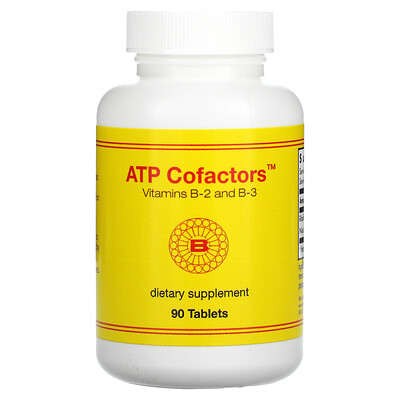

$34.99 $0.38 per serving


Product analysis
ATP Cofactors offers reasonable value for its B-vitamin combination, but a cardiovascular benefit from its particular niacin preparation is not established.
AI assessment of the formula, label and price. How scoring works
Nutrient Quality60
The niacin preparation is clearly identified, while the riboflavin form is less clearly disclosed. Naming the niacin form helps distinguish it from preparations with different effects.
Ingredient Transparency81
Ingredient amounts are disclosed and some forms are identified. Unspecified forms still limit like-for-like comparisons.
Value For Money70
The riboflavin comparison is competitive and the niacin comparison is reasonable. Together they support fair value for the ingredients provided.
Customer Satisfaction84
Customer feedback is strongly positive. A large review pool gives a broad view of satisfaction, though reviews do not establish health benefits.
Product Focus0
The formula is simple, but support for the cardiovascular purpose considered here is not established. That uncertainty does not show that the ingredients are clinically ineffective.
- Format
Tablet - Container
- 90 Tablet(s)
- Per serving
- $0.38
- Customer rating
- 4.8 · 1,123 ratings
Goals

Impact
Limited evidence
Niacin · 500 mg
ATP Cofactors lists 500 mg of inositol hexanicotinate under niacin, but this preparation has no credited contribution to the cardiovascular markers considered here. Riboflavin is also listed, yet no target pathway receives support from a credited ingredient. That lack of credited support does not establish that the preparation is clinically ineffective.
How this product is rated for Cardiovascular Support
Ingredient fit28
Niacin is listed, but its inositol hexanicotinate preparation receives no cardiovascular contribution; riboflavin is an additional active.
Goal fit
The listed ingredients have links to other goals, while this preparation is not credited for cardiovascular focus.
Dose adequacy
Although 500 mg is declared, no cardiovascular dose contribution is credited to this preparation.
Pathways0
No target cardiovascular pathway receives support from a credited ingredient.
Depth
No pathway is supported by a credited ingredient.
Breadth
None of the three target pathways reaches the coverage level.
Evidence0
The supplied facts identify no credited ingredient at an effective dose or in a studied preparation for this goal.
Evidence strength
No credited ingredient reaches an effective dose for the goal markers.
Studied preparation
No credited ingredient is at an effective dose in a studied preparation for this goal.
Formulation logic35
No cardiovascular contributor is credited, though no ingredient conflict is flagged.
Partner coverage
No cardiovascular ingredient is credited, so no standalone contributor or needed partner is represented.
Conflicts
No ingredient combination is flagged as conflicting for this goal.
Effective doses
There is no credited cardiovascular ingredient to which the effective-dose threshold applies.

Impact
Limited evidence
Ingredients
| Ingredient | Amount per serving | Score |
|---|---|---|
Riboflavin | 100 mg | |
Niacin (Inositol Hexanicotinate) | 500 mg |
Niacin (Inositol Hexanicotinate) · 500 mg OverallScore62
Each serving supplies 500 mg of niacin as inositol hexanicotinate. The whole-product serving costs about $0.39.
How this ingredient is rated
Active Ingredient Quality & Bioavailability57
The niacin source is inositol hexanicotinate, a distinct form of niacin.
Niacin Form & Goal Alignment
Inositol hexanicotinate is the identified niacin form.
Precursor Source Quality
The identified source is inositol hexanicotinate.
Dose, Safety & Label Transparency67
The serving lists 500 mg of niacin as inositol hexanicotinate. Inositol hexanicotinate is generally associated with less flushing; no no-flush claim is identified in the saved facts.
Clarity of Chemical Form
The niacin form is identified as inositol hexanicotinate.
Form-Specific Dosage Efficacy
The serving lists 500 mg of niacin.
Flush Risk & Safety Labeling
Inositol hexanicotinate is generally associated with less flushing; no no-flush claim is identified in the saved facts.
Value60
A whole-product serving costs about $0.39; the price covers the full product.
Price Per Effective Serving
A whole-product serving costs about $0.39; the price covers the full product.
Riboflavin · 100 mg OverallScore68
Each serving provides 100 mg of standard riboflavin, a high amount in the evaluation. A whole-product serving costs about $0.39.
How this ingredient is rated
Active Ingredient Quality & Bioavailability30
Standard riboflavin must be converted into active forms in the body.
Riboflavin Form Quality
Standard riboflavin must be converted into active forms in the body.
Dose, Safety & Label Transparency100
The serving provides 100 mg of riboflavin, a high amount in the evaluation. The phosphate-yield distinction does not apply to this form.
Dosage for Energy & Metabolism
The serving provides 100 mg of riboflavin, a high amount in the evaluation.
R5P Elemental Yield Transparency
The phosphate-yield distinction does not apply to standard riboflavin.
Additive Purity
No artificial colors, flavors or synthetic sweeteners were flagged in the available ingredient information.
Value80
A whole-product serving costs about $0.39.
Price per Serving Value
A whole-product serving costs about $0.39.
Alternative products
Report alternatives
Sources
Published studies used for the product analysis and the top-ranked studies for each ingredient and goal.
- The current state of niacin in cardiovascular disease prevention: a systematic review and meta-regression.
- Effects of niacin on apo A1 and B levels: a systematic review and meta-analysis of randomised controlled trials.
- Effect of lipid-lowering therapies on lipoprotein(a) levels: a comprehensive meta-analysis of randomized controlled trials.
- Extended-release niacin vs gemfibrozil for the treatment of low levels of high-density lipoprotein cholesterol. Niaspan-Gemfibrozil Study Group.
- Equivalent efficacy of a time-release form of niacin (Niaspan) given once-a-night versus plain niacin in the management of hyperlipidemia.
- Differential effect of two nicotinic acid preparations on low-density lipoprotein subclass distribution in patients classified as low-density lipoprotein pattern A, B, or I.
- The ARBITER 6-HALTS Trial (Arterial Biology for the Investigation of the Treatment Effects of Reducing Cholesterol 6-HDL and LDL Treatment Strategies in Atherosclerosis): final results and the impact of medication adherence, dose, and treatment duration.
- The effects of extended-release niacin on carotid intimal media thickness, endothelial function and inflammatory markers in patients with the metabolic syndrome.
- Effect of niacin therapy on cardiovascular outcomes in patients with coronary artery disease.
- Effect of niacin on endothelial function: a systematic review and meta-analysis of randomized controlled trials.