
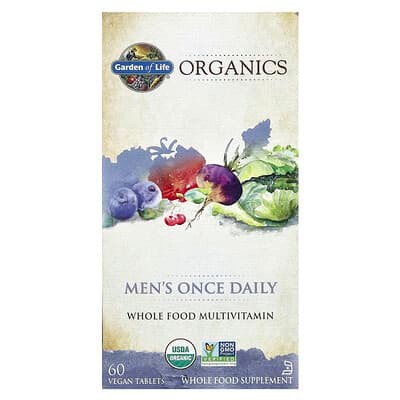
Men's Once Daily

Goals


Product analysis
Men's Once Daily may help fill everyday nutrient gaps and support normal energy and immune functions. Its blends do not disclose all component details, making their added contribution difficult to judge.
AI assessment of the formula, label and price. How scoring works
Nutrient Quality34
Food and yeast source descriptions do not establish superior nutrient quality. Vitamin K and selenium lack clear form identities, while much of the remaining form quality is uncertain.
Ingredient Transparency78
All listed amounts and nearly all source descriptions are disclosed. The blend components and some source proportions remain unclear, limiting a detailed comparison.
Value For Money40
Vitamin K is affordable at the serving cost, but the selenium portion is expensive for its amount. Value for most other nutrients is uncertain, so the food-blend description does not establish a price advantage.
Customer Satisfaction92
Customer ratings are very positive across thousands of reviews. The broad feedback reflects satisfaction without proving the nutritional benefits of the food blends.
Product Focus22
The nutrients may support everyday health and immune function when they fill dietary gaps. The unspecified blend makes the contribution of every active ingredient harder to establish.
- Format
Tablet - Container
- 60 Tablet(s)
- Per serving
- $0.58
- Also available
 Men's Once Daily$23.79
- Customer rating
- 4.8 · 6,419 ratings
Goals

Impact
Highest effect
Folate · 400 mcg DFEVitamin B12 · 7.2 mcgVitamin D · 25 mcgVitamin K · 120 mcgSelenium · 55 mcgZinc · 3.9 mgVitamin C · 90 mg

Impact
High effect
Vitamin C · 90 mgZinc · 3.9 mgVitamin A · 900 mcgVitamin D · 25 mcgSelenium · 55 mcg

Impact
High effect
Folate · 400 mcg DFEVitamin B12 · 7.2 mcgVitamin K · 120 mcgVitamin D · 25 mcg

Impact
High effect
Vitamin K · 120 mcgVitamin B12 · 7.2 mcgVitamin B6 · 8.5 mgFolate · 400 mcg DFEVitamin D · 25 mcg

Impact
Moderate effect
Vitamin K · 120 mcgVitamin D · 25 mcgSelenium · 55 mcgVitamin B12 · 7.2 mcgVitamin B6 · 8.5 mgVitamin E · 15 mgFolate · 400 mcg DFENiacin · 18.4 mgVitamin C · 90 mg
Ingredients
| Ingredient | Amount per serving | Score |
|---|---|---|
Vitamin A (Beta-Carotene, Organic Food Blend) | 900 mcg | |
Vitamin C (Organic Food Blend) | 90 mg | |
Vitamin D (D3) | 25 mcg | |
Vitamin E (Organic Food Blend) | 15 mg | |
Vitamin K (Saccharomyces cerevisiae) | 120 mcg | |
Thiamin (Organic Food Blend) | 1.38 mg | |
Riboflavin (Organic Food Blend) | 1.5 mg | |
Niacin (Organic Food Blend) | 18.4 mg | |
Vitamin B6 (Organic Food Blend) | 8.5 mg | |
Folate (Organic Food Blend) | 400 mcg DFE | |
Vitamin B12 (Methylcobalamin, Saccharomyces cerevisiae) | 7.2 mcg | |
Biotin (Organic Food Blend) | 120 mcg | |
Pantothenic Acid (Organic Food Blend) | 5 mg | |
Zinc (Organic Food Blend) | 3.9 mg | |
Selenium (Organic Food Blend) | 55 mcg | |
Manganese (Organic Food Blend) | 0.8 mg | |
Chromium (Organic Food Blend) | 35 mcg | |
Organic Food Blend | 587 mg |
Selenium (Organic Food Blend) · 55 mcg OverallScore30
55 mcg of selenium per serving contributes to daily intake. The cost is high relative to the selenium supplied. The selenium form is unspecified.
How this ingredient is rated
Active Ingredient Quality & Bioavailability0
The selenium form is unspecified. Its absorption cannot be determined from the form.
Selenium Chemical Form
The selenium form is unspecified.
Form Transparency & Isomer Specificity
Without the chemical form, its identity and absorption are unclear.
Dose, Safety & Label Transparency70
55 mcg of selenium per serving contributes to daily intake. The 55 mcg serving is below the 400 mcg adult upper limit, leaving room for selenium from food.
Dosage Efficacy Sweet Spot
55 mcg of selenium per serving contributes to daily intake.
Safety Margin & UL Adherence
The 55 mcg serving is below the 400 mcg adult upper limit, leaving room for selenium from food.
Value10
The cost is high relative to the selenium supplied.
Price per 200 mcg Serving
The cost is high relative to the selenium supplied.
Vitamin K (Saccharomyces cerevisiae) · 120 mcg OverallScore20
Alternative products
Report alternatives
Sources
Published studies used for the product analysis and the top-ranked studies for each ingredient and goal.
- Associations of dietary folate, vitamin B6 and B12 intake with cardiovascular outcomes in 115664 participants: a large UK population-based cohort.
- Folate, Homocysteine, and Adverse Outcomes After Ischemic Stroke.
- Effect of folic acid on endothelial function following acute myocardial infarction.
- Folic acid enhances endothelial function and reduces blood pressure in smokers: a randomized controlled trial.
- 5-methyltetrahydrofolate, the active form of folic acid, restores endothelial function in familial hypercholesterolemia.
- The current state of niacin in cardiovascular disease prevention: a systematic review and meta-regression.
- Effects of niacin on apo A1 and B levels: a systematic review and meta-analysis of randomised controlled trials.
- Effect of lipid-lowering therapies on lipoprotein(a) levels: a comprehensive meta-analysis of randomized controlled trials.
- Extended-release niacin vs gemfibrozil for the treatment of low levels of high-density lipoprotein cholesterol. Niaspan-Gemfibrozil Study Group.
- Equivalent efficacy of a time-release form of niacin (Niaspan) given once-a-night versus plain niacin in the management of hyperlipidemia.
- Effect of supplementation with high-selenium yeast on plasma lipids: a randomized trial.
- Association of selenium and cadmium with heart failure and mortality based on the National Health and Nutrition Examination Survey.
- Higher serum selenium concentration is associated with lower risk of all-cause and cardiovascular mortality among individuals with chronic kidney disease: A population-based cohort study of NHANES.
- Selenium status in the body and cardiovascular disease: a systematic review and meta-analysis.
- Associations of selenium status with all-cause and cause-specific mortality: a systematic review and meta-analysis of cohort studies.
- Vitamin B12 Status and Cardiovascular Risk: Novel Insights from NMR-Based Lipoprotein Profiling in 20,665 Adults.
- Pregnancy Metal Mixtures and Blood Pressure and Hypertension in Mid-Life: A Prospective U.S. Cohort Study.
- Vitamin B12 Deficiency, Hyperhomocysteinemia, and Diabetes as Metabolic Determinants of Cardiovascular Risk in Mexican Women.
- Impact of serum vitamin (Vitamin D, Vitamin B12) and trace element (Fe, Zn, Cu) levels on major adverse cardiovascular events and poor prognosis in STEMI patients undergoing primary PCI.
- Vasoplegic syndrome after cardiovascular surgery: A review of pathophysiology and outcome-oriented therapeutic management.