
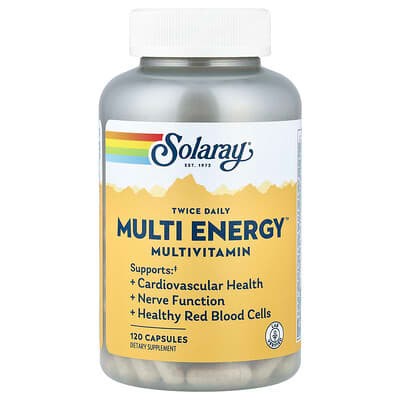
Twice Daily Multi Energy Multi-Vita-Min

Goals
$31.79 $0.52 per serving


Product analysis
Twice Daily Multi Energy Multi-Vita-Min may help fill nutritional gaps relevant to normal skin maintenance. Undisclosed proportions within several combined sources make precise ingredient comparisons harder.
AI assessment of the formula, label and price. How scoring works
Nutrient Quality39
The natural vitamin E form is a favorable feature, and the boron forms are reasonable choices. Quality for most other ingredients remains uncertain, despite many forms being named.
Ingredient Transparency77
Ingredient amounts and most forms are disclosed, making much of the label easy to check. Most combined sources omit their proportions, leaving the amount from each source unclear.
Value For Money41
Vitamin A and vitamin E offer reasonably favorable value. Boron and PABA are less economical, while uncertainty for most other ingredients prevents a clear value conclusion for the whole formula.
Customer Satisfaction72
Customer ratings are very positive, but come from a small number of buyers. The limited feedback makes the satisfaction picture less settled.
Product Focus34
The clearest role is filling nutrient gaps relevant to skin maintenance and normal body functions. The heart and eye associations do not establish general cardiovascular protection or better everyday vision.
- Format
Capsule - Container
- 120 Capsule(s)
- Per serving
- $0.52
- Customer rating
- 4.8 · 26 ratings
Goals

Impact
High effect
Zinc · 15 mgVitamin C · 300 mgCopper · 1 mgSelenium · 100 mcgVitamin E · 200 IU

Impact
Moderate effect
Zinc · 15 mgVitamin E · 200 IUVitamin C · 300 mgCopper · 1 mgVitamin A · 15000 IU

Impact
Moderate effect
Vitamin D · 400 IUVitamin E · 200 IUVitamin C · 300 mg

Impact
Moderate effect
Potassium · 20 mgMagnesium · 100 mgVitamin D · 400 IUSelenium · 100 mcgVitamin B12 · 50 mcgVitamin B6 · 50 mgVitamin E · 200 IUFolate · 400 mcgNiacin · 50 mgVitamin C · 300 mg
Ingredients
| Ingredient | Amount per serving | Score |
|---|---|---|
Vitamin A (Beta-Carotene, Retinyl Palmitate) | 15000 IU | |
Vitamin C (Acerola Cherry, Ascorbic Acid, Rose Hip) | 300 mg | |
Vitamin D (Cholecalciferol, Fish) | 400 IU | |
Vitamin E (D-Alpha-Tocopheryl Succinate) | 200 IU | |
Thiamine (Thiamine Mononitrate) | 50 mg | |
Riboflavin | 50 mg | |
Niacin (Niacinamide) | 50 mg | |
Vitamin B6 (Pyridoxine Hydrochloride) | 50 mg | |
Folate (Folic Acid) | 400 mcg | |
Vitamin B12 (Cyanocobalamin) | 50 mcg | |
Biotin | 300 mcg | |
Pantothenic Acid (Calcium Pantothenate) | 50 mg | |
Calcium (Calcium Amino Acid Chelate, Calcium Carbonate) | 200 mg | |
Iron (Iron Fumarate) | 18 mg | |
Iodine (Kelp, Potassium Iodide) | 225 mcg | |
Magnesium (Magnesium Amino Acid Chelate, Magnesium Oxide) | 100 mg | |
Zinc (Zinc Amino Acid Chelate) | 15 mg | |
Selenium (Selenomethionine) | 100 mcg | |
Copper (Copper Gluconate) | 1 mg | |
Manganese (Manganese Gluconate) | 6 mg | |
Chromium (Chromium Polynicotinate) | 200 mcg | |
Sodium | 5 mg | |
Potassium (Potassium Chloride) | 20 mg | |
PABA | 25 mg | |
Choline Bitartrate | 25 mg | |
Inositol | 25 mg | |
Boron (Boron Aspartate, Boron Citrate, Boron Glycinate, Boron Lysinate) | 1 mg |
PABA · 25 mg OverallScore78
The serving provides 25 mg of PABA, but the whole-product cost relative to that amount is high. No specific purity grade is stated. The Other Ingredients list has no artificial dyes, titanium dioxide, or hydrogenated oils.
How this ingredient is rated
Active Ingredient Quality & Bioavailability80
PABA is named, but a specific purity grade is not stated.
PABA Source & Grade
PABA is named without a specific purity grade.
Dose, Safety & Label Transparency95
The label states 25 mg of PABA per serving. The Other Ingredients list has no artificial dyes, titanium dioxide, or hydrogenated oils.
PABA Dosage Alignment
The serving contains 25 mg of PABA.
Label Disclosure Clarity
The PABA amount is separately stated as 25 mg per serving.
Additive and Excipient Quality
The Other Ingredients list has no artificial dyes, titanium dioxide, or hydrogenated oils.
Value40
The whole-product cost relative to the PABA amount is high.
Price per 100mg PABA
The whole-product cost per 100 mg of PABA is high.
Vitamin E (D-Alpha-Tocopheryl Succinate) · 200 IU OverallScore66
A serving provides 200 IU of vitamin E at a moderate serving price. The form is D-Alpha-Tocopheryl Succinate. No mixed tocopherol complex or tocotrienols are specified.
How this ingredient is rated
Active Ingredient Quality & Bioavailability46
The form is D-Alpha-Tocopheryl Succinate. A mixed tocopherol complex and tocotrienols are not specified.
Natural (d-alpha) vs. Synthetic (dl-alpha)
The form is D-Alpha-Tocopheryl Succinate.
Mixed Tocopherol Isomer Diversity
A mixed tocopherol complex is not specified.
Tocotrienol Complex Inclusion
Tocotrienols are not specified.
Dose, Safety & Label Transparency85
A serving provides 200 IU of vitamin E. The amount and D-Alpha-Tocopheryl Succinate form are stated; individual alpha, gamma and delta amounts are not specified.
Therapeutic Dosage Range
The serving provides 200 IU of vitamin E.
Label Transparency and Isomer Specificity
The amount and D-Alpha-Tocopheryl Succinate form are stated; individual alpha, gamma and delta amounts are not specified.
Value70
The serving price is moderate.
Cost per Natural-Form Therapeutic Serving
The serving price is moderate.
Vitamin A (Beta-Carotene, Retinyl Palmitate) · 15000 IU OverallScore70
Each serving provides 15,000 IU of vitamin A, with a relatively low cost for the amount supplied. It combines natural beta-carotene and retinyl palmitate.
How this ingredient is rated
Active Ingredient Quality & Bioavailability64
It combines natural beta-carotene and retinyl palmitate; retinyl palmitate is preformed vitamin A.
Vitamin A Chemical Form & Source
It combines natural beta-carotene and retinyl palmitate; retinyl palmitate is preformed vitamin A.
Dose, Safety & Label Transparency72
15,000 IU per serving is a high vitamin A amount, including 4,950 IU of preformed vitamin A. The label gives the source split: 67% beta-carotene and 33% retinyl palmitate.
Dosage Efficacy & Safety Thresholds
15,000 IU per serving is a high vitamin A amount, including 4,950 IU of preformed vitamin A.
Label Transparency of Specific Forms
The label gives the source split: 67% beta-carotene and 33% retinyl palmitate.
Value80
The cost for a given amount of vitamin A is relatively low.
Price per 5,000 IU Dose
The cost for a given amount of vitamin A is relatively low.
Alternative products
Report alternatives
Sources
Published studies used for the product analysis and the top-ranked studies for each ingredient and goal.
- Associations of dietary folate, vitamin B6 and B12 intake with cardiovascular outcomes in 115664 participants: a large UK population-based cohort.
- Folate, Homocysteine, and Adverse Outcomes After Ischemic Stroke.
- Effect of folic acid on endothelial function following acute myocardial infarction.
- Folic acid enhances endothelial function and reduces blood pressure in smokers: a randomized controlled trial.
- 5-methyltetrahydrofolate, the active form of folic acid, restores endothelial function in familial hypercholesterolemia.
- Circulating and dietary magnesium and risk of cardiovascular disease: a systematic review and meta-analysis of prospective studies.
- Magnesium and the risk of cardiovascular events: a meta-analysis of prospective cohort studies.
- Quantitative Association Between Serum/Dietary Magnesium and Cardiovascular Disease/Coronary Heart Disease Risk: A Dose-Response Meta-analysis of Prospective Cohort Studies.
- Comparative Efficacy of Nutraceuticals on Endothelial Function: A Systematic Review and Network Meta-Analysis.
- Serum magnesium, mortality, and cardiovascular disease in chronic kidney disease and end-stage renal disease patients: a systematic review and meta-analysis.
- The current state of niacin in cardiovascular disease prevention: a systematic review and meta-regression.
- Effects of niacin on apo A1 and B levels: a systematic review and meta-analysis of randomised controlled trials.
- Effect of lipid-lowering therapies on lipoprotein(a) levels: a comprehensive meta-analysis of randomized controlled trials.
- Extended-release niacin vs gemfibrozil for the treatment of low levels of high-density lipoprotein cholesterol. Niaspan-Gemfibrozil Study Group.
- Equivalent efficacy of a time-release form of niacin (Niaspan) given once-a-night versus plain niacin in the management of hyperlipidemia.
- Sex-specific associations between sodium and potassium intake and overall and cause-specific mortality: a large prospective U.S. cohort study, systematic review, and updated meta-analysis of cohort studies.
- Potassium intake, stroke, and cardiovascular disease a meta-analysis of prospective studies.
- Blood pressure response to changes in sodium and potassium intake: a metaregression analysis of randomised trials.
- Twenty-Four-Hour Urinary Sodium and Potassium Excretion and Their Associations With Blood Pressure Among Adults in China: Baseline Survey of Action on Salt China.
- Dietary Sodium and Potassium Intake and Risk of Non-Fatal Cardiovascular Diseases: The Million Veteran Program.