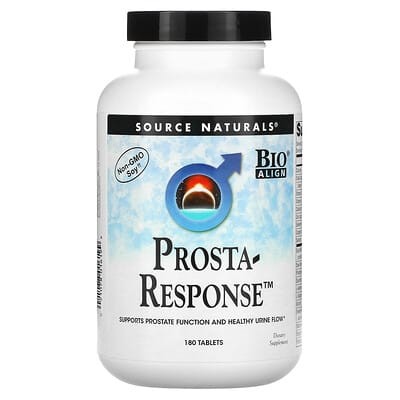
Prosta-Response

Prosta-Response

Source Naturals4.7 (543 ratings)
Format:Tablet Quantity: 180 Tablet(s) · 36 servings
Goals
$47.61 $1.32 per serving

About this product

Normal immune and antioxidant nutrition is the clearest role of the broad blend. Zinc, selenium and vitamin D can help fill shortfalls, while additional benefits for weight, testosterone, hair or everyday vision remain limited when nutrient intake is already adequate.

The stated 28 mg zinc amount comes from citrate and methionine sources, with 1 mg copper also disclosed. The zinc sources have favorable absorption potential, but their proportions are missing, and the selenium blend contains both selenomethionine and sodium selenite. Vitamin D at 63 mcg is a substantial addition to an existing supplement routine.

The plant mix does not establish specific prostate or hair benefits simply by listing many extracts. Saw palmetto is declared at 800 mg without a fatty-acid percentage, and the nettle extract has no stated ratio or marker strength. Small ginger, green tea and amino-acid amounts add limited support, while incomplete preparation details and high cost weaken the case for the complete combination.

Who is it for
  • Adults seeking a broad nutrient and botanical blend after reviewing their existing vitamin D, zinc and selenium intake.
Best for
  • Supporting normal nutrient functions when specific dietary gaps have been identified.

Pros

  • The zinc sources are named and have favorable absorption potential.
  • Zinc and copper quantities are disclosed together.
  • Major plant extract quantities are listed separately.

Cons

  • Saw palmetto fatty-acid content is unknown.
  • Nettle strength and mixed-mineral proportions are not fully disclosed.
  • Small ginger, green tea and amino-acid amounts have limited relevance to the broad intended uses.
  • Plant preparation gaps make targeted benefits difficult to judge.
  • The full combination is costly for several of its individual nutrients and plant ingredients.

Warnings

  • Soy is included, so the blend does not fit someone with a soy allergy.
  • Flower pollen extract may not suit people with a known sensitivity to pollen-derived supplements.
  • The 63 mcg vitamin D, 28 mg zinc and 175 mcg selenium amounts need to be included when checking total intake from overlapping supplements.

Product analysis

44 out of 100

Prosta-Response supplies nutrients that may help fill dietary gaps within a broad botanical blend. Many unspecified forms and weak value for several ingredients make it harder to choose for a targeted purchase.

AI assessment of the formula, label and price. How scoring works

Nutrient Quality32

Zinc uses favorable forms, but selenium combines forms of differing quality without stating their proportions. Copper is incompletely identified, and most botanicals lack enough form detail for a firm quality comparison.

Ingredient Transparency61

Amounts are stated, but most ingredient forms are unspecified. The mixed zinc, selenium and ginkgo sources also omit proportions, leaving their balance unclear.

Value For Money29

Several nutrients and botanicals are expensive at the full serving cost. Many other comparisons remain uncertain, so the broad list does not establish good value.

Customer Satisfaction77

Customer feedback is very positive across several hundred ratings. The feedback describes satisfaction without establishing benefits across the formula’s many purposes.

Product Focus36

The clearest supported roles involve normal nutrient functions when intake is low. The wide ingredient mix and many goals make the formula difficult to judge as a targeted supplement.

Format
Tablet
Container
180 Tablet(s)
Per serving
$1.32
Customer rating
4.7 · 543 ratings
Report analysis

Goals

Immunity
Impact
Highest effect
C Ingredient FitA+ PathwaysA+ EvidenceA+ Formulation Logic
Zinc · 28 mgVitamin D · 63 mcgSelenium · 175 mcg

Zinc, Selenium and Vitamin D contribute to normal immune function when intake is low. Copper provides further nutritional support when low intake impairs immune-cell function.

How this product is rated for Immunity

Ingredient fit63

Zinc is a principal relevant ingredient. Declared amounts provide partial contributions, with smaller or unresolved quantities limiting the amount comparison.
Goal fit
Relevant ingredients share the formula with other actives, making its focus on this goal less concentrated.
Dose adequacy
Most relevant amounts make substantial contributions, with some below their supplied comparison endpoints.

Pathways100

The strongest represented area is lymphocyte function and immune regulation, with substantial coverage. 3 areas reach substantial coverage, representing several aspects of the goal.
Depth
The strongest represented area is lymphocyte function and immune regulation, with substantial coverage.
Breadth
3 areas reach substantial coverage, representing several aspects of the goal.

Evidence100

Zinc anchors the saved findings. Nutritional or regular-use findings support bounded expectations rather than a promise to prevent infection.
Evidence strength
Zinc provides the strongest contribution in the saved findings; this does not establish infection prevention or benefits above adequate nutritional intake.
Studied preparation
The relevant ingredients meet the supplied preparation criteria, without establishing superiority of individual forms.

Formulation logic100

The relevant ingredients have no unmet partner requirement or triggered conflict. Their amounts meet the supplied minimum comparison level.
Partner coverage
The relevant ingredients can contribute independently or have their required partner present; no added combination benefit is established.
Conflicts
None of the evaluated ingredient conflicts was triggered.
Effective doses
The relevant amounts meet the supplied minimum comparison level; this is not a guaranteed clinical response threshold.
Study evidence
Ginger Not classified

No linked studies yet.
Green Tea Not classified 2 studies
Selenium Mixed 37 studies
Vitamin D Supportive 85 studies
Vitamin E Supportive 21 studies
Zinc Supportive 73 studies
Longevity
Impact
High effect
C Ingredient FitC PathwaysB+ EvidenceA+ Formulation Logic
Vitamin D · 63 mcgGreen Tea · 15 mgGlycine · 150 mg

Vitamin D helps preserve muscle function when deficiency causes weakness; supplementation has not shown the same benefit in vitamin D-replete adults.

How this product is rated for Longevity

Ingredient fit60

The formula covers broader nutritional or product purposes, so only part of its ingredient mix relates to the assessed aging roles. Amount support is partial.
Goal fit
The formula covers broader nutritional or product purposes, so only part of its ingredient mix relates to the assessed aging roles.
Dose adequacy
Included amounts only partly meet the saved amount criteria; small or unknown quantities limit the findings without establishing ineffectiveness.

Pathways60

The main saved connection is antioxidant defence. Coverage is concentrated in one pathway rather than spread broadly.
Depth
The strongest saved connection is antioxidant defence; this describes an ingredient role rather than a demonstrated slowing of aging.
Breadth
Only one assessed pathway met the saved coverage requirement, so the findings do not indicate broad coverage of aging-related functions.

Evidence83

Vitamin D supplies the strongest included evidence in the saved findings; the supplied scientific context limits transfer to routine anti-aging use.
Evidence strength
Vitamin D supplies the strongest included evidence in the saved findings; the supplied scientific context limits transfer to routine anti-aging use.
Studied preparation
The saved findings recognize the included preparations as studied; this does not establish benefit for the finished product.

Formulation logic100

No required ingredient partner was missing in the saved findings; this does not establish a combined anti-aging benefit. No configured ingredient conflict was identified in the supplied findings.
Partner coverage
No required ingredient partner was missing in the saved findings; this does not establish a combined anti-aging benefit.
Conflicts
No configured ingredient conflict was identified in the supplied findings.
Effective doses
All counted ingredients meet the saved minimum amount criterion; this is not a proven minimum effective anti-aging dose.
Study evidence
Glycine Mixed 14 studies
Green Tea Supportive 9 studies
Lycopene Supportive 11 studies
Selenium Supportive 27 studies
Vitamin D Supportive 50 studies
Vitamin E Supportive 19 studies
Zinc Supportive 10 studies
Impact
High effect
D+ Ingredient FitB+ PathwaysA- EvidenceA+ Formulation Logic
Zinc · 28 mgVitamin E · 147 mgCopper · 1 mg

Zinc has a normal visual-cycle role. Copper contributes a formulation role alongside zinc, rather than an established independent vision improvement. The supplied AREDS findings apply to defined combinations in selected AMD populations, so they do not establish routine vision improvement from these nutrients.

How this product is rated for Eye Health

Ingredient fit55

The counted eye-related nutrients sit within a formula that also serves broader nutritional purposes.
Goal fit
The counted eye-related nutrients sit within a formula that also serves broader nutritional purposes.
Dose adequacy
The counted nutrients receive a mixture of full and partial amount recognition; some declared ingredients fall below the cutoff.

Pathways80

The strongest saved coverage concerns retinal and lens antioxidant roles. Coverage is concentrated in retinal and lens antioxidant roles and photoreceptor structure and the visual cycle.
Depth
The strongest saved coverage concerns retinal and lens antioxidant roles.
Breadth
Coverage is concentrated in retinal and lens antioxidant roles and photoreceptor structure and the visual cycle.

Evidence88

Copper leads the saved evidence finding; the supplied clinical context limits claims of routine vision improvement. The counted preparations meet the saved checks; this does not make the product equivalent to a complete clinical regimen.
Evidence strength
Copper leads the saved evidence finding; the supplied clinical context limits claims of routine vision improvement.
Studied preparation
The counted preparations meet the saved checks; this does not make the product equivalent to a complete clinical regimen.

Formulation logic100

The counted ingredients meet the saved partner requirements. No configured ingredient conflict was found in the supplied facts.
Partner coverage
The counted ingredients meet the saved partner requirements.
Conflicts
No configured ingredient conflict was found in the supplied facts.
Effective doses
All ingredients counted by this rule meet its minimum amount criterion; this does not establish a proven effective clinical dose.
Study evidence
Copper Supportive 7 studies
Ginkgo Supportive 11 studies
Lycopene Supportive 5 studies
Selenium Supportive 15 studies
Vitamin D Disputed 35 studies
Vitamin E Disputed 35 studies
Zinc Supportive 39 studies
Everyday Health
Impact
High effect
C- Ingredient FitB+ PathwaysB+ EvidenceA+ Formulation Logic
Vitamin D · 63 mcgGlycine · 150 mgSelenium · 175 mcgZinc · 28 mg

Vitamin D contributes to bone and mineral nutrition, while zinc and selenium support normal immune and antioxidant functions. These nutrients can help fill dietary gaps, but extra benefit is not established when intake is adequate. Ginger and glycine are present in small amounts, and their symptom-specific evidence does not establish broad routine health benefits.

How this product is rated for Everyday Health

Ingredient fit59

Relevant nutrients contribute to this goal alongside ingredients whose broad-health benefits are not established here. The ingredients counted in this finding provide substantial amounts under the saved comparison; larger amounts do not imply extra benefit.
Goal fit
Relevant nutrients contribute to this goal alongside ingredients whose broad-health benefits are not established here.
Dose adequacy
The ingredients counted in this finding provide substantial amounts under the saved comparison; larger amounts do not imply extra benefit.

Pathways80

The strongest saved area is antioxidant and immune defence. Other areas are included only where the supplied amounts and findings support them.
Depth
The strongest saved contribution concerns antioxidant and immune defence, with usefulness bounded by the relevant ingredient evidence.
Breadth
The saved findings cover bone and mineral metabolism, antioxidant and immune defence; this describes nutritional reach, not proven health improvements.

Evidence82

Vitamin D leads the saved evidence finding. Nutrient availability can help low intake, but does not prove additional outcomes above adequacy.
Evidence strength
Vitamin D provides the strongest supported contribution here, with benefits limited to the populations and nutritional roles described.
Studied preparation
The saved finding accepts the counted preparations as studied; that does not establish superiority or benefits beyond the supported use.

Formulation logic100

The counted ingredients can contribute alone or have the partner required by the saved finding; no extra combination benefit is established. No configured conflict was matched.
Partner coverage
The counted ingredients can contribute alone or have the partner required by the saved finding; no extra combination benefit is established.
Conflicts
No configured ingredient conflict was matched in the supplied facts; this is a limited interaction check.
Effective doses
All ingredients counted in this finding meet its amount threshold; this is not proof of a clinically effective dose.
Study evidence
Ginger Supportive 25 studies
Glycine Supportive 4 studies
Selenium Supportive 70 studies
Vitamin D Supportive 115 studies
Zinc Supportive 60 studies
Skin Health
Impact
High effect
C- Ingredient FitC PathwaysA- EvidenceA+ Formulation Logic
Zinc · 28 mgGlycine · 150 mgCopper · 1 mgSelenium · 175 mcgLycopene · 10 mgGreen Tea · 15 mgVitamin E · 147 mg

Lycopene may modestly influence selected UV-related skin-damage measures, but small studies have mixed findings. Zinc can support skin repair when intake is low, while copper is needed for collagen and elastin cross-linking. These normal mineral roles do not establish extra cosmetic benefit when intake is adequate. The combination does not establish sunscreen-equivalent protection.

How this product is rated for Skin Health

Ingredient fit58

Copper leads the relevant ingredient finding, alongside other goals where present. Declared amounts provide partial exposure coverage.
Goal fit
The product combines relevant skin-related ingredients with ingredients linked to other goals.
Dose adequacy
Copper and other counted ingredients provide partial coverage of the supplied comparison amounts.

Pathways60

The strongest supplied connection is uv antioxidant defence. This describes the ingredients’ assigned roles rather than a measured improvement in skin.
Depth
The strongest connection is uv antioxidant defence, reflecting declared amounts and assigned ingredient roles.
Breadth
One mechanism reaches the supplied coverage threshold, leaving support focused.

Evidence89

Copper leads the supplied evidence finding. Nutritional adequacy or limited surrogate findings do not establish universal cosmetic improvement.
Evidence strength
Copper leads the supplied evidence finding; normal nutrient needs do not prove extra cosmetic benefit when intake is adequate.
Studied preparation
The qualifying ingredients meet the supplied preparation criteria, without establishing superiority of their declared forms.

Formulation logic100

No required partner is missing and no specified formulation conflict was matched. Clearing the exposure threshold does not prove an effective skin dose.
Partner coverage
The counted ingredients work without an additional required partner or have that partner present.
Conflicts
No specified formulation conflict was matched in the supplied facts.
Effective doses
All counted ingredients clear the minimum exposure threshold; this does not establish a clinically effective skin dose.
Study evidence
Copper Supportive 16 studies
Glycine Disputed 2 studies
Green Tea Supportive 37 studies
Lycopene Supportive 20 studies
Selenium Supportive 22 studies
Vitamin E Supportive 38 studies
Zinc Supportive 66 studies
Inflammation
Impact
High effect
C Ingredient FitB+ PathwaysA+ EvidenceA+ Formulation Logic
Vitamin D · 63 mcgGlycine · 150 mgVitamin E · 147 mgGreen Tea · 15 mg

Zinc can help correct low intake that contributes to inflammatory activity; extra benefit with adequate intake is not established. Selenium and vitamin E support antioxidant functions, while vitamin D has shown a transient inflammation-marker signal rather than consistent clinical benefit. The small ginger amount offers little connection to the repeated-exposure muscle-pain findings. Lycopene’s antioxidant role does not establish a broad anti-inflammatory effect.

How this product is rated for Inflammation

Ingredient fit61

The vitamins and minerals provide the main connection to this goal. The included amounts provide only part of the supplied comparison range, limiting the amount-based contribution.
Goal fit
Several ingredients serve other nutritional purposes, so the formula has a broader focus than inflammation support.
Dose adequacy
The included amounts provide only part of the supplied comparison range, limiting the amount-based contribution.

Pathways80

The strongest saved connection is to oxidative stress; this describes a mechanism-related finding rather than established symptom relief. The saved findings cover oxidative stress and inflammatory gene signaling, without broad coverage of the other mechanisms.
Depth
The strongest saved connection is to oxidative stress; this describes a mechanism-related finding rather than established symptom relief.
Breadth
The saved findings cover oxidative stress and inflammatory gene signaling, without broad coverage of the other mechanisms.

Evidence96

The saved findings favor the vitamin evidence, but normal nutrient functions do not establish added benefit in adequately nourished adults.
Evidence strength
The saved findings favor the vitamin evidence, but normal nutrient functions do not establish added benefit in adequately nourished adults.
Studied preparation
The saved findings recognize the included preparation, but matching a preparation does not remove the limits of its clinical evidence.

Formulation logic100

The supplied findings identify no missing required partner or matched conflict. The included amounts pass the minimum comparison threshold, which does not prove clinical effectiveness.
Partner coverage
The included ingredients do not require an additional partner in the supplied findings; this does not demonstrate synergy.
Conflicts
No ingredient conflict was identified by the supplied checks; these checks do not establish comprehensive safety.
Effective doses
All ingredients retained in the amount-based findings pass the minimum comparison threshold; that threshold is not a proven effective dose.
Study evidence
Ginger Supportive 30 studies
Glycine Supportive 7 studies
Lycopene Supportive 15 studies
Selenium Supportive 34 studies
Vitamin D Supportive 101 studies
Vitamin E Supportive 20 studies
Zinc Supportive 64 studies

Ingredients

IngredientAmount per servingScore
Calories
22 Calorie(s)
Total Carbohydrates
4 Gram(s)
Vitamin D3 (Cholecalciferol)
63 mcg
Vitamin E (D-Alpha-Tocopheryl Succinate)
147 mg
Zinc (OptiZinc, Zinc Citrate)
28 mg 76
Selenium (L-Selenomethionine, Sodium Selenite)
175 mcg 55
Copper (Copper Sebacic Acid Complex)
1 mg 48
Sodium
11 mg
SoyLife Non-GMO Isoflavone Complex
1 Gram(s)
Saw Palmetto berry extract
800 mg 25
Phytosterol Complex
314 mg
Quercetin
300 mg
L-Alanine
150 mg 59
L-Glutamic Acid
150 mg 82
Glycine
150 mg 24
Swedish Flower pollen extract (Alpha-Amino Acids)
150 mg
Marshmallow root extract
130 mg
Stinging Nettle root extract
120 mg 74
Pumpkin seed oil extract
100 mg
Red Clover flowering tops extract
50 mg
Ginkgo leaf extract (Flavone Glycosides, Terpene Lactones)
40 mg 85
Uva Ursi
40 mg
Oregon Grape
30 mg
Pygeum bark extract (Sterols)
15 mg
Green Tea leaf extract
15 mg
Ginger
10 mg 41
Proanthodyn (Grape seed extract)
10 mg
Lycopene
10 mg 70
Men 18–50
Report overview
Glutamic Acid · 150 mg OverallScore82
A+ Active Ingredient Quality & BioavailabilityA+ Dose, Safety & Label TransparencyF Value
Each serving provides 150 mg of L-glutamic acid. The whole-product serving costs about $1.32.
How this ingredient is rated

Active Ingredient Quality & Bioavailability100

L-glutamic acid is specified, and its free-acid form fits the indicated product use.
Isomer Specificity (L-Form)
The ingredient is identified as L-glutamic acid, specifying the L form.
Chemical Form Suitability
The free L-glutamic acid form fits the product’s indicated use.

Dose, Safety & Label Transparency100

The serving separately discloses 150 mg of L-glutamic acid.
Supplemental Dosage Adequacy
The 150 mg per serving is a substantial amount of L-glutamic acid.
Label Disclosure & Transparency
The amount is individually disclosed as 150 mg of L-glutamic acid per serving.

Value10

The whole-product serving costs about $1.32, a high price in this comparison.
Price per Serving Efficiency
The price is about $1.32 per whole-product serving.
B+ Active Ingredient Quality & BioavailabilityA Dose, Safety & Label TransparencyF Value
+2
Each serving provides 28 mg of zinc and 1 mg of copper. Their zinc-to-copper balance is higher than the evaluation’s preference, which is not a clinical standard.
How this ingredient is rated

Active Ingredient Quality & Bioavailability84

The named sources are zinc citrate and zinc methionine; the contribution of each to the total zinc is unknown.
Zinc Form Bioavailability
The named sources are zinc citrate and zinc methionine; the contribution of each to the total zinc is unknown.

Dose, Safety & Label Transparency91

The serving provides 28 mg of zinc and 1 mg of copper. Their zinc-to-copper ratio is higher than the evaluation’s preference.
Elemental Dose Transparency
The elemental zinc amount and source are stated, with 28 mg of zinc per serving.
Zinc Dosage Safety & Effectiveness
The serving supplies 28 mg of zinc.
Zinc-to-Copper Mineral Balance
The same serving supplies 1 mg of copper; the zinc-to-copper ratio is higher than the evaluation’s preference. That preference is not a clinical standard.

Value30

A whole-product serving costs about $1.32. The price is relatively high in the serving-price comparison.
Price Per Serving Efficiency
A whole-product serving costs about $1.32. The price is relatively high in the serving-price comparison.
Alanine · 150 mg OverallScore59
C Active Ingredient Quality & BioavailabilityB- Dose, Safety & Label TransparencyF Value
Each serving lists 150 mg of L-alanine, a moderate amount in the comparison. Based on the whole-product price, it costs about $8.82 per gram of alanine, high for that amount.
How this ingredient is rated

Active Ingredient Quality & Bioavailability63

L-alanine is identified, but its preparation is not established in the available facts.
Alanine Isomer Specificity
The ingredient is identified as L-alanine, specifying the L-isomer.
Absorption Efficiency (Free-Form vs. Protein-Bound)
The available facts do not establish whether the alanine is free-form, hydrolyzed, or protein-bound.

Dose, Safety & Label Transparency72

The serving states 150 mg of L-alanine, so its individual amount is available for comparison.
Alanine Dosage Potency
The serving contains 150 mg of L-alanine, a moderate amount in the comparison.
Label Transparency & Proprietary Blends
The amount of alanine is separately disclosed as 150 mg per serving.

Value25

The whole-product price works out to about $8.82 per gram of alanine, high for that amount.
Price per Gram of Alanine
Based on the whole-product price, alanine costs about $8.82 per gram, high for that amount.
Report alternatives

Sources

Published studies used for the product analysis and the top-ranked studies for each ingredient and goal.

  1. A green tea extract high in catechins reduces body fat and cardiovascular risks in humans.
    Nagao T; Hase T; Tokimitsu I · Obesity (Silver Spring, Md.) · 2007
    Randomized trial240 participantsCardiovascular Support forGreen Tea
  2. The effects of green tea supplementation on cardiovascular risk factors: A systematic review and meta-analysis.
    Zamani M; Kelishadi MR; Ashtary-Larky D; Amirani N; Goudarzi K; Torki IA; Bagheri R; Ghanavati M; Asbaghi O · Frontiers in nutrition · 2023
    Meta-analysis55 studies pooledCardiovascular Support forGreen Tea
  3. Effect of Green Tea on Blood Pressure in Healthy Individuals: A Meta-Analysis.
    Yıldırım Ayaz E; Dincer B; Mesci B · Alternative therapies in health and medicine · 2023
    Meta-analysis680 participants9 studies pooledCardiovascular Support forGreen Tea
  4. Effects of green tea on lipid profile in overweight and obese women.
    Li A; Wang Q; Li P; Zhao N; Liang Z · International journal for vitamin and nutrition research. Internationale Zeitschrift fur Vitamin- und Ernahrungsforschung. Journal international de vitaminologie et de nutrition · 2024
    Meta-analysis1,818 participants15 studies pooledCardiovascular Support forGreen Tea
  5. Green tea consumption and risk of cardiovascular and ischemic related diseases: A meta-analysis.
    Pang J; Zhang Z; Zheng TZ; Bassig BA; Mao C; Liu X; Zhu Y; Shi K; Ge J; Yang YJ; Dejia-Huang; Bai M; Peng Y · International journal of cardiology · 2016
    Meta-analysis259,267 participants9 studies pooledCardiovascular Support forGreen Tea
  6. Effects of lycopene intake on HDL-cholesterol and triglyceride levels: A systematic review with meta-analysis.
    Inoue T; Yoshida K; Sasaki E; Aizawa K; Kamioka H · Journal of food science · 2021
    Meta-analysis854 participants11 studies pooledCardiovascular Support forLycopene
  7. Improvement of vascular endothelial function by intake of lycopene-rich tomato juice in healthy adults: a randomized, placebo-controlled, double-blind, parallel-group comparative study.
    Yoshida K; Nakazawa Y; Takahashi S; Suzuki S · Food & function · 2025
    Randomized trial75 participantsCardiovascular Support forLycopene
  8. Tomato and lycopene supplementation and cardiovascular risk factors: A systematic review and meta-analysis.
    Cheng HM; Koutsidis G; Lodge JK; Ashor A; Siervo M; Lara J · Atherosclerosis · 2017
    Meta-analysis21 studies pooledCardiovascular Support forLycopene
  9. Lycopene and tomato and risk of cardiovascular diseases: A systematic review and meta-analysis of epidemiological evidence.
    Cheng HM; Koutsidis G; Lodge JK; Ashor AW; Siervo M; Lara J · Critical reviews in food science and nutrition · 2019
    Meta-analysis25 studies pooledCardiovascular Support forLycopene
  10. Lycopene and risk of cardiovascular diseases: A meta-analysis of observational studies.
    Song B; Liu K; Gao Y; Zhao L; Fang H; Li Y; Pei L; Xu Y · Molecular nutrition & food research · 2018
    Meta-analysis14 studies pooledCardiovascular Support forLycopene
  11. Effect of supplementation with high-selenium yeast on plasma lipids: a randomized trial.
    Rayman MP; Stranges S; Griffin BA; Pastor-Barriuso R; Guallar E · Annals of internal medicine · 2011
    Randomized trial501 participantsCardiovascular Support forSelenium
  12. Association of selenium and cadmium with heart failure and mortality based on the National Health and Nutrition Examination Survey.
    Xing X; Xu M; Yang L; Shao C; Wang Y; Qi M; Niu X; Gao D · Journal of human nutrition and dietetics : the official journal of the British Dietetic Association · 2023
    Cohort study15,689 participantsCardiovascular Support forSelenium
  13. Higher serum selenium concentration is associated with lower risk of all-cause and cardiovascular mortality among individuals with chronic kidney disease: A population-based cohort study of NHANES.
    Zhu D; Zhong Q; Lin T; Song T · Frontiers in nutrition · 2023
    Cohort study3,063 participantsCardiovascular Support forSelenium
  14. Selenium status in the body and cardiovascular disease: a systematic review and meta-analysis.
    Kuria A; Tian H; Li M; Wang Y; Aaseth JO; Zang J; Cao Y · Critical reviews in food science and nutrition · 2021
    Meta-analysis13 studies pooledCardiovascular Support forSelenium
  15. Associations of selenium status with all-cause and cause-specific mortality: a systematic review and meta-analysis of cohort studies.
    Cui Z; Xie R; Lu X; Schomburg L; Brenner H; Schöttker B · Redox biology · 2025
    Meta-analysis95 participants20 studies pooledCardiovascular Support Everyday Health forSelenium
  16. Comparative Efficacy of Nutraceuticals on Endothelial Function: A Systematic Review and Network Meta-Analysis.
    Norouzzadeh M; Rashedi MH; Mahdavi-Mazdeh G; Kosari A; Shahinfar H · Current atherosclerosis reports · 2026
    Meta-analysisCardiovascular Support forVitamin D
  17. A Randomized Trial of Vitamin D Supplementation on Vascular Function in CKD.
    Kumar V; Yadav AK; Lal A; Kumar V; Singhal M; Billot L; Gupta KL; Banerjee D; Jha V · Journal of the American Society of Nephrology : JASN · 2017
    Randomized trial120 participantsCardiovascular Support forVitamin D
  18. Randomized, placebo-controlled, double-blind clinical trial on the contributions of vitamin D in the control of cardiovascular risk factors, depressive symptoms and suicide risk.
    Porto C; Petribu K; Barbosa N; Magalhães R; Lira C; Porto AB; Markman-Filho B; Lordsleem A; Calado E; Magalhães J; Sougey E; Silva T; Junio A; Bandeira F; Leão R · American heart journal plus : cardiology research and practice · 2025
    Randomized trial224 participantsCardiovascular Support forVitamin D
  19. Dose responses of vitamin D3 supplementation on arterial stiffness in overweight African Americans with vitamin D deficiency: A placebo controlled randomized trial.
    Raed A; Bhagatwala J; Zhu H; Pollock NK; Parikh SJ; Huang Y; Havens R; Kotak I; Guo DH; Dong Y · PloS one · 2017
    Randomized trial70 participantsCardiovascular Support forVitamin D
  20. Paricalcitol and endothelial function in chronic kidney disease trial.
    Zoccali C; Curatola G; Panuccio V; Tripepi R; Pizzini P; Versace M; Bolignano D; Cutrupi S; Politi R; Tripepi G; Ghiadoni L; Thadhani R; Mallamaci F · Hypertension (Dallas, Tex. : 1979) · 2015
    Randomized trial88 participantsCardiovascular Support forVitamin D