


Vitamin D Supportive
$11.19 $0.37 per serving
Product analysis
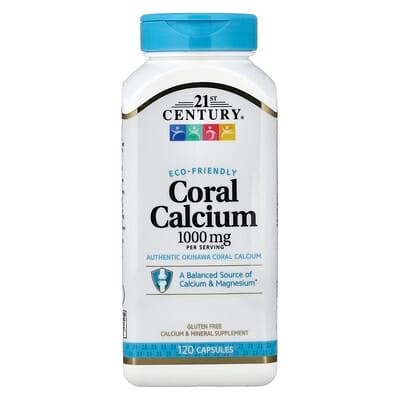
21st Century Coral Calcium 1000 mg provides a substantial amount of minerals for bone nutrition, with 1,000 mg of calcium, 500 mg of magnesium and 10 mcg of vitamin D3 in four capsules. Vitamin D3 helps the body absorb calcium, but the large single calcium amount may not be fully absorbed and the magnesium source mix is unclear. It offers good value for calcium.
AI assessment of the formula, label and price. How scoring works
Nutrient Quality35
Vitamin D3 is a favorably assessed form, while the coral calcium source does not fully identify the precise calcium compound. Magnesium includes oxide and an unidentified source in unknown proportions, limiting confidence in its absorption.
Ingredient Transparency70
The three nutrient amounts are clearly stated. Some sources and individual form quantities remain unclear, making the mineral blend harder to compare precisely.
Value For Money46
The large calcium content is good value for the price. Magnesium and vitamin D offer less compelling value when their forms and doses are considered separately.
Customer Satisfaction84
Customer satisfaction is favorable. The number of ratings gives the positive average a meaningful base of feedback.
Product Focus73
The calcium, magnesium and vitamin D3 combination is particularly well aligned with bone nutrition. Several additional nutritional goals relate to the minerals, but do not establish broad benefits beyond basic mineral support.
- Format
Capsule - Container
- 120 Capsule(s)
- Per serving
- $0.37
- Customer rating
- 4.8 · 1,301 ratings
Goals

Impact
Highest effect
Vitamin D · 10 mcgMagnesium · 500 mg
Coral Calcium 1000 mg is a substantial mineral option for filling calcium and magnesium gaps in everyday nutrition. The selected serving supplies 1000 mg calcium for bone maintenance and 500 mg magnesium for cellular energy processes and mineral metabolism. The stored directions describe taking a serving twice daily, so the serving amounts should not be mistaken for the full instructed regimen.
Magnesium Supportive

Impact
Highest effect
Magnesium · 500 mgCalcium · 1000 mgVitamin D · 10 mcg
Coral Calcium 1000 mg offers substantial mineral intake support, with 1,000 mg calcium to help fill a dietary gap. Magnesium at 500 mg supports normal bone metabolism. Vitamin D3 at 10 mcg complements the minerals by helping calcium absorption.
Vitamin D Supportive
Calcium Supportive
Magnesium Supportive


Impact
High effect
Vitamin D · 10 mcgMagnesium · 500 mg
Coral Calcium 1000 mg offers a conditional nutritional fit for stress relief through its 500 mg magnesium serving. Magnesium has relevant support in low-magnesium or selected settings, while broad lasting relief remains uncertain. The assessed amount is one selected serving and is not multiplied by the twice-daily directions.
Vitamin D Supportive
Magnesium Supportive

Impact
High effect
Vitamin D · 10 mcgMagnesium · 500 mg
Coral Calcium 1000 mg offers a conditional nutritional fit for energy when magnesium intake is inadequate. Its 500 mg magnesium can help fill a nutrient gap associated with tiredness.
Vitamin D Supportive
Magnesium Supportive

Impact
High effect
Magnesium · 500 mgVitamin D · 10 mcg
Coral Calcium 1000 mg has a narrow cardiovascular-support fit through its 500 mg elemental magnesium. Magnesium relates to vascular tone and arterial stiffness, with inconsistent supplied findings. The selected serving remains the basis for comparison, even though the retained adult directions describe taking it twice daily.
Vitamin D Mixed
Magnesium Supportive

Impact
High effect
Magnesium · 500 mgVitamin D · 10 mcg
Coral Calcium 1000 mg offers limited heart-health support mainly through its 500 mg magnesium serving. Magnesium supports electrolyte balance and vascular tone, although vascular-marker benefits are inconsistent.
Vitamin D Mixed
Magnesium Supportive
Ingredients
| Ingredient | Amount per serving | Score |
|---|---|---|
Vitamin D3 (Cholecalciferol) | 10 mcg | |
Calcium | 1000 mg | |
Magnesium (Coral Calcium, Magnesium Oxide) | 500 mg |
Calcium · 1000 mg OverallScore56
21st Century Coral Calcium 1000 mg offers good value for calcium, with 1000 mg per serving from coral calcium. The price is $0.049 per 100 mg of calcium; the full formula costs $0.49 per serving. Some of the large single dose may not be absorbed. The Other Ingredients list includes a configured artificial additive.
Magnesium (Coral Calcium, Magnesium Oxide) · 500 mg OverallScore41
21st Century Coral Calcium 1000 mg provides a large amount of magnesium, 500 mg per serving. magnesium oxide is named, but another magnesium source is unspecified and the proportions are unknown. $0.098 per 100 mg magnesium is low; the $0.49 serving price covers the full formula.
Alternative products
Report alternatives
Sources
Published studies used for the product analysis and the top-ranked studies for each ingredient and goal.
- What is the impact of daily oral supplementation of vitamin D3 (cholecalciferol) plus calcium on the incidence of hip fracture in older people? A systematic review and meta-analysis.
- Calcium supplementation prevents seasonal bone loss and changes in biochemical markers of bone turnover in elderly New England women: a randomized placebo-controlled trial.
- The effects of calcium supplementation (milk powder or tablets) and exercise on bone density in postmenopausal women.
- The efficacy of calcium supplementation alone in elderly Thai women over a 2-year period: a randomized controlled trial.
- Calcium-enriched foods and bone mass growth in prepubertal girls: a randomized, double-blind, placebo-controlled trial.
- Association between Serum Magnesium and Fractures: A Systematic Review and Meta-Analysis of Observational Studies.
- Bioabsorbable Magnesium-Based Materials Potential and Safety in Bone Surgery: A Systematic Review.
- Vascularized bone grafting fixed by biodegradable magnesium screw for treating osteonecrosis of the femoral head.
- An update on magnesium and bone health.
- Sex-specific differences in the association of magnesium intake with femoral neck bone mineral density among older adults.
- Pregnancy vitamin D supplementation and offspring bone mineral density in childhood follow-up of a randomized controlled trial.
- Vitamin D analogs and bone: preclinical and clinical studies with eldecalcitol.
- Efficacy of vitamin D fortified foods on bone mineral density and serum bone biomarkers: A systematic review and meta-analysis of interventional studies.
- Cholecalciferol Supplementation Attenuates Bone Loss in Incident Kidney Transplant Recipients: A Prespecified Secondary Endpoint Analysis of a Randomized Controlled Trial.
- Vitamin D supplementation and bone health in post-menopausal women: a 24-month randomized controlled intervention with enhanced bioavailability formulations.
- Circulating and dietary magnesium and risk of cardiovascular disease: a systematic review and meta-analysis of prospective studies.
- Magnesium and the risk of cardiovascular events: a meta-analysis of prospective cohort studies.
- Quantitative Association Between Serum/Dietary Magnesium and Cardiovascular Disease/Coronary Heart Disease Risk: A Dose-Response Meta-analysis of Prospective Cohort Studies.
- Comparative Efficacy of Nutraceuticals on Endothelial Function: A Systematic Review and Network Meta-Analysis.
- Serum magnesium, mortality, and cardiovascular disease in chronic kidney disease and end-stage renal disease patients: a systematic review and meta-analysis.