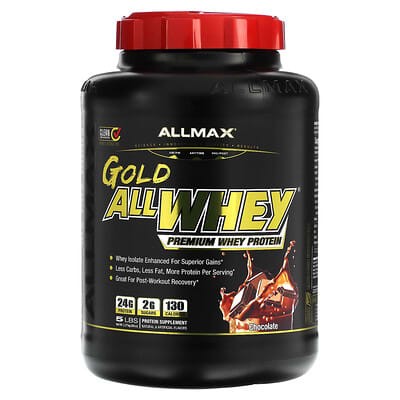
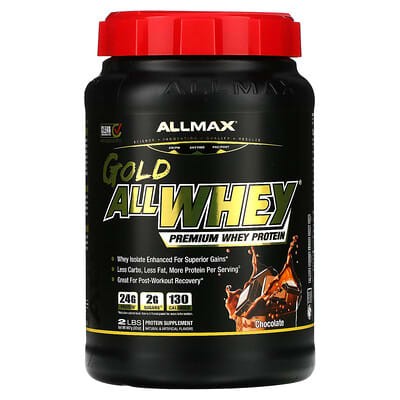
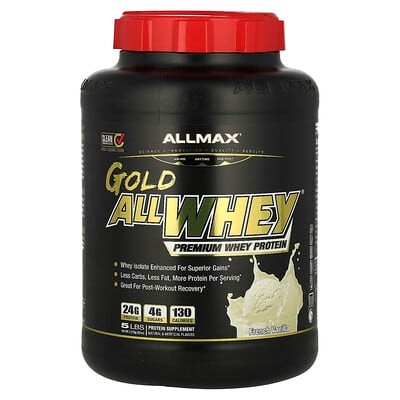
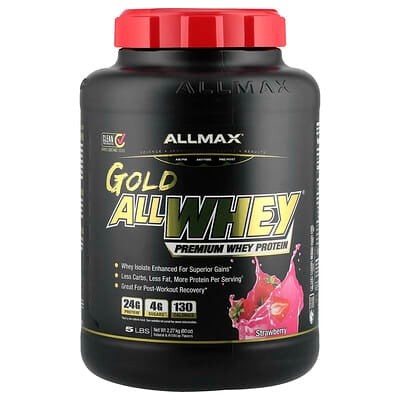
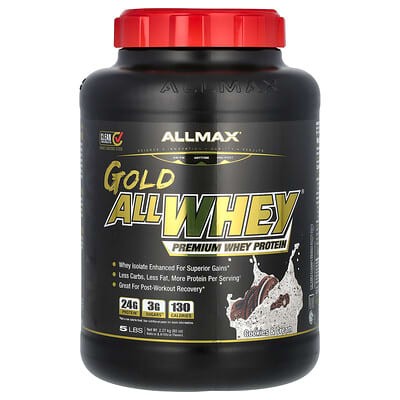
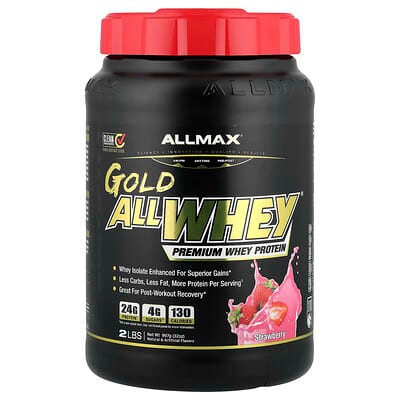
Product Image

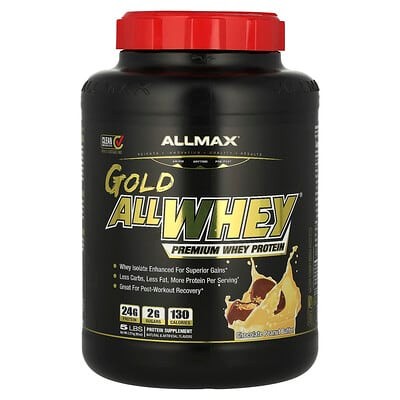
GOLD ALLWHEY Chocolate Peanut Butter

ALLMAX
4.6
★ ★ ★ ★ ★
(1632 ratings)
Sodium 130 mg
Potassium 208 mg
Protein 24 Gram(s)
Product Image
Score74
A lean 24 g protein serving supports daily protein intake. Limited potassium and incomplete ingredient disclosure reduce its usefulness for heart-focused shoppers.
How scoring works
Quantity:5 lb(s) • (71 servings)
Goals:

Score 74

A lean 24 g protein serving supports daily protein intake. Limited potassium and incomplete ingredient disclosure reduce its usefulness for heart-focused shoppers.
How scoring works
$109.99($1.54 per serving)
iHerb
$ 118.44
Vitacost
$ 109.99
Report prices

Analysis

The 24 g protein serving is appropriate for routine protein supplementation and comes with only 4 g carbohydrate. Calcium and iron are included, but the formula's main purpose is clearly protein delivery rather than broad micronutrient support.

Potassium at 208 mg makes only a modest contribution to daily intake. Sodium is also too low for focused hydration, and the formula has no magnesium, omega-3s, CoQ10, or other heart-directed active.

The supplied nutrition panel gives exact amounts for the listed nutrients. Protein type, mineral compounds, flavoring ingredients, and other additives are not shown, while the serving value is only moderate compared with close alternatives.

Who is it for
  • Adults seeking a flavored whey powder
  • People wanting 24 g protein with modest carbohydrates
  • Users focused on general protein intake
Best for
  • Routine protein supplementation
  • Post-workout shakes
  • General nutrition

Pros

  • Provides 24 g protein
  • Contains only 4 g carbohydrate
  • Lists all key nutrition amounts
  • Supplies calcium and iron

Cons

  • Potassium amount is modest
  • No targeted cardiovascular active is present
  • Protein and mineral forms are not named
  • Serving value is not a standout

Warnings

  • Whey is milk-derived and is unsuitable for people with a milk allergy
  • Each serving contains 65 mg cholesterol, which may matter to people limiting dietary cholesterol
  • The 130 mg sodium amount is not suitable for substantial sweat replacement

Nutrient quality

82 Highest impact

The protein amount is meaningful and the macronutrient profile is practical. Incomplete whey-source detail and weak heart-specific coverage are the main limitations.

.
Ingredient transparency

69 High impact

Core nutrition totals are clear enough for basic comparison. Missing complete ingredients, use directions, and detailed protein or blend composition leave notable gaps.

.

Customer satisfaction

69 High impact

Aggregate satisfaction data are favorable and supported by substantial volume. Specific firsthand comments were not supplied, leaving repeated complaints and purpose fit uncertain.

.

Value for money

78 High impact

The protein amount provides fair value for the category. Cost and formulation trade-offs keep it from standing out.

.
Report analysis

Ingredients

IngredientAmount per serving
Calories
130 Calorie(s)
Total Fat
2 Gram(s)
Cholesterol
65 mg
Total Carbohydrates
4 Gram(s)
Protein
24 Gram(s)
Calcium
127 mg
Iron
1 mg
Sodium
130 mg
Potassium
208 mg
Gluten Free Adults 18–50
Report overview
Sodium · 130 mg OverallScore54
D- Active Ingredient Quality & BioavailabilityC- Dose, Safety & Label TransparencyB- Value

The 130 mg sodium amount is too low for meaningful replacement of heavy sweat losses. Potassium is disclosed, but the mineral forms and any trace-mineral or buffering support are absent. The serving cost reflects a protein-focused formula, so its value is only neutral when judged as a complex product rather than an electrolyte supplement.

Potassium · 208 mg OverallScore32
F Active Ingredient Quality & BioavailabilityC Dose, Safety & Label TransparencyF Value

The 208 mg potassium serving provides a moderate amount but remains below the collection median. Its source compound is not disclosed, leaving absorption quality uncertain. The per-serving cost is below the market median, yet the modest potassium dose limits value for targeted supplementation.

Loading alternative details
Report alternatives

Sources

Published studies used for the product analysis and the top-ranked studies for each ingredient and goal.

  1. Oral potassium supplementation for management of essential hypertension: A meta-analysis of randomized controlled trials.
    Poorolajal J; Zeraati F; Soltanian AR; Sheikh V; Hooshmand E; Maleki A · PloS one · 2017
    Meta-analysis1,213 participants23 studies pooledHeart Health forPotassium
  2. Potassium intake, stroke, and cardiovascular disease a meta-analysis of prospective studies.
    D'Elia L; Barba G; Cappuccio FP; Strazzullo P · Journal of the American College of Cardiology · 2011
    Meta-analysis247,510 participants11 studies pooledHeart Health forPotassium
  3. Effect of Potassium Supplementation on Endothelial Function: A Systematic Review and Meta-Analysis of Intervention Studies.
    D'Elia L; Cappuccio FP; Masulli M; La Fata E; Rendina D; Galletti F · Nutrients · 2023
    Meta-analysis332 participants5 studies pooledHeart Health forPotassium
  4. Magnesium and Potassium Supplementation for Systolic Blood Pressure Reduction in the General Normotensive Population: A Systematic Review and Subgroup Meta-Analysis for Optimal Dosage and Treatment Length.
    Behers BJ; Behers BM; Stephenson-Moe CA; Vargas IA; Meng Z; Thompson AJ; Melchor J; Wojtas CN; Rosario MA; Baker JF; Deevers AC; Mouratidis RW; Sweeney MJ · Nutrients · 2024
    Meta-analysisHeart Health forPotassium
  5. Potassium intake and risk of stroke in women with hypertension and nonhypertension in the Women's Health Initiative.
    Seth A; Mossavar-Rahmani Y; Kamensky V; Silver B; Lakshminarayan K; Prentice R; Van Horn L; Wassertheil-Smoller S · Stroke · 2015
    Cohort study90,137 participantsHeart Health forPotassium
  6. Effect of high potassium diet on endothelial function.
    Blanch N; Clifton PM; Petersen KS; Willoughby SR; Keogh JB · Nutrition, metabolism, and cardiovascular diseases : NMCD · 2015
    Randomized trial35 participantsHeart Health forPotassium
  7. Associations between sodium, potassium, and blood pressure: results from the Hispanic Community Health Study/Study of Latinos, a prospective cohort study.
    Swift SL; Sotres-Alvarez D; Raij L; Wassertheil-Smoller S; Schneiderman N; Llabre M; Zeki Al Hazzouri A; Rundek T; Van Horn L; Daviglus M; Castaneda S; Youngblood M; Mossavar-Rahmani Y; Elfassy T · The American journal of clinical nutrition · 2024
    Cohort study11,429 participantsHeart Health forPotassium
  8. Long-Term Potassium Monitoring and Dynamics in Heart Failure and Risk of Mortality.
    Núñez J; Bayés-Genís A; Zannad F; Rossignol P; Núñez E; Bodí V; Miñana G; Santas E; Chorro FJ; Mollar A; Carratalá A; Navarro J; Górriz JL; Lupón J; Husser O; Metra M; Sanchis J · Circulation · 2019
    Cohort study2,164 participantsHeart Health forPotassium
  9. Serum potassium levels provide prognostic information in symptomatic heart failure beyond traditional clinical variables.
    Toledo CC; Vellosa Schwartzmann P; Miguel Silva L; da Silva Ferreira G; Bianchini Cardoso F; Citelli Ribeiro V; Paim LR; Antunes-Correa LM; Carvalho Sposito A; Matos Souza JR; Modolo R; Nadruz W; Fernandes de Carvalho LS; Coelho-Filho OR · ESC heart failure · 2021
    Cohort study178 participantsHeart Health forPotassium
  10. Finerenone, Serum Potassium, and Clinical Outcomes in Heart Failure With Mildly Reduced or Preserved Ejection Fraction.
    Vardeny O; Vaduganathan M; Claggett BL; Desai AS; Jhund PS; Lam CSP; Senni M; Shah SJ; Voors AA; Zannad F; Pitt B; Matsumoto S; Merkely B; Zieroth S; Yilmaz MB; Lay-Flurrie J; Viswanathan P; Horvat-Broecker A; Scalise A; McMurray JJV; Solomon SD · JAMA cardiology · 2025
    Randomized trial6,001 participantsHeart Health forPotassium