
Nutrient quality
Several well-regarded vitamin and mineral forms support broad nutritional coverage. Aggressive amounts for some ages and many token-dose extras are substantial weaknesses.
.
 iHerb iHerb | $ 28.86 | |
 Pure Formulas Pure Formulas | $ 28.86 | |
 Vitacost Vitacost | $ 28.99 | |
| iHerb | $ 28.86 |
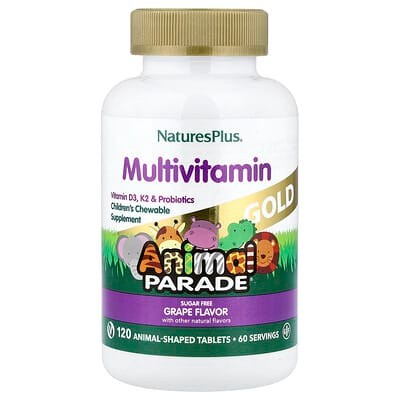
Two grape-flavored chewables provide a broad mix led by vitamins A, C, D3, E, K2, and B vitamins. Mineral coverage includes 5 mg iron, 1 mg copper, 60 mcg chromium, and smaller amounts of calcium, magnesium, zinc, iodine, selenium, and manganese.
Copper aminoate and chromium picolinate are useful forms, while iron aminoate is paired with vitamin C, folate, and vitamin B12. The iron and chromium amounts fit maintenance rather than correction, and the zinc-to-copper balance is not ideal for targeted copper use.
Chewability and 60 servings make routine use practical for someone who needs this format. Probiotic strains, enzymes, fatty acids, and choline appear in amounts too small to drive the product decision.
Several well-regarded vitamin and mineral forms support broad nutritional coverage. Aggressive amounts for some ages and many token-dose extras are substantial weaknesses.
.Most vitamin and mineral amounts are visible. Generic blends, unclear probiotic potency, and missing non-active ingredients reduce transparency.
.The supplied average rating is exceptionally strong. No specific review comments were supplied, so repeated negative experiences cannot be assessed.
.Broad nutrient coverage provides some practical value. Numerous token-dose extras weaken formula efficiency and competitiveness.
.| Ingredient | Amount per serving |
|---|---|
Calories | 10 Calorie(s) |
Total Carbohydrates | 2 Gram(s) |
Vitamin A (Beta-Carotene) | 1500 mcg RAE |
Vitamin C (Ascorbic Acid) | 60 mg |
Vitamin D3 | 13 mcg |
Vitamin E (D-Alpha-Tocopheryl Acetate) | 20 mg |
Vitamin K2 (Menatetrenone) | 40 mcg |
Thiamine (Thiamine Hydrochloride, Vitamin B1) | 1.5 mg |
Riboflavin (Vitamin B2) | 1.7 mg |
Niacin (Niacinamide) | 20 mg NE |
Vitamin B6 (Pyridoxine Hydrochloride) | 2 mg |
Folate (Calcium L-5-Methyltetrahydrofolate) | 17 mcg DFE |
Vitamin B12 (Methylcobalamin) | 6 mcg |
Biotin | 50 mcg |
Pantothenic Acid (Calcium Pantothenate) | 10 mg |
Choline (Choline Bitartrate) | 0.01 mg |
Calcium (Calcium Aminoate) | 50 mg |
Iron (Iron Aminoate Complex) | 5 mg |
Iodine (Kelp) | 100 mcg |
Magnesium (Magnesium Aminoate Complex) | 10 mg |
Zinc (Zinc Aminoate) | 3 mg |
Selenium (Sodium Selenite) | 35 mcg |
Copper (Copper Aminoate Complex) | 1 mg |
Manganese (Manganese Aminoate Complex) | 1 mg |
Chromium (Chromium Picolinate) | 60 mcg |
Potassium (Potassium Aminoate Complex) | 1 mg |
Essential Fatty Acid Complex (Flax, Spirulina, Sunflower) | 2 mg |
Enzyme Blend | 1.4 mg |
Lutein (active Carotenoid) | 0.5 mg |
Lactbacillus acidophilus | 0.25 mg |
Lactobacillus plantarum | 0.25 mg |
Streptococcus thermophilus | 0.25 mg |
Lemon Bioflavonoid Complex (Citrus limon) | 0.2 mg |
Copper aminoate is a clearly identified amino acid complex with favorable absorption potential. The 1 mg amount falls within a sensible daily maintenance range, while the zinc-to-copper ratio falls outside the preferred balance range. The serving cost is competitive for the copper delivered.
Chromium picolinate is a well-absorbed organic form. The 60 mcg serving is limited to maintenance use, and the single-number label leaves elemental-versus-compound ambiguity. Cost per standard chromium amount is very high; no high-dose metabolic companion active materially offsets that cost.