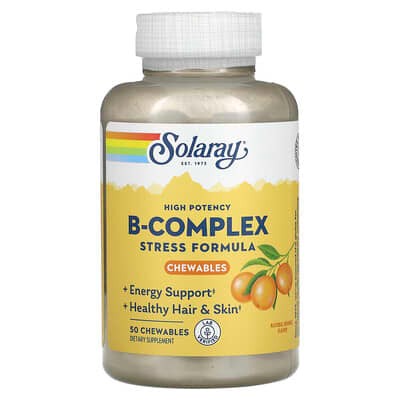
Nutrient quality
The broad vitamin pattern is relevant and mostly substantial. An extreme listed B12 amount and hidden support base make dose safety and quality impossible to confirm.
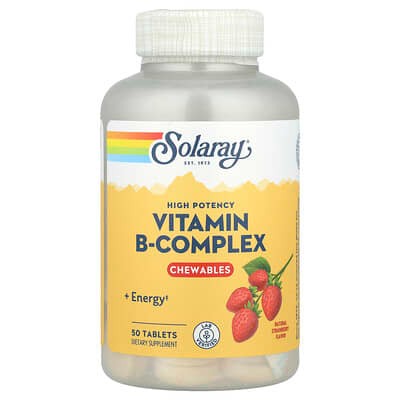
.
 Vitacost Vitacost | $ 15.49 | |
 Amazon Amazon | $ 15.49 | |
 Pure Formulas Pure Formulas | $ 15.49 | |
 iHerb iHerb | $ 15.49 |
Vitamin C, niacinamide, pantothenic acid, biotin, and the remaining B vitamins cover antioxidant and normal energy-metabolism roles. A chewable tablet may suit people who have difficulty swallowing capsules.
Most vitamins use conventional forms, including pyridoxine hydrochloride and cyanocobalamin. Choline, inositol, and PABA are present only in small amounts, so they add little beyond the core nutrient panel.
The supplied data list vitamin B12 at 30 mg, an implausibly high amount for this category that should be checked directly against the package before use. The 30 mg support base is not broken down, leaving the full formula harder to screen for sensitivities.
The broad vitamin pattern is relevant and mostly substantial. An extreme listed B12 amount and hidden support base make dose safety and quality impossible to confirm.
.Most active amounts are visible, but the B12 entry and support base create major uncertainty. Missing directions and chewable ingredients further weaken clarity.
.The aggregate satisfaction signal is strong and supported by extensive volume. Missing review details prevent assessment of taste complaints or purpose fit.
.Convenience and broad coverage provide some value. The unresolved B12 amount and hidden support base make clearer chewables more competitive.
.A broad B-complex supports carbohydrate metabolism and cellular energy production. Several amounts are suitable for maintenance, while the reported Vitamin B12 amount is unusually large and may reflect a label-data anomaly.
Most B vitamins use conventional forms rather than the most bioactive choices. The chewable format and stress blend add convenience and breadth, but several duplicated names and small secondary ingredients weaken precision.

A convenient chewable supplies B vitamins plus vitamin C for energy metabolism and antioxidant support. The amounts are generally substantial enough to contribute rather than merely decorate the label.
Folate is not identified by chemical form, and most B vitamins use conventional rather than active forms. The product remains narrow and does not provide the minerals or fat-soluble vitamins expected from broad daily coverage.
| Ingredient | Amount per serving |
|---|---|
Calories | 15 Calorie(s) |
Sugar | 0 Gram(s) |
Vitamin C (Ascorbic Acid) | 250 mg |
Thiamine (Thiamine Mononitrate, Vitamin B1) | 7.5 mg |
Riboflavin (Vitamin B2) | 8.5 mg |
Niacin (Niacinamide) | 50 mg |
Vitamin B6 (Pyridoxine Hydrochloride) | 10 mg |
Folate | 400 mcg |
Vitamin B12 (Cyanocobalamin) | 30 mg |
Biotin | 300 mcg |
Pantothenic Acid (Calcium D-Pantothenate) | 50 mg |
Inositol | 30 mg |
PABA | 20 mg |
Stress & Vitamin C Support Base | 30 mg |
Choline (Choline Bitartrate) | 30 mg |
PABA is clearly listed at 20 mg, but the amount is too small for robust standalone support. Immediate release is acceptable at this nutritional dose, and the separate line item makes the amount easy to verify. Cost efficiency is weak because the serving delivers little PABA for its cost.
Calcium pantothenate provides a stable and well-absorbed form of vitamin B5. The disclosed amount supports general maintenance and metabolic needs, and the label clearly identifies the source. Excipient purity cannot be verified from the supplied data, and cost efficiency per active amount is poor.
The 50 mg niacinamide amount is suitable for general B-vitamin or multivitamin coverage. The one chewable tablet lacks specialized release technology, and the label provides no explicit no-flush guidance. The serving is expensive relative to the niacin form and amount.
Published studies used for the product analysis and the top-ranked studies for each ingredient and goal.