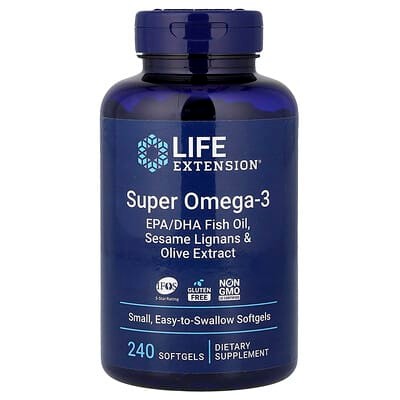
Product Image

Super Omega-3

Life Extension
4.8
★ ★ ★ ★ ★
(5471 ratings)
EPA (Eicosapentaenoic Acid) 700 mg
DHA 500 mg
Fish Oil 2000 mg
Product Image
Score83
A concentrated EPA-and-DHA serving is clearly disclosed, but missing form and testing details limit confidence in oil quality.
How scoring works
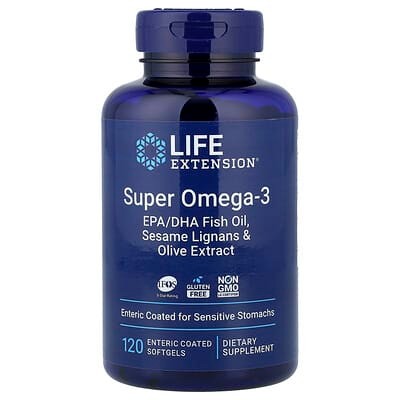
Quantity:120 Softgel(s) • (60 servings)
Goals:
Anti-Inflammatory Support
Heart Health
Cardiovascular Support
Mental Focus

Score 83

A concentrated EPA-and-DHA serving is clearly disclosed, but missing form and testing details limit confidence in oil quality.
How scoring works
$24.00($0.40 per serving)
iHerb
$ 32.25
Vitacost
$ 31.99
iHerb
$ 32.25
Walmart
$ 24.00
Vitacost
$ 31.63
Report prices

Analysis

The formula supplies 700 mg EPA and 500 mg DHA per serving, giving a high omega-3 dose. Both key omega-3s are quantified, so the active amount is easy to assess.

The concentrated serving fits adults seeking meaningful omega-3 intake for heart health and cardiovascular support. The amount of active omega-3 provided per serving also compares favorably with the product cost.

The label does not identify the omega-3 molecular form or provide independent purity and oxidation test results, so important quality details remain uncertain. The softgel(s) format may be convenient for routine use, but the disclosed facts do not establish freshness or contaminant control.

Who is it for
  • Adults seeking a concentrated daily fish-oil serving
  • People focused on cardiovascular or inflammatory support
Best for
  • Heart Health
  • Cardiovascular Support
  • Anti-Inflammatory Support

Pros

  • EPA and DHA are listed separately at 700 mg and 500 mg per serving
  • Concentrated active omega-3 amount per serving
  • Serving count supports a practical daily routine

Cons

  • Omega-3 molecular form is not identified
  • Independent purity and oxidation testing is not provided
  • Fish source or processing details are limited

Warnings

  • Avoid if you have a fish allergy because the active oil is fish-derived.
  • The 1200 mg combined EPA, DHA serving may add to bleeding risk with anticoagulant or antiplatelet medicines; discuss this dose with the prescribing clinician.
  • Fish oil can cause burping or stomach upset; taking it with a meal may improve tolerance.

Nutrient quality

86 Highest impact

A substantial omega-3 dose with quantified olive and sesame compounds provides useful depth and breadth. Missing fish species, oil form, purification, and independent testing limit confidence.

.
Ingredient transparency

82 Highest impact

Active amounts are individually disclosed, and no proprietary blend hides the supplied doses. Complete use directions, excipients, and some source or quality details remain unavailable.

.

Customer satisfaction

71 High impact

Supplied aggregate data indicate strong satisfaction with a large response base. Specific comments are absent, so recurring complaints and purpose-specific experiences cannot be verified.

.

Value for money

90 Highest impact

Substantial omega-3s and strong package efficiency create very good value. Incomplete oil-quality documentation remains the main trade-off.

.

Report analysis

Goals

Anti-Inflammatory Support
Impact
Highest effect
A+ Goal FitA Strength of SupportA CoverageA Formula Quality
Fish Oil · 2000 mg

EPA and DHA provide a substantial, well-supported way to influence inflammatory signaling and help produce inflammation-resolving mediators. Olive polyphenols and sesame lignans add complementary antioxidant support.

The fish-oil actives and most companion markers are clearly quantified, giving the formula both depth and useful breadth. Its design remains focused, with the polyphenols supporting rather than distracting from the omega-3 core.

Study evidence
Fish Oil Supportive 68 studies
Heart Health
Impact
Highest effect
A+ Goal FitA Strength of SupportB+ CoverageA Formula Quality
EPA (Eicosapentaenoic Acid) · 700 mg

The clearly disclosed EPA and DHA combination strongly supports triglyceride management and cardiovascular lipid balance. Olive polyphenols and sesame lignans add compatible antioxidant support without displacing the main omega-3 dose.

The serving provides 700 mg EPA and 500 mg DHA, a meaningful daily amount but below prescription-level dosing used for very high triglycerides. The formula is transparent about the key fatty acids, making its practical heart contribution easy to assess.

Study evidence
Cardiovascular Support
Impact
Highest effect
A+ Goal FitB+ Strength of SupportB CoverageA- Formula Quality
Fish Oil · 2000 mg

The disclosed EPA and DHA amounts give the formula direct relevance to lipid and inflammatory balance. Their combined amount reaches a useful daily range, while olive polyphenols and sesame lignans add antioxidant protection.

The formula covers lipid support and oxidative stress with meaningful depth. Confidence in form quality is moderated by missing fatty-acid molecular form, purification details, species, and named third-party testing.

Study evidence
Fish Oil Supportive 185 studies
Mental Focus
Impact
High effect
D+ Goal FitA- Strength of SupportC CoverageB+ Formula Quality

EPA and DHA are supplied at substantial amounts and may support brain membranes and inflammatory balance over time. Olive polyphenols and sesame lignans broaden antioxidant support but do not create a strong acute focus effect.

The formula offers good depth in long-term brain-support pathways without stimulants, neurotransmitter precursors, or adaptogens. Exact fatty-acid disclosure is strong, while molecular form and independent contaminant testing remain unknown.

Study evidence

Ingredients

IngredientAmount per serving
Calories
25 Calorie(s)
Total Fat
2.5 Gram(s)
Cholesterol
5 mg
Pure+ Wild Fish Oil concentrate
2000 mg
Eicosapentaenoic Acid
700 mg
Docosahexaenoic Acid
500 mg
Polyphen-Oil Olive extract
300 mg
Polyphenols
19.5 mg
Hydroxytyrosol/Tyrosol
5.2 mg
Verbascoside/Oleuropein
4.4 mg
Sesame seed Lignan extract
10 mg
Gluten Free Adults 18–50
Report overview
C Active Ingredient Quality & BioavailabilityC Dose, Safety & Label TransparencyB+ Value

The molecular form is unspecified; ePA density is modest, and a multi-compound antioxidant system supports stability. The serving provides a strong EPA amount with more EPA than DHA but not a strongly EPA-centric ratio. No purification or third-party verification is shown, while normalized cost is favorable.

DHA · 500 mg OverallScore59
C- Active Ingredient Quality & BioavailabilityD Dose, Safety & Label TransparencyB+ Value

Olive polyphenols help protect the oil from oxidation, but the DHA chemical form is not disclosed. The 500 mg DHA amount reaches the high-potency tier and combined EPA and DHA provide moderate oil concentration. Fish species and independent purity certification are missing, although normalized DHA cost remains favorable.

Fish Oil · 2000 mg OverallScore58
F Active Ingredient Quality & BioavailabilityA- Dose, Safety & Label TransparencyA+ Value

The disclosed EPA and DHA reach a standard effective range, and the oil has a high active concentration. Molecular form, purification method, named third-party testing, and fish species are not supplied, while enteric coating mainly supports tolerance rather than proving oil quality. Olive polyphenols and sesame lignans may help protect the oil, and the larger package provides excellent active-dose value.

Loading alternative details
Report alternatives

Sources

Published studies used for the product analysis and the top-ranked studies for each ingredient and goal.

  1. Dose-dependent effects of fish oil on cardio-metabolic biomarkers in healthy middle-aged and elderly Chinese people: a double-blind randomized controlled trial.
    Song J; Hu M; Li C; Yang B; Ding Q; Wang C; Mao L · Food & function · 2018
    Randomized trial201 participantsAnti-Inflammatory Support forFish Oil
  2. Eicosapentaenoic acid supplementation alleviates pruritus, enhances skin moisture, and mitigates depression in maintenance hemodialysis patients.
    Lin YL; Wang CL; Chiang TI · Frontiers in nephrology · 2024
    Randomized trial60 participantsAnti-Inflammatory Support forFish Oil
  3. Lowering effects of fish oil supplementation on proinflammatory markers in hypertension: results from a randomized controlled trial.
    Yang B; Ren XL; Li ZH; Shi MQ; Ding F; Su KP; Guo XJ; Li D · Food & function · 2020
    Randomized trial77 participantsAnti-Inflammatory Support forFish Oil
  4. The effects of ω-3 fish oil emulsion-based parenteral nutrition plus combination treatment for acute paraquat poisoning.
    Meng Z; Dong Y; Gao H; Yao D; Gong Y; Meng Q; Zheng T; Cui X; Su X; Tian Y · The Journal of international medical research · 2019
    Randomized trial174 participantsAnti-Inflammatory Support forFish Oil
  5. Effects of Omega-3 Fatty Acid Intake in Patients Undergoing Dialysis: A Systematic Review and Meta-Analysis of Randomized Controlled Trials.
    Liu R; Jiang J; Fu Z; Liu C; Yao L; Quan H · Journal of the American Nutrition Association · 2022
    Meta-analysis49 studies pooledAnti-Inflammatory Support forFish Oil
  6. Marine Omega-3 Supplementation and Cardiovascular Disease: An Updated Meta-Analysis of 13 Randomized Controlled Trials Involving 127 477 Participants.
    Hu Y; Hu FB; Manson JE · Journal of the American Heart Association · 2020
    Meta-analysis127,477 participants13 studies pooledCardiovascular Support forFish Oil
  7. Impact of omega-3 fatty acids on hypertriglyceridemia, lipidomics, and gut microbiome in patients with type 2 diabetes.
    Lu J; Liu R; Ren H; Wang S; Hu C; Shi Z; Li M; Liu W; Wan Q; Su Q; Li Q; Zheng H; Qu S; Yang F; Ji H; Lin H; Qi H; Wu X; Wu K; Chen Y; Xu Y; Xu M; Wang T; Zheng J; Ning G; Zheng R; Bi Y; Zhong H; Wang W · Med (New York, N.Y.) · 2025
    Randomized trial309 participantsCardiovascular Support forFish Oil
  8. A systematic review of fish-oil supplements for the prevention and treatment of hypertension.
    Campbell F; Dickinson HO; Critchley JA; Ford GA; Bradburn M · European journal of preventive cardiology · 2013
    Meta-analysis1,524 participants17 studies pooledCardiovascular Support forFish Oil
  9. Effects of fish oil-derived fatty acids on suboptimal cardiovascular health: A multicenter, randomized, double-blind, placebo-controlled trial.
    Zeng Q; Dong SY; Liu YP; Fu J; Shuai P; Zhao ZM; Li TX · Nutrition, metabolism, and cardiovascular diseases : NMCD · 2017
    Randomized trial422 participantsCardiovascular Support forFish Oil
  10. Effect of High-Dose Marine Omega-3 Fatty Acids on Atherosclerosis: A Systematic Review and Meta-Analysis of Randomized Clinical Trials.
    Sekikawa A; Cui C; Sugiyama D; Fabio A; Harris WS; Zhang X · Nutrients · 2020
    Meta-analysis6 studies pooledCardiovascular Support forFish Oil
  11. Effects of eicosapentaenoic acid on major coronary events in hypercholesterolaemic patients (JELIS): a randomised open-label, blinded endpoint analysis.
    Yokoyama M; Origasa H; Matsuzaki M; Matsuzawa Y; Saito Y; Ishikawa Y; Oikawa S; Sasaki J; Hishida H; Itakura H; Kita T; Kitabatake A; Nakaya N; Sakata T; Shimada K; Shirato K; Japan EPA lipid intervention study (JELIS) Investigators · Lancet (London, England) · 2007
    Randomized trial18,645 participantsHeart Health forEPA (Eicosapentaenoic Acid)
  12. Effects of EPA on coronary artery disease in hypercholesterolemic patients with multiple risk factors: sub-analysis of primary prevention cases from the Japan EPA Lipid Intervention Study (JELIS).
    Saito Y; Yokoyama M; Origasa H; Matsuzaki M; Matsuzawa Y; Ishikawa Y; Oikawa S; Sasaki J; Hishida H; Itakura H; Kita T; Kitabatake A; Nakaya N; Sakata T; Shimada K; Shirato K; JELIS Investigators, Japan · Atherosclerosis · 2008
    Randomized trial14,981 participantsHeart Health forEPA (Eicosapentaenoic Acid)
  13. Effects of omega-3 fatty acids on coronary revascularization and cardiovascular events: a meta-analysis.
    Dinu M; Sofi F; Lotti S; Colombini B; Mattioli AV; Catapano AL; Casula M; Baragetti A; Wong ND; Steg PG; Ambrosio G · European journal of preventive cardiology · 2024
    Meta-analysis134,144 participants18 studies pooledHeart Health forEPA (Eicosapentaenoic Acid)
  14. Incremental effects of eicosapentaenoic acid on cardiovascular events in statin-treated patients with coronary artery disease.
    Matsuzaki M; Yokoyama M; Saito Y; Origasa H; Ishikawa Y; Oikawa S; Sasaki J; Hishida H; Itakura H; Kita T; Kitabatake A; Nakaya N; Sakata T; Shimada K; Shirato K; Matsuzawa Y; JELIS Investigators · Circulation journal : official journal of the Japanese Circulation Society · 2009
    Randomized trialHeart Health forEPA (Eicosapentaenoic Acid)
  15. Omega-3 Fatty Acids for the Management of Hypertriglyceridemia: A Science Advisory From the American Heart Association.
    Skulas-Ray AC; Wilson PWF; Harris WS; Brinton EA; Kris-Etherton PM; Richter CK; Jacobson TA; Engler MB; Miller M; Robinson JG; Blum CB; Rodriguez-Leyva D; de Ferranti SD; Welty FK; American Heart Association Council on Arteriosclerosis, Thrombosis and Vascular Biology; Council on Lifestyle and Cardiometabolic Health; Council on Cardiovascular Disease in the Young; Council on Cardiovascular and Stroke Nursing; and Council on Clinical Cardiology · Circulation · 2020
    OtherHeart Health forEPA (Eicosapentaenoic Acid)
  16. The influence of n-3 polyunsaturated fatty acids on cognitive function in individuals without dementia: a systematic review and dose-response meta-analysis.
    Suh SW; Lim E; Burm SY; Lee H; Bae JB; Han JW; Kim KW · BMC medicine · 2024
    Meta-analysis9,660 participants24 studies pooledMental Focus forEPA (Eicosapentaenoic Acid)
  17. EPA supplementation improves teacher-rated behaviour and oppositional symptoms in children with ADHD.
    Gustafsson PA; Birberg-Thornberg U; Duchén K; Landgren M; Malmberg K; Pelling H; Strandvik B; Karlsson T · Acta paediatrica (Oslo, Norway : 1992) · 2011
    Randomized trial92 participantsMental Focus forEPA (Eicosapentaenoic Acid)
  18. Docosahexaenoic Acid (DHA) and Eicosapentaenoic Acid (EPA)-Should They Be Mandatory Supplements in Pregnancy?
    Amza M; Haj Hamoud B; Sima RM; Dinu MD; Gorecki GP; Popescu M; Gică N; Poenaru MO; Pleș L · Biomedicines · 2024
    Narrative reviewMental Focus forEPA (Eicosapentaenoic Acid)
  19. Supplementation with oil rich in eicosapentaenoic acid, but not in docosahexaenoic acid, improves global cognitive function in healthy, young adults: results from randomized controlled trials.
    Patan MJ; Kennedy DO; Husberg C; Hustvedt SO; Calder PC; Khan J; Forster J; Jackson PA · The American journal of clinical nutrition · 2021
    Randomized trial310 participantsMental Focus forEPA (Eicosapentaenoic Acid)