Product Image

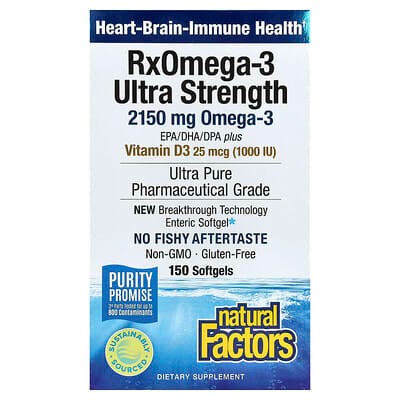
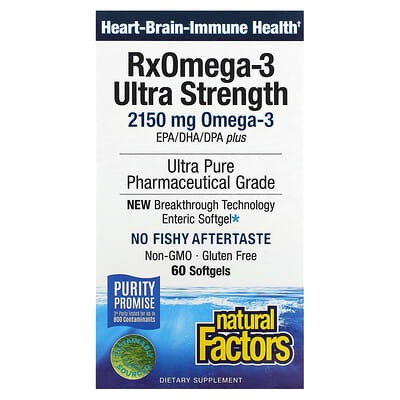
Ultra Strength One-per-Day RxOmega-3

Natural Factors
4.9
★ ★ ★ ★ ★
(5412 ratings)
DHA 300 mg
Fish Oil 1425 mg
Omega-3 900 mg
Product Image
Score82
A large supply of concentrated one-per-day omega-3 offers strong convenience, but the fatty-acid breakdown is unclear and the oil is ethyl ester based.
How scoring works
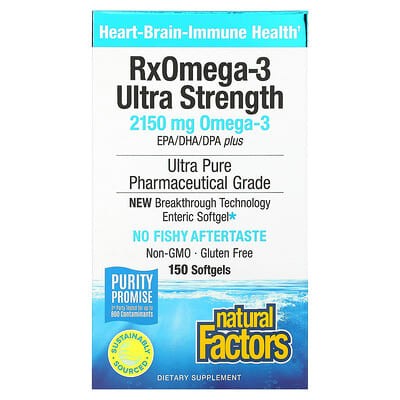
Quantity:150 Softgel(s) • (150 servings)
Goals:
Anti-Inflammatory Support
Cardiovascular Support
Skin Health

Score 82

A large supply of concentrated one-per-day omega-3 offers strong convenience, but the fatty-acid breakdown is unclear and the oil is ethyl ester based.
How scoring works
$47.57($0.31 per serving)
iHerb
$ 47.57
Vitacost
$ 47.57
Report prices

Analysis

Each softgel provides 900 mg total omega-3 from 1,425 mg of fish-oil concentrate. The large bottle supports consistent long-term use without increasing the daily capsule count.

The active list shows 600 mg and 300 mg entries both named DHA ethyl ester, leaving no separately identified EPA amount. That ambiguity matters for goal-specific use, and ethyl esters generally absorb less efficiently than triglyceride forms.

Anchovy, mackerel, and sardine are disclosed as sources, which is useful for allergy screening and source clarity. The supplied information does not state antioxidant protection or independent purity and oxidation testing.

Who is it for
  • Long-term users wanting one softgel daily
  • Adults seeking a concentrated maintenance dose
  • Value-focused shoppers comfortable with ethyl esters
Best for
  • Consistent cardiovascular support
  • General inflammatory balance
  • High-count one-per-day use

Pros

  • Provides 900 mg total omega-3 per softgel
  • Large bottle improves convenience
  • Names anchovy, mackerel, and sardine sources

Cons

  • Does not clearly disclose EPA separately
  • Uses ethyl ester fatty acids
  • No stated antioxidant or independent quality testing

Warnings

  • Avoid if allergic to fish
  • Marine omega-3 may compound bleeding risk with anticoagulant or antiplatelet drugs

Nutrient quality

89 Highest impact

The concentrated serving provides substantial omega-fatty-acid support in one softgel. Ethyl-ester delivery and an unclear EPA-to-DHA split limit quality.
Ingredient transparency

72 High impact

Important active-label details are incomplete or ambiguous. Complete use directions and inactive-ingredient details are not available.

Customer satisfaction

74 High impact

The aggregate satisfaction measure is favorable, with response volume determining how much confidence it deserves. Comment-level evidence is absent, so recurring complaints and purpose fit cannot be verified.

Value for money

96 Highest impact

High active concentration and bulk packaging create excellent value. The basic ethyl-ester form and ambiguous labeling remain its main trade-offs.

Report analysis

Goals

Anti-Inflammatory Support
Impact
High effect
A Goal FitC+ Strength of SupportC CoverageA+ Formula Quality
Fish Oil · 1425 mg

A concentrated fish-oil serving supplies a meaningful total omega-3 amount for pro-resolving inflammatory pathways. Human evidence for EPA and DHA is strong, but the individual fatty-acid listing is ambiguous and does not clearly identify EPA.

Small-fish sourcing and pharmaceutical-grade concentrate support quality. The ethyl ester form is less readily absorbed than triglyceride oil, and antioxidant protection is not disclosed.

Study evidence
Fish Oil Supportive 68 studies
Cardiovascular Support
Impact
High effect
A Goal FitC Strength of SupportC CoverageA+ Formula Quality
Fish Oil · 1425 mg

Concentrated marine omega fats directly support triglycerides, vascular function, and inflammatory balance. The total omega-fat amount is practical for daily cardiovascular support.

The ethyl ester form is less efficiently absorbed than triglyceride forms. EPA is not separately identified and two DHA entries create label ambiguity, so the active profile cannot be fully assessed.

Skin Health
Impact
High effect
B+ Goal FitB- Strength of SupportC+ CoverageB+ Formula Quality
Omega-3 · 900 mg

A concentrated omega-3 amount may support skin-barrier lipids and balanced inflammatory signaling. The active amount is substantial relative to the fish-oil concentrate.

Ethyl ester delivery offers moderate absorption. Repeated DHA labeling without a clearly stated EPA amount and absent oxidation or purity details reduce confidence in the active profile.

Study evidence
Omega-3 Supportive 35 studies

Ingredients

IngredientAmount per serving
Calories
15 Calorie(s)
Total Fat
1.5 Gram(s)
Cholesterol
5 mg
pharmaceutical grade Fish Oil concentrate
1425 mg
Omega-3 Fatty Acids
900 mg
Docosahexaenoic Acid Ethyl Ester
300 mg
Gluten Free Adults 18–50 Dairy Free Sugar Free
Report overview
DHA · 300 mg OverallScore73
F Active Ingredient Quality & BioavailabilityA Dose, Safety & Label TransparencyA+ Value

The label identifies DHA as an ethyl ester, a less bioavailable form than triglyceride DHA. The 900 mg DHA serving reaches a high-potency amount. No protective antioxidant is listed, while pharmaceutical-grade anchovy, mackerel, and sardine oil strengthens contaminant transparency and value is strong.

Fish Oil · 1425 mg OverallScore60
D+ Active Ingredient Quality & BioavailabilityD Dose, Safety & Label TransparencyA+ Value

Small-fish sourcing and pharmaceutical-grade oil are positives, while ethyl ester form is less bioavailable. The active amount is concentrated, but EPA is not individually disclosed and the DHA listing is ambiguous. Active-dose value is excellent, though antioxidant protection is not shown.

Omega-3 · 900 mg OverallScore51
D- Active Ingredient Quality & BioavailabilityF Dose, Safety & Label TransparencyA+ Value

The label identifies an ethyl ester oil with a moderate active concentration. Named small-fish sources improve source clarity, although antioxidant and independent purity details are absent. Low cost relative to the declared omega content supports excellent value.

Loading alternative details
Report alternatives

Sources

Published studies used for the product analysis and the top-ranked studies for each ingredient and goal.

  1. Dose-dependent effects of fish oil on cardio-metabolic biomarkers in healthy middle-aged and elderly Chinese people: a double-blind randomized controlled trial.
    Song J; Hu M; Li C; Yang B; Ding Q; Wang C; Mao L · Food & function · 2018
    Randomized trial201 participantsAnti-Inflammatory Support forFish Oil
  2. Eicosapentaenoic acid supplementation alleviates pruritus, enhances skin moisture, and mitigates depression in maintenance hemodialysis patients.
    Lin YL; Wang CL; Chiang TI · Frontiers in nephrology · 2024
    Randomized trial60 participantsAnti-Inflammatory Support forFish Oil
  3. Lowering effects of fish oil supplementation on proinflammatory markers in hypertension: results from a randomized controlled trial.
    Yang B; Ren XL; Li ZH; Shi MQ; Ding F; Su KP; Guo XJ; Li D · Food & function · 2020
    Randomized trial77 participantsAnti-Inflammatory Support forFish Oil
  4. The effects of ω-3 fish oil emulsion-based parenteral nutrition plus combination treatment for acute paraquat poisoning.
    Meng Z; Dong Y; Gao H; Yao D; Gong Y; Meng Q; Zheng T; Cui X; Su X; Tian Y · The Journal of international medical research · 2019
    Randomized trial174 participantsAnti-Inflammatory Support forFish Oil
  5. Effects of Omega-3 Fatty Acid Intake in Patients Undergoing Dialysis: A Systematic Review and Meta-Analysis of Randomized Controlled Trials.
    Liu R; Jiang J; Fu Z; Liu C; Yao L; Quan H · Journal of the American Nutrition Association · 2022
    Meta-analysis49 studies pooledAnti-Inflammatory Support forFish Oil
  6. Dietetic intervention in psoriatic arthritis: the DIETA trial.
    Leite BF; Morimoto MA; Gomes CMF; Klemz BNC; Genaro PS; Shivappa N; Hébert JR; Damasceno NRT; Pinheiro MM · Advances in rheumatology (London, England) · 2022
    Randomized trial97 participantsSkin Health forOmega-3
  7. Omega-3 fatty acid supplement skin cancer prophylaxis in lung transplant recipients: A randomized, controlled pilot trial.
    Miura K; Vail A; Chambers D; Hopkins PM; Ferguson L; Grant M; Rhodes LE; Green AC · The Journal of heart and lung transplantation : the official publication of the International Society for Heart Transplantation · 2019
    Randomized trial49 participantsSkin Health forOmega-3
  8. Clinical and metabolic response to flaxseed oil omega-3 fatty acids supplementation in patients with diabetic foot ulcer: A randomized, double-blind, placebo-controlled trial.
    Soleimani Z; Hashemdokht F; Bahmani F; Taghizadeh M; Memarzadeh MR; Asemi Z · Journal of diabetes and its complications · 2018
    Randomized trial60 participantsSkin Health forOmega-3
  9. Treatment of hard-to-heal wounds in ischaemic lower extremities with a novel fish skin-derived matrix.
    Lee YJ; Han HJ; Shim HS · Journal of wound care · 2024
    Randomized trial50 participantsSkin Health forOmega-3
  10. Effect of eicosapentaenoic acid, an omega-3 polyunsaturated fatty acid, on UVR-related cancer risk in humans. An assessment of early genotoxic markers.
    Rhodes LE; Shahbakhti H; Azurdia RM; Moison RM; Steenwinkel MJ; Homburg MI; Dean MP; McArdle F; Beijersbergen van Henegouwen GM; Epe B; Vink AA · Carcinogenesis · 2003
    Randomized trial42 participantsSkin Health forOmega-3