
Nutrient quality
Wild Alaskan salmon oil in softgels with an unspecified molecular form gives the formula reasonable ingredient quality. Dose uncertainty or limited delivery detail prevents a confident quality assessment.
 Vitacost Vitacost | $ 24.47 | |
 Pure Formulas Pure Formulas | $ 24.47 | |
 iHerb iHerb | $ 24.47 |
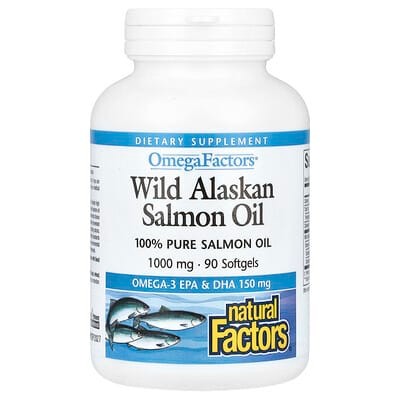
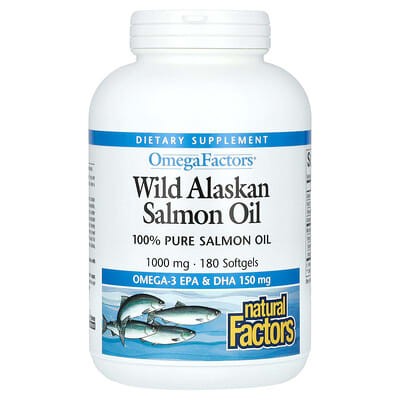
Each softgel supplies 80 mg of EPA and 70 mg of DHA from wild Alaskan salmon oil. The 200 mg total omega-3 amount is modest and represents a small fraction of the 1,000 mg oil serving.
A 180-serving package makes consistent use inexpensive and convenient. Sourcing is clearer than in many generic oils, but molecular form, oxidation protection, and independent purity verification are not stated.
The product fits users who want a long supply of low-dose salmon oil rather than high-potency omega-3 support. Package efficiency does not overcome the limited active amount for cardiovascular or inflammatory goals.
Wild Alaskan salmon oil in softgels with an unspecified molecular form gives the formula reasonable ingredient quality. Dose uncertainty or limited delivery detail prevents a confident quality assessment.
The meaningful actives and their amounts are clearly identified. Serving guidance and the complete inactive-ingredient list are not fully supplied.
The aggregate rating is strong and supported by useful review volume. No review excerpts are supplied to assess repeated complaints or purpose-specific experiences.
Premium positioning or disclosure limits weaken the value case. Serving value is reasonable, with trade-offs in delivery or disclosure.

EPA and DHA support cardiovascular lipid and inflammatory pathways, but the active amounts here are very small. The serving is unlikely to provide a meaningful triglyceride-focused contribution.
Wild salmon sourcing and separate EPA and DHA disclosure are useful quality signals. Missing molecular-form, purification, and oxidation details still limit confidence in oil quality.

Salmon oil supplies EPA and DHA, but the combined 150 mg amount is far below the stated minimum for anti-inflammatory support. The larger fish-oil number mainly reflects total oil rather than active omega-3s.
Individual fatty acids are clearly disclosed and the single-source formula is focused. Low concentration prevents meaningful depth despite a strong ingredient class.
| Ingredient | Amount per serving |
|---|---|
Calories | 10 Calorie(s) |
Total Fat | 1 Gram(s) |
Polyunsaturated Fat | 0.5 Gram(s) |
Cholesterol | 5 mg |
wild Alaskan Salmon Oil | 1000 mg |
Omega-3 Fatty Acids | 200 mg |
Eicosapentaenoic Acid | 80 mg |
Docosahexaenoic Acid | 70 mg |
EPA and DHA are clearly disclosed, but they form a small share of the salmon oil. The molecular form, antioxidant protection, and independent purity testing are not supplied. The larger package improves active-cost efficiency despite the dilute oil.
The molecular form is unspecified; ePA density is low, and no protective antioxidant is listed. The serving provides a minimal EPA amount with more EPA than DHA but not a strongly EPA-centric ratio. No purification or third-party verification is shown, while normalized cost is moderate.
Wild Alaskan salmon is a strong source, but molecular form, purification, and testing are not disclosed. EPA and DHA are transparent but deliver a very low dose at low concentration. Active-dose value is average and antioxidant protection is not shown.
Published studies used for the product analysis and the top-ranked studies for each ingredient and goal.