
Nutrient quality
Kosher fish oil in softgels with an unspecified molecular form gives the formula reasonable ingredient quality. Dose uncertainty or limited delivery detail prevents a confident quality assessment.
 iHerb iHerb | $ 31.60 | |
 Daily Vita Daily Vita | $ 39.16 | |
 Vitacost Vitacost | $ 39.16 |
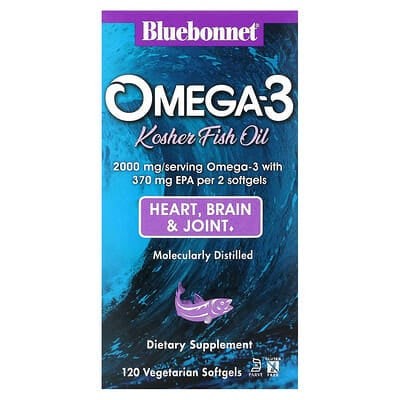
The serving supplies 370 mg of EPA, 120 mg of DHA, and 30 mg of DPA. That balance favors EPA but provides only a moderate total active amount from 2,000 mg of fish oil.
Clear individual fatty-acid quantities make the dose easy to assess, and kosher positioning may matter to some users. Molecular form, fish species, oxidation protection, and independent purity verification are not included in the supplied data.
The formula fits adults seeking basic maintenance rather than high-potency omega-3 supplementation. Users targeting substantial DHA or wanting a more concentrated oil will need a better-aligned product.
Kosher fish oil in softgels with an unspecified molecular form gives the formula reasonable ingredient quality. Dose uncertainty or limited delivery detail prevents a confident quality assessment.
Important active details are incomplete or internally inconsistent. Serving guidance and the complete inactive-ingredient list are not fully supplied.
The aggregate rating is strong but the review volume limits confidence. No review excerpts are supplied to assess repeated complaints or purpose-specific experiences.
Premium positioning or disclosure limits weaken the value case. The useful active content appears limited relative to the serving cost.

EPA and DHA are clearly separated and directly relevant to lipid and inflammatory support. Their combined amount is moderate, while molecular form, antioxidant protection, and independent purity details are absent.
The formula contributes to several linked omega-3 pathways but lacks the depth needed for stronger triglyceride support. Its focused design is coherent, with no unrelated actives diluting the fish-oil serving.

EPA and DHA directly support the body's production of inflammation-resolving mediators. These omega-3 fatty acids have strong human evidence for supporting inflammatory balance.
The combined 490 mg of EPA and DHA provides moderate support but falls short of a high-potency serving. Individual omega-3 amounts are transparent, though molecular form and independent testing are not disclosed.

EPA and DHA support inflammatory balance and skin-barrier lipids, giving the product a valid skin role. The combined EPA and DHA amount is moderate and less substantial than a concentrated omega-3 formula.
Individual fatty acids are disclosed, but the molecular form is not specified beyond fish oil. Fish-derived oil is unsuitable for people with fish allergy, and omega-3s may add to bleeding risk with anticoagulants.
| Ingredient | Amount per serving |
|---|---|
Calories | 20 Calorie(s) |
Total Fat | 2 Gram(s) |
Saturated Fat | 0.6 Gram(s) |
Polyunsaturated Fat | 0.6 Gram(s) |
Monounsaturated Fat | 0.5 Gram(s) |
Fish Oil | 2000 mg |
Total Omega-3 Fatty Acids | 580 mg |
Eicosapentaenoic Acid | 370 mg |
Docosahexaenoic Acid | 120 mg |
Docosapentaenoic Acid | 30 mg |
EPA is highly concentrated within the stated omega-3 content, though the molecular form and oxidation protection are not disclosed. The serving provides a moderate EPA amount with a strongly EPA-focused balance, but no purification or independent testing is mentioned. Cost efficiency lands in the premium tier rather than matching the strong concentration.
Separate EPA and DHA amounts make the active dose easy to assess. The actives are dilute relative to the total fish oil, while molecular form, antioxidant protection, and independent purity testing are not supplied. Value is moderate for the amount of disclosed EPA and DHA.
The combined 490 mg EPA and DHA amount provides a low maintenance dose at about 25% of the fish oil, indicating low concentration. The molecular form, purification method, and independent testing are not stated. The low active yield makes the cost inefficient despite a modest serving price.
Published studies used for the product analysis and the top-ranked studies for each ingredient and goal.