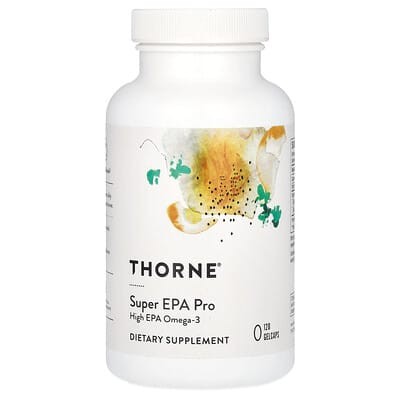
Super EPA Pro

Super EPA Pro

Thorne4.9 (382 ratings)
Format:Softgel Quantity: 120 Gelcap(s) · 60 servings
Goals
$93.00 $1.55 per serving

Product analysis

48 out of 100

Super EPA Pro provides fish oil with EPA and DHA that may support heart health. Incomplete oil details make it harder to compare the preparation with other fish oils.

AI assessment of the formula, label and price. How scoring works

Nutrient Quality27

Fish oil is identified, but its preparation quality remains uncertain. The other entries do not establish which fat forms are present.

Ingredient Transparency43

Some amounts are listed and fish oil is identified. The oil amount and full composition are not disclosed, which limits a detailed comparison.

Value For Money40

Value for money cannot be established from the available ingredient cost information. A reliable cost comparison needs clearer oil details.

Customer Satisfaction80

Customers give consistently very positive ratings. Feedback comes from a smaller group of customers, so it gives a narrower view of satisfaction.

Product Focus77

The formula centers on heart health with a secondary link to longer-term brain support. The evidence does not establish an immediate improvement in concentration.

Format
Softgel
Container
120 Gelcap(s)
Per serving
$1.55
Customer rating
4.9 · 382 ratings
Report analysis

Goals

Impact
Highest effect
A Ingredient FitC PathwaysA+ EvidenceA+ Formulation Logic
EPA (Eicosapentaenoic Acid) · 1300 mg

DHA has modest lipid and vascular evidence, with blood-pressure findings dependent on exposure and population. EPA offers limited triglyceride-related support; routine supplements do not inherit prescription EPA outcome findings. Fish oil and marine oils (EPA/DHA carrier) cannot be assessed fully because the relevant amount or preparation is unresolved.

How this product is rated for Heart Health

Ingredient fit91

EPA (Eicosapentaenoic Acid), DHA (Docosahexaenoic Acid) connect to heart-related functions. Some amounts provide only partial exposure relative to the supplied comparisons.
Goal fit
EPA (Eicosapentaenoic Acid), DHA (Docosahexaenoic Acid) provide the relevant connection; the product's broader ingredient and goal mix limits its focus.
Dose adequacy
DHA (Docosahexaenoic Acid) provide partial exposure compared with the supplied comparison ranges; this does not establish an ineffective dose.

Pathways60

The clearest connection is triglyceride metabolism. Support is concentrated in that route.
Depth
The strongest represented route is triglyceride metabolism, with support limited to the ingredients and amounts supplied.
Breadth
The findings cover one route, with limited breadth beyond that mechanism.

Evidence100

The supplied findings support nutrient or surrogate roles more clearly than general cardiovascular-event prevention.
Evidence strength
The supplied findings support nutrient or surrogate roles more clearly than general cardiovascular-event prevention.
Studied preparation
The eligible declared ingredients meet the supplied preparation comparison; this does not establish superiority over other forms.

Formulation logic100

The relevant ingredients do not require another partner, and no specified conflict was identified. The amount comparisons do not establish added benefit from combining ingredients.
Partner coverage
The relevant ingredients can contribute without an additional required partner; no extra combination benefit is established.
Conflicts
No specified ingredient conflict was identified in the supplied findings.
Effective doses
The ingredients included in this finding clear the supplied minimum exposure comparison; this is not a proven clinical efficacy threshold.
Study evidence
Mental Focus
Impact
High effect
A Ingredient FitC PathwaysC- EvidenceA+ Formulation Logic

DHA and EPA are omega-3 fats linked to longer-term brain-related processes. The saved findings place them in synaptic plasticity and neuroprotection, but the supplied research does not establish immediate focus improvement. Positive DHA findings involved months of intake in adults with low DHA intake, while long-term omega-3 results were mixed. These serving amounts do not establish that repeated-use context.

How this product is rated for Mental Focus

Ingredient fit93

DHA and EPA are the two ingredients considered for this goal. Both declared omega-3 amounts contribute to the saved amount finding; this does not establish an acute focus dose.
Goal fit
DHA and EPA are the two ingredients considered for this goal.
Dose adequacy
Both declared omega-3 amounts contribute to the saved amount finding; this does not establish an acute focus dose.

Pathways60

The saved finding concentrates on synaptic plasticity and neuroprotection, rather than immediate alertness.
Depth
The saved finding concentrates on synaptic plasticity and neuroprotection, rather than immediate alertness.
Breadth
Only the synaptic-plasticity and neuroprotection route is substantially represented.

Evidence56

EPA leads the saved evidence finding, while the supplied research does not establish acute focus enhancement. EPA receives the studied-preparation finding; DHA does not receive that finding in the saved result.
Evidence strength
EPA leads the saved evidence finding, while the supplied research does not establish acute focus enhancement.
Studied preparation
EPA receives the studied-preparation finding; DHA does not receive that finding in the saved result.

Formulation logic100

Both omega-3 ingredients meet the saved amount threshold, which is distinct from proven acute efficacy. No configured ingredient conflict was identified in the saved findings.
Partner coverage
The credited ingredients work alone or have their required partner in the saved findings.
Conflicts
No configured ingredient conflict was identified in the saved findings.
Effective doses
Both omega-3 ingredients meet the saved amount threshold, which is distinct from proven acute efficacy.
Study evidence

Ingredients

IngredientAmount per servingScore
Calories
20 Calorie(s)
Total Fat
2 Gram(s)
Eicosapentaenoic Acid Ethyl Ester (Fish Oil)
1300 mg 48
Docosahexaenoic Acid Ethyl Ester (Fish Oil)
320 mg 30
Gluten Free Adults 18–50
Report overview
F Active Ingredient Quality & BioavailabilityB+ Dose, Safety & Label TransparencyD+ Value
The two-softgel serving supplies a high labeled amount of 1,300 mg of EPA and substantially less DHA, making EPA quantity its main strength. The ethyl ester form is identified, but the available details cannot establish EPA concentration in the oil.
How this ingredient is rated

Active Ingredient Quality & Bioavailability15

The form can be considered only alongside an unresolved concentration: the EPA dose is known, but its share of the oil cannot be established.
Molecular Form and Bioavailability
The oil explicitly uses ethyl esters, which may be less readily absorbed than triglyceride forms.
EPA Concentration Density
EPA concentration cannot be established because compatible total fish-oil or total omega-3 amounts are unavailable; the concentration remains unknown.
Oxidation Protection
The available information establishes no recognized antioxidant inclusion; that does not measure the oil's oxidation or freshness.

Dose, Safety & Label Transparency80

The declared amount and EPA-led balance help the comparison, while independent contaminant-testing evidence is unavailable.
Absolute EPA Dose per Serving
The serving provides 1300 mg of EPA, a high labeled amount; this is EPA itself, not the total oil amount.
EPA-Centric Ratio
The serving has 1300 mg of EPA and 320 mg of DHA, giving EPA a clear lead.
Purity and Contaminant Testing
The available information establishes neither independent contaminant testing nor an oil-purification claim; it does not show that the oil is contaminated.

Value50

The EPA-specific price is moderate.
Price per Gram of EPA
About $1.19 per gram of EPA, based on the declared EPA amount rather than total fish oil.
DHA (Fish Oil) · 320 mg OverallScore30
F Active Ingredient Quality & BioavailabilityD Dose, Safety & Label TransparencyF Value
Report alternatives

Sources

Published studies used for the product analysis and the top-ranked studies for each ingredient and goal.

  1. Effects of eicosapentaenoic acid on major coronary events in hypercholesterolaemic patients (JELIS): a randomised open-label, blinded endpoint analysis.
    Yokoyama M; Origasa H; Matsuzaki M; Matsuzawa Y; Saito Y; Ishikawa Y; Oikawa S; Sasaki J; Hishida H; Itakura H; Kita T; Kitabatake A; Nakaya N; Sakata T; Shimada K; Shirato K; Japan EPA lipid intervention study (JELIS) Investigators · Lancet (London, England) · 2007
    Randomized trial18,645 participantsHeart Health forEPA (Eicosapentaenoic Acid)
  2. Effects of EPA on coronary artery disease in hypercholesterolemic patients with multiple risk factors: sub-analysis of primary prevention cases from the Japan EPA Lipid Intervention Study (JELIS).
    Saito Y; Yokoyama M; Origasa H; Matsuzaki M; Matsuzawa Y; Ishikawa Y; Oikawa S; Sasaki J; Hishida H; Itakura H; Kita T; Kitabatake A; Nakaya N; Sakata T; Shimada K; Shirato K; JELIS Investigators, Japan · Atherosclerosis · 2008
    Randomized trial14,981 participantsHeart Health forEPA (Eicosapentaenoic Acid)
  3. Effects of omega-3 fatty acids on coronary revascularization and cardiovascular events: a meta-analysis.
    Dinu M; Sofi F; Lotti S; Colombini B; Mattioli AV; Catapano AL; Casula M; Baragetti A; Wong ND; Steg PG; Ambrosio G · European journal of preventive cardiology · 2024
    Meta-analysis134,144 participants18 studies pooledHeart Health forEPA (Eicosapentaenoic Acid)
  4. Incremental effects of eicosapentaenoic acid on cardiovascular events in statin-treated patients with coronary artery disease.
    Matsuzaki M; Yokoyama M; Saito Y; Origasa H; Ishikawa Y; Oikawa S; Sasaki J; Hishida H; Itakura H; Kita T; Kitabatake A; Nakaya N; Sakata T; Shimada K; Shirato K; Matsuzawa Y; JELIS Investigators · Circulation journal : official journal of the Japanese Circulation Society · 2009
    Randomized trialHeart Health forEPA (Eicosapentaenoic Acid)
  5. Omega-3 Fatty Acids for the Management of Hypertriglyceridemia: A Science Advisory From the American Heart Association.
    Skulas-Ray AC; Wilson PWF; Harris WS; Brinton EA; Kris-Etherton PM; Richter CK; Jacobson TA; Engler MB; Miller M; Robinson JG; Blum CB; Rodriguez-Leyva D; de Ferranti SD; Welty FK; American Heart Association Council on Arteriosclerosis, Thrombosis and Vascular Biology; Council on Lifestyle and Cardiometabolic Health; Council on Cardiovascular Disease in the Young; Council on Cardiovascular and Stroke Nursing; and Council on Clinical Cardiology · Circulation · 2020
    OtherHeart Health forEPA (Eicosapentaenoic Acid)
  6. The influence of n-3 polyunsaturated fatty acids on cognitive function in individuals without dementia: a systematic review and dose-response meta-analysis.
    Suh SW; Lim E; Burm SY; Lee H; Bae JB; Han JW; Kim KW · BMC medicine · 2024
    Meta-analysis9,660 participants24 studies pooledMental Focus forEPA (Eicosapentaenoic Acid)
  7. EPA supplementation improves teacher-rated behaviour and oppositional symptoms in children with ADHD.
    Gustafsson PA; Birberg-Thornberg U; Duchén K; Landgren M; Malmberg K; Pelling H; Strandvik B; Karlsson T · Acta paediatrica (Oslo, Norway : 1992) · 2011
    Randomized trial92 participantsMental Focus forEPA (Eicosapentaenoic Acid)
  8. Docosahexaenoic Acid (DHA) and Eicosapentaenoic Acid (EPA)-Should They Be Mandatory Supplements in Pregnancy?
    Amza M; Haj Hamoud B; Sima RM; Dinu MD; Gorecki GP; Popescu M; Gică N; Poenaru MO; Pleș L · Biomedicines · 2024
    Narrative reviewMental Focus forEPA (Eicosapentaenoic Acid)
  9. Supplementation with oil rich in eicosapentaenoic acid, but not in docosahexaenoic acid, improves global cognitive function in healthy, young adults: results from randomized controlled trials.
    Patan MJ; Kennedy DO; Husberg C; Hustvedt SO; Calder PC; Khan J; Forster J; Jackson PA · The American journal of clinical nutrition · 2021
    Randomized trial310 participantsMental Focus forEPA (Eicosapentaenoic Acid)