
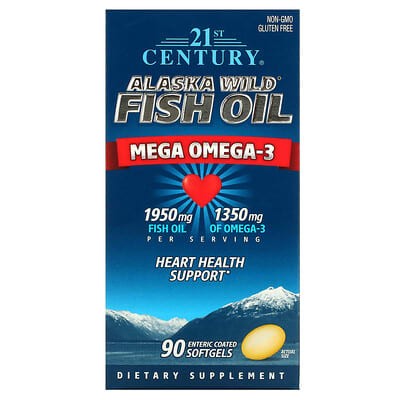
Alaska Wild Fish Oil Mega Omega-3

Goals
$12.58 $0.41 per serving


Product analysis
Alaska Wild Fish Oil Mega Omega-3 supplies EPA and DHA that may support healthy blood fats. The amounts of these two fats are clearly stated, but their chemical forms are unspecified, limiting comparison of absorption quality.
AI assessment of the formula, label and price. How scoring works
Nutrient Quality20
The chemical forms of EPA and DHA are not disclosed, so absorption quality is hard to compare. Other listed fats do not clarify that uncertainty.
Ingredient Transparency70
The separate EPA and DHA amounts make the active content easier to understand than total fish-oil weight alone. Their chemical forms are missing, which limits comparison between preparations.
Value For Money78
The serving offers good value for EPA and more moderate value for DHA. Value for the remaining fat content is uncertain.
Customer Satisfaction82
Customer feedback is strongly positive across a substantial number of ratings. The feedback supports satisfaction without proving cardiovascular or concentration benefits.
Product Focus76
The clearest purpose is supporting blood fats through EPA and DHA. Links to inflammation and longer-term brain nutrition are less certain and do not establish an immediate focus benefit.
- Format
Softgel - Container
- 90 Softgel(s)
- Per serving
- $0.41
- Customer rating
- 4.8 · 884 ratings
Goals

Impact
Highest effect
Fish Oil · 1950 mg
EPA and DHA can lower triglycerides, with direct evidence from much higher daily active amounts in selected populations. The separately disclosed active amounts are more informative than total fish-oil weight. The serving only partly matches those exposures, and triglyceride support does not establish prevention of cardiovascular events or rhythm stability.
How this product is rated for Cardiovascular Support
Ingredient fit83
The identified ingredients keep the formula focused, though its uses extend beyond cardiovascular support.
Goal fit
The identified ingredients keep the formula focused, though its uses extend beyond cardiovascular support.
Dose adequacy
The disclosed amounts partly meet the saved comparison ranges; small or unresolved amounts limit the finding.
Pathways60
The strongest recorded connection concerns triglyceride metabolism. This describes a mechanism rather than proven event prevention.
Depth
The strongest recorded connection concerns triglyceride metabolism. This describes a mechanism rather than proven event prevention.
Breadth
Only part of the selected cardiovascular mechanisms reaches the saved coverage threshold.
Evidence83
EPA declared active leads the saved evidence finding; the supported outcomes remain limited to the specific markers and populations described.
Evidence strength
EPA declared active leads the saved evidence finding; the supported outcomes remain limited to the specific markers and populations described.
Studied preparation
The saved findings recognize the evaluated preparations, while the supplied population and outcome limitations still apply.
Formulation logic100
No required partner is missing in the saved findings; this does not establish added benefit from combining ingredients.
Partner coverage
No required partner is missing in the saved findings; this does not establish added benefit from combining ingredients.
Conflicts
No matched ingredient conflict was recorded in the supplied findings.
Effective doses
All counted ingredients meet the saved minimum amount threshold, which does not prove a clinically effective cardiovascular dose.

Impact
Highest effect
EPA (Eicosapentaenoic Acid) · 965 mg
EPA and DHA offer modest support for triglyceride and selected vascular measures. The explicitly declared amounts receive substantial recognition, with EPA leading the saved evidence contribution. This does not establish prevention of major cardiovascular events or reproduce prescription purified-EPA treatment findings. The DHA catalogue entries refer to the same active amount and do not represent additional DHA.
How this product is rated for Heart Health
Ingredient fit90
EPA and DHA supply a focused marine-fatty-acid contribution.
Goal fit
EPA and DHA supply a focused marine-fatty-acid contribution.
Dose adequacy
EPA is near its full reference; DHA receives partial amount recognition.
Pathways60
The saved findings concentrate on triglyceride metabolism, with no other pathway reaching meaningful coverage.
Depth
The strongest covered pathway is triglyceride metabolism.
Breadth
One listed pathway reaches the coverage threshold.
Evidence100
EPA leads the recognized evidence contribution. The saved preparation recognition does not establish event prevention or remove the specific evidence limitations above.
Evidence strength
EPA provides the strongest recognized evidence contribution at the supplied amounts.
Studied preparation
Credited ingredients at recognized amounts meet the saved preparation criterion.
Formulation logic100
No required partner is missing and no configured conflict was identified. All credited amounts pass the saved minimum contribution threshold.
Partner coverage
All credited ingredients work alone or have their required partner.
Conflicts
No configured conflict was identified.
Effective doses
All credited amounts pass the saved minimum contribution threshold; this is not proof of clinical efficacy.
DHA (Docosahexaenoic Acid) Not classified
No linked studies yet.

Impact
High effect
Fish Oil · 1950 mg
EPA and DHA contribute to fatty-acid processes involved in inflammation, and supplied trials report changes in inflammatory markers with marine fatty acids. Results are inconsistent across studies and do not establish routine clinical benefit. The serving declares 965 mg EPA and 385 mg DHA separately; the saved result gives them unequal amount recognition, without treating total fish-oil weight as the active dose.
How this product is rated for Inflammation
Ingredient fit70
EPA and DHA provide the counted connection to this goal. Total fish-oil weight is not treated as an active dose.
Goal fit
The recognized ingredients are relatively focused on this goal, though the product is also linked to other goals.
Dose adequacy
EPA receives greater amount recognition than DHA; both contribute, while total fish-oil mass receives no independent credit.
Pathways44
Anti-inflammatory fatty-acid mediators is the strongest represented route in the saved findings. One route reaches the saved breadth threshold; the other routes remain limited.
Depth
Anti-inflammatory fatty-acid mediators is the strongest represented route in the saved findings.
Breadth
One route reaches the saved breadth threshold; the other routes remain limited.
Evidence70
EPA leads the saved evidence finding; marine fatty-acid biomarker results do not establish routine clinical benefit.
Evidence strength
EPA leads the saved evidence finding; marine fatty-acid biomarker results do not establish routine clinical benefit.
Studied preparation
The ingredients counted at recognized amounts match preparations accepted by the saved calculation; this does not expand their clinical benefits.
Formulation logic100
The counted ingredients have no missing partner or matched conflict and meet the saved amount threshold.
Partner coverage
The counted ingredients work independently or have their required partner.
Conflicts
No ingredient conflict was identified in the supplied calculation.
Effective doses
All counted ingredients reach the saved amount threshold; this threshold does not prove a clinical benefit.

Impact
High effect
DHA and EPA relate to longer-term brain nutrition rather than immediate focus. Positive DHA findings involved repeated use in adults with low intake and mainly memory or reaction-time outcomes. Long-term omega-3 results are mixed, so these findings do not establish an acute concentration benefit.
How this product is rated for Mental Focus
Ingredient fit77
The included amounts partly match the supplied comparisons, with low or undisclosed amounts limiting some contributions.
Goal fit
Several ingredients serve other purposes, giving the formula a broader focus than acute attention.
Dose adequacy
The included amounts partly match the supplied comparisons, with low or undisclosed amounts limiting some contributions.
Pathways60
The strongest saved connection concerns synaptic plasticity and neuroprotection; a mechanism-related finding does not establish broad attention improvement.
Depth
The strongest saved connection concerns synaptic plasticity and neuroprotection; a mechanism-related finding does not establish broad attention improvement.
Breadth
Coverage centers on one mechanism, leaving the other focus-related routes unrepresented.
Evidence56
EPA and DHA findings concern repeated use and selected outcomes, rather than immediate focus.
Evidence strength
EPA and DHA findings concern repeated use and selected outcomes, rather than immediate focus.
Studied preparation
Some included preparations do not match those studied, limiting transfer of the clinical findings.
Formulation logic100
No required partner is missing in the supplied findings; this does not establish synergy. No conflict was identified by the supplied checks.
Partner coverage
No required partner is missing in the supplied findings; this does not establish synergy.
Conflicts
No conflict was identified by the supplied checks.
Effective doses
All retained ingredients pass the minimum amount comparison, which is not proof of an effective clinical dose.
DHA (Docosahexaenoic Acid) Not classified
No linked studies yet.
Ingredients
| Ingredient | Amount per serving | Score |
|---|---|---|
Calories | 20 Calorie(s) | |
Total Fat | 2 Gram(s) | |
Polyunsaturated Fat | 1.5 Gram(s) | |
Cholesterol | 10 mg | |
Fish Oil | 1950 mg | |
Total EPA/DHA Omega-3 | 1350 mg | |
Eicosapentaenoic Acid | 965 mg | |
Docosahexaenoic Acid | 385 mg |
EPA (Eicosapentaenoic Acid) · 965 mg OverallScore80
A serving provides 965 mg of EPA, about 49.5% of the fish oil. The whole-product serving price works out to about $0.43 per gram of EPA.
How this ingredient is rated
Active Ingredient Quality & Bioavailability58
The EPA molecular form is not established in the saved information. EPA makes up about 49.5% of the 1950 mg of fish oil per serving. Tocopherol is identified as an antioxidant; its presence does not measure the oil’s oxidation.
Molecular Form and Bioavailability
The EPA molecular form is not established in the saved information.
EPA Concentration Density
EPA makes up about 49.5% of the 1950 mg of fish oil per serving.
Oxidation Protection
Tocopherol is identified as an antioxidant; its presence does not measure the oil’s oxidation.
Dose, Safety & Label Transparency92
Each serving has 965 mg of EPA and 385 mg of DHA. The oil is described as purified; a qualifying third-party contaminant-testing claim is not confirmed in the saved information.
Absolute EPA Dose per Serving
Each serving provides 965 mg of EPA, a higher amount.
EPA-Centric Ratio
Each serving has 965 mg of EPA and 385 mg of DHA, so EPA is higher.
Purity and Contaminant Testing
The oil is described as purified; a qualifying third-party contaminant-testing claim is not confirmed in the saved information.
Value100
Based on the whole-product serving price, the cost works out to about $0.43 per gram of EPA.
Price per Gram of EPA
Based on the whole-product serving price, the cost works out to about $0.43 per gram of EPA.
Fish Oil · 1950 mg OverallScore73
Each serving provides 965 mg of EPA and 385 mg of DHA from 1,950 mg of fish oil. At the whole-product serving price, that works out to about $0.31 per gram of EPA and DHA combined.
How this ingredient is rated
Active Ingredient Quality & Bioavailability44
The molecular form is not established in the saved facts. The evaluation records a specific purification method, although its name is not in the saved facts.
Omega-3 Molecular Form
The molecular form is not established in the saved facts.
Purification & Filtration Method
The evaluation records a specific purification method, although its name is not in the saved facts.
Third-Party Purity & Potency Verification
The saved facts do not record an independent-testing claim.
Source & Sustainability
The evaluation recognizes a fish source that meets its sourcing criteria.
Dose, Safety & Label Transparency88
A serving provides 1,350 mg of EPA and DHA combined. EPA and DHA together account for about 69.2% of the 1,950 mg of fish oil per serving. A qualifying antioxidant is recorded.
Total Active Omega-3 Dose (EPA + DHA)
A serving provides 1,350 mg of EPA and DHA combined.
Omega-3 Potency & Concentration
EPA and DHA together account for about 69.2% of the 1,950 mg of fish oil per serving.
EPA & DHA Individual Disclosure
EPA and DHA are listed separately at 965 mg and 385 mg per serving, respectively.
Oxidation Protection (Stabilizers)
The evaluation records a qualifying antioxidant, though its identity is not specified in the saved facts.
Value100
The whole-product serving price works out to about $0.31 per gram of EPA and DHA combined.
Cost Per Gram of Active EPA + DHA
The whole-product serving price works out to about $0.31 per gram of EPA and DHA combined.
DHA · 385 mg OverallScore65
Each serving provides 385 mg of DHA. The whole-product price works out to about $1.09 per gram of DHA.
How this ingredient is rated
Active Ingredient Quality & Bioavailability59
The DHA chemical form is not established in the saved facts. Total omega-3 accounts for about 69% of the oil.
DHA Chemical Form & Bioavailability
The saved facts do not establish the DHA chemical form; oil identity alone does not establish it.
Oxidation Protection & Stability
A protective antioxidant is recorded; that alone does not establish measured freshness or oxidation.
Oil Concentration & Purity
The recorded total omega-3 amount is about 69% of the oil mass; this is not the DHA percentage.
Dose, Safety & Label Transparency73
Each serving provides 385 mg of DHA. A fish or krill source is recorded. A distillation or purity-testing claim is recorded.
DHA Absolute Dosage
Each serving provides 385 mg of DHA.
Purity & Heavy Metal Verification
A distillation or purity-testing claim is recorded; actual contaminant results are not provided.
Ingredient Source Transparency
The saved facts record a fish or krill source for the DHA.
Value60
The whole-product price works out to about $1.09 per gram of DHA.
Price per Gram of DHA
The whole-product price works out to about $1.09 per gram of DHA.
Alternative products
Report alternatives
Sources
Published studies used for the product analysis and the top-ranked studies for each ingredient and goal.
- Marine Omega-3 Supplementation and Cardiovascular Disease: An Updated Meta-Analysis of 13 Randomized Controlled Trials Involving 127 477 Participants.
- Impact of omega-3 fatty acids on hypertriglyceridemia, lipidomics, and gut microbiome in patients with type 2 diabetes.
- A systematic review of fish-oil supplements for the prevention and treatment of hypertension.
- Effects of fish oil-derived fatty acids on suboptimal cardiovascular health: A multicenter, randomized, double-blind, placebo-controlled trial.
- Effect of High-Dose Marine Omega-3 Fatty Acids on Atherosclerosis: A Systematic Review and Meta-Analysis of Randomized Clinical Trials.
- Effects of eicosapentaenoic acid on major coronary events in hypercholesterolaemic patients (JELIS): a randomised open-label, blinded endpoint analysis.
- Effects of EPA on coronary artery disease in hypercholesterolemic patients with multiple risk factors: sub-analysis of primary prevention cases from the Japan EPA Lipid Intervention Study (JELIS).
- Effects of omega-3 fatty acids on coronary revascularization and cardiovascular events: a meta-analysis.
- Incremental effects of eicosapentaenoic acid on cardiovascular events in statin-treated patients with coronary artery disease.
- Omega-3 Fatty Acids for the Management of Hypertriglyceridemia: A Science Advisory From the American Heart Association.
- Dose-dependent effects of fish oil on cardio-metabolic biomarkers in healthy middle-aged and elderly Chinese people: a double-blind randomized controlled trial.
- Eicosapentaenoic acid supplementation alleviates pruritus, enhances skin moisture, and mitigates depression in maintenance hemodialysis patients.
- Lowering effects of fish oil supplementation on proinflammatory markers in hypertension: results from a randomized controlled trial.
- The effects of ω-3 fish oil emulsion-based parenteral nutrition plus combination treatment for acute paraquat poisoning.
- Effects of Omega-3 Fatty Acid Intake in Patients Undergoing Dialysis: A Systematic Review and Meta-Analysis of Randomized Controlled Trials.
- The influence of n-3 polyunsaturated fatty acids on cognitive function in individuals without dementia: a systematic review and dose-response meta-analysis.
- EPA supplementation improves teacher-rated behaviour and oppositional symptoms in children with ADHD.
- Docosahexaenoic Acid (DHA) and Eicosapentaenoic Acid (EPA)-Should They Be Mandatory Supplements in Pregnancy?
- Supplementation with oil rich in eicosapentaenoic acid, but not in docosahexaenoic acid, improves global cognitive function in healthy, young adults: results from randomized controlled trials.