No linked studies yet.
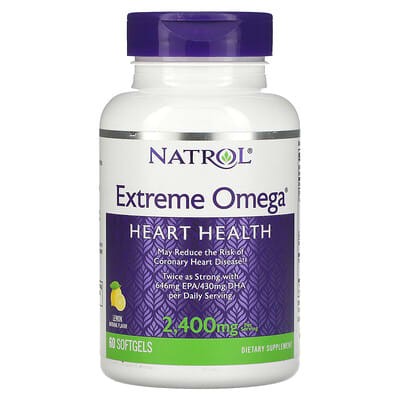
Extreme Omega 2400 mg Lemon Natural Flavor
Product analysis
Extreme Omega 2400 mg Lemon Natural Flavor supplies EPA and DHA at favorable value, with the clearest role in supporting triglyceride metabolism. Their individual amounts make the active omega-3 contribution easier to compare than total oil weight alone.
AI assessment of the formula, label and price. How scoring works
Nutrient Quality20
The specific EPA and DHA forms are not disclosed. That limits a clear comparison of absorption quality, without establishing that the oil itself is poor quality.
Ingredient Transparency40
EPA and DHA amounts are stated separately, helping you compare the active omega-3 content. Several other amounts, forms and component details are missing, so the full fat profile is less clear.
Value For Money72
EPA and DHA offer favorable value at the whole-product cost. Value for the other fat components cannot be judged confidently.
Customer Satisfaction82
Customer feedback is very positive across several hundred ratings. The review base supports the satisfaction picture without proving cardiovascular benefits.
Product Focus69
EPA and DHA give the formula a clear omega-3 purpose, centered on triglyceride metabolism. Changes in blood markers do not establish noticeable symptom relief or prevention of cardiovascular events.
- Format
Softgel - Container
- 60 Softgel(s)
- Per serving
- $0.39
- Customer rating
- 4.8 · 795 ratings
Goals
EPA and DHA have a connection to triglyceride and selected vascular measures. This product declares their active amounts separately, rather than relying on fish-oil mass. Routine supplementation has not demonstrated a general reduction in major cardiovascular events in the supplied primary-prevention evidence. Results from prescription purified EPA in selected high-risk patients do not transfer to this supplement.
How this product is rated for Heart Health
Ingredient fit76
Goal fit
Dose adequacy
Pathways59
Depth
Breadth
Evidence100
Evidence strength
Studied preparation
Formulation logic100
Partner coverage
Conflicts
Effective doses
The declared EPA and DHA connect this product mainly to triglyceride metabolism. Trials support triglyceride lowering at specific daily exposures and preparations, but separately declared fatty acids cannot automatically reproduce a combined-product trial. The supplied findings do not establish prevention of major cardiovascular events, and a label serving does not specify the duration or frequency used in trials.

How this product is rated for Cardiovascular Support
Ingredient fit85
Goal fit
Dose adequacy
Pathways60
Depth
Breadth
Evidence83
Evidence strength
Studied preparation
Formulation logic100
Partner coverage
Conflicts
Effective doses
EPA and DHA may lower some markers of inflammation in the blood. These marine omega-3 fats offer a more direct connection to inflammation than fish-oil weight alone, because their individual amounts are declared here. A change in a blood marker does not tell you whether you will feel better or get a broad clinical benefit.

How this product is rated for Inflammation
Ingredient fit65
Goal fit
Dose adequacy
Pathways17
Depth
Breadth
Evidence70
Evidence strength
Studied preparation
Formulation logic100
Partner coverage
Conflicts
Effective doses
The serving supplies 430 mg DHA and 646 mg EPA. These omega-3s relate mainly to longer-term brain support; the supplied evidence does not support expecting an immediate improvement in concentration, and DHA findings depend on intake and duration.
How this product is rated for Mental Focus
Ingredient fit62
Goal fit
Dose adequacy
Pathways53
Depth
Breadth
Evidence56
Evidence strength
Studied preparation
Formulation logic100
Partner coverage
Conflicts
Effective doses
No linked studies yet.
Ingredients
| Ingredient | Amount per serving | Score |
|---|---|---|
Calories | 30 Calorie(s) | |
Total Fat | 3 Gram(s) | |
Saturated Fat | 0 Gram(s) | |
Trans Fat | 0 Gram(s) | |
Polyunsaturated Fat | 2 Gram(s) | |
Monounsaturated Fat | 0 Gram(s) | |
Cholesterol | 20 mg | |
Vitamin E (D-Alpha-Tocopherol) | 20.1 mg | |
Omega-3 Fish Oil | 2400 mg | |
Eicosapentaenoic Acid | 646 mg | |
Docosahexaenoic Acid | 430 mg |
How this ingredient is rated
Active Ingredient Quality & Bioavailability50
Molecular Form and Bioavailability
EPA Concentration Density
Oxidation Protection
Dose, Safety & Label Transparency82
Absolute EPA Dose per Serving
EPA-Centric Ratio
Purity and Contaminant Testing
Value80
Price per Gram of EPA
How this ingredient is rated
Active Ingredient Quality & Bioavailability44
Omega-3 Molecular Form
Purification & Filtration Method
Third-Party Purity & Potency Verification
Source & Sustainability
Dose, Safety & Label Transparency79
Total Active Omega-3 Dose (EPA + DHA)
Omega-3 Potency & Concentration
EPA & DHA Individual Disclosure
Oxidation Protection (Stabilizers)
Value100
Cost Per Gram of Active EPA + DHA
How this ingredient is rated
Active Ingredient Quality & Bioavailability42
DHA Chemical Form & Bioavailability
Oxidation Protection & Stability
Oil Concentration & Purity
Dose, Safety & Label Transparency73
DHA Absolute Dosage
Purity & Heavy Metal Verification
Ingredient Source Transparency
Value80
Price per Gram of DHA
Alternative products
Sources
Published studies used for the product analysis and the top-ranked studies for each ingredient and goal.
- Marine Omega-3 Supplementation and Cardiovascular Disease: An Updated Meta-Analysis of 13 Randomized Controlled Trials Involving 127 477 Participants.
- Impact of omega-3 fatty acids on hypertriglyceridemia, lipidomics, and gut microbiome in patients with type 2 diabetes.
- A systematic review of fish-oil supplements for the prevention and treatment of hypertension.
- Effects of fish oil-derived fatty acids on suboptimal cardiovascular health: A multicenter, randomized, double-blind, placebo-controlled trial.
- Effect of High-Dose Marine Omega-3 Fatty Acids on Atherosclerosis: A Systematic Review and Meta-Analysis of Randomized Clinical Trials.
- Supplementation with vitamin E alone is associated with reduced myocardial infarction: a meta-analysis.
- Vitamin E ameliorates blood cholesterol level and alters gut microbiota composition: A randomized controlled trial.
- Effects of long-term vitamin E supplementation on cardiovascular events and cancer: a randomized controlled trial.
- Independent and combined associations of dietary antioxidant exposure with all-cause and cause-specific mortality in the general population.
- Tocotrienol rich fraction supplementation improved lipid profile and oxidative status in healthy older adults: A randomized controlled study.
- Effects of eicosapentaenoic acid on major coronary events in hypercholesterolaemic patients (JELIS): a randomised open-label, blinded endpoint analysis.
- Effects of EPA on coronary artery disease in hypercholesterolemic patients with multiple risk factors: sub-analysis of primary prevention cases from the Japan EPA Lipid Intervention Study (JELIS).
- Effects of omega-3 fatty acids on coronary revascularization and cardiovascular events: a meta-analysis.
- Incremental effects of eicosapentaenoic acid on cardiovascular events in statin-treated patients with coronary artery disease.
- Omega-3 Fatty Acids for the Management of Hypertriglyceridemia: A Science Advisory From the American Heart Association.
- Dose-dependent effects of fish oil on cardio-metabolic biomarkers in healthy middle-aged and elderly Chinese people: a double-blind randomized controlled trial.
- Eicosapentaenoic acid supplementation alleviates pruritus, enhances skin moisture, and mitigates depression in maintenance hemodialysis patients.
- Lowering effects of fish oil supplementation on proinflammatory markers in hypertension: results from a randomized controlled trial.
- The effects of ω-3 fish oil emulsion-based parenteral nutrition plus combination treatment for acute paraquat poisoning.
- Effects of Omega-3 Fatty Acid Intake in Patients Undergoing Dialysis: A Systematic Review and Meta-Analysis of Randomized Controlled Trials.