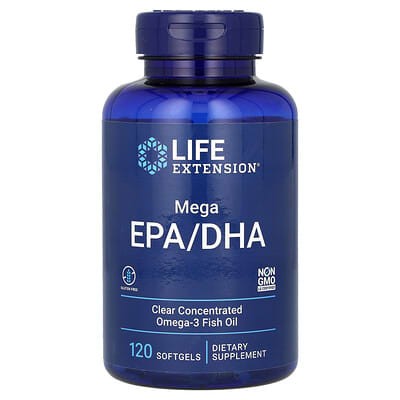
Mega EPA/DHA

Mega EPA/DHA

Life Extension4.9 (10,930 ratings)
Format:Softgel Quantity: 120 Softgel(s) · 60 servings
Goals
$22.50 $0.37 per serving

Product analysis

62 out of 100

Mega EPA/DHA supplies omega-3 fats with support for how the body manages triglycerides, a type of blood fat. The separate EPA and DHA amounts make it easier to compare the relevant fats with other fish-oil supplements.

AI assessment of the formula, label and price. How scoring works

Nutrient Quality21

The EPA and DHA chemical forms are unspecified, limiting comparisons between oil preparations. Other incomplete ingredient details leave the broader quality picture uncertain.

Ingredient Transparency59

EPA and DHA amounts are disclosed separately from the larger oil weight, making the relevant fats easier to compare. Another ingredient lacks an amount, and most specific forms remain missing.

Value For Money92

Both EPA and DHA offer favorable value for the full serving cost. Separate active-fat amounts make those cost comparisons more informative than total oil weight alone.

Customer Satisfaction95

Customer feedback is strongly positive across a very large number of ratings. That provides a broad picture of buyer satisfaction, without establishing heart-health effects.

Product Focus73

EPA and DHA give the formula a clear central purpose in omega-3 nutrition. Its triglyceride-related role has a clearer basis than immediate focus or reliable everyday inflammation relief.

Format
Softgel
Container
120 Softgel(s)
Per serving
$0.37
Customer rating
4.9 · 10,930 ratings
Report analysis

Goals

Impact
Highest effect
B Ingredient FitC PathwaysA+ EvidenceA+ Formulation Logic
EPA (Eicosapentaenoic Acid) · 720 mg

EPA and DHA contribute mainly to triglyceride-related support, with limited evidence for selected blood-pressure measures. This serving explicitly declares their amounts, so the assessment can distinguish active fatty acids from the larger fish-oil weight. Routine EPA/DHA supplementation has not established general cardiovascular-event prevention, and findings from prescription purified EPA do not transfer to this product. Combining EPA and DHA does not establish an extra benefit.

How this product is rated for Heart Health

Ingredient fit79

Heart-related ingredients sit within a broader formula with other active ingredients. The relevant declared amounts provide substantial but incomplete coverage of the saved exposure comparison.
Goal fit
Heart-related ingredients sit within a broader formula with other active ingredients.
Dose adequacy
The relevant declared amounts provide substantial but incomplete coverage of the saved exposure comparison.

Pathways60

The strongest saved connection is to triglyceride metabolism. Coverage across other heart-related roles is limited.
Depth
The strongest saved connection is to triglyceride metabolism.
Breadth
The broader saved findings cover triglyceride metabolism. .

Evidence100

EPA (Eicosapentaenoic Acid) leads the saved evidence finding. Accepted preparation matches do not remove the ingredient-specific limitations described above.
Evidence strength
EPA (Eicosapentaenoic Acid) provides the leading evidence contribution in the saved comparison; its clinical limitations still apply.
Studied preparation
The saved finding accepts the preparations used for its included ingredients; it does not establish that every labelled preparation matches a clinical trial.

Formulation logic100

The saved checks find no missing required partner or configured conflict. The included amounts pass the minimum comparison screen.
Partner coverage
The included ingredients do not lack a required partner under the saved finding; this does not establish added benefit from combining them.
Conflicts
No configured ingredient conflict was triggered by the supplied facts.
Effective doses
All ingredients included in this amount screen meet its minimum comparison level; that level is not a proven effective dose.
Study evidence
Inflammation
Impact
Moderate effect
C+ Ingredient FitF PathwaysC+ EvidenceA+ Formulation Logic
Fish Oil · 2000 mgVitamin E · 2.7 mcg
Study evidence
Fish Oil Supportive 68 studies
Vitamin E Supportive 20 studies
Cardiovascular Support
Impact
Highest effect
A- Ingredient FitC PathwaysB+ EvidenceA+ Formulation Logic
Fish Oil · 2000 mgVitamin E · 2.7 mcg

EPA and DHA are the relevant fish-oil components for triglyceride metabolism. The declared active amounts, rather than total oil weight, underpin the saved findings. The supporting trials used specific preparations and populations, so these marker findings do not establish prevention of heart attacks, strokes or rhythm problems.

How this product is rated for Cardiovascular Support

Ingredient fit87

Relevant ingredients sit within a broader formula, so cardiovascular support is only part of its focus.
Goal fit
Relevant ingredients sit within a broader formula, so cardiovascular support is only part of its focus.
Dose adequacy
The declared amounts provide partial support across the relevant ingredients; lower or unresolved amounts limit the finding.

Pathways60

Triglyceride metabolism is the main area represented in the saved findings. Other cardiovascular functions have less support here.
Depth
The strongest saved coverage concerns triglyceride metabolism.
Breadth
Coverage is concentrated in one main area rather than spread across several cardiovascular functions.

Evidence83

The saved findings include study-matched ingredients, but marker changes and normal nutrient roles do not establish cardiovascular-event prevention.
Evidence strength
EPA declared active provides the strongest included evidence, with the population and outcome limitations described above.
Studied preparation
The included preparations meet the saved study-match criteria; this does not establish equivalent benefits for every person or form.

Formulation logic100

The included ingredients have no identified partner gap or configured conflict. Their amounts reach the saved minimum comparison.
Partner coverage
The included ingredients can contribute alone or have their required partner; no additional combination benefit is established.
Conflicts
No configured ingredient conflict was identified in the supplied facts.
Effective doses
The included ingredients reach the saved minimum amount comparison; this is not a proven clinical-benefit threshold.
Study evidence
Fish Oil Supportive 185 studies
Vitamin E Mixed 79 studies
Mental Focus
Impact
High effect
B- Ingredient FitC- PathwaysC- EvidenceA+ Formulation Logic
Study evidence

Ingredients

IngredientAmount per servingScore
Calories
20 Calorie(s)
Total Fat
2 Gram(s)
Vitamin E (D-Alpha-Tocopherol)
2.7 mcg
Fish Oil Concentrate
2000 mg 61
Eicosapentaenoic Acid
720 mg 72
Docosahexaenoic Acid
480 mg 52
Adults 18–50
Report overview
C Active Ingredient Quality & BioavailabilityB- Dose, Safety & Label TransparencyA+ Value
The serving provides 720 mg of EPA at a low cost per gram. Its molecular form is unspecified. No purification or contaminant-testing claim is identified.
How this ingredient is rated

Active Ingredient Quality & Bioavailability60

The EPA molecular form is not specified. EPA makes up about 36% of the fish oil. Tocopherols and an additional antioxidant, either rosemary extract or astaxanthin, are indicated.
Molecular Form and Bioavailability
The EPA molecular form is not specified.
EPA Concentration Density
EPA makes up about 36% of the fish oil.
Oxidation Protection
Tocopherols and an additional antioxidant, either rosemary extract or astaxanthin, are indicated.

Dose, Safety & Label Transparency70

Each serving provides 720 mg of EPA. The serving has 480 mg of DHA, less than its EPA. No purification or contaminant-testing claim is identified.
Absolute EPA Dose per Serving
Each serving provides 720 mg of EPA.
EPA-Centric Ratio
The serving has 480 mg of DHA, less than its EPA.
Purity and Contaminant Testing
No purification or contaminant-testing claim is identified.

Value100

The cost per gram of EPA is low.
Price per Gram of EPA
The cost per gram of EPA is low.
Fish Oil · 2000 mg OverallScore61
F Active Ingredient Quality & BioavailabilityA- Dose, Safety & Label TransparencyA+ Value
A serving contains 2000 mg of fish oil. It provides 1200 mg combined EPA and DHA, at a low estimated cost per gram. The molecular form is also unclear.
How this ingredient is rated

Active Ingredient Quality & Bioavailability14

The molecular form of the oil is not specified. No purification process is specified. No independent testing is mentioned. A specific fish source is identified.
Omega-3 Molecular Form
The molecular form of the oil is not specified.
Purification & Filtration Method
No purification process is specified.
Third-Party Purity & Potency Verification
No independent testing is mentioned.
Source & Sustainability
A specific fish source is identified.

Dose, Safety & Label Transparency88

A serving provides 720 mg EPA and 480 mg DHA, totaling 1200 mg. An antioxidant for oil protection is included.
Total Active Omega-3 Dose (EPA + DHA)
A serving provides 720 mg EPA and 480 mg DHA, totaling 1200 mg.
Omega-3 Potency & Concentration
EPA and DHA make up about 60% of the fish oil.
EPA & DHA Individual Disclosure
EPA and DHA amounts are listed separately.
Oxidation Protection (Stabilizers)
An antioxidant for oil protection is included.

Value100

The estimated cost per gram of EPA and DHA is low.
Cost Per Gram of Active EPA + DHA
The estimated cost per gram of EPA and DHA is low.
DHA · 480 mg OverallScore52
D- Active Ingredient Quality & BioavailabilityD Dose, Safety & Label TransparencyB+ Value
A serving provides 480 mg of DHA. The cost per gram of DHA is low. The chemical form of DHA is unspecified. No purity testing or distillation claim is available.
How this ingredient is rated

Active Ingredient Quality & Bioavailability42

The chemical form of DHA is unspecified. The oil concentration is unclear without a comparable total omega-3 or combined EPA and DHA amount and oil amount.
DHA Chemical Form & Bioavailability
The chemical form of DHA is unspecified.
Oxidation Protection & Stability
An antioxidant is indicated, though its identity is not available here.
Oil Concentration & Purity
The oil concentration is unclear without a comparable total omega-3 or combined EPA and DHA amount and oil amount.

Dose, Safety & Label Transparency49

A serving provides 480 mg of DHA. No purity testing or distillation claim is available.
DHA Absolute Dosage
A serving provides 480 mg of DHA.
Purity & Heavy Metal Verification
No purity testing or distillation claim is available.
Ingredient Source Transparency
The source includes small fish or krill, though the specific source is not identified here.

Value80

The cost per gram of DHA is low.
Price per Gram of DHA
The cost per gram of DHA is low.
Report alternatives

Sources

Published studies used for the product analysis and the top-ranked studies for each ingredient and goal.

  1. Marine Omega-3 Supplementation and Cardiovascular Disease: An Updated Meta-Analysis of 13 Randomized Controlled Trials Involving 127 477 Participants.
    Hu Y; Hu FB; Manson JE · Journal of the American Heart Association · 2020
    Meta-analysis127,477 participants13 studies pooledCardiovascular Support forFish Oil
  2. Impact of omega-3 fatty acids on hypertriglyceridemia, lipidomics, and gut microbiome in patients with type 2 diabetes.
    Lu J; Liu R; Ren H; Wang S; Hu C; Shi Z; Li M; Liu W; Wan Q; Su Q; Li Q; Zheng H; Qu S; Yang F; Ji H; Lin H; Qi H; Wu X; Wu K; Chen Y; Xu Y; Xu M; Wang T; Zheng J; Ning G; Zheng R; Bi Y; Zhong H; Wang W · Med (New York, N.Y.) · 2025
    Randomized trial309 participantsCardiovascular Support forFish Oil
  3. A systematic review of fish-oil supplements for the prevention and treatment of hypertension.
    Campbell F; Dickinson HO; Critchley JA; Ford GA; Bradburn M · European journal of preventive cardiology · 2013
    Meta-analysis1,524 participants17 studies pooledCardiovascular Support forFish Oil
  4. Effects of fish oil-derived fatty acids on suboptimal cardiovascular health: A multicenter, randomized, double-blind, placebo-controlled trial.
    Zeng Q; Dong SY; Liu YP; Fu J; Shuai P; Zhao ZM; Li TX · Nutrition, metabolism, and cardiovascular diseases : NMCD · 2017
    Randomized trial422 participantsCardiovascular Support forFish Oil
  5. Effect of High-Dose Marine Omega-3 Fatty Acids on Atherosclerosis: A Systematic Review and Meta-Analysis of Randomized Clinical Trials.
    Sekikawa A; Cui C; Sugiyama D; Fabio A; Harris WS; Zhang X · Nutrients · 2020
    Meta-analysis6 studies pooledCardiovascular Support forFish Oil
  6. Supplementation with vitamin E alone is associated with reduced myocardial infarction: a meta-analysis.
    Loffredo L; Perri L; Di Castelnuovo A; Iacoviello L; De Gaetano G; Violi F · Nutrition, metabolism, and cardiovascular diseases : NMCD · 2016
    Meta-analysis16 studies pooledCardiovascular Support forVitamin E
  7. Vitamin E ameliorates blood cholesterol level and alters gut microbiota composition: A randomized controlled trial.
    Chen B; Li Y; Li Z; Hu X; Zhen H; Chen H; Nie C; Hou Y; Zhu S; Xiao L; Li T · Nutrition, metabolism, and cardiovascular diseases : NMCD · 2025
    Randomized trial90 participantsCardiovascular Support forVitamin E
  8. Effects of long-term vitamin E supplementation on cardiovascular events and cancer: a randomized controlled trial.
    Lonn E; Bosch J; Yusuf S; Sheridan P; Pogue J; Arnold JM; Ross C; Arnold A; Sleight P; Probstfield J; Dagenais GR; HOPE and HOPE-TOO Trial Investigators · JAMA · 2005
    Randomized trial9,541 participantsCardiovascular Support forVitamin E
  9. Independent and combined associations of dietary antioxidant exposure with all-cause and cause-specific mortality in the general population.
    Liu Z; He Z; Xing Y · Journal of nutritional science · 2026
    Cohort study34,955 participantsCardiovascular Support forVitamin E
  10. Tocotrienol rich fraction supplementation improved lipid profile and oxidative status in healthy older adults: A randomized controlled study.
    Chin SF; Ibahim J; Makpol S; Abdul Hamid NA; Abdul Latiff A; Zakaria Z; Mazlan M; Mohd Yusof YA; Abdul Karim A; Wan Ngah WZ · Nutrition & metabolism · 2011
    Randomized trial62 participantsCardiovascular Support forVitamin E
  11. Effects of eicosapentaenoic acid on major coronary events in hypercholesterolaemic patients (JELIS): a randomised open-label, blinded endpoint analysis.
    Yokoyama M; Origasa H; Matsuzaki M; Matsuzawa Y; Saito Y; Ishikawa Y; Oikawa S; Sasaki J; Hishida H; Itakura H; Kita T; Kitabatake A; Nakaya N; Sakata T; Shimada K; Shirato K; Japan EPA lipid intervention study (JELIS) Investigators · Lancet (London, England) · 2007
    Randomized trial18,645 participantsHeart Health forEPA (Eicosapentaenoic Acid)
  12. Effects of EPA on coronary artery disease in hypercholesterolemic patients with multiple risk factors: sub-analysis of primary prevention cases from the Japan EPA Lipid Intervention Study (JELIS).
    Saito Y; Yokoyama M; Origasa H; Matsuzaki M; Matsuzawa Y; Ishikawa Y; Oikawa S; Sasaki J; Hishida H; Itakura H; Kita T; Kitabatake A; Nakaya N; Sakata T; Shimada K; Shirato K; JELIS Investigators, Japan · Atherosclerosis · 2008
    Randomized trial14,981 participantsHeart Health forEPA (Eicosapentaenoic Acid)
  13. Effects of omega-3 fatty acids on coronary revascularization and cardiovascular events: a meta-analysis.
    Dinu M; Sofi F; Lotti S; Colombini B; Mattioli AV; Catapano AL; Casula M; Baragetti A; Wong ND; Steg PG; Ambrosio G · European journal of preventive cardiology · 2024
    Meta-analysis134,144 participants18 studies pooledHeart Health forEPA (Eicosapentaenoic Acid)
  14. Incremental effects of eicosapentaenoic acid on cardiovascular events in statin-treated patients with coronary artery disease.
    Matsuzaki M; Yokoyama M; Saito Y; Origasa H; Ishikawa Y; Oikawa S; Sasaki J; Hishida H; Itakura H; Kita T; Kitabatake A; Nakaya N; Sakata T; Shimada K; Shirato K; Matsuzawa Y; JELIS Investigators · Circulation journal : official journal of the Japanese Circulation Society · 2009
    Randomized trialHeart Health forEPA (Eicosapentaenoic Acid)
  15. Omega-3 Fatty Acids for the Management of Hypertriglyceridemia: A Science Advisory From the American Heart Association.
    Skulas-Ray AC; Wilson PWF; Harris WS; Brinton EA; Kris-Etherton PM; Richter CK; Jacobson TA; Engler MB; Miller M; Robinson JG; Blum CB; Rodriguez-Leyva D; de Ferranti SD; Welty FK; American Heart Association Council on Arteriosclerosis, Thrombosis and Vascular Biology; Council on Lifestyle and Cardiometabolic Health; Council on Cardiovascular Disease in the Young; Council on Cardiovascular and Stroke Nursing; and Council on Clinical Cardiology · Circulation · 2020
    OtherHeart Health forEPA (Eicosapentaenoic Acid)
  16. Dose-dependent effects of fish oil on cardio-metabolic biomarkers in healthy middle-aged and elderly Chinese people: a double-blind randomized controlled trial.
    Song J; Hu M; Li C; Yang B; Ding Q; Wang C; Mao L · Food & function · 2018
    Randomized trial201 participantsInflammation forFish Oil
  17. Eicosapentaenoic acid supplementation alleviates pruritus, enhances skin moisture, and mitigates depression in maintenance hemodialysis patients.
    Lin YL; Wang CL; Chiang TI · Frontiers in nephrology · 2024
    Randomized trial60 participantsInflammation forFish Oil
  18. Lowering effects of fish oil supplementation on proinflammatory markers in hypertension: results from a randomized controlled trial.
    Yang B; Ren XL; Li ZH; Shi MQ; Ding F; Su KP; Guo XJ; Li D · Food & function · 2020
    Randomized trial77 participantsInflammation forFish Oil
  19. The effects of ω-3 fish oil emulsion-based parenteral nutrition plus combination treatment for acute paraquat poisoning.
    Meng Z; Dong Y; Gao H; Yao D; Gong Y; Meng Q; Zheng T; Cui X; Su X; Tian Y · The Journal of international medical research · 2019
    Randomized trial174 participantsInflammation forFish Oil
  20. Effects of Omega-3 Fatty Acid Intake in Patients Undergoing Dialysis: A Systematic Review and Meta-Analysis of Randomized Controlled Trials.
    Liu R; Jiang J; Fu Z; Liu C; Yao L; Quan H · Journal of the American Nutrition Association · 2022
    Meta-analysis49 studies pooledInflammation forFish Oil