
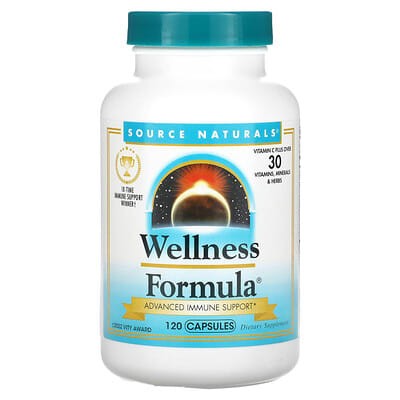

$18.38 $0.91 per serving


Product analysis
Wellness Formula provides nutrients that support normal immune function, especially when dietary intake is low. Limited ingredient-form and composition details make the full combination harder to compare.
AI assessment of the formula, label and price. How scoring works
Nutrient Quality31
Zinc uses favorable forms, while selenium uses a less favorable form. Most botanical forms are unspecified, limiting a confident comparison of the wider formula.
Ingredient Transparency56
All amounts are listed, but most ingredient forms are unspecified. The proportions within combined nutrient sources are undisclosed, limiting a full comparison.
Value For Money31
The confirmed comparisons are mostly unfavorable, including zinc and selenium. Value for many other ingredients remains uncertain.
Customer Satisfaction91
Customer ratings are consistently very positive. A substantial number of ratings provides a broad view of customer satisfaction.
Product Focus37
The clearest role is filling nutritional gaps that affect normal immune function and related body processes. The many botanicals do not establish an additional benefit once nutrient needs are met.
- Format
Capsule - Container
- 120 Capsule(s)
- Per serving
- $0.91
- Also available
 Wellness Formula$11.62
- Customer rating
- 4.8 · 5,016 ratings
Goals

Impact
Highest effect
Vitamin C · 1300 mgZinc · 23 mgVitamin A · 1500 mcgVitamin D · 20 mcgSelenium · 60 mcgEuropean Elder · 240 mgPropolis · 295 mg
Vitamin C supports immune-cell activity and may modestly shorten colds with regular use. Vitamins A and D support normal immune regulation and barriers, while zinc and selenium contribute to normal immune function, especially when intake is low. Propolis is counted in the saved findings, but its generic amount does not reproduce evidence from a standardized acute throat spray.
How this product is rated for Immunity
Ingredient fit56
Vitamin C, zinc, vitamins A and D, selenium and propolis are counted within a broad formula. Their declared amounts meet the minimum saved comparison.
Goal fit
The formula includes relevant nutrients alongside ingredients aimed at other goals.
Dose adequacy
Vitamin C and vitamin A reach their full saved comparisons; zinc, vitamin D, selenium and propolis contribute at smaller relative amounts.
Pathways100
The saved findings span several immune functions, although this does not establish prevention of infection.
Depth
Barrier defense is a strongest tracked area, alongside substantial innate activity and immune regulation.
Breadth
All four tracked immune areas reach the saved breadth comparison.
Evidence100
Vitamin C supplies the clearest respiratory-symptom connection, while other nutrients mainly support normal immune function.
Evidence strength
Vitamin C has the strongest supporting connection among the ingredients meeting the saved amount comparison.
Studied preparation
The saved findings accept the counted preparations; this does not establish a special benefit for the product's particular forms.
Formulation logic100
The counted ingredients need no additional partner. The saved findings identify no matched ingredient conflict.
Partner coverage
The counted ingredients can contribute without an additional partner.
Conflicts
No configured ingredient conflict was matched.
Effective doses
All six counted ingredients meet the saved minimum amount comparison.
Ginger Not classified
No linked studies yet.

Impact
High effect
Vitamin D · 20 mcgPropolis · 295 mgVitamin C · 1300 mg
Zinc can help address low intake that contributes to inflammatory signalling, while vitamin C has shown a CRP reduction mainly in people with elevated starting CRP. Propolis composition varies with botanical origin and extraction, so selected-disease findings do not establish a generic systemic benefit. Selenium’s normal antioxidant role does not prove extra benefit when intake is adequate. The small garlic and ginger amounts received no contribution.
How this product is rated for Inflammation
Ingredient fit48
Relevant ingredients sit within a broader formula, limiting its focus on this particular goal. Smaller or unresolved amounts limit the comparison with the referenced exposures.
Goal fit
Relevant ingredients sit within a broader formula, limiting its focus on this particular goal.
Dose adequacy
Smaller or unresolved amounts limit the comparison with the referenced exposures.
Pathways80
Oxidative and mitochondrial stress is the strongest recorded mechanism; this does not establish broad clinical benefit.
Depth
Oxidative and mitochondrial stress is the strongest recorded mechanism; this does not establish broad clinical benefit.
Breadth
Two inflammatory mechanisms reached the required coverage level; other mechanisms remained less represented.
Evidence96
Propolis leads the saved evidence finding, with its specific population and outcome limitations still applying.
Evidence strength
Propolis leads the saved evidence finding, with its specific population and outcome limitations still applying.
Studied preparation
Contributing preparations matched those recognized in the saved result; this does not establish a trial of the complete product.
Formulation logic100
No missing required partner or configured conflict reduced recognized contributions. All counted amounts reached the minimum comparison threshold.
Partner coverage
No missing required partner reduced recognized contributions; this does not demonstrate extra benefit from combining ingredients.
Conflicts
No configured ingredient conflict was identified in the supplied calculation.
Effective doses
All counted ingredients reached the minimum comparison threshold, which is not a proven minimum effective clinical dose.

Impact
High effect
Vitamin D · 20 mcgSelenium · 60 mcgZinc · 23 mgVitamin C · 1300 mg
Vitamin C, zinc and selenium contribute to normal antioxidant and immune functions and can help fill dietary gaps. Vitamin D also supplies mineral nutrition. These nutrient roles do not establish immune enhancement above adequacy or routine prevention of illness. Elderberry's limited acute respiratory research does not establish daily wellness or prevention, and the small ginger and calcium amounts are excluded.
How this product is rated for Everyday Health
Ingredient fit49
Recognized nutrients sit among 21 other actives, making this a broad formula with limited goal focus.
Goal fit
Recognized nutrients sit among 21 other actives, making this a broad formula with limited goal focus.
Dose adequacy
Included amounts receive partial overall recognition; excluded small nutrient and ginger amounts add none.
Pathways60
Antioxidant and immune functions dominate, with a smaller bone/mineral contribution.
Depth
Antioxidant and immune functions receive the strongest coverage.
Breadth
Only antioxidant and immune functions meet the coverage threshold.
Evidence82
Vitamin D leads the saved evidence comparison; its contribution concerns nutrient availability when intake is low.
Evidence strength
Vitamin D supplies the strongest saved evidence contribution, without establishing added benefit above nutritional adequacy.
Studied preparation
All 5 ingredients meeting the amount threshold pass the preparation comparison; named forms receive no superiority bonus.
Formulation logic100
Recognized ingredients have no missing required partner or listed conflict; their amount findings are described separately.
Partner coverage
No credited ingredient lacks a required partner.
Conflicts
No listed ingredient conflict was found.
Effective doses
All 5 included ingredients reach the minimum exposure threshold, which is not a proven clinical benefit threshold.

Impact
High effect
Vitamin D · 20 mcgZinc · 23 mgVitamin C · 1300 mg
Zinc can help address shedding related to zinc deficiency, without establishing added regrowth when intake is adequate. Vitamin C supports normal collagen production and selenium participates in antioxidant biology, but these roles do not establish routine hair-growth benefits. The vitamin A amount remains unresolved because stored declarations do not match the imported ingredient inventory; it cannot be treated as a quantified contribution.
How this product is rated for Hair Health
Ingredient fit48
The formula has a broad nutritional or other focus, which limits its concentration on hair health. The relevant amounts only partly meet the saved comparison, so their practical contribution is limited.
Goal fit
The formula has a broad nutritional or other focus, which limits its concentration on hair health.
Dose adequacy
The relevant amounts only partly meet the saved comparison, so their practical contribution is limited.
Pathways60
The strongest recorded connection concerns follicle antioxidant protection, without establishing a clinical hair-growth effect.
Depth
The strongest recorded connection concerns follicle antioxidant protection, without establishing a clinical hair-growth effect.
Breadth
Only follicle antioxidant protection reached the saved coverage threshold; this does not establish broader hair effects.
Evidence98
Zinc leads the saved evidence comparison, but its supplied limitations still determine what hair benefits can be expected.
Evidence strength
Zinc leads the saved evidence comparison, but its supplied limitations still determine what hair benefits can be expected.
Studied preparation
The included preparations meet the saved preparation finding; this does not establish a trial of the finished product.
Formulation logic95
The included contributions have no missing required partner or recorded conflict. Amount thresholds describe the saved comparison, not demonstrated hair results.
Partner coverage
No required partner was missing for the included contributions; this does not establish an extra benefit from combining ingredients.
Conflicts
No ingredient conflict was recorded in the supplied findings.
Effective doses
Some contributions do not pass the saved minimum amount threshold, including the unresolved vitamin A amount.

Impact
Moderate effect
Vitamin C at 1300 mg supports collagen formation, while zinc and vitamin D contribute to normal cell functions. Selenium supplies a nutrient rather than a well-established standalone nail intervention. Higher vitamin C amounts do not establish a proportionally larger nail benefit.
How this product is rated for Nail Health
Ingredient fit50
The assessment identifies 4 relevant ingredients, alongside 25 other actives. The product is linked to 12 goals. The saved amount assessment is largely aligned with its ingredient benchmarks.
Goal fit
The assessment identifies 4 relevant ingredients, alongside 25 other actives. The product is linked to 12 goals.
Dose adequacy
The saved amount assessment is largely aligned with its ingredient benchmarks. Undisclosed amounts add no support.
Pathways60
The strongest saved coverage is in silicon and matrix cross-linking. 1 of 2 target areas reaches the saved coverage threshold: silicon and matrix cross-linking. Structural protein supply has no coverage.
Depth
The strongest saved coverage is in silicon and matrix cross-linking. This describes ingredient roles, not measured nail improvement.
Breadth
1 of 2 target areas reaches the saved coverage threshold: silicon and matrix cross-linking. Structural protein supply has no coverage.
Evidence59
Vitamin C provides the strongest saved evidence contribution at an amount counted by the assessment. Nail-specific benefits still depend on the limits of the supplied evidence. Most counted preparations match the saved research criteria; Selenium do not.
Evidence strength
Vitamin C provides the strongest saved evidence contribution at an amount counted by the assessment. Nail-specific benefits still depend on the limits of the supplied evidence.
Studied preparation
Most counted preparations match the saved research criteria; Selenium do not.
Formulation logic100
The counted ingredients can contribute independently or have their required partner present. 4 of 4 counted ingredients reach the saved minimum amount benchmark. No configured conflict was found.
Partner coverage
The counted ingredients can contribute independently or have their required partner present.
Conflicts
No configured ingredient conflict was found in the saved assessment.
Effective doses
4 of 4 counted ingredients reach the saved minimum amount benchmark.

Impact
Moderate effect
Zinc · 23 mgVitamin D · 20 mcg
Zinc may help restore testosterone if zinc deficiency has lowered it. Extra zinc has not raised testosterone in people who already get enough. Vitamin D adds a possible hormone benefit when vitamin D levels are low, rather than a predictable boost with adequate intake.
How this product is rated for Testosterone Support
Ingredient fit43
Zinc’s possible hormone benefit concerns correcting zinc deficiency, rather than raising testosterone above adequate nutrition.
Goal fit
Zinc is directly relevant to this goal, with limits on the hormone benefit you can expect.
Dose adequacy
The selected serving provides Zinc 23 mg and Ginger 30 mg; these quantities do not predict a hormone increase.
Pathways11
The ingredient mix relates mainly to testosterone production, though an increase is uncertain.
Depth
The ingredient mix relates mainly to testosterone production, though an increase is uncertain.
Breadth
The ingredients do not imply a broad effect across stress regulation, testosterone production and hormone availability.
Evidence93
Zinc’s possible hormone benefit concerns correcting zinc deficiency, rather than raising testosterone above adequate nutrition.
Evidence strength
Zinc’s possible hormone benefit concerns correcting zinc deficiency, rather than raising testosterone above adequate nutrition.
Studied preparation
Zinc’s preparation does not remove the limits on a hormone benefit in everyday users.
Formulation logic100
No particular ingredient conflict or required missing partner is identified.
Partner coverage
No required missing partner is identified for the relevant ingredients.
Conflicts
No particular ingredient conflict is identified.
Effective doses
The selected serving provides Zinc 23 mg and Ginger 30 mg; these quantities do not predict a hormone increase.
Ginger Not classified
No linked studies yet.
Ingredients
| Ingredient | Amount per serving | Score |
|---|---|---|
Calories | 5 Calorie(s) | |
Total Carbohydrates | 1 Gram(s) | |
Vitamin A | 1500 mcg | |
Vitamin C (Ascorbic Acid, Zinc Ascorbate) | 1300 mg | |
Vitamin D3 (Cholecalciferol) | 20 mcg | |
Calcium (Dibasic Calcium Phosphate) | 39 mg | |
Zinc (Zinc Ascorbate, Zinc Citrate) | 23 mg | |
Selenium (Sodium Selenite) | 60 mcg | |
Copper (Copper Citrate) | 162 mcg | |
Sodium | 6 mg | |
Garlic | 360 mg | |
Propolis extract | 295 mg | |
Echinacea purpurea extract | 270 mg | |
Elderberry fruit extract | 240 mg | |
Aromatic Solomon's Seal | 120 mg | |
Horehound aerial parts extract | 100 mg | |
Andrographis aerial parts extract | 100 mg | |
Olive Leaf Extract | 100 mg | |
Isatis root extract | 75 mg | |
Eleuthero root extract | 75 mg | |
Elecampane | 70 mg | |
Citrus Bioflavonoid Complex | 60 mg | |
Isatis leaf extract | 60 mg | |
Cinnamomum spp. bark extract | 55 mg | |
Kudzu root extract | 55 mg | |
Mullein | 50 mg | |
Angelica root extract | 45 mg | |
Astragalus Root Extract | 45 mg | |
Elecampane Root Extract | 30 mg | |
Pau d'Arco Bark Extract | 30 mg | |
Cayenne | 30 mg | |
Ginger root extract | 30 mg | |
Coptis Rhizome Extract | 25 mg | |
Proanthodyn (Grape Seed Extract) | 10 mg |
Zinc (Zinc Ascorbate, Zinc Citrate) · 23 mg OverallScore64
A serving supplies 23 mg of zinc from zinc ascorbate and zinc citrate, with amounts from each form unknown. Its 0.162 mg of copper means the serving contains much more zinc than copper, a notable balance consideration.
How this ingredient is rated
Active Ingredient Quality & Bioavailability80
Zinc ascorbate and zinc citrate are listed, but how much zinc comes from each is not established in the saved facts.
Zinc Form Bioavailability
Zinc ascorbate and zinc citrate are listed, but how much zinc comes from each is not established in the saved facts.
Dose, Safety & Label Transparency64
The serving provides 23 mg of zinc and 0.162 mg of copper, with much more zinc than copper.
Elemental Dose Transparency
The elemental zinc amount is stated as 23 mg per serving, alongside its named source.
Zinc Dosage Safety & Effectiveness
The serving supplies 23 mg of zinc.
Zinc-to-Copper Mineral Balance
The serving has 23 mg of zinc and 0.162 mg of copper, a much higher amount of zinc relative to copper.
Value30
The whole-product serving costs about $0.92.
Price Per Serving Efficiency
The whole-product serving costs about $0.92.
European Elder · 240 mg OverallScore85
The selected serving lists 240 mg of elderberry fruit extract. The saved facts identify the fruit but do not specify the scientific species.
How this ingredient is rated
Composition and Label Disclosure70
The saved facts identify elderberry fruit extract but do not specify the scientific species.
Botanical Identity Detail
The saved facts identify elderberry fruit extract but do not specify the scientific species.
Composition and Label Disclosure100
The selected serving lists 240 mg of elderberry fruit extract.
Actual Preparation Amount Disclosure
The selected serving lists 240 mg of elderberry fruit extract.
Commercial Price and Usability
A whole-product serving costs about $0.92; the evaluation does not assess price.
Vitamin C (Ascorbic Acid, Zinc Ascorbate) · 1300 mg OverallScore45
Each serving provides 1,300 mg of vitamin C from ascorbic acid and zinc ascorbate, with unknown source proportions. The whole-product serving price works out to about $0.71 per 1,000 mg of vitamin C.
How this ingredient is rated
Active Ingredient Quality & Bioavailability30
The vitamin C comes from ascorbic acid and zinc ascorbate; their individual proportions are unknown.
Vitamin C Chemical Form & Delivery System
Ascorbic acid and zinc ascorbate are named as sources, but their individual proportions are unknown.
Gastric Comfort & pH Balance
Ascorbic acid is acidic; the saved evaluation does not establish buffering for the mixture.
Dose, Safety & Label Transparency73
The serving provides 1,300 mg of vitamin C from multiple sources, whose individual proportions are unknown.
Optimal Dosage Targeting
Each serving provides 1,300 mg of vitamin C, a comparatively large amount.
Purity & Excipient Quality
The saved evaluation identifies standard excipients.
Mineral & Source Transparency
The vitamin C amount and sources are identified, but their individual proportions are unknown.
Value20
The whole-product serving price works out to about $0.71 per 1,000 mg of vitamin C.
Price per Gram of Vitamin C
The whole-product serving price works out to about $0.71 per 1,000 mg of vitamin C.
Alternative products
Report alternatives
Sources
Published studies used for the product analysis and the top-ranked studies for each ingredient and goal.
- Elderberry Supplementation Reduces Cold Duration and Symptoms in Air-Travellers: A Randomized, Double-Blind Placebo-Controlled Clinical Trial.
- COVID-19: Is There Evidence for the Use of Herbal Medicines as Adjuvant Symptomatic Therapy?
- Effect of a Standardized Ginger Root Powder Regimen on Chemotherapy-Induced Nausea and Vomiting: A Multicenter, Double-Blind, Placebo-Controlled Randomized Trial.
- Efficacy and safety of steamed ginger extract for gastric health: a randomized, double-blind, placebo-controlled multi-center clinical trial.
- Ginger extract versus Loratadine in the treatment of allergic rhinitis: a randomized controlled trial.
- The effect of frankincense (Boswellia serrata, oleoresin) and ginger (Zingiber officinale, rhizoma) on heavy menstrual bleeding: A randomized, placebo-controlled, clinical trial.
- The effect of ginger (Zingiber officinale) supplementation on clinical, biochemical, and anthropometric parameters in patients with multiple sclerosis: a double-blind randomized controlled trial.
- Associations of selenium status with all-cause and cause-specific mortality: a systematic review and meta-analysis of cohort studies.
- Dietary Antioxidants, Circulating Antioxidant Concentrations, Total Antioxidant Capacity, and Risk of All-Cause Mortality: A Systematic Review and Dose-Response Meta-Analysis of Prospective Observational Studies.
- The efficacy and safety of selenium supplementation versus placebo in the treatment of Graves' orbitopathy: A systematic review and meta-analysis of randomised controlled trials.
- Associations of plasma metal concentrations with the risks of all-cause and cardiovascular disease mortality in Chinese adults.
- Updates on clinical studies of selenium supplementation in radiotherapy.
- Dietary intake and blood concentrations of antioxidants and the risk of cardiovascular disease, total cancer, and all-cause mortality: a systematic review and dose-response meta-analysis of prospective studies.
- Scientific Opinion on the substantiation of a health claim related to vitamin C and increasing non haem iron absorption pursuant to Article 14 of Regulation (EC) No 1924/2006.
- Vitamin C Depletion and All-Cause Mortality in Renal Transplant Recipients.
- Associations of Serum Biomarkers of Fruit and Vegetable Intake With the Risk of Cause-Specific Mortality and All-Cause Mortality: A National Prospective Cohort Study.
- Relation between plasma ascorbic acid and mortality in men and women in EPIC-Norfolk prospective study: a prospective population study. European Prospective Investigation into Cancer and Nutrition.
- Vitamin D supplementation for prevention of mortality in adults.
- Effect of vitamin D on gastrointestinal symptoms and health-related quality of life in irritable bowel syndrome patients: a randomized double-blind clinical trial.
- The impact of vitamin D administration on mortality in COVID-19 patients: a systematic review and meta-analysis of randomized controlled trials.