
Immune

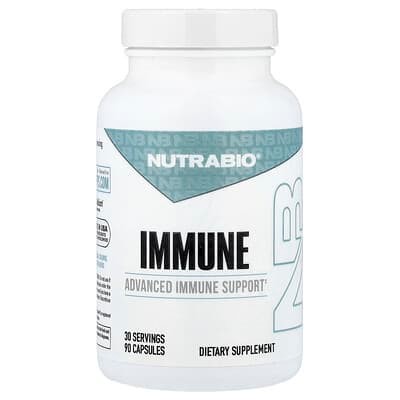
Immune

NutraBio4.8 (110 ratings)
Format:Capsule Quantity: 90 Veggie Cap(s) · 30 servings
Goals
$34.99 $1.16 per serving

About this product

The 50 mg zinc serving is the main factor in deciding whether the formula fits. Zinc bisglycinate is clearly identified, and 3 mg copper is included, but the zinc amount exceeds the adult daily upper limit of 40 mg. Copper inclusion does not establish that this zinc exposure is suitable for routine long-term use.

Vitamin C at 500 mg, vitamin D3 at 50 mcg and selenium at 200 mcg provide additional nutritional support for normal immune and antioxidant functions. Their usefulness depends on nutritional need rather than the assumption that larger amounts improve immunity. The high mineral content also does not establish extra hair, testosterone, weight or bone benefits in adequately nourished adults.

The added 600 mg NAC, 500 mg EpiCor, ginger extract and grape seed extract are individually quantified, improving comparison with hidden blends. Ginger has a stated marker percentage, although its preparation and amount do not establish broad effects on inflammation or calorie burning. The full serving is relatively costly for the core nutrients, making the high zinc exposure a more consequential trade-off than the length of the ingredient list.

Who is it for
  • Adults who have a specific, supervised reason for a high-zinc formula
  • People seeking individually quantified nutrients and antioxidant additions
Best for
  • A deliberately chosen high-zinc regimen with professional oversight
  • Comparing separately stated active amounts and mineral sources

Pros

  • Zinc and copper use clearly identified chelated forms
  • Every listed active has a stated amount
  • Ginger includes a marker percentage
  • NAC and EpiCor are individually quantified

Cons

  • Zinc exceeds the adult daily upper limit in one serving
  • Large nutrient amounts do not establish added benefit above adequate intake
  • Ginger preparation limits transfer of broader benefit claims
  • Limited value for several core nutrients
  • The formula supplies no calcium for direct bone-mineral coverage

Warnings

  • The 50 mg zinc serving exceeds the 40 mg adult daily upper limit; seek guidance before ongoing daily use and avoid stacking zinc supplements.
  • The 200 mcg selenium serving adds substantially to total intake; excessive selenium can worsen hair loss, so account for other selenium-containing supplements.


Product analysis

63 out of 100

Immune provides vitamins and minerals that support normal immune function, especially when dietary intake is low. Its cost looks high when judged by several individual nutrients.

AI assessment of the formula, label and price. How scoring works

Nutrient Quality59

Zinc and copper use favorable forms for the body to use, while selenium has a more moderate form profile. Quality remains uncertain for several other ingredients.

Ingredient Transparency96

All listed amounts and nearly all forms are disclosed. Missing N-acetyl cysteine preparation details limit a fully complete comparison.

Value For Money26

The serving price is relatively high in the vitamin C, zinc, selenium, copper and ginger comparisons. Value for the remaining ingredients is uncertain.

Customer Satisfaction73

Feedback is favorable across hundreds of ratings. That provides a broader picture of buyer satisfaction.

Product Focus67

The main role is nutritional support for normal immune function. Its many other named uses are largely conditional on low nutrient intake rather than dependable added benefits when needs are already met.

Format
Capsule
Container
90 Veggie Cap(s)
Per serving
$1.16
Customer rating
4.8 · 110 ratings
Report analysis

Goals

Everyday Health
Impact
Highest effect
B- Ingredient FitB+ PathwaysB+ EvidenceA+ Formulation Logic
Vitamin D · 50 mcgSelenium · 200 mcgZinc · 50 mgVitamin C · 500 mg

Vitamin D contributes to bone and mineral functions, while vitamin C, zinc and selenium support normal immune or antioxidant functions when intake is low. Copper is present alongside zinc, satisfying the saved partner check. The selected 50 mg zinc amount does not establish extra benefit above adequate intake. Ginger contributes little to the saved findings at the supplied amount.

How this product is rated for Everyday Health

Ingredient fit74

The selected serving provides a partial contribution against the saved amount references, with the recognized ingredients contributing to different degrees.
Goal fit
Relevant ingredients share the formula with additional actives whose general-health contributions are not established here.
Dose adequacy
The selected serving provides a partial contribution against the saved amount references, with the recognized ingredients contributing to different degrees.

Pathways80

The strongest represented area is antioxidant and immune defence, reflecting the recognized ingredients and their amounts.
Depth
The strongest represented area is antioxidant and immune defence, reflecting the recognized ingredients and their amounts.
Breadth
The more substantially represented areas are bone and mineral metabolism, antioxidant and immune defence.

Evidence82

Vitamin D provides the strongest recognized basis here; the supplied context still limits expectations for routine benefits in adequately nourished adults.
Evidence strength
Vitamin D provides the strongest recognized basis here; the supplied context still limits expectations for routine benefits in adequately nourished adults.
Studied preparation
The recognized preparations meet the saved check; this does not establish superiority of the named forms or broad clinical benefits.

Formulation logic100

None of the defined ingredient-conflict conditions was triggered by the supplied facts.
Partner coverage
The recognized ingredients can contribute independently or have their required partners present; no added combined benefit is established.
Conflicts
None of the defined ingredient-conflict conditions was triggered by the supplied facts.
Effective doses
All recognized ingredients meet the saved minimum amount threshold; this is not a proven clinical treatment threshold.
Study evidence
Ginger Supportive 25 studies
Selenium Supportive 70 studies
Vitamin C Supportive 56 studies
Vitamin D Supportive 115 studies
Zinc Supportive 60 studies
Impact
Highest effect
C+ Ingredient FitB PathwaysA EvidenceA+ Formulation Logic
Vitamin D · 50 mcgVitamin C · 500 mg

Zinc can help address low intake that contributes to inflammatory signalling. Vitamin C has shown a CRP reduction in people with elevated starting CRP, rather than a consistent benefit across all participants. Vitamin D findings include a transient biomarker change without established broad clinical benefit. Ginger received no contribution at the supplied amount, and NAC’s glutathione role does not establish anti-inflammatory efficacy.

How this product is rated for Inflammation

Ingredient fit70

The recognized anti-inflammatory ingredients sit within a broader formula, reducing its focus on this goal. Smaller or unresolved amounts limit the saved comparison with the referenced exposures.
Goal fit
The recognized anti-inflammatory ingredients sit within a broader formula, reducing its focus on this goal.
Dose adequacy
Smaller or unresolved amounts limit the saved comparison with the referenced exposures.

Pathways77

Inflammatory gene signalling is the strongest recorded mechanism; mechanism coverage does not prove clinical benefit.
Depth
Inflammatory gene signalling is the strongest recorded mechanism; mechanism coverage does not prove clinical benefit.
Breadth
Two inflammatory mechanisms reached the required coverage level; the other mechanisms remained less represented.

Evidence93

Vitamin D leads the saved evidence finding, with its population and outcome limitations still applying.
Evidence strength
Vitamin D leads the saved evidence finding, with its population and outcome limitations still applying.
Studied preparation
Contributing preparations matched those recognized in the saved result; this does not establish a clinical trial of the complete product.

Formulation logic100

No missing required partner or configured conflict reduced the recognized contributions. All counted amounts reached the minimum comparison threshold.
Partner coverage
No missing required partner reduced the recognized contributions; this does not demonstrate extra benefit from combining ingredients.
Conflicts
No configured ingredient conflict was identified in the supplied calculation.
Effective doses
All counted ingredients reached the minimum comparison threshold, which is not a proven minimum effective clinical dose.
Study evidence
Ginger Supportive 30 studies
Selenium Supportive 34 studies
Vitamin C Supportive 50 studies
Vitamin D Supportive 101 studies
Zinc Supportive 64 studies
Immunity
Impact
Highest effect
B Ingredient FitA+ PathwaysA+ EvidenceA+ Formulation Logic
Vitamin C · 500 mgZinc · 50 mgVitamin D · 50 mcgSelenium · 200 mcg

Zinc supports normal immune-cell function, especially when intake is low. Swallowed zinc does not inherit the cold-duration findings from repeatedly used lozenges. Vitamin D, selenium and copper support normal immune function; extra intake does not establish infection prevention when nutrition is adequate. Vitamin C may modestly shorten colds with regular use. Ginger's symptom-related rationale does not establish routine immune benefit, despite its inclusion in the saved calculation.

How this product is rated for Immunity

Ingredient fit79

Several immune nutrients contribute within a broader formula; their serving amounts provide substantial but uneven saved support.
Goal fit
Relevant immune nutrients are present alongside ingredients aimed at other functions, making the formula less focused.
Dose adequacy
Serving amounts provide uneven support, with some nutrients meeting their comparison and others contributing less.

Pathways100

The saved findings span immune regulation, innate cells, barriers and oxidative balance.
Depth
The strongest saved contribution concerns immune regulation; this describes a functional connection rather than demonstrated infection prevention.
Breadth
The saved findings cover barriers, innate cells, immune regulation and oxidative balance.

Evidence99

Nutrient evidence leads; ginger lacks a verified studied preparation and a routine immunity outcome.
Evidence strength
Vitamin C leads the saved findings, supporting a modest regular-use cold-duration role rather than guaranteed infection prevention.
Studied preparation
Ginger was not matched to a studied preparation; the nutrient preparations supplied the remaining saved support.

Formulation logic100

Copper accompanies the high zinc amount, so the saved zinc-without-copper conflict was not triggered.
Partner coverage
The included ingredients need no additional required partner for their saved contribution; this does not demonstrate extra benefit from combining them.
Conflicts
Copper is present alongside high zinc, so the saved zinc-without-copper concern was not triggered.
Effective doses
All included ingredients meet the saved minimum amount comparison; that threshold is not a proven clinical effective dose.
Study evidence
Ginger Not classified

No linked studies yet.

Selenium Mixed 37 studies
Vitamin C Supportive 53 studies
Vitamin D Supportive 85 studies
Zinc Supportive 73 studies
Skin Health
Impact
Highest effect
B- Ingredient FitB PathwaysA+ EvidenceA+ Formulation Logic
Zinc · 50 mgVitamin C · 500 mgCopper · 3 mgSelenium · 200 mcg

Vitamin C supports collagen formation and wound healing when intake is low. Zinc helps repair skin when zinc intake is inadequate. Copper supports collagen and elastin cross-linking, but added copper has no established cosmetic benefit with adequate intake.

How this product is rated for Skin Health

Ingredient fit74

The relevant ingredients primarily provide nutritional support within a broader formula. Their saved amount findings do not establish extra cosmetic benefit.
Goal fit
Relevant skin ingredients share the formula with ingredients aimed at other needs.
Dose adequacy
The credited amounts meet the saved reference; this does not establish extra benefit above nutritional needs.

Pathways76

The strongest saved connection is to dermal collagen matrix. Ingredient roles and limited outcome evidence should not be read as proven cosmetic improvements.
Depth
The main connection is to dermal collagen matrix, with the amount and ingredient limitations carried into the finding.
Breadth
Two targeted pathways reach the saved coverage threshold; hydration and water binding remain unsupported.

Evidence100

Vitamin C leads the saved evidence finding. The supplied scientific context limits claims to the relevant nutritional role or preparation-specific outcomes.
Evidence strength
Vitamin C provides the strongest saved evidence contribution; this does not establish broad cosmetic improvement.
Studied preparation
The credited preparations meet the saved preparation checks, while the supplied evidence still limits transfer to routine skin outcomes.

Formulation logic100

The credited ingredients need no missing partner, and no configured conflicts were identified. Those findings do not establish added benefit from combining ingredients.
Partner coverage
The credited ingredients can contribute without an additional required partner.
Conflicts
No configured ingredient conflict was identified in the supplied findings.
Effective doses
All credited ingredients meet the saved minimum amount threshold; that threshold is not a proven effective skin dose.
Study evidence
Copper Supportive 16 studies
Selenium Supportive 22 studies
Vitamin C Supportive 53 studies
Zinc Supportive 66 studies
Impact
Highest effect
B Ingredient FitC PathwaysA+ EvidenceA+ Formulation Logic
Vitamin D · 50 mcgZinc · 50 mgVitamin C · 500 mg

Zinc can help diffuse shedding when zinc intake is low, without established extra regrowth in nutrient-replete adults. Vitamin C supports normal collagen formation and iron absorption, but does not establish independent hair regrowth. Selenium has an antioxidant role without clear routine hair benefit; excessive intake can worsen hair loss.

How this product is rated for Hair Health

Ingredient fit78

The relevant nutrient ingredients connect with hair mainly through nutritional sufficiency, with the selected serving determining the amount finding.
Goal fit
Recognized hair-related ingredients sit within a broader formula that also serves other purposes.
Dose adequacy
The recognized ingredients reach the saved amount anchors per selected serving; this does not establish additional benefit at higher intakes.

Pathways60

The saved mechanism findings are concentrated rather than broad, and do not establish clinical regrowth.
Depth
The strongest saved coverage is in antioxidant protection; nutrient antioxidant roles alone do not establish hair regrowth.
Breadth
Antioxidant protection is the only specified mechanism reaching the saved coverage threshold.

Evidence98

The saved evidence finding recognizes individual ingredients and preparations, subject to their specific hair-outcome limitations.
Evidence strength
Zinc leads the saved evidence finding, although the supplied context limits how confidently routine hair benefits can be expected.
Studied preparation
The recognized preparations meet the saved preparation criteria; this does not mean the finished product has demonstrated regrowth.

Formulation logic100

The saved findings show no unmet partner requirement or configured conflict; amount recognition does not prove extra benefit from the combination.
Partner coverage
The recognized ingredients have no unmet partner requirement in the saved findings; this does not establish synergy.
Conflicts
No configured ingredient conflict was identified; this finding does not establish overall safety.
Effective doses
All ingredients counted here pass the saved minimum amount threshold, which is a comparison criterion rather than a proven treatment dose.
Study evidence
Copper Adverse 4 studies
Selenium Disputed 7 studies
Vitamin D Disputed 34 studies
Zinc Supportive 22 studies
Testosterone Support
Impact
High effect
B- Ingredient FitF PathwaysA EvidenceA+ Formulation Logic
Zinc · 50 mgVitamin D · 50 mcg

Zinc can help restore testosterone affected by low zinc intake; it does not establish an increase when zinc intake is adequate. Selenium findings from infertility treatment do not establish testosterone improvement in unselected adults.

How this product is rated for Testosterone Support

Ingredient fit71

The recognized ingredients are part of a broader formula with limited focus on testosterone support. The declared amounts reach the saved reference range; this does not establish a testosterone-raising dose.
Goal fit
The recognized ingredients are part of a broader formula with limited focus on testosterone support.
Dose adequacy
The declared amounts reach the saved reference range; this does not establish a testosterone-raising dose.

Pathways18

The strongest recorded connection is testicular testosterone synthesis, without establishing an increase in circulating testosterone.
Depth
The strongest recorded connection is testicular testosterone synthesis, without establishing an increase in circulating testosterone.
Breadth
No functional area reaches the saved coverage benchmark.

Evidence93

The leading ingredient is recognized in the saved findings, while population and nutrient-status distinctions limit expectations for routine hormone improvement.
Evidence strength
The leading ingredient is recognized in the saved findings, while population and nutrient-status distinctions limit expectations for routine hormone improvement.
Studied preparation
The declared preparation is recognized in the saved comparison; this does not establish benefit for every population.

Formulation logic100

No configured ingredient conflict was identified from the supplied facts. No required partner is missing for the recognized ingredients.
Partner coverage
No required partner is missing for the recognized ingredient contributions; this does not establish synergy.
Conflicts
No configured ingredient conflict was identified from the supplied facts.
Effective doses
The counted ingredients meet the saved amount threshold, which is not a proven effective testosterone dose.
Study evidence
Ginger Not classified

No linked studies yet.

Selenium No effect 16 studies
Vitamin D Supportive 56 studies
Zinc Disputed 7 studies

Ingredients

IngredientAmount per servingScore
Vitamin C (Ascorbic Acid)
500 mg 52
Vitamin D3 (Cholecalciferol)
50 mcg
Zinc (Albion Zinc Bisglycinate Chelate)
50 mg 76
Selenium (Albion Selenium Glycinate)
200 mcg 63
Copper (Albion Copper Bisglycinate Chelate)
3 mg 67
N-Acetyl Cysteine
600 mg
EpiCor (Saccharomyces cerevisiae)
500 mg
Ginger root standardized extract (Gingerols)
300 mg 76
Grape seed standardized extract (Polyphenols)
100 mg
Gluten Free Adults 18–50 Dairy Free Sugar Free No Allergies
Report overview
A+ Active Ingredient Quality & BioavailabilityB Dose, Safety & Label TransparencyF Value
+3
Each serving contains 50 mg of zinc as bisglycinate, exceeding the adult daily upper limit before other sources are counted. The same serving contains 3 mg copper.
How this ingredient is rated

Active Ingredient Quality & Bioavailability100

The named zinc form is zinc bisglycinate.
Zinc Form Bioavailability
The named zinc form is zinc bisglycinate.

Dose, Safety & Label Transparency75

50 mg zinc per serving exceeds the adult daily upper limit before other sources; the serving also contains 3 mg copper.
Elemental Dose Transparency
The saved facts state 50 mg of elemental zinc per serving and identify the source as bisglycinate.
Zinc Dosage Safety & Effectiveness
Each serving provides 50 mg zinc, which exceeds the adult daily upper limit before zinc from other sources is included.
Zinc-to-Copper Mineral Balance
The serving contains 50 mg zinc and 3 mg copper; their balance is a provisional comparison, not proof of safety.

Value30

A whole-product serving costs about $1.17; the price is not allocated to zinc alone.
Price Per Serving Efficiency
A whole-product serving costs about $1.17; the price is not allocated to zinc alone.
B+ Composition And Label DisclosureA+ Composition And Label DisclosureF Commercial Price And Usability
A serving provides 300 mg of ginger root extract, with a 5% ginger marker value recorded. The whole-product serving costs about $1.17.
How this ingredient is rated

Composition and Label Disclosure81

The extract has a recorded 5% marker value, and the available source details identify root and species.
Ginger Marker Disclosure
A 5% ginger marker value is recorded for the extract; a marker amount in milligrams is unavailable.
Botanical Source Detail
The saved source details identify ginger species and root.

Composition and Label Disclosure100

The serving gives a separate 300 mg ginger amount; no flagged additives or flow agents are recorded in the evaluation.
Ginger Amount Disclosure
The ginger amount is stated separately as 300 mg per serving.
Other Ingredients Disclosure
The evaluation records no flagged additives or flow agents.

Commercial Price and Usability20

The whole-product serving costs about $1.17.
Selected-Serving Price Comparison
The whole-product serving costs about $1.17.
A+ Active Ingredient Quality & BioavailabilityC- Dose, Safety & Label TransparencyF Value
Each serving provides 3 mg of copper as copper bisglycinate, above the amount favored in the evaluation. It also contains 50 mg of zinc, a higher zinc-to-copper ratio than the evaluation favors.
How this ingredient is rated

Active Ingredient Quality & Bioavailability100

Copper Bisglycinate is a named amino acid chelate that the evaluation considers favorable for absorption; the copper amount is also disclosed.
Copper Form Bioavailability
Copper Bisglycinate is an amino acid chelate that the evaluation considers favorable for absorption.
Elemental Copper Labeling Clarity
The copper row identifies 3 mg of copper per serving and names copper bisglycinate as its source.

Dose, Safety & Label Transparency57

The serving provides 3 mg of copper, above the amount favored in the evaluation, with 50 mg of zinc; their ratio is above the balance favored in the evaluation.
Copper Dosage Safety & Efficacy
Each serving provides 3 mg of copper, above the amount favored in the evaluation.
Zinc-to-Copper Balance
The serving has 50 mg of zinc and 3 mg of copper, a zinc-to-copper ratio that is higher than the evaluation favors.

Value20

The whole-product serving costs about $1.17.
Price Per Serving Efficiency
The whole-product serving costs about $1.17.
Report alternatives

Sources

Published studies used for the product analysis and the top-ranked studies for each ingredient and goal.

  1. The Association between Dietary and Circulating Copper Levels and Osteoporosis: a Scoping Review.
    Ju Y; Xiong W; Pang Y; Chen Z; Hou J; Zheng S; Li Z; Liu T; Xia H; Xia M; Zhong Y; Li J; Jiang X · Biological trace element research · 2026
    Scoping review18 studies pooledBone Health forCopper
  2. Association between dietary copper, iron, zinc, selenium intake and osteopenia or osteoporosis in elderly hypertensive patients: a retrospective cohort study.
    Chen M; Jia L; Gao R · Frontiers in nutrition · 2024
    Cohort study5,286 participantsBone Health forCopper
  3. Associations of dietary copper intake with total bone mineral density and lumbar spine bone mineral density in American adults.
    Hu M; Wang Z; Li C; Zheng Y; Hu J · Medicine · 2025
    Cross-sectional studyBone Health forCopper
  4. The association between dietary mineral intake and bone mineral density: a cross-sectional study.
    Wei M; Wei J; Huang S · Journal of health, population, and nutrition · 2025
    Cross-sectional study11,520 participantsBone Health forCopper
  5. Association between dietary copper intake and bone mineral density in children and adolescents aged 8-19 years: A cross-sectional study.
    Cui A; Yan J; Li H; Fan Z; Wei X; Wang H; Zhuang Y · PloS one · 2024
    Cross-sectional study6,965 participantsBone Health forCopper
  6. Can Dietary Intake of Vitamin C-Oriented Foods Reduce the Risk of Osteoporosis, Fracture, and BMD Loss? Systematic Review With Meta-Analyses of Recent Studies.
    Zeng LF; Luo MH; Liang GH; Yang WY; Xiao X; Wei X; Yu J; Guo D; Chen HY; Pan JK; Huang HT; Liu Q; Guan ZT; Han YH; Zhao D; Zhao JL; Hou SR; Wu M; Lin JT; Li JH; Liang WX; Ou AH; Wang Q; Li ZP; Liu J · Frontiers in endocrinology · 2020
    Meta-analysis19,484 participants17 studies pooledBone Health forVitamin C
  7. Dietary vitamin C intake and the risk of hip fracture: a dose-response meta-analysis.
    Sun Y; Liu C; Bo Y; You J; Zhu Y; Duan D; Cui H; Lu Q · Osteoporosis international : a journal established as result of cooperation between the European Foundation for Osteoporosis and the National Osteoporosis Foundation of the USA · 2019
    Meta-analysis6 studies pooledBone Health forVitamin C
  8. Smoking, antioxidant vitamins, and the risk of hip fracture.
    Melhus H; Michaëlsson K; Holmberg L; Wolk A; Ljunghall S · Journal of bone and mineral research : the official journal of the American Society for Bone and Mineral Research · 1999
    Cohort study66,651 participantsBone Health forVitamin C
  9. Micronutrients and the risk of hip fracture: Case-control study.
    Torbergsen AC; Watne LO; Wyller TB; Frihagen F; Strømsøe K; Bøhmer T; Mowe M · Clinical nutrition (Edinburgh, Scotland) · 2018
    Case-control study189 participantsBone Health forVitamin C
  10. Favorable effect of dietary vitamin C on bone mineral density in postmenopausal women (KNHANES IV, 2009): discrepancies regarding skeletal sites, age, and vitamin D status.
    Kim YA; Kim KM; Lim S; Choi SH; Moon JH; Kim JH; Kim SW; Jang HC; Shin CS · Osteoporosis international : a journal established as result of cooperation between the European Foundation for Osteoporosis and the National Osteoporosis Foundation of the USA · 2016
    Cross-sectional study1,196 participantsBone Health forVitamin C
  11. Pregnancy vitamin D supplementation and offspring bone mineral density in childhood follow-up of a randomized controlled trial.
    Moon RJ; D' Angelo S; Curtis EM; Ward KA; Crozier SR; Schoenmakers I; Javaid MK; Bishop NJ; Godfrey KM; Cooper C; Harvey NC; MAVIDOS Trial Group · The American journal of clinical nutrition · 2024
    Randomized trial454 participantsBone Health forVitamin D
  12. Vitamin D analogs and bone: preclinical and clinical studies with eldecalcitol.
    Matsumoto T; Takano T; Saito H; Takahashi F · BoneKEy reports · 2014
    Narrative reviewBone Health forVitamin D
  13. Efficacy of vitamin D fortified foods on bone mineral density and serum bone biomarkers: A systematic review and meta-analysis of interventional studies.
    Tangestani H; Djafarian K; Emamat H; Arabzadegan N; Shab-Bidar S · Critical reviews in food science and nutrition · 2020
    Meta-analysis1,786 participants20 studies pooledBone Health forVitamin D
  14. Cholecalciferol Supplementation Attenuates Bone Loss in Incident Kidney Transplant Recipients: A Prespecified Secondary Endpoint Analysis of a Randomized Controlled Trial.
    Tsujita M; Doi Y; Obi Y; Hamano T; Tomosugi T; Futamura K; Okada M; Hiramitsu T; Goto N; Isaka Y; Takeda A; Narumi S; Watarai Y · Journal of bone and mineral research : the official journal of the American Society for Bone and Mineral Research · 2022
    Randomized trial193 participantsBone Health forVitamin D
  15. Vitamin D supplementation and bone health in post-menopausal women: a 24-month randomized controlled intervention with enhanced bioavailability formulations.
    Rasool N; Munir Y · European journal of clinical nutrition · 2026
    Randomized trial612 participantsBone Health forVitamin D
  16. Increased incidence of fractures in middle-aged and elderly men with low intakes of phosphorus and zinc.
    Elmståhl S; Gullberg B; Janzon L; Johnell O; Elmståhl B · Osteoporosis international : a journal established as result of cooperation between the European Foundation for Osteoporosis and the National Osteoporosis Foundation of the USA · 1999
    Cohort study6,576 participantsBone Health forZinc
  17. Zinc Supplementation Increases Procollagen Type 1 Amino-Terminal Propeptide in Premenarcheal Girls: A Randomized Controlled Trial.
    Berger PK; Pollock NK; Laing EM; Chertin V; Bernard PJ; Grider A; Shapses SA; Ding KH; Isales CM; Lewis RD · The Journal of nutrition · 2016
    Randomized trial147 participantsBone Health forZinc
  18. Randomized controlled trial of prenatal zinc supplementation and fetal bone growth.
    Merialdi M; Caulfield LE; Zavaleta N; Figueroa A; Costigan KA; Dominici F; Dipietro JA · The American journal of clinical nutrition · 2004
    Randomized trial242 participantsBone Health forZinc
  19. The effects of zinc supplementation on serum zinc, alkaline phosphatase activity and fracture healing of bones.
    Sadighi A; Roshan MM; Moradi A; Ostadrahimi A · Saudi medical journal · 2009
    Randomized trial60 participantsBone Health forZinc
  20. Is Zinc an Important Trace Element on Bone-Related Diseases and Complications? A Meta-analysis and Systematic Review from Serum Level, Dietary Intake, and Supplementation Aspects.
    Ceylan MN; Akdas S; Yazihan N · Biological trace element research · 2021
    Meta-analysis40 studies pooledBone Health forZinc