
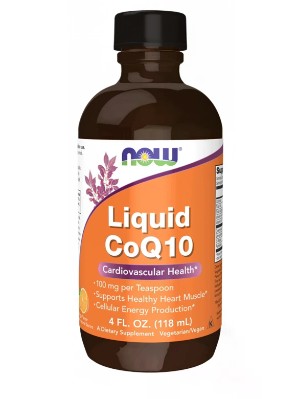

$14.50 $0.60 per serving


Product analysis
Liquid CoQ10 offers a liquid option with limited support for some blood-vessel and blood-fat measures, alongside B vitamins for normal nutrient use. The unspecified CoQ10 form makes comparisons harder, and the liquid format has no established advantage.
AI assessment of the formula, label and price. How scoring works
Nutrient Quality32
Several B-vitamin forms are named, but the CoQ10 preparation and several other forms are unspecified. The liquid format does not establish better absorption or a stronger effect.
Ingredient Transparency76
The listed amounts are disclosed, and several B-vitamin forms are named. Most other forms are omitted, leaving the CoQ10 preparation and NAD identity less clear.
Value For Money40
The cost relative to the CoQ10 serving offers modest value. Most added ingredients lack enough information for dependable value comparisons.
Customer Satisfaction76
Customer ratings are very positive across a few hundred responses. The moderate review base gives a useful picture of satisfaction, without confirming an energy or heart benefit.
Product Focus55
CoQ10 has limited support for some blood-vessel measures, while the B vitamins support normal nutrition. The broad proposed uses do not establish an everyday energy or metabolism boost in well-nourished adults.
- Format
Liquid - Container
- 4 Liquid(s)
- Per serving
- $0.60
- Customer rating
- 4.7 · 433 ratings
Goals

Impact
High effect
Coenzyme Q-10 · 100 mgVitamin B12 · 100 mcgVitamin B6 · 7 mg
Coenzyme Q10 may contribute to blood-pressure, lipid and blood-vessel measures in selected adults, with mixed results; 100 mg per serving falls below the conventional exposure used as the main comparison. B6 and B12 participate in homocysteine metabolism without established general cardiac prevention benefit. Their forms do not establish additional cardiovascular protection.
How this product is rated for Heart Health
Ingredient fit59
Heart-related ingredients sit within a broader formula with other active ingredients. The relevant declared amounts provide partial coverage of the saved exposure comparison.
Goal fit
Heart-related ingredients sit within a broader formula with other active ingredients.
Dose adequacy
The relevant declared amounts provide partial coverage of the saved exposure comparison.
Pathways53
The strongest saved connection is to blood-vessel function. Coverage across other heart-related roles is limited.
Depth
The strongest saved connection is to blood-vessel function.
Breadth
The broader saved findings cover blood-vessel function. .
Evidence98
Coenzyme Q-10 leads the saved evidence finding. Accepted preparation matches do not remove the ingredient-specific limitations described above.
Evidence strength
Coenzyme Q-10 provides the leading evidence contribution in the saved comparison; its clinical limitations still apply.
Studied preparation
The saved finding accepts the preparations used for its included ingredients; it does not establish that every labelled preparation matches a clinical trial.
Formulation logic100
The saved checks find no missing required partner or configured conflict. The included amounts pass the minimum comparison screen.
Partner coverage
The included ingredients do not lack a required partner under the saved finding; this does not establish added benefit from combining them.
Conflicts
No configured ingredient conflict was triggered by the supplied facts.
Effective doses
All ingredients included in this amount screen meet its minimum comparison level; that level is not a proven effective dose.

Impact
Moderate effect
Coenzyme Q-10 · 100 mgVitamin B12 · 100 mcg
CoQ10 at 100 mg relates to mitochondrial energy production, while vitamin B12 supports normal neurological function and may help fill a nutritional gap. The unspecified CoQ10 preparation limits transfer of the selected skin-aging results, and neither ingredient establishes life extension.
How this product is rated for Longevity
Ingredient fit51
Relevant ingredients sit within a broader formula with several other purposes, limiting its focus on healthy aging. The assessed amounts provide partial coverage of the saved reference levels, with undisclosed quantities limiting the assessment.
Goal fit
Relevant ingredients sit within a broader formula with several other purposes, limiting its focus on healthy aging.
Dose adequacy
The assessed amounts provide partial coverage of the saved reference levels, with undisclosed quantities limiting the assessment.
Pathways10
The strongest saved connection is mitochondrial energy production, with limited coverage. No pathway reaches the saved coverage threshold.
Depth
The strongest saved connection is mitochondrial energy production, with limited coverage.
Breadth
No pathway reaches the saved coverage threshold.
Evidence54
Vitamin B12 supplies the strongest saved evidence finding at the assessed amount; the scope of its actual cognitive evidence still matters. Some effective entries match studied preparations; Coenzyme Q-10 does not.
Evidence strength
Vitamin B12 supplies the strongest saved evidence finding at the assessed amount; the scope of its actual cognitive evidence still matters.
Studied preparation
Some effective entries match studied preparations; Coenzyme Q-10 does not.
Formulation logic100
The assessed ingredients can work alone or have their required partner. No configured ingredient conflict was found in the supplied assessment. All assessed ingredients reach the saved minimum amount threshold.
Partner coverage
The assessed ingredients can work alone or have their required partner.
Conflicts
No configured ingredient conflict was found in the supplied assessment.
Effective doses
All assessed ingredients reach the saved minimum amount threshold.

Impact
High effect
Coenzyme Q-10 · 100 mgVitamin B12 · 100 mcgVitamin B6 · 7 mgNiacin · 0.7 mg
CoQ10 has limited support for blood-pressure, lipid and vessel-function markers in adults with abnormal blood lipids. The findings concern measured markers and do not establish cardiovascular-event prevention. Higher amounts do not establish proportionately larger benefits. Vitamin B6 and B12 participate in homocysteine metabolism without establishing additional event prevention. The liquid form has no demonstrated superiority.
How this product is rated for Cardiovascular Support
Ingredient fit59
Skin-related ingredients appear within a broader formula with other intended uses. The amounts provide an uneven match to the comparison range; this limits how closely the formula resembles the evaluated exposures.
Goal fit
Skin-related ingredients appear within a broader formula with other intended uses.
Dose adequacy
The amounts provide an uneven match to the comparison range; this limits how closely the formula resembles the evaluated exposures.
Pathways73
Endothelial nitric-oxide function is the strongest assigned cardiovascular role; the result does not establish the complete product's clinical effect. The assigned roles span endothelial nitric-oxide function, homocysteine clearance, without establishing event prevention.
Depth
Endothelial nitric-oxide function is the strongest assigned cardiovascular role; the result does not establish the complete product's clinical effect.
Breadth
The assigned roles span endothelial nitric-oxide function, homocysteine clearance, without establishing event prevention.
Evidence88
Coenzyme Q-10 leads the evidence finding, subject to its specific clinical and population limitations. The counted ingredients match the saved preparation requirements, without confirming a trial of this complete formula.
Evidence strength
Coenzyme Q-10 leads the evidence finding, subject to its specific clinical and population limitations.
Studied preparation
The counted ingredients match the saved preparation requirements, without confirming a trial of this complete formula.
Formulation logic100
The evaluated ingredients have no missing required partner or configured conflict. All counted amounts pass the minimum comparison.
Partner coverage
No required partner is missing from the counted ingredients; this does not establish an additional combination benefit.
Conflicts
No configured conflict was identified among the evaluated ingredients.
Effective doses
All counted ingredients pass the minimum amount comparison; passing it does not prove a clinical cardiovascular benefit.

Impact
High effect
Niacin · 0.7 mgVitamin B12 · 100 mcgVitamin B5 · 5 mgVitamin B6 · 7 mgCoenzyme Q-10 · 100 mg
Coenzyme Q-10 participates in cellular energy transfer, while the B vitamins support normal energy metabolism. Those roles do not establish that extra intake raises whole-body calorie expenditure in adequately nourished adults. The supplied CoQ10 studies address metabolic markers, rather than general thermogenesis. Niacin is present at a small amount and receives no saved contribution.
How this product is rated for Metabolism Support
Ingredient fit65
Coenzyme Q-10 supplies the saved ingredient contribution, but its normal cellular role does not establish increased whole-body energy expenditure.
Goal fit
Other actives broaden the formula beyond this goal, reducing its focus.
Dose adequacy
The known amounts provide partial support in the saved comparison, without establishing a proven thermogenic dose.
Pathways17
The strongest saved functional coverage concerns mitochondrial energy and fat oxidation. That mechanism does not by itself establish greater whole-body energy expenditure.
Depth
The strongest saved contribution concerns mitochondrial energy and fat oxidation, with partial functional coverage.
Breadth
No function reaches the saved breadth threshold.
Evidence96
Vitamin B5 is the strongest saved evidence contributor. The supplied scientific context does not establish a routine increase in calorie expenditure.
Evidence strength
Vitamin B5 supplies the strongest saved evidence contribution; this does not override limitations in the direct energy-expenditure findings.
Studied preparation
The counted amounts match preparations accepted in the saved comparison.
Formulation logic100
The counted ingredients can contribute independently and no configured conflict is found. Their known amounts pass the saved minimum.
Partner coverage
The counted ingredients can contribute independently or have the required partner.
Conflicts
No configured ingredient conflict was identified in the supplied facts.
Effective doses
The counted amounts pass the saved minimum, which does not establish a proven increase in energy expenditure.

Impact
Moderate effect
Coenzyme Q-10 · 100 mg
CoQ10 may affect some blood markers linked to inflammation, but that doesn't mean it reliably reduces inflammation or improves symptoms in everyday use. The relevant benefit is limited to particular people with coronary artery disease taking statins, and even there, different markers didn't respond alike. Taking more CoQ10 doesn't make that limited benefit more predictable.
How this product is rated for Inflammation
Ingredient fit33
CoQ10 may affect some inflammation-related blood markers, but broad relief from inflammation is uncertain.
Goal fit
CoQ10 may affect some inflammation-related blood markers, but broad relief from inflammation is uncertain.
Dose adequacy
CoQ10 provides 100 mg per serving, compared with a 300 mg daily reference; a serving is not a daily regimen.
Pathways13
CoQ10 may affect some inflammation-related blood markers, but broad relief from inflammation is uncertain.
Depth
CoQ10 may affect some inflammation-related blood markers, but broad relief from inflammation is uncertain.
Breadth
The ingredients do not imply broad effects across multiple inflammatory processes.
Evidence93
Ordinary ubiquinone has limited relevance to inflammation markers; the same amount of ubiquinol cannot automatically be treated as equivalent.
Evidence strength
CoQ10 may affect some inflammation-related blood markers, but broad relief from inflammation is uncertain.
Studied preparation
Ordinary ubiquinone has limited relevance to inflammation markers; the same amount of ubiquinol cannot automatically be treated as equivalent.
Formulation logic100
No particular ingredient conflict or missing required companion is identified. The amounts alone do not predict symptom relief.
Partner coverage
No missing required companion ingredient is identified.
Conflicts
No particular ingredient conflict is identified.
Effective doses
CoQ10 provides 100 mg per serving, compared with a 300 mg daily reference; a serving is not a daily regimen.

Impact
Moderate effect
Vitamin B5 · 5 mgVitamin B12 · 100 mcgCoenzyme Q-10 · 100 mg
CoQ10 at 100 mg offers a partial contribution related to cellular energy production, with limited preparation-specific fatigue evidence. B6, B12 and pantothenic acid support nutritional functions relevant to energy, while the unspecified NAD declaration does not establish NADH identity or a clear independent fatigue benefit.
How this product is rated for Energy
Ingredient fit66
Energy-relevant ingredients sit alongside ingredients directed at other uses, giving the formula a broader focus. The declared amounts provide partial coverage of the amounts used in the saved assessment.
Goal fit
Energy-relevant ingredients sit alongside ingredients directed at other uses, giving the formula a broader focus.
Dose adequacy
The declared amounts provide partial coverage of the amounts used in the saved assessment.
Pathways8
The strongest saved contribution concerns mitochondrial energy production, with partial coverage. No selected energy pathway reaches the saved threshold for substantial coverage.
Depth
The strongest saved contribution concerns mitochondrial energy production, with partial coverage.
Breadth
No selected energy pathway reaches the saved threshold for substantial coverage.
Evidence43
Coenzyme Q-10 provides the strongest saved evidence among ingredients at an assessed effective amount; the practical benefit remains dependent on context. Preparation coverage is partial; Coenzyme Q-10 is not matched to a studied preparation in the saved findings.
Evidence strength
Coenzyme Q-10 provides the strongest saved evidence among ingredients at an assessed effective amount; the practical benefit remains dependent on context.
Studied preparation
Preparation coverage is partial; Coenzyme Q-10 is not matched to a studied preparation in the saved findings.
Formulation logic100
The credited ingredients can contribute independently or have their required partners. No configured ingredient conflicts were recorded in the saved findings. All credited ingredients meet the saved minimum amount.
Partner coverage
The credited ingredients can contribute independently or have their required partners.
Conflicts
No configured ingredient conflicts were recorded in the saved findings.
Effective doses
All credited ingredients meet the saved minimum amount.
Vitamin B5 Not classified
No linked studies yet.
Ingredients
| Ingredient | Amount per serving | Score |
|---|---|---|
Calories | 20 Calorie(s) | |
Total Fat | 2 Gram(s) | |
Total Carbohydrates | 1 Gram(s) | |
Niacin (NAD Trihydrate) | 0.7 mg | |
Vitamin B-6 (P-5-P Monohydrate) | 7 mg | |
Vitamin B12 (Cyanocobalamin) | 100 mcg | |
Pantothenic Acid (Pantethine) | 5 mg | |
Coenzyme Q10 | 100 mg | |
Stevia extract | 20 mg | |
D-Ribose | 10 mg | |
NAD Trihydrate | 5 mg |
Coenzyme Q-10 · 100 mg OverallScore42
Each serving supplies 100 mg of CoQ10, but the saved facts do not identify its form. That makes comparison with products naming ubiquinol or ubiquinone less direct.
How this ingredient is rated
Active Ingredient Quality & Bioavailability12
The saved facts do not identify the CoQ10 form or a qualifying absorption-enhancing ingredient or delivery claim.
Molecular Form: Ubiquinol vs. Ubiquinone
The saved facts do not identify whether the CoQ10 is ubiquinol or ubiquinone.
Formulation & Absorption Enhancers
The saved facts do not identify a qualifying liposomal, micellar or nanoemulsion claim, or black pepper extract.
Dose, Safety & Label Transparency72
Each serving supplies 100 mg of CoQ10; the unknown form limits form-specific comparison. The amount is stated and no excipients flagged by the evaluation are recorded.
Clinical Dosage Alignment
Each serving supplies 100 mg of CoQ10; the form is unknown, limiting form-specific comparison.
Label Transparency & Fillers
The amount is recorded and no standard fillers or additives flagged by the evaluation are identified in the saved facts.
Value40
The whole-product price is about $0.60 per serving containing 100 mg of CoQ10.
Price Per Effective Serving
A whole-product serving costs about $0.60 and contains 100 mg of CoQ10.
Vitamin B12 (Cyanocobalamin) · 100 mcg OverallScore21
Each serving provides 100 mcg of vitamin B12 as cyanocobalamin, a lower amount in this comparison. Based on the whole-product price, it works out to about $6.04 per 1,000 mcg of B12.
How this ingredient is rated
Active Ingredient Quality & Bioavailability10
Cyanocobalamin is the identified B12 form; the comparison distinguishes it from coenzyme forms such as methylcobalamin.
Bioactive B12 Form Selection
Cyanocobalamin is the identified B12 form; the comparison distinguishes it from coenzyme forms such as methylcobalamin.
Dose, Safety & Label Transparency37
100 mcg per serving is a lower amount in the comparison. The form is identified as cyanocobalamin.
Therapeutic Dosage Level
The 100 mcg per serving is a lower amount in the evaluation’s serving-size comparison.
Label and Form Transparency
The label identifies 100 mcg of cyanocobalamin per serving.
Value10
The whole-product price works out to about $6.04 per 1,000 mcg of B12. It includes the rest of the product as well.
Price per 1,000 mcg B12
Based on the whole-product price, the cost is about $6.04 per 1,000 mcg of B12.
Alternative products
Report alternatives
Sources
Published studies used for the product analysis and the top-ranked studies for each ingredient and goal.
- Effects of Coenzyme Q10 Supplementation on Lipid Profiles in Adults: A Meta-analysis of Randomized Controlled Trials.
- Six-month supplementation with high dose coenzyme Q10 improves liver steatosis, endothelial, vascular and myocardial function in patients with metabolic-dysfunction associated steatotic liver disease: a randomized double-blind, placebo-controlled trial.
- The effect of coenzyme Q10 on morbidity and mortality in chronic heart failure: results from Q-SYMBIO: a randomized double-blind trial.
- [Coenzyme Q-10 in the treatment of patients with chronic heart failure and reduced left ventricular ejection fraction: systematic review and meta-analysis].
- Effect of coenzyme Q10 in Europeans with chronic heart failure: A sub-group analysis of the Q-SYMBIO randomized double-blind trial.
- The current state of niacin in cardiovascular disease prevention: a systematic review and meta-regression.
- Effects of niacin on apo A1 and B levels: a systematic review and meta-analysis of randomised controlled trials.
- Effect of lipid-lowering therapies on lipoprotein(a) levels: a comprehensive meta-analysis of randomized controlled trials.
- Extended-release niacin vs gemfibrozil for the treatment of low levels of high-density lipoprotein cholesterol. Niaspan-Gemfibrozil Study Group.
- Equivalent efficacy of a time-release form of niacin (Niaspan) given once-a-night versus plain niacin in the management of hyperlipidemia.
- Vitamin B12 Status and Cardiovascular Risk: Novel Insights from NMR-Based Lipoprotein Profiling in 20,665 Adults.
- Pregnancy Metal Mixtures and Blood Pressure and Hypertension in Mid-Life: A Prospective U.S. Cohort Study.
- Vitamin B12 Deficiency, Hyperhomocysteinemia, and Diabetes as Metabolic Determinants of Cardiovascular Risk in Mexican Women.
- Impact of serum vitamin (Vitamin D, Vitamin B12) and trace element (Fe, Zn, Cu) levels on major adverse cardiovascular events and poor prognosis in STEMI patients undergoing primary PCI.
- Vasoplegic syndrome after cardiovascular surgery: A review of pathophysiology and outcome-oriented therapeutic management.
- Association between serum pyridoxal 5'-phosphate levels and all-cause, cardiovascular mortality, and cardiovascular disease in adults: a population-based cohort study.
- Folate and vitamin B6 rapidly normalize endothelial dysfunction in children with type 1 diabetes mellitus.
- Pyridoxine improves endothelial function in cardiac transplant recipients.
- Folate and vitamin B6 from diet and supplements in relation to risk of coronary heart disease among women.
- Efficacy and safety of pyridoxal 5'-phosphate (MC-1) in high-risk patients undergoing coronary artery bypass graft surgery: the MEND-CABG II randomized clinical trial.