No linked studies yet.
Product analysis
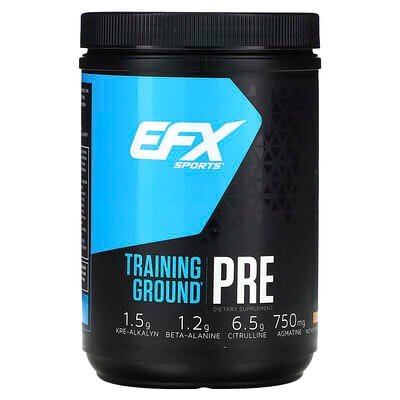
Training Ground PRE Orange Mango may help with workout alertness and short-term exercise performance. It is expensive for the creatine, tyrosine and caffeine it provides.
AI assessment of the formula, label and price. How scoring works
Nutrient Quality22
Most ingredient forms are unspecified, making it hard to compare their quality with other workout supplements. Naming beta-alanine alone does not resolve that uncertainty for the rest of the blend.
Ingredient Transparency66
The ingredient amounts are clearly shown, so serving sizes can be compared. Most forms are missing, which makes it harder to check exactly which preparations are included.
Value For Money25
The blend is expensive for several of its key workout ingredients, particularly creatine, tyrosine and caffeine. Value for the remaining ingredients is less certain.
Customer Satisfaction68
Customer ratings are favorable. The small number of ratings limits how broadly they reflect buyers’ experiences.
Product Focus58
The clearest purpose is workout performance and short-term alertness, despite a much wider range of possible uses. Several exercise benefits depend on continued use, and the caffeine amount may cause jitteriness or anxiety.

- Format
Powder - Container
- 17 Liquid(s)
- Per serving
- $1.74
- Customer rating
- 4.6 · 17 ratings
Goals
Caffeine can support acute exercise performance, most consistently endurance, by affecting central drive and perceived fatigue; strength and sprint responses vary. Citrulline has mixed evidence for selected cycling and repetition outcomes, with preparation differences limiting transfer. Beta-alanine contributes toward repeated loading for short high-intensity efforts; a single serving does not establish that regimen. Creatine supports repeated high-intensity exercise when the declared monohydrate amount and sustained intake match the evidence.
How this product is rated for Fitness
Ingredient fit72
Goal fit
Dose adequacy
Pathways100
Depth
Breadth
Evidence73
Evidence strength
Studied preparation
Formulation logic100
Partner coverage
Conflicts
Effective doses
Caffeine can improve short-term vigilance and sustained attention. The 300 mg serving exceeds the amount at which the saved comparison stops giving extra amount credit and carries a jitteriness and anxiety concern. Tyrosine has conditional and inconsistent cognitive-control findings, while repeated-use creatine findings do not establish immediate focus improvement.
How this product is rated for Mental Focus
Ingredient fit58
Goal fit
Dose adequacy
Pathways80
Depth
Breadth
Evidence79
Evidence strength
Studied preparation
Formulation logic93
Partner coverage
Conflicts
Effective doses
No linked studies yet.
Caffeine provides the clearest immediate contribution by increasing alertness and reducing sleepiness; 300 mg per serving receives no added alertness contribution above the saved plateau. Beta-alanine has a narrower role in high-intensity exercise after repeated supplementation, which one serving cannot reproduce. Citrulline malate has mixed evidence for strength endurance. The creatine preparation does not match the studied monohydrate material, and tyrosine does not establish routine vitality.
How this product is rated for Energy
Ingredient fit62
Goal fit
Dose adequacy
Pathways60
Depth
Breadth
Evidence93
Evidence strength
Studied preparation
Formulation logic100
Partner coverage
Conflicts
Effective doses
No linked studies yet.

Creatine at 1.5 g may support muscle energy and body mass alongside resistance training, although early weight change can include water. Betaine at 2.6 g is close to the studied daily exposure, but lean-mass findings are mixed; citrulline and beta-alanine relate more to training performance than direct weight gain. Caffeine at 300 mg triggers the saved concerns for weight gain and its combination with creatine.
How this product is rated for Weight Gain
Ingredient fit71
Goal fit
Dose adequacy
Pathways74
Depth
Breadth
Evidence50
Evidence strength
Studied preparation
Formulation logic86
Partner coverage
Conflicts
Effective doses
No linked studies yet.
The 300 mg caffeine amount offers an acute alertness contribution and triggers the saved concern for caffeine above 200 mg per serving. Tyrosine at 1500 mg relates mainly to acute stress or sleep-loss performance. The 1500 mg buffered-creatine preparation has a limited comparison with the higher monohydrate exposure used in the supplied memory research.
How this product is rated for Brain Health
Ingredient fit51
Goal fit
Dose adequacy
Pathways42
Depth
Breadth
Evidence52
Evidence strength
Studied preparation
Formulation logic93
Partner coverage
Conflicts
Effective doses
Creatine has a meaningful connection to muscle energy and resistance-training adaptation, but the declared preparation cannot be assumed equivalent to the studied monohydrate. Betaine anhydrous has limited, inconsistent training evidence, with some favorable body-composition findings and a later trial finding no added hypertrophy. Caffeine can improve acute strength, power or endurance, but this does not establish sustained muscle-mass gain. The creatine and high-caffeine combination also triggers the supplied formulation concern.
How this product is rated for Muscle Gain
Ingredient fit81
Goal fit
Dose adequacy
Pathways80
Depth
Breadth
Evidence75
Evidence strength
Studied preparation
Formulation logic93
Partner coverage
Conflicts
Effective doses
No linked studies yet.
Ingredients
| Ingredient | Amount per serving | Score |
|---|---|---|
Citrulline Malate | 6500 mg | |
Trimethylglycine | 2600 mg | |
Hydromax Glycerol Complex | 2500 mg | |
Taurine | 2000 mg | |
L-Glycine | 2000 mg | |
Kre-Alkalyn | 1500 mg | |
L-Tyrosine | 1500 mg | |
CarnoSyn (Beta-Alanine) | 1200 mg | |
Agmatine Sulfate | 750 mg | |
Caffeine | 300 mg |
How this ingredient is rated
Active Ingredient Quality & Bioavailability70
Tyrosine Chemical Form
Purity and Sourcing Signals
Dose, Safety & Label Transparency100
Tyrosine Dosage Adequacy
Label Transparency and Blends
Value10
Price per Gram of Tyrosine
How this ingredient is rated
Active Ingredient Quality & Bioavailability0
Glycine Sourcing and Purity Standards
Dose, Safety & Label Transparency74
Clinically Relevant Dosage
Label Transparency and Yield Disclosure
Clean Label and Excipient Quality
Value30
Cost Efficiency per 1,000mg of Glycine
How this ingredient is rated
Active Ingredient Quality & Bioavailability74
Creatine Form & Evidence Base
Additive Quality
Dose, Safety & Label Transparency76
Clinical Dosage Adequacy
Label Transparency & Third-Party Testing
Value10
Price per Effective Dose
Alternative products
Sources
Published studies used for the product analysis and the top-ranked studies for each ingredient and goal.
- Oral creatine monohydrate supplementation improves brain performance: a double-blind, placebo-controlled, cross-over trial.
- Creatine in Huntington disease is safe, tolerable, bioavailable in brain and reduces serum 8OH2'dG.
- Creatine supplementation and cognitive performance in elderly individuals.
- Effects of high-load, velocity-intentional variable resistance training combined with creatine supplementation on neuroplasticity, oxidative stress, inflammation, physical function, cognitive performance and quality of life in older adults: A randomized, double-blind, placebo-controlled trial.
- Single-Dose Creatine Reduces Sleep Deprivation-Induced Deterioration in Cognitive Performance.
- Combined L-carnosine and L-tyrosine supplementation as an ergogenic strategy for physical and cognitive performance under fatigue in professional football players.
- Effect of tyrosine supplementation on clinical and healthy populations under stress or cognitive demands--A review.
- Influence of nutritional tyrosine on cognition and functional connectivity in healthy old humans.
- Dietary Tyrosine Intake (FFQ) Is Associated with Locus Coeruleus, Attention and Grey Matter Maintenance: An MRI Structural Study on 398 Healthy Individuals of the Berlin Aging Study-II.
- Baseline-dependent effect of dopamine's precursor L-tyrosine on working memory gating but not updating.
- Taurine Supplementation Lowers Blood Pressure and Improves Vascular Function in Prehypertension: Randomized, Double-Blind, Placebo-Controlled Study.
- Taurine ameliorates blood pressure and vascular function in patients with type 2 diabetes: Randomized, double-blind, placebo-controlled trial.
- Taurine reduces the risk for metabolic syndrome: a systematic review and meta-analysis of randomized controlled trials.
- Effects of Oral Taurine Supplementation on Cardiometabolic Risk Factors: A Meta-analysis and Systematic Review of Randomized Clinical Trials.
- The effects of taurine supplementation on glycemic control and serum lipid profile in patients with type 2 diabetes: a randomized, double-blind, placebo-controlled trial.
- Cognitive and mood improvements of caffeine in habitual consumers and habitual non-consumers of caffeine.
- Caffeine-containing energy drink improves physical performance of elite rugby players during a simulated match.
- Differential cognitive effects of energy drink ingredients: caffeine, taurine, and glucose.
- Does Single or Combined Caffeine and Taurine Supplementation Improve Athletic and Cognitive Performance without Affecting Fatigue Level in Elite Boxers? A Double-Blind, Placebo-Controlled Study.
- Trait Energy and Fatigue Modify the Effects of Caffeine on Mood, Cognitive and Fine-Motor Task Performance: A Post-Hoc Study.