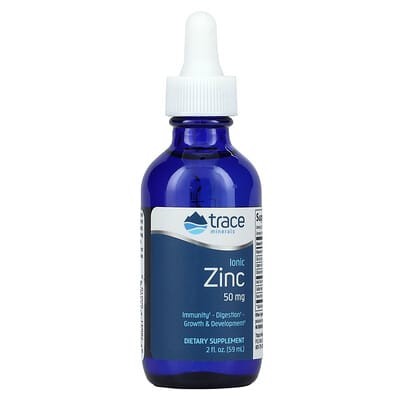
Ionic Zinc 50 mg

Ionic Zinc 50 mg

Trace Minerals4.5 (5,214 ratings)
Format:Liquid Quantity: 2 Liquid(s) · 48 servings
Goals

About this product

The 50 mg zinc amount is the main decision point. Zinc supports normal immune function and skin repair when intake is low, but this serving exceeds the adult daily upper intake level identified in the supplied findings. More zinc does not establish stronger immunity, improved vision or higher testosterone when zinc needs are already met.

Copper is quantified at 2 mg, which gives more information than an unknown mineral balance. Its presence does not remove the concern created by the high zinc amount. Zinc and copper both use sulfate forms, which are less favored choices in the supplied ingredient comparison.

The trace mineral additions are secondary to zinc. Magnesium and boron amounts are small, while the stated sulfate mass does not establish an elemental sulfur amount or the benefits of other sulfur preparations. The zinc contribution offers reasonable value, but the high dose makes suitability more important than cost.

Who is it for
  • Adults whose zinc plan specifically calls for a high amount with professional oversight
Best for
  • A defined high-zinc regimen with intake review

Pros

  • Clearly states the zinc dose and sulfate source
  • Quantifies the included copper
  • Reasonable value for the zinc contribution

Cons

  • High zinc amount offers no established extra benefit with adequate intake
  • Sulfate mineral forms are less favored
  • Small magnesium and boron amounts add limited support
  • Sulfate weight does not establish elemental sulfur content

Warnings

  • A 50 mg zinc serving exceeds the adult daily upper intake level of 40 mg; long-term daily use warrants professional oversight.
  • Included copper does not cancel the high zinc exposure; account for zinc from food and other supplements before use.


Product analysis

53 out of 100

Ionic Zinc 50 mg supports normal immune function and skin repair, especially when zinc intake is inadequate. Its zinc and copper sulfate forms are less favorable choices among the compared mineral forms.

AI assessment of the formula, label and price. How scoring works

Nutrient Quality26

Zinc and copper use sulfate forms, which are less favorable choices in their form comparisons. The quality of the trace-mineral sources and the unnamed blend remains uncertain.

Ingredient Transparency76

Amounts and most ingredient sources are disclosed, helping with serving comparisons. The blend details and relative sulfur sources are unspecified, leaving parts of the composition unclear.

Value For Money61

The zinc content is moderately priced, with more favorable comparisons for copper, chloride and sulfur. Magnesium and boron cannot be judged reliably for value.

Customer Satisfaction83

A large number of customers give generally positive feedback. Those opinions describe satisfaction without establishing additional benefits from high zinc intake.

Product Focus39

Zinc has a clear nutritional role across immunity, skin and other normal functions, particularly when intake is low. The high serving amount does not establish greater benefit, and the unnamed blend limits a complete view of the formula.

Format
Liquid
Container
2 Liquid(s)
Per serving
$0.31
Customer rating
4.5 · 5,214 ratings
Report analysis

Goals

Immunity
Impact
Highest effect
B- Ingredient FitB+ PathwaysA+ EvidenceA+ Formulation Logic
Magnesium · 25 mgZinc · 50 mg

Zinc contributes to normal immune-cell function and regulation. Copper can help restore immune processes impaired by low intake, without establishing extra protection when intake is adequate.

How this product is rated for Immunity

Ingredient fit74

Zinc connects the formula to immunity. The included amounts reach the saved comparison endpoints; this does not mean larger amounts provide greater immune benefit.
Goal fit
Relevant immune nutrients are included within a broader formula with other active ingredients.
Dose adequacy
The included amounts reach the saved comparison endpoints; this does not mean larger amounts provide greater immune benefit.

Pathways80

The strongest saved finding concerns lymphocyte function and immune regulation.
Depth
The strongest saved finding concerns lymphocyte function and immune regulation.
Breadth
The broader saved findings cover innate immune cell activity, lymphocyte function and immune regulation.

Evidence100

Zinc provides the strongest saved evidence finding. Nutritional function or modest regular-use symptom support does not establish general infection prevention.
Evidence strength
Zinc drives the strongest saved evidence finding; the practical support remains bounded by its specific nutritional or regular-use role.
Studied preparation
The saved finding accepts the declared forms without establishing that they outperform other forms.

Formulation logic100

No unmet ingredient partner or configured conflict was identified. The included contributors meet the saved minimum amount criterion; this does not establish clinical effectiveness.
Partner coverage
The included ingredients have no unmet partner requirement in the supplied findings.
Conflicts
No configured ingredient conflict was identified in the supplied findings.
Effective doses
The included contributors meet the saved minimum amount criterion; this does not establish clinical effectiveness.
Study evidence
Magnesium Supportive 8 studies
Zinc Supportive 73 studies
Hair Health
Impact
High effect
B- Ingredient FitF PathwaysA+ EvidenceA+ Formulation Logic
Zinc · 50 mg

Zinc can help address diffuse shedding when zinc intake is deficient.

How this product is rated for Hair Health

Ingredient fit74

Relevant nutritional ingredients are present, with the amount findings determining how much they contribute.
Goal fit
The formula includes relevant nutrients alongside ingredients serving broader purposes.
Dose adequacy
The declared amount fully meets the supplied comparison anchors; this does not establish extra hair benefit.

Pathways9

Hair-fibre nutrition is the strongest finding; this does not establish follicular regrowth.
Depth
Hair-fibre nutrition is the strongest finding; this does not establish follicular regrowth.
Breadth
None of the evaluated processes reaches the supplied coverage requirement.

Evidence98

Zinc provides the strongest relevant support, specifically for deficiency-related shedding.
Evidence strength
Zinc provides the strongest relevant support, specifically for deficiency-related shedding.
Studied preparation
The saved findings accept the relevant preparations for comparison; this does not prove the whole product produces the studied hair outcomes.

Formulation logic100

The supplied findings identify no missing required partners or configured conflicts. Amount comparisons do not establish a combined hair-growth effect.
Partner coverage
No required ingredient partner is missing from the supplied findings.
Conflicts
No configured ingredient conflict was found in the supplied findings.
Effective doses
All counted ingredients meet the supplied minimum amount comparison; this is not a proven effective hair dose.
Study evidence
Copper Adverse 4 studies
Zinc Supportive 22 studies
Skin Health
Impact
High effect
B- Ingredient FitC- PathwaysA- EvidenceA Formulation Logic
Zinc · 50 mgCopper · 2 mg

Zinc supports skin repair when zinc intake is deficient, and copper is needed for connective-tissue enzymes. Those normal roles do not establish improved skin from extra minerals when intake is adequate. The sulfur amount is unresolved, limiting its amount contribution. The saved structural recognition does not establish a proven effect on elasticity, wrinkles or hydration.

How this product is rated for Skin Health

Ingredient fit72

The formula’s recognized ingredients and disclosed quantities determine its skin focus and amount findings.
Goal fit
The formula includes recognized skin-related ingredients alongside actives aimed at other goals, reducing its skin focus.
Dose adequacy
The recognized ingredients receive partial amount recognition; smaller or unresolved quantities limit the contribution assigned to the serving.

Pathways56

The assigned coverage is concentrated in the mechanisms below and does not establish benefit across every aspect of skin health.
Depth
The strongest assigned contribution concerns dermal collagen matrix; this reflects the saved findings rather than a confirmed clinical effect.
Breadth
Only one evaluated mechanism reaches the coverage threshold, leaving the other aspects of skin support limited.

Evidence89

The saved evidence findings recognize the ingredients below, while the supplied scientific context limits expectations for routine skin improvement.
Evidence strength
Copper supplies the leading recognized evidence contribution, although ingredient context limits what skin benefits can be expected.
Studied preparation
The saved calculation recognizes the counted preparations as studied; ingredient-specific context still limits transfer to routine skin improvement.

Formulation logic92

The counted ingredients have no unmet partner requirement or identified configured conflict. Their minimum amount findings are separate from proof of clinical benefit.
Partner coverage
The counted ingredients have no unmet partner requirement in the saved findings; this does not establish added benefit from combining them.
Conflicts
No configured ingredient conflict was identified; this finding does not assess overall safety or personal suitability.
Effective doses
The amounts of Sulfur do not clear the minimum threshold; other counted ingredients do.
Study evidence
Copper Supportive 16 studies
Sulfur Supportive 20 studies
Zinc Supportive 66 studies
Everyday Health
Impact
High effect
B Ingredient FitD+ PathwaysB- EvidenceA+ Formulation Logic
Magnesium · 25 mgBoron · 100 mcgZinc · 50 mg

Zinc supplies a nutrient involved in normal immune functions, chiefly relevant when intake is low. The selected serving contains 50 mg, a high nutritional amount whose retained contribution does not establish greater immune benefit or suitability. Copper is present, so the evaluated high-zinc-without-copper combination does not apply. Smaller magnesium and boron amounts add no independent contribution in the saved findings.

How this product is rated for Everyday Health

Ingredient fit78

The relevant ingredients contribute to normal defence functions. Their main value is nutrient availability when intake is low.
Goal fit
The formula includes relevant nutrients alongside additional actives that do not establish a contribution to this goal.
Dose adequacy
The counted amounts make substantial nutritional contributions; larger amounts do not establish greater benefit or suitability.

Pathways52

The counted ingredients span normal defence functions. These are contributions to normal nutrient functions rather than proof of broad health improvements.
Depth
The strongest nutritional contribution concerns normal antioxidant and immune functions.
Breadth
The saved findings extend across normal defence functions; this describes nutritional roles rather than proven improvements in all these areas.

Evidence72

Zinc anchors the strongest supported nutritional contribution. The preparation findings do not establish extra benefit from named chemical forms or supplementation above adequate intake.
Evidence strength
Zinc provides the strongest supported contribution among the counted ingredients, primarily as nutrition for low intake rather than demonstrated extra benefit above adequacy.
Studied preparation
The counted preparations meet the saved preparation finding; no superiority of a named form or delivery method is established.

Formulation logic100

The independently counted ingredients satisfy the amount and partner checks, with no evaluated conflict triggered. These findings do not establish synergy or overall suitability.
Partner coverage
The counted nutrients work independently or have their required partner present; this does not establish an added combination benefit.
Conflicts
None of the evaluated ingredient combinations triggered a conflict finding; this does not establish overall suitability.
Effective doses
All independently counted ingredients meet the saved amount check; smaller present ingredients may remain outside this finding.
Study evidence
Boron Supportive 6 studies
Magnesium Supportive 114 studies
Zinc Supportive 60 studies
Testosterone Support
Impact
Moderate effect
C+ Ingredient FitF PathwaysA EvidenceA+ Formulation Logic
Magnesium · 25 mgZinc · 50 mgBoron · 100 mcg

Zinc may help restore testosterone when low zinc is behind the problem. Getting enough zinc matters for normal testosterone, but extra zinc has not increased it in people who already get enough.

How this product is rated for Testosterone Support

Ingredient fit67

Zinc’s practical relevance is correcting low zinc, rather than raising testosterone above an adequate level. Other declared ingredients serve purposes beyond testosterone.
Goal fit
Zinc’s practical relevance is correcting low zinc, rather than raising testosterone above an adequate level.
Dose adequacy
The serving provides Zinc 50 mg, Magnesium 25 mg; these amounts do not guarantee a testosterone increase.

Pathways0

Correcting zinc deficiency is distinct from directly enhancing hormone production. Several proposed hormone processes do not ensure a broader benefit.
Depth
Zinc relates to testosterone through nutrient sufficiency; this is different from a general hormone boost.
Breadth
Ingredients linked to different hormone processes do not necessarily produce broader benefits when combined.

Evidence93

Zinc’s practical relevance is correcting low zinc, rather than raising testosterone above an adequate level.
Evidence strength
Zinc’s practical relevance is correcting low zinc, rather than raising testosterone above an adequate level.
Studied preparation
Recognized ingredient preparations do not remove the limits on who may experience a hormone benefit.

Formulation logic100

No particular ingredient conflict is identified. The relevant ingredients do not require an additional missing partner for their individual roles.
Partner coverage
The relevant ingredients do not require an additional missing partner for their individual roles.
Conflicts
No particular ingredient conflict is identified.
Effective doses
The serving provides Zinc 50 mg, Magnesium 25 mg; these amounts do not guarantee a testosterone increase.
Study evidence
Boron Disputed 3 studies
Magnesium Disputed 5 studies
Zinc Disputed 7 studies
Bone Health
Impact
Highest effect
B+ Ingredient FitC PathwaysA+ EvidenceA+ Formulation Logic
Magnesium · 25 mgCopper · 2 mgBoron · 100 mcgZinc · 50 mg

Copper helps cross-link bone collagen, particularly when dietary intake is deficient. Zinc also participates in normal bone-building processes, but routine extra zinc has not established improved adult bone density or fracture prevention. The 50 mg zinc serving exceeds the highest supplied reference amount, without evidence of additional bone benefit. Magnesium and boron are present in small amounts below the saved inclusion thresholds.

How this product is rated for Bone Health

Ingredient fit84

Zinc and copper provide the counted bone-related contributions within a broader mineral product. Zinc and copper reach the upper reference range; the larger zinc amount does not establish extra benefit.
Goal fit
Zinc and copper provide the counted bone-related contributions within a broader mineral product.
Dose adequacy
Zinc and copper reach the upper reference range; the larger zinc amount does not establish extra benefit.

Pathways60

Collagen formation is the only covered area; mineral supply, calcium regulation and bone-protein activation receive no contribution.
Depth
Collagen matrix formation is the most strongly covered area in the saved findings.
Breadth
Collagen formation is the only covered area; mineral supply, calcium regulation and bone-protein activation receive no contribution.

Evidence98

Zinc supplies the strongest counted evidence. The counted ingredients match the preparation categories accepted in the supplied comparison; this does not establish extra benefit from their named forms.
Evidence strength
Zinc anchors the strongest counted evidence here; nutritional roles do not establish routine fracture prevention.
Studied preparation
The counted ingredients match the preparation categories accepted in the supplied comparison; this does not establish extra benefit from their named forms.

Formulation logic100

The counted ingredients have the required partner support. No defined conflict was found, and all counted amounts meet the saved inclusion threshold.
Partner coverage
The counted ingredients either work independently or have their required partner present.
Conflicts
No conflict defined in the supplied comparison was found.
Effective doses
All counted ingredients meet the saved amount threshold; this does not make every amount a proven effective bone dose.
Study evidence
Boron Supportive 5 studies
Copper Disputed 20 studies
Magnesium Supportive 48 studies
Zinc Supportive 33 studies

Ingredients

IngredientAmount per servingScore
Magnesium (Ionic Trace Minerals)
25 mg
Zinc (Zinc Sulfate)
50 mg 50
Copper (Copper Sulfate)
2 mg 65
Chloride (Ionic Trace Minerals)
55 mg 41
Ionic Trace Minerals Complex
350 mg
Sulfate (Ionic Trace Minerals, Zinc Sulfate)
40 mg 64
Boron (Ionic Trace Minerals)
100 mcg
Gluten Free Adults 18–50 Vegan Dairy Free No Allergies Vegetarian
Report overview
B+ Active Ingredient Quality & BioavailabilityD- Dose, Safety & Label TransparencyB+ Value
The declared 40 mg of sulfate does not establish how much elemental sulfur the serving contains. At about $0.32 for the whole-product serving, it has a relatively low serving price, but cost per known amount of sulfur cannot be compared.
How this ingredient is rated

Active Ingredient Quality & Bioavailability80

An ionic sulfur claim is recorded, but the specific sulfur carrier is not identified in the saved facts.
Sulfur Source & Chemical Form
The saved facts flag ionic sulfur; that description does not establish a verified absorption advantage or identify the chemical carrier.

Dose, Safety & Label Transparency40

Sulfate quantity is available, but the elemental sulfur amount remains unknown; an absent sulfur figure does not mean the serving contains none.
Elemental Sulfur Potency
The 40 mg figure is sulfate weight, not declared elemental sulfur; no sulfur yield is inferred.
Quantitative Complex Disclosure
The serving explicitly lists 40 mg sulfate, providing compound-quantity detail without establishing the elemental sulfur amount.

Value80

Serving price compares the entire product; it does not isolate the cost or establish the quality of its sulfur.
Price per Serving vs. Collection Median
The whole product costs about $0.32 per serving, a relatively low serving price in the supplied comparison.
F Active Ingredient Quality & BioavailabilityD- Dose, Safety & Label TransparencyB+ Value
The serving declares a small 55 mg of chloride, but the saved facts do not identify a specific source salt. The whole-product serving costs about $0.32, providing a serving-cost comparison while the chemical source remains uncertain.
How this ingredient is rated

Active Ingredient Quality & Bioavailability20

A specific chloride salt is not established in the saved facts. That limits comparison of the chemical source without demonstrating poor purity or absorption.
Chloride source quality
The saved facts do not identify a specific chloride salt, so its chemical source remains uncertain.

Dose, Safety & Label Transparency42

The chloride quantity is visible, though its small amount limits how much the serving contributes. Source information is also incomplete.
Chloride amount per serving
The declared 55 mg supplies a small amount of chloride per serving.
Amount and source disclosure
The chloride amount is declared, but its specific source salt is not established in the saved facts.

Value80

About $0.32 per whole-product serving. The price provides a serving-cost comparison without establishing ingredient quality or an equal chloride amount across products.
Price per serving
The labeled whole-product serving costs about $0.32; this is not a separate chloride price or a cost per equivalent chloride amount.
F Active Ingredient Quality & BioavailabilityA- Dose, Safety & Label TransparencyB+ Value
Report alternatives

Sources

Published studies used for the product analysis and the top-ranked studies for each ingredient and goal.

  1. [Comparative study of the urinary excretion of boron, calcium, magnesium and phosphorus in postmenopausal women with and without osteoporosis].
    José Ramón V; Mora Mora M; Marino Alarcón O; Hernández G; Josefina Linares L; Urdaneta Romero H; Arévalo González E · Investigacion clinica · 2013
    Case-control study45 participantsBone Health forBoron
  2. Effect of dietary boron on mineral, estrogen, and testosterone metabolism in postmenopausal women.
    Nielsen FH; Hunt CD; Mullen LM; Hunt JR · FASEB journal : official publication of the Federation of American Societies for Experimental Biology · 1987
    Single-arm trial12 participantsBone Health forBoron
  3. The relationship between boron and magnesium status and bone mineral density in the human: a review.
    Volpe SL; Taper LJ; Meacham S · Magnesium research · 1994
    Narrative reviewBone Health forBoron
  4. Effects of boron supplementation on bone mineral density and dietary, blood, and urinary calcium, phosphorus, magnesium, and boron in female athletes.
    Meacham SL; Taper LJ; Volpe SL · Environmental health perspectives · 1995
    Randomized trial28 participantsBone Health forBoron
  5. Metabolic responses of postmenopausal women to supplemental dietary boron and aluminum during usual and low magnesium intake: boron, calcium, and magnesium absorption and retention and blood mineral concentrations
    C D Hunt, J L Herbel, F H Nielsen · The American Journal of Clinical Nutrition · 1997
    Non-randomized trial11 participantsBone Health forBoron
  6. The Association between Dietary and Circulating Copper Levels and Osteoporosis: a Scoping Review.
    Ju Y; Xiong W; Pang Y; Chen Z; Hou J; Zheng S; Li Z; Liu T; Xia H; Xia M; Zhong Y; Li J; Jiang X · Biological trace element research · 2026
    Scoping review18 studies pooledBone Health forCopper
  7. Association between dietary copper, iron, zinc, selenium intake and osteopenia or osteoporosis in elderly hypertensive patients: a retrospective cohort study.
    Chen M; Jia L; Gao R · Frontiers in nutrition · 2024
    Cohort study5,286 participantsBone Health forCopper
  8. Associations of dietary copper intake with total bone mineral density and lumbar spine bone mineral density in American adults.
    Hu M; Wang Z; Li C; Zheng Y; Hu J · Medicine · 2025
    Cross-sectional studyBone Health forCopper
  9. The association between dietary mineral intake and bone mineral density: a cross-sectional study.
    Wei M; Wei J; Huang S · Journal of health, population, and nutrition · 2025
    Cross-sectional study11,520 participantsBone Health forCopper
  10. Association between dietary copper intake and bone mineral density in children and adolescents aged 8-19 years: A cross-sectional study.
    Cui A; Yan J; Li H; Fan Z; Wei X; Wang H; Zhuang Y · PloS one · 2024
    Cross-sectional study6,965 participantsBone Health forCopper
  11. Association between Serum Magnesium and Fractures: A Systematic Review and Meta-Analysis of Observational Studies.
    Dominguez LJ; Veronese N; Ciriminna S; Pérez-Albela JL; Vásquez-López VF; Rodas-Regalado S; Di Bella G; Parisi A; Tagliaferri F; Barbagallo M · Nutrients · 2023
    Meta-analysis119,755 participants4 studies pooledBone Health forMagnesium
  12. Bioabsorbable Magnesium-Based Materials Potential and Safety in Bone Surgery: A Systematic Review.
    Hung CH; Kwok YC; Yip J; Wong HH; Leung YY · Craniomaxillofacial trauma & reconstruction · 2025
    Systematic review386 participants8 studies pooledBone Health forMagnesium
  13. Vascularized bone grafting fixed by biodegradable magnesium screw for treating osteonecrosis of the femoral head.
    Zhao D; Huang S; Lu F; Wang B; Yang L; Qin L; Yang K; Li Y; Li W; Wang W; Tian S; Zhang X; Gao W; Wang Z; Zhang Y; Xie X; Wang J; Li J · Biomaterials · 2016
    Randomized trial48 participantsBone Health forMagnesium
  14. An update on magnesium and bone health.
    Rondanelli M; Faliva MA; Tartara A; Gasparri C; Perna S; Infantino V; Riva A; Petrangolini G; Peroni G · Biometals : an international journal on the role of metal ions in biology, biochemistry, and medicine · 2022
    Narrative reviewBone Health forMagnesium
  15. Sex-specific differences in the association of magnesium intake with femoral neck bone mineral density among older adults.
    Wang B; Tan X; Yao X; Zhu Z · Endocrine connections · 2025
    Cross-sectional study1,343 participantsBone Health forMagnesium
  16. Increased incidence of fractures in middle-aged and elderly men with low intakes of phosphorus and zinc.
    Elmståhl S; Gullberg B; Janzon L; Johnell O; Elmståhl B · Osteoporosis international : a journal established as result of cooperation between the European Foundation for Osteoporosis and the National Osteoporosis Foundation of the USA · 1999
    Cohort study6,576 participantsBone Health forZinc
  17. Zinc Supplementation Increases Procollagen Type 1 Amino-Terminal Propeptide in Premenarcheal Girls: A Randomized Controlled Trial.
    Berger PK; Pollock NK; Laing EM; Chertin V; Bernard PJ; Grider A; Shapses SA; Ding KH; Isales CM; Lewis RD · The Journal of nutrition · 2016
    Randomized trial147 participantsBone Health forZinc
  18. Randomized controlled trial of prenatal zinc supplementation and fetal bone growth.
    Merialdi M; Caulfield LE; Zavaleta N; Figueroa A; Costigan KA; Dominici F; Dipietro JA · The American journal of clinical nutrition · 2004
    Randomized trial242 participantsBone Health forZinc
  19. The effects of zinc supplementation on serum zinc, alkaline phosphatase activity and fracture healing of bones.
    Sadighi A; Roshan MM; Moradi A; Ostadrahimi A · Saudi medical journal · 2009
    Randomized trial60 participantsBone Health forZinc
  20. Is Zinc an Important Trace Element on Bone-Related Diseases and Complications? A Meta-analysis and Systematic Review from Serum Level, Dietary Intake, and Supplementation Aspects.
    Ceylan MN; Akdas S; Yazihan N · Biological trace element research · 2021
    Meta-analysis40 studies pooledBone Health forZinc



