


Calcium Supportive
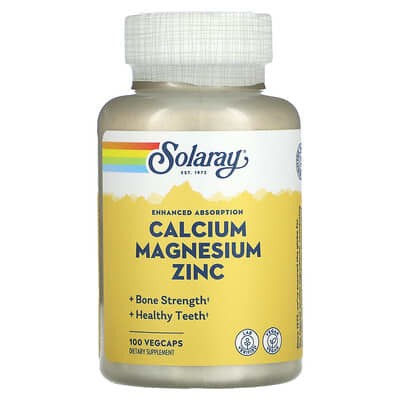
$12.69 $0.50 per serving
Product analysis
Solaray Calcium Magnesium Zinc combines 1,000 mg of calcium, 500 mg of magnesium and 25 mg of zinc in four vegetarian capsules for bone and everyday mineral nutrition. The two main minerals use mixed forms, including citrate and less readily absorbed forms, with unspecified proportions. The four-capsule serving and substantial magnesium and zinc amounts are important considerations.
AI assessment of the formula, label and price. How scoring works
Nutrient Quality36
The calcium and magnesium blends contain several forms with different absorption potential, but the amounts from each form are not stated. Magnesium oxide is less readily absorbed than some alternatives.
Ingredient Transparency68
The amounts and forms of the three principal minerals are stated individually. The proportions of the calcium and magnesium forms are not disclosed.
Value For Money71
Calcium and zinc offer good value for their supplied amounts, while magnesium value is more moderate. The full four-capsule serving costs $0.50.
Customer Satisfaction93
Customers rate the formula very highly. The very large number of ratings gives that feedback added weight.
Product Focus60
The mineral blend is well suited to bone and general nutrient support. Its connections to numerous other health goals are often conditional on nutrient intake.
- Format
Capsule - Container
- 100 VegCap(s)
- Per serving
- $0.50
- Also available
 Calcium Magnesium Zinc$22.06
- Customer rating
- 4.8 · 21,288 ratings
Goals

Impact
Highest effect
Magnesium · 500 mgCalcium · 1000 mgZinc · 25 mg
Calcium Magnesium Zinc supports bone mineral intake with 1000 mg calcium per serving for normal mineralization. Magnesium adds 500 mg for normal bone metabolism. Zinc adds 25 mg as a cofactor for bone-forming cells.
Magnesium Supportive
Zinc Supportive

Impact
Highest effect
Magnesium · 500 mgZinc · 25 mg
Calcium Magnesium Zinc offers substantial mineral coverage for everyday nutrition when dietary intake falls short. Magnesium at 500 mg supports normal energy and mineral metabolism, while 1,000 mg of calcium contributes to bone mineral nutrition. Zinc at 25 mg adds normal immune and antioxidant functions. The three nutrients provide complementary roles rather than a single-purpose contribution.
Magnesium Supportive
Zinc Supportive

Impact
High effect
Magnesium · 500 mgZinc · 25 mg
Calcium Magnesium Zinc offers immune support mainly through its 25 mg zinc content. Zinc supports normal immune-cell function and regulation. The broader mineral combination is less specifically focused on immunity.
Zinc Supportive
Magnesium Supportive

Impact
Moderate effect
Magnesium · 500 mg
Calcium Magnesium Zinc fits energy support when low magnesium intake contributes to tiredness. Its 500 mg magnesium serving, supplied in citrate, oxide and amino acid chelate forms, supports magnesium-dependent energy metabolism.
Magnesium Supportive

Impact
High effect
Zinc · 25 mgMagnesium · 500 mg
Calcium Magnesium Zinc has a limited fit for bowel regularity through its 500 mg magnesium blend. Citrate and oxide can retain water in the bowel, but their individual amounts are not disclosed alongside the chelated form. Its 25 mg zinc supports intestinal tissue repair when zinc intake is inadequate.
Zinc Supportive
Magnesium Supportive

Impact
Highest effect
Magnesium · 500 mgZinc · 25 mg
Calcium Magnesium Zinc offers nutritional support with a limited direct connection to testosterone enhancement. Its 25 mg zinc is relevant when correcting inadequate intake. Magnesium at 500 mg supplies a substantial declared amount, but the supplied hormone findings depend on exercise and participant circumstances that cannot be assumed for the user.
Zinc Disputed
Magnesium Disputed
Ingredients
| Ingredient | Amount per serving | Score |
|---|---|---|
Total Carbohydrates | 1 Gram(s) | |
Calcium (Calcium Amino Acid Chelate Complex, Calcium Carbonate, Calcium Citrate, Calcium Hydroxide) | 1000 mg | |
Magnesium (Magnesium Amino Acid Chelate Complex, Magnesium Citrate, Magnesium Oxide) | 500 mg | |
Zinc (Zinc Amino Acid Chelate Complex) | 25 mg | |
Glutamic Acid Hydrochloride | 100 mg |
Glutamic Acid · 100 mg OverallScore75
Solaray Calcium Magnesium Zinc is inexpensive for glutamic acid at $0.63 per 100 mg estimated glutamic acid. The serving lists 100 mg of Glutamic Acid Hydrochloride; the free glutamic acid amount is unknown. The full formula costs $0.51 per serving. The free glutamic acid amount is not disclosed, so the price uses an estimate from the hydrochloride amount.
Zinc (Zinc Amino Acid Chelate Complex) · 25 mg OverallScore60
Solaray Calcium Magnesium Zinc is a useful zinc choice, with 25 mg per serving as Zinc Amino Acid Chelate. That is a substantial amount. The copper amount is unknown, so the zinc-to-copper balance cannot be determined. At $0.20 per 10 mg zinc and $0.51 per serving, the zinc is good value; the serving price pays for the full formula.
Calcium (Calcium Amino Acid Chelate Complex, Calcium Carbonate, Calcium Citrate, Calcium Hydroxide) · 1000 mg OverallScore67
Solaray Calcium Magnesium Zinc provides a useful amount of calcium: 1000 mg per serving. The calcium sources are Calcium Amino Acid Chelate, Calcium Carbonate, Calcium Citrate, Calcium Hydroxide; their proportions are unknown. A flow agent is present. At $0.05 per 100 mg of calcium, it offers good value; the cost is $0.51 per labeled serving for the full formula.
Alternative products
Report alternatives
Sources
Published studies used for the product analysis and the top-ranked studies for each ingredient and goal.
- What is the impact of daily oral supplementation of vitamin D3 (cholecalciferol) plus calcium on the incidence of hip fracture in older people? A systematic review and meta-analysis.
- Calcium supplementation prevents seasonal bone loss and changes in biochemical markers of bone turnover in elderly New England women: a randomized placebo-controlled trial.
- The effects of calcium supplementation (milk powder or tablets) and exercise on bone density in postmenopausal women.
- The efficacy of calcium supplementation alone in elderly Thai women over a 2-year period: a randomized controlled trial.
- Calcium-enriched foods and bone mass growth in prepubertal girls: a randomized, double-blind, placebo-controlled trial.
- Association between Serum Magnesium and Fractures: A Systematic Review and Meta-Analysis of Observational Studies.
- Bioabsorbable Magnesium-Based Materials Potential and Safety in Bone Surgery: A Systematic Review.
- Vascularized bone grafting fixed by biodegradable magnesium screw for treating osteonecrosis of the femoral head.
- An update on magnesium and bone health.
- Sex-specific differences in the association of magnesium intake with femoral neck bone mineral density among older adults.
- Increased incidence of fractures in middle-aged and elderly men with low intakes of phosphorus and zinc.
- Zinc Supplementation Increases Procollagen Type 1 Amino-Terminal Propeptide in Premenarcheal Girls: A Randomized Controlled Trial.
- Randomized controlled trial of prenatal zinc supplementation and fetal bone growth.
- The effects of zinc supplementation on serum zinc, alkaline phosphatase activity and fracture healing of bones.
- Is Zinc an Important Trace Element on Bone-Related Diseases and Complications? A Meta-analysis and Systematic Review from Serum Level, Dietary Intake, and Supplementation Aspects.
- Circulating and dietary magnesium and risk of cardiovascular disease: a systematic review and meta-analysis of prospective studies.
- Magnesium and the risk of cardiovascular events: a meta-analysis of prospective cohort studies.
- Quantitative Association Between Serum/Dietary Magnesium and Cardiovascular Disease/Coronary Heart Disease Risk: A Dose-Response Meta-analysis of Prospective Cohort Studies.
- Comparative Efficacy of Nutraceuticals on Endothelial Function: A Systematic Review and Network Meta-Analysis.
- Serum magnesium, mortality, and cardiovascular disease in chronic kidney disease and end-stage renal disease patients: a systematic review and meta-analysis.