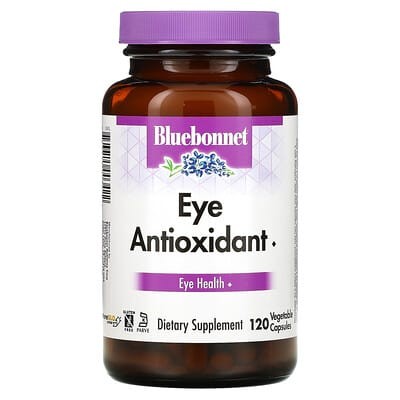
Eye Antioxidant

Eye Antioxidant

Bluebonnet4.7 (993 ratings)
Format:Capsule Quantity: 120 Capsule(s) · 60 servings
Goals

About this product

The formula supports eye-related nutrition more clearly than routine visual improvement. Vitamin A and riboflavin matter when intake is inadequate, while zinc and vitamins C and E contribute nutritional or antioxidant roles. Evidence tied to defined combinations for selected eye conditions cannot be transferred to any broadly similar blend.

Zinc picolinate at 25 mg and selenium as selenomethionine are clearly identified source choices. The 500 mg vitamin C serving uses plain L-ascorbic acid, with no buffered or stomach-friendly feature established. Several other ingredient forms and the eye-support blend remain unclear, preventing a complete view of the serving.

The added flax, glutathione, taurine and alpha-lipoic-acid amounts provide less support than the main nutrients. Flax powder cannot be assumed to work like flaxseed oil, and antioxidant roles alone do not establish visible skin changes or slower aging. Several individual nutrient contributions are relatively costly, which limits value if improved everyday vision is the main aim.

Who is it for
  • Adults seeking nutrients involved in normal eye function when dietary intake is low
  • People who understand that the blend is not equivalent to a specific condition-directed eye regimen
Best for
  • Eye-related nutritional gap coverage
  • Combining vitamin C with identified zinc and selenium sources

Pros

  • Zinc picolinate and selenomethionine are clearly identified
  • Vitamin C amount is stated directly
  • Riboflavin contributes to normal eye nutrition when intake is low

Cons

  • Eye-support blend and some ingredient details are unresolved
  • Small glutathione and taurine amounts add limited support
  • Flax composition does not establish the findings associated with flaxseed oil
  • Value is limited for several core nutrient contributions
  • Copper amount is not disclosed

Warnings

  • The 25 mg zinc contribution needs to be counted alongside food and other supplements when assessing total zinc intake.


Product analysis

58 out of 100

Eye Antioxidant supplies nutrients that support normal eye nutrition, especially when intake is low. Its broader mix does not establish sharper everyday vision in adequately nourished adults.

AI assessment of the formula, label and price. How scoring works

Nutrient Quality47

Zinc, selenium and chromium use favorable identified forms. Quality remains uncertain for many other ingredients, including several additions without named forms.

Ingredient Transparency77

Most ingredient amounts and half of the forms are disclosed, making much of the serving checkable. Missing details limit comparisons for the remaining ingredients.

Value For Money36

Vitamin C and several minerals are relatively expensive for their contributions. More reasonable value from some additions does not settle the value of the full formula.

Customer Satisfaction80

Customer feedback is strongly positive across around a thousand ratings. That gives a substantial basis for understanding satisfaction.

Product Focus59

The clearest benefit is nutritional support for normal eye and immune functions when intake is low. The evidence for selected eye disease combinations cannot establish routine visual improvement from this formula.

Format
Capsule
Container
120 Capsule(s)
Per serving
$0.83
Customer rating
4.7 · 993 ratings
Report analysis

Goals

Immunity
Impact
Highest effect
C Ingredient FitA+ PathwaysA+ EvidenceA+ Formulation Logic
Vitamin C · 500 mgZinc · 25 mgVitamin A · 3000 mcgSelenium · 100 mcg

Vitamin A contributes to barrier nutrition, zinc to normal immune-cell function and selenium to oxidative balance when intake is low. Vitamin C has modest regular-use evidence for shorter colds. These contributions cover several immune functions, but the large nutrient amounts do not establish extra immune enhancement or safety; vitamin E's mixed older-adult evidence does not demonstrate routine respiratory protection.

How this product is rated for Immunity

Ingredient fit64

Vitamin A, zinc, selenium and vitamin C, with vitamin E in the saved findings provide the relevant immune connection. The amount comparison concerns one selected serving.
Goal fit
The meaningful immune connection comes from vitamin a, zinc, selenium and vitamin c, with vitamin e in the saved findings. Broader uses do not establish additional immune effects.
Dose adequacy
Amounts contribute unevenly across the included ingredients; greater amounts do not establish greater clinical benefit.

Pathways100

The strongest represented area is barrier and antimicrobial defense. Four immune areas have substantial representation.
Depth
The strongest contribution concerns barrier and antimicrobial defense.
Breadth
Four immune areas have substantial representation.

Evidence100

Vitamin C leads the saved evidence finding. Regular vitamin C use may modestly shorten colds; prevention or treatment from a single serving is not established.
Evidence strength
Regular vitamin C use may modestly shorten colds; prevention or treatment from a single serving is not established.
Studied preparation
The included preparations meet the supplied comparison, without establishing superiority of named forms or delivery methods.

Formulation logic100

No configured ingredient conflict was identified; this is not an overall safety judgment. The included ingredients meet the amount threshold and have no missing required partner.
Partner coverage
The included ingredients work independently or have their required partner; this does not demonstrate extra benefit from combining them.
Conflicts
No configured ingredient conflict was identified; this is not an overall safety judgment.
Effective doses
The included ingredients meet the supplied amount threshold; this does not prove clinical effectiveness.
Study evidence
Selenium Mixed 37 studies
Vitamin A Supportive 107 studies
Vitamin C Supportive 53 studies
Vitamin E Supportive 21 studies
Zinc Supportive 73 studies
Impact
Highest effect
C+ Ingredient FitA+ PathwaysB+ EvidenceA+ Formulation Logic
Zinc · 25 mgVitamin E · 67 mgVitamin C · 500 mgVitamin A · 3000 mcg

Vitamin A supports the visual cycle and dark adaptation when low intake or deficiency is corrected; extra benefit with adequate intake is not established. Riboflavin helps maintain normal eye nutrition, with deficiency correction distinct from improved vision in adequately nourished adults. Zinc, vitamin c, vitamin e have nutritional or antioxidant roles, but their eye-disease evidence concerns defined combinations in selected AMD populations, not routine visual improvement.

How this product is rated for Eye Health

Ingredient fit69

The declared amounts largely meet the saved comparisons, although some contribute less at this serving.
Goal fit
The relevant ingredients form part of a broader formula with several other purposes, limiting its concentration on vision.
Dose adequacy
The declared amounts largely meet the saved comparisons, although some contribute less at this serving.

Pathways100

The strongest identified connection concerns antioxidant protection in the retina and lens.
Depth
The strongest identified connection concerns antioxidant protection in the retina and lens.
Breadth
The identified connections cover eye focusing, antioxidant protection in the retina and lens, light-sensitive cell structure and the visual cycle.

Evidence84

Zinc leads the saved evidence findings, while the supplied context limits what can be claimed for routine vision.
Evidence strength
Zinc leads the saved evidence findings, while the supplied context limits what can be claimed for routine vision.
Studied preparation
The evaluated preparations meet the supplied preparation comparison; study population and outcome limitations still apply.

Formulation logic100

The evaluated ingredients have no unmet partner requirement in the supplied findings.
Partner coverage
The evaluated ingredients have no unmet partner requirement in the supplied findings.
Conflicts
No configured ingredient conflict was identified.
Effective doses
The evaluated ingredients meet the saved minimum amount comparison; this is not a proven threshold for visual benefit.
Study evidence
Flavonoid Supportive 5 studies
Ginkgo Supportive 11 studies
Riboflavin Supportive 69 studies
Selenium Supportive 15 studies
Taurine Supportive 1 study
Vitamin A Supportive 65 studies
Vitamin C Disputed 24 studies
Vitamin E Disputed 35 studies
Zinc Supportive 39 studies
Everyday Health
Impact
Highest effect
B- Ingredient FitB+ PathwaysB+ EvidenceA+ Formulation Logic
Selenium · 100 mcgTaurine · 100 mgZinc · 25 mgVitamin C · 500 mg

Riboflavin and niacin contribute to normal energy metabolism, while vitamin C, zinc and selenium contribute to normal defence functions. Their nutritional value is clearest when intake is low. These normal roles do not establish broader health improvements above adequate intake. The small glutathione and taurine amounts did not meaningfully contribute to the findings.

How this product is rated for Everyday Health

Ingredient fit73

The useful contributions vary in size; Gluthathione, Taurine fell below the minimum amount used here.
Goal fit
Relevant nutrients contribute to general health, alongside other actives whose routine general-health contribution is not established here.
Dose adequacy
The useful contributions vary in size; Gluthathione, Taurine fell below the minimum amount used here.

Pathways80

The strongest contribution concerns normal antioxidant and immune functions. Other meaningful coverage is limited to the named nutrient roles.
Depth
The strongest finding concerns normal antioxidant and immune functions, based on the relevant ingredients and their supplied amounts.
Breadth
Meaningful coverage extends to normal energy metabolism, normal antioxidant and immune functions.

Evidence82

Selenium provides the leading evidence contribution. Nutritional functions and the preparation findings do not establish broad health improvements above adequate intake.
Evidence strength
Selenium leads the evidence contribution; its nutrient role does not establish extra benefit above adequate intake.
Studied preparation
The included preparations meet the preparation criteria; this does not establish superiority of a particular form.

Formulation logic100

The included ingredients can contribute without a missing required partner, and no configured conflict was found. Their amounts pass the saved minimum contribution check.
Partner coverage
The included ingredients can contribute independently or have their required partners; no extra benefit from combining them is established.
Conflicts
No configured ingredient conflict was identified in the supplied facts.
Effective doses
The included amounts all meet the minimum amount used here; that threshold is not a proven clinical dose.
Study evidence
Selenium Supportive 70 studies
Taurine No effect 3 studies
Vitamin C Supportive 56 studies
Zinc Supportive 60 studies
Skin Health
Impact
Highest effect
B- Ingredient FitC+ PathwaysA+ EvidenceA+ Formulation Logic
Zinc · 25 mgVitamin C · 500 mgGluthathione · 10 mgSelenium · 100 mcgVitamin E · 67 mg

Vitamin C and zinc support collagen formation and repair when their intake is deficient, while riboflavin supports normal skin when intake is low. Added amounts have no established extra cosmetic benefit when intake is adequate. The carotenoid source declarations remain unreconciled, preventing a matched lutein exposure. Flax powder cannot inherit the limited skin findings for flaxseed oil, and the small glutathione amount does not receive a contribution.

How this product is rated for Skin Health

Ingredient fit74

The formula’s recognized ingredients and disclosed quantities determine its skin focus and amount findings.
Goal fit
The formula includes recognized skin-related ingredients alongside actives aimed at other goals, reducing its skin focus.
Dose adequacy
The recognized ingredients receive partial amount recognition; smaller or unresolved quantities limit the contribution assigned to the serving.

Pathways70

The assigned coverage is concentrated in the mechanisms below and does not establish benefit across every aspect of skin health.
Depth
The strongest assigned contribution concerns uv antioxidant defence; this reflects the saved findings rather than a confirmed clinical effect.
Breadth
The saved findings cover collagen structure and UV-related antioxidant activity, with weaker support for barrier lipids and none for water binding.

Evidence100

The saved evidence findings recognize the ingredients below, while the supplied scientific context limits expectations for routine skin improvement.
Evidence strength
Vitamin C supplies the leading recognized evidence contribution, although ingredient context limits what skin benefits can be expected.
Studied preparation
The saved calculation recognizes the counted preparations as studied; ingredient-specific context still limits transfer to routine skin improvement.

Formulation logic100

The counted ingredients have no unmet partner requirement or identified configured conflict. Their minimum amount findings are separate from proof of clinical benefit.
Partner coverage
The counted ingredients have no unmet partner requirement in the saved findings; this does not establish added benefit from combining them.
Conflicts
No configured ingredient conflict was identified; this finding does not assess overall safety or personal suitability.
Effective doses
All counted ingredients clear the saved minimum amount threshold; passing it does not make each amount a proven effective skin dose.
Study evidence
Flax Supportive 7 studies
Niacin Supportive 61 studies
Selenium Supportive 22 studies
Vitamin A Supportive 106 studies
Vitamin C Supportive 53 studies
Vitamin E Supportive 38 studies
Zinc Supportive 66 studies
Hair Health
Impact
High effect
B- Ingredient FitC PathwaysA+ EvidenceA+ Formulation Logic
Zinc · 25 mgVitamin C · 500 mg

Zinc can help address a dietary gap that contributes to diffuse shedding, without established extra regrowth when intake is adequate. The vitamin E declaration does not establish the mixed-tocotrienol exposure used in the limited hair-count study. Antioxidant and collagen-related nutrient functions do not by themselves establish hair regrowth.

How this product is rated for Hair Health

Ingredient fit70

The included ingredients sit within a broader formula with other actives and several intended uses. Some amounts make only partial contributions.
Goal fit
The included ingredients sit within a broader formula with other actives and several intended uses.
Dose adequacy
The included amounts provide a partial match to the comparison references, with smaller or unresolved amounts limiting the finding.

Pathways60

The strongest saved pathway connection is follicle antioxidant protection, reaching the comparison reference.
Depth
The strongest saved pathway connection is follicle antioxidant protection, reaching the comparison reference.
Breadth
1 of 3 target areas meet the comparison's coverage level; this does not establish clinical benefit.

Evidence98

Zinc provides the leading included evidence reference, with the ingredient's specific limitations still applying.
Evidence strength
Zinc provides the leading included evidence reference, with the ingredient's specific limitations still applying.
Studied preparation
The included declarations meet the saved preparation check; this alone does not establish a benefit in people with adequate nutrient intake.

Formulation logic100

No unmet partner requirement or specified conflict was found. All included amounts meet the minimum comparison level.
Partner coverage
The included ingredients have no unmet partner requirement in the supplied findings.
Conflicts
No specified ingredient conflict was found; this check does not establish overall safety.
Effective doses
All included ingredients meet the comparison's minimum amount level; this is not a proven effective dose.
Study evidence
Niacin Disputed 2 studies
Selenium Disputed 7 studies
Vitamin A Disputed 13 studies
Vitamin E No effect 3 studies
Zinc Supportive 22 studies
Impact
High effect
C- Ingredient FitC- PathwaysA+ EvidenceA+ Formulation Logic
Vitamin E · 67 mgTaurine · 100 mgVitamin C · 500 mg

Vitamins C and E and selenium support antioxidant defenses; vitamin C’s CRP finding is limited to elevated baseline CRP. Zinc can help correct low intake associated with inflammation. The smaller flax, glutathione, taurine and alpha lipoic acid amounts add no saved contribution, and NAC’s precursor role does not establish inflammation relief.

How this product is rated for Inflammation

Ingredient fit58

Vitamin C, vitamin E, selenium and zinc contribute within a broader formula; several other amounts add no contribution. The four contributing nutrients provide mixed coverage of their saved reference ranges.
Goal fit
Vitamin C, vitamin E, selenium and zinc contribute within a broader formula; several other amounts add no contribution.
Dose adequacy
The four contributing nutrients provide mixed coverage of their saved reference ranges.

Pathways58

Only oxidative stress meets the saved coverage threshold; broader coverage is not shown.
Depth
Vitamin E provides the strongest saved contribution to oxidative stress.
Breadth
Only oxidative stress meets the saved coverage threshold; broader coverage is not shown.

Evidence96

Vitamin E leads the saved evidence finding, but antioxidant function does not establish routine inflammation relief.
Evidence strength
Vitamin E leads the saved evidence finding, but antioxidant function does not establish routine inflammation relief.
Studied preparation
The saved result recognizes the contributing forms as studied preparations; this does not establish that this complete product has demonstrated clinical benefit.

Formulation logic100

The counted ingredients meet the saved amount threshold and have no unmet partner requirement. No configured conflicts were identified.
Partner coverage
The contributing ingredients have no unmet partner requirement in the supplied findings.
Conflicts
No configured ingredient conflict was identified in the supplied findings.
Effective doses
All ingredients counted as contributors meet the saved amount threshold; this threshold does not establish a proven clinical dose.
Study evidence
Flax Supportive 35 studies
Selenium Supportive 34 studies
Taurine Supportive 12 studies
Vitamin C Supportive 50 studies
Vitamin E Supportive 20 studies
Zinc Supportive 64 studies

Ingredients

IngredientAmount per servingScore
Vitamin A (Beta-Carotene)
3000 mcg
Vitamin C (L-Ascorbic Acid)
500 mg 52
Vitamin E (D-Alpha-Tocopheryl Succinate)
67 mg
Riboflavin
5 mg
Niacin (Niacinamide)
20 mg
Zinc (Zinc Picolinate)
25 mg 73
Selenium (L-Selenomethionine)
100 mcg 77
Chromium (Chromium Picolinate)
100 mcg 47
Citrus Bioflavonoid Complex
100 mg 62
Flax, Powder
100 mg 63
N-Acetyl-L-Cysteine
100 mg
Taurine
100 mg 42
Alpha Lipoic Acid
25 mg
Ginkgo biloba leaf extract
20 mg
L-Glutathione
10 mg 24
Eye Support Blend:
0 NP
Gluten Free Adults 18–50 Kosher Dairy Free Sugar Free
Report overview
A+ Active Ingredient Quality & BioavailabilityC+ Dose, Safety & Label TransparencyF Value
The serving provides 25 mg of zinc as picolinate. Zinc picolinate receives a favorable absorption assessment.
How this ingredient is rated

Active Ingredient Quality & Bioavailability100

Zinc picolinate receives a favorable absorption assessment.
Zinc Form Bioavailability
Zinc picolinate receives a favorable absorption assessment.

Dose, Safety & Label Transparency67

The serving provides 25 mg of zinc. The saved copper amount is unknown, leaving the zinc-to-copper balance unassessed.
Elemental Dose Transparency
The saved facts specify the elemental zinc amount and its source.
Zinc Dosage Safety & Effectiveness
The serving provides 25 mg of zinc, a substantial amount in this comparison.
Zinc-to-Copper Mineral Balance
The copper amount is unknown in the saved facts, so zinc-to-copper balance cannot be assessed. Unknown does not mean zero copper.

Value30

A whole-product serving costs about $0.84, which is relatively high in this comparison.
Price Per Serving Efficiency
A whole-product serving costs about $0.84, which is relatively high in this comparison.
A+ Active Ingredient Quality & BioavailabilityA- Dose, Safety & Label TransparencyF Value
Each serving supplies 100 mcg of selenium, an amount in the evaluation’s maintenance category. The recorded source is l-selenomethionine.
How this ingredient is rated

Active Ingredient Quality & Bioavailability100

The listed selenium is l-selenomethionine, with its chemical form specified.
Selenium Chemical Form
The recorded selenium form is l-selenomethionine.
Form Transparency & Isomer Specificity
The form is specified as l-selenomethionine, including the L designation.

Dose, Safety & Label Transparency88

100 mcg per serving falls in the evaluation’s maintenance category. The evaluation’s general safety check flags no excess from the serving amount.
Dosage Efficacy Sweet Spot
100 mcg per serving falls in the evaluation’s maintenance category.
Safety Margin & UL Adherence
The evaluation flags no excess at 100 mcg per serving; selenium from food and other sources also contributes to total intake.

Value10

Based on the whole-product serving price and stated selenium, the cost is about $1.68 per 200 mcg of selenium.
Price per 200 mcg Serving
Based on the whole-product serving price and stated selenium, the cost is about $1.68 per 200 mcg of selenium.
Flavonoid · 100 mg OverallScore62
F Active Ingredient Quality & BioavailabilityA+ Dose, Safety & Label TransparencyB- Value
A serving provides 100 mg of flavonoid ingredient, but its active-compound concentration is unclear in the saved facts. The price is about $0.84 per 100 mg of declared ingredient, based on whole-product serving prices.
How this ingredient is rated

Active Ingredient Quality & Bioavailability20

The saved facts do not establish an active-marker percentage or extract ratio, leaving the active-compound concentration unclear.
Standardization and Active Marker Disclosure
No active-marker percentage or extract ratio is recorded in the saved facts.
Bioavailability and Delivery Technology
No specific absorption enhancer or special delivery technology is recorded in the saved facts.

Dose, Safety & Label Transparency100

A serving provides 100 mg of declared flavonoid ingredient; that amount does not by itself establish the pure active-compound content.
Declared Flavonoid Ingredient Amount
A serving provides 100 mg of declared flavonoid ingredient.
Label Transparency and Blend Clarity
The total ingredient amount is specified; the amount of pure active compounds is not established by that total.

Value70

The price is about $0.84 per 100 mg of declared flavonoid ingredient, based on whole-product serving prices.
Price per 100mg Declared Flavonoid Ingredient
The price is about $0.84 per 100 mg of declared flavonoid ingredient, based on whole-product serving prices.
Report alternatives

Sources

Published studies used for the product analysis and the top-ranked studies for each ingredient and goal.

  1. Glutathione reduces the toxicity and improves quality of life of women diagnosed with ovarian cancer treated with cisplatin: results of a double-blind, randomised trial.
    Smyth JF; Bowman A; Perren T; Wilkinson P; Prescott RJ; Quinn KJ; Tedeschi M · Annals of oncology : official journal of the European Society for Medical Oncology · 1997
    Randomized trial151 participantsEveryday Health forGluthathione
  2. Glutathione and morbidity in a community-based sample of elderly.
    Julius M; Lang CA; Gleiberman L; Harburg E; DiFranceisco W; Schork A · Journal of clinical epidemiology · 1995
    Cross-sectional study33 participantsEveryday Health forGluthathione
  3. The role of zinc, copper, plasma glutathione peroxidase enzyme, and vitamins in the development of allergic diseases in early childhood: The Polish mother and child cohort study.
    Stelmach I; Grzelewski T; Bobrowska-Korzeniowska M; Kopka M; Majak P; Jerzynska J; Stelmach W; Polańska K; Sobala W; Gromadzińska J; Wąsowicz W; Hanke W · Allergy and asthma proceedings · 2014
    Cohort study240 participantsEveryday Health forGluthathione
  4. Status of glutathione and other thiols and disulfides in human plasma.
    Kleinman WA; Richie JP · Biochemical pharmacology · 2000
    Cross-sectional studyEveryday Health forGluthathione
  5. Impact of a tailored exercise regimen on physical capacity and plasma proteome profile in post-COVID-19 condition.
    Chowdhury MMH; Fontaine MN; Lord SE; Quenum AJI; Limoges MA; Rioux-Perreault C; Lucier JF; Cliche DO; Levesque D; Boisvert FM; Cantin AM; Allard-Chamard H; Menendez A; Ilangumaran S; Piché A; Dionne IJ; Ramanathan S · Frontiers in physiology · 2024
    Single-arm trialEveryday Health forGluthathione
  6. Associations of selenium status with all-cause and cause-specific mortality: a systematic review and meta-analysis of cohort studies.
    Cui Z; Xie R; Lu X; Schomburg L; Brenner H; Schöttker B · Redox biology · 2025
    Meta-analysis95 participants20 studies pooledEveryday Health forSelenium
  7. Dietary Antioxidants, Circulating Antioxidant Concentrations, Total Antioxidant Capacity, and Risk of All-Cause Mortality: A Systematic Review and Dose-Response Meta-Analysis of Prospective Observational Studies.
    Jayedi A; Rashidy-Pour A; Parohan M; Zargar MS; Shab-Bidar S · Advances in nutrition (Bethesda, Md.) · 2019
    Meta-analysis507,251 participants41 studies pooledEveryday Health forSelenium
  8. The efficacy and safety of selenium supplementation versus placebo in the treatment of Graves' orbitopathy: A systematic review and meta-analysis of randomised controlled trials.
    Sharabati I; Qafesha RM; Hindawi MD; Amro S; Ayesh BM · Clinical endocrinology · 2024
    Meta-analysis4 studies pooledEveryday Health Eye Health forSelenium
  9. Associations of plasma metal concentrations with the risks of all-cause and cardiovascular disease mortality in Chinese adults.
    Shi L; Yuan Y; Xiao Y; Long P; Li W; Yu Y; Liu Y; Liu K; Wang H; Zhou L; Yang H; Li X; He M; Wu T · Environment international · 2021
    Cohort study6,155 participantsEveryday Health forSelenium
  10. Updates on clinical studies of selenium supplementation in radiotherapy.
    Puspitasari IM; Abdulah R; Yamazaki C; Kameo S; Nakano T; Koyama H · Radiation oncology (London, England) · 2015
    Systematic review16 studies pooledEveryday Health forSelenium
  11. Cognitive Effects of Taurine and Related Sulphur-Containing Amino Acids: A Systematic Review of Human Trials and Considerations for Plant-Based Dietary Transitions.
    Moore JA; Cousins AL; Taylor RMJ; Griffiths AR; Young HA · Foods (Basel, Switzerland) · 2026
    Systematic review244 participants8 studies pooledEveryday Health forTaurine
  12. Association between habitual dietary taurine intake and the risk of metabolic dysfunction-associated steatotic liver disease: a prospective cohort study.
    Zhang S; Xu X; Wang D; Gu Y; Wu H; Meng G; Zhang Q; Liu L; Borné Y; Niu K; Bai L · Food & function · 2026
    Cohort study16,699 participantsEveryday Health forTaurine
  13. Effects of Oral Taurine Supplementation on Cardiometabolic Risk Factors: A Meta-analysis and Systematic Review of Randomized Clinical Trials.
    Nie Z; Liu Y; Zhang M; Wu C; Cao Q; Xu J; Zheng Y; Min Z; Zhang W; Han S · Nutrition reviews · 2025
    Meta-analysis34 studies pooledEveryday Health forTaurine
  14. Dietary intake and blood concentrations of antioxidants and the risk of cardiovascular disease, total cancer, and all-cause mortality: a systematic review and dose-response meta-analysis of prospective studies.
    Aune D; Keum N; Giovannucci E; Fadnes LT; Boffetta P; Greenwood DC; Tonstad S; Vatten LJ; Riboli E; Norat T · The American journal of clinical nutrition · 2019
    Meta-analysis69 studies pooledEveryday Health forVitamin C
  15. Scientific Opinion on the substantiation of a health claim related to vitamin C and increasing non haem iron absorption pursuant to Article 14 of Regulation (EC) No 1924/2006.
    EFSA Panel on Dietetic Products, Nutrition and Allergies (NDA) · EFSA journal. European Food Safety Authority · 2026
    Guideline / consensusEveryday Health forVitamin C
  16. Vitamin C Depletion and All-Cause Mortality in Renal Transplant Recipients.
    Sotomayor CG; Eisenga MF; Gomes Neto AW; Ozyilmaz A; Gans ROB; Jong WHA; Zelle DM; Berger SP; Gaillard CAJM; Navis GJ; Bakker SJ · Nutrients · 2018
    Cohort study598 participantsEveryday Health forVitamin C
  17. Associations of Serum Biomarkers of Fruit and Vegetable Intake With the Risk of Cause-Specific Mortality and All-Cause Mortality: A National Prospective Cohort Study.
    Pu L; Zhang R; Wang X; Zhao T; Sun H; Han L · Frontiers in nutrition · 2022
    Cohort study12,530 participantsEveryday Health forVitamin C
  18. Relation between plasma ascorbic acid and mortality in men and women in EPIC-Norfolk prospective study: a prospective population study. European Prospective Investigation into Cancer and Nutrition.
    Khaw KT; Bingham S; Welch A; Luben R; Wareham N; Oakes S; Day N · Lancet (London, England) · 2001
    Cohort study19,496 participantsEveryday Health forVitamin C
  19. Effectiveness of sodium bicarbonate and zinc chloride mouthwashes in the treatment of oral mucositis and quality of life in patients with cancer under chemotherapy.
    Mohammadi F; Oshvandi K; Kamallan SR; Khazaei S; Ranjbar H; Ahmadi-Motamayel F; Gillespie M; Jenabi E; Vafaei SY · Nursing open · 2022
    Randomized trial144 participantsEveryday Health forZinc
  20. Zinc supplementation in young children with acute diarrhea in India.
    Sazawal S; Black RE; Bhan MK; Bhandari N; Sinha A; Jalla S · The New England journal of medicine · 1995
    Randomized trial937 participantsEveryday Health forZinc



