
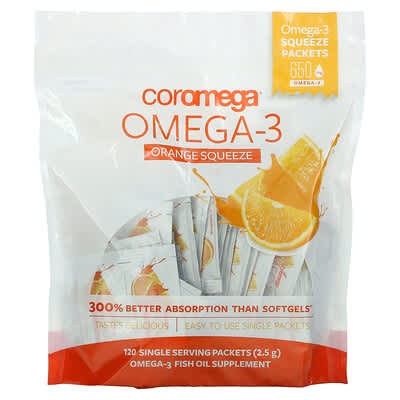

$49.99 $0.41 per serving

Product analysis
Omega-3 Orange Squeeze provides EPA and DHA for a modest nutritional contribution related to triglyceride metabolism and skin-barrier fats. Its DHA content is relatively expensive, and most ingredient forms are not clearly specified.
AI assessment of the formula, label and price. How scoring works
Nutrient Quality21
The main omega-3s lack clear form details, limiting a close quality comparison. Naming fish species does not establish the oil structure or the quality of every component.
Ingredient Transparency65
Most amounts are stated and the main fatty-acid amounts are visible. Sparse form details and one unclear composition entry limit a complete comparison.
Value For Money41
Value is middling for EPA and weaker for DHA. The vitamin C and other assessed contributions do not have a clear value conclusion.
Customer Satisfaction72
Customer feedback is generally favorable across several hundred ratings. The review base gives useful satisfaction context without establishing health benefits.
Product Focus62
The formula offers modest omega-3 support related to triglyceride metabolism. Broader skin, eye and inflammation benefits remain uncertain and depend on the preparation and person.
- Format
Powder - Container
- 120 Packet(s)
- Per serving
- $0.41
- Customer rating
- 4.5 · 429 ratings
Goals

Impact
High effect
Fish Oil · 2000 mgVitamin C · 12 mg

Impact
Moderate effect
Fish Oil · 2000 mgVitamin C · 12 mg

Impact
Moderate effect
Vitamin C · 12 mgOmega-3 · 650 mg

Impact
High effect
Vitamin C · 12 mgEPA (Eicosapentaenoic Acid) · 350 mg
DHA (Docosahexaenoic Acid) Not classified
No linked studies yet.
Ingredients
| Ingredient | Amount per serving | Score |
|---|---|---|
Calories | 20 Calorie(s) | |
Total Fat | 2 Gram(s) | |
Saturated Fat | 0.5 Gram(s) | |
Cholesterol | 10 mg | |
Vitamin C | 12 mg | |
Fish Oil (Anchovy, Sardine) | 2000 mg | |
Omega-3 Fatty Acids | 650 mg | |
Eicosapentaenoic Acid | 350 mg | |
Docosahexaenoic Acid | 230 mg | |
Stevia Leaf Extract | 10 mg |
Omega-3 · 650 mg OverallScore59
A serving provides 580 mg of EPA and DHA at a moderate cost per gram. EPA and DHA make up 29% of the oil. The omega-3 molecular form is not specified. A qualifying purity certification is not established.
How this ingredient is rated
Active Ingredient Quality & Bioavailability52
The omega-3 molecular form is not specified. The oil has a specified source and an antioxidant.
Molecular Form & Absorption Potential
The omega-3 molecular form is not specified.
Source Purity & Oxidative Protection
The oil has a specified source and an antioxidant.
Dose, Safety & Label Transparency55
A serving lists 350 mg of EPA and 230 mg of DHA. Together they make up 29% of the oil.
EPA & DHA Label Specificity
A serving lists 350 mg of EPA and 230 mg of DHA.
Active Ingredient Concentration
EPA and DHA make up 29% of the 2000 mg of oil.
Third-Party Purity Verification
No qualifying independent testing or purity certification is reported.
Value80
The cost per gram of EPA and DHA is moderate.
Price per 1000mg of EPA+DHA
The cost per gram of EPA and DHA is moderate.
EPA (Eicosapentaenoic Acid) · 350 mg OverallScore50
Each serving provides 350 mg of EPA at a moderate cost per gram of EPA. The EPA molecular form is not specified in the available information. No oil purification or specific contaminant testing claim is apparent in the available information.
How this ingredient is rated
Active Ingredient Quality & Bioavailability41
The EPA molecular form is not specified in the available information. EPA makes up about 18% of the fish oil.
Molecular Form and Bioavailability
The EPA molecular form is not specified in the available information.
EPA Concentration Density
EPA makes up about 18% of the fish oil.
Oxidation Protection
Tocopherol is included, though actual protection from oxidation is not established.
Dose, Safety & Label Transparency60
Each serving provides 350 mg of EPA and 230 mg of DHA. No oil purification or specific contaminant testing claim is apparent in the available information.
Absolute EPA Dose per Serving
Each serving provides 350 mg of EPA.
EPA-Centric Ratio
The serving contains 230 mg of DHA, less than the EPA amount.
Purity and Contaminant Testing
No oil purification or specific contaminant testing claim is apparent in the available information.
Value50
The cost per gram of EPA is moderate.
Price per Gram of EPA
The cost per gram of EPA is moderate.
Fish Oil (Anchovy, Sardine) · 2000 mg OverallScore35
A serving supplies 580 mg of EPA and DHA at a midrange cost per gram of those fats. The molecular form of the fish oil is unclear. Purification details are unclear.
How this ingredient is rated
Active Ingredient Quality & Bioavailability14
The molecular form of the fish oil is unclear. A purification process is not specified. Independent testing is not specified.
Omega-3 Molecular Form
The molecular form of the fish oil is unclear.
Purification & Filtration Method
A purification process is not specified.
Third-Party Purity & Potency Verification
Independent testing is not specified.
Source & Sustainability
A specific fish source is indicated, but the species is unclear in the available details.
Dose, Safety & Label Transparency48
The serving provides 350 mg EPA and 230 mg DHA. EPA and DHA make up about 29% of the fish oil. An antioxidant is indicated, though its identity is unclear in the available details.
Total Active Omega-3 Dose (EPA + DHA)
The serving provides 580 mg of EPA and DHA combined.
Omega-3 Potency & Concentration
EPA and DHA make up about 29% of the fish oil.
EPA & DHA Individual Disclosure
EPA and DHA are listed separately at 350 mg and 230 mg per serving.
Oxidation Protection (Stabilizers)
An antioxidant is indicated, though its identity is unclear in the available details.
Value50
The cost per gram of EPA and DHA is midrange.
Cost Per Gram of Active EPA + DHA
The cost per gram of EPA and DHA is midrange.
Alternative products
Report alternatives
Sources
Published studies used for the product analysis and the top-ranked studies for each ingredient and goal.
- Marine Omega-3 Supplementation and Cardiovascular Disease: An Updated Meta-Analysis of 13 Randomized Controlled Trials Involving 127 477 Participants.
- Impact of omega-3 fatty acids on hypertriglyceridemia, lipidomics, and gut microbiome in patients with type 2 diabetes.
- A systematic review of fish-oil supplements for the prevention and treatment of hypertension.
- Effects of fish oil-derived fatty acids on suboptimal cardiovascular health: A multicenter, randomized, double-blind, placebo-controlled trial.
- Effect of High-Dose Marine Omega-3 Fatty Acids on Atherosclerosis: A Systematic Review and Meta-Analysis of Randomized Clinical Trials.
- Vitamin C may reduce troponin and CKMB levels after PCI and CABG: a meta-analysis.
- Vitamin C improves endothelium-dependent vasodilation by restoring nitric oxide activity in essential hypertension.
- Vitamin C supplementation improves blood pressure and oxidative stress after acute exercise in patients with poorly controlled type 2 diabetes mellitus: A randomized, placebo-controlled, cross-over study.
- Vascular benefits of vitamin C supplementation against fine particulate air pollution in healthy adults: A double-blind randomised crossover trial.
- Ascorbic acid reduces blood pressure and arterial stiffness in type 2 diabetes.
- Dietary omega-3 LCPUFA intake in the prevention of neovascular age-related macular degeneration: a systematic review and meta-analysis.
- Dietary omega-3 polyunsaturated fatty acids and fish intake and risk of age-related macular degeneration.
- Dietary fatty acid intake, plasma fatty acid levels, and the risk of age-related macular degeneration (AMD): a dose-response meta-analysis of prospective cohort studies.
- Dietary ω-3 fatty acid and fish intake and incident age-related macular degeneration in women.
- Can Omega-3 Fatty Acids Serve as a Preventive Strategy for Age-Related Macular Degeneration? A Systematic Review and Meta-Analysis.
- Role of Oral Vitamin 'C' on Astigmatic Errors in Phacoemulsification.
- Ascorbic acid metabolites are involved in intraocular pressure control in the general population.
- Nutritional modulation of cataract.
- Dietary n-3 Fatty Acid, α-Tocopherol, Zinc, vitamin D, vitamin C, and β-carotene are Associated with Age-Related Macular Degeneration in Japan.
- Adherence to a Mediterranean diet, lifestyle and age-related macular degeneration: the Coimbra Eye Study - report 3.