
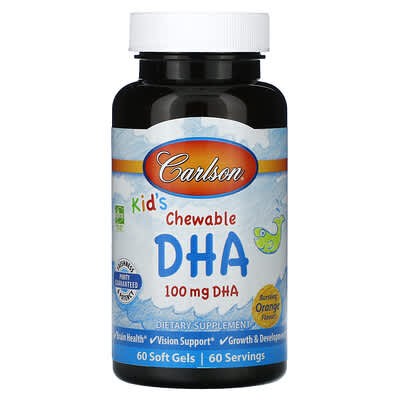
Kid's Chewable DHA 100 mg Bursting Orange Flavor!

Goals
$10.95 $0.18 per serving


Product analysis
Kid's Chewable DHA 100 mg Bursting Orange Flavor! offers DHA and EPA in an orange-flavored chewable format intended for children.
AI assessment of the formula, label and price. How scoring works
Nutrient Quality25
Some vitamin E and oil-form details are named, but the full ingredient quality remains uncertain. The fish-oil form itself is not clearly identified for a precise comparison.
Ingredient Transparency53
Most amounts are stated, but one combined declaration lacks its own amount. Its composition cannot be confirmed, and several form details remain unclear.
Value For Money20
The fish-oil content is relatively costly for the EPA and DHA supplied. The child-oriented chewable format does not resolve that cost comparison.
Customer Satisfaction96
Customer feedback is very positive across many thousands of ratings. That provides a broad picture of satisfaction without establishing cardiovascular effects or individual suitability.
Product Focus0
The serving amounts do not closely match the adult cardiovascular exposures used for comparison. That limits a heart-health conclusion and does not establish whether the serving meets an individual child’s needs.
- Format
Softgel - Container
- 60 Softgel(s)
- Per serving
- $0.18
- Also available
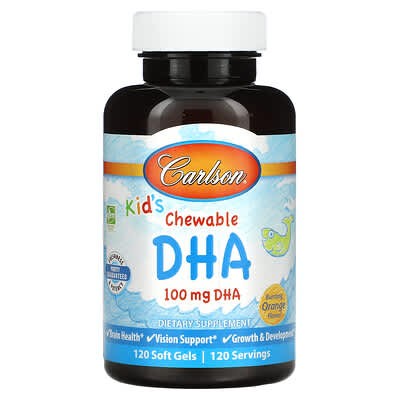 Kid's Chewable DHA 100 mg Bursting Orange Flavor!$20.32
- Customer rating
- 4.9 · 19,827 ratings
Goals

Impact
Limited evidence
Fish Oil · 600 mgVitamin E · 6.7 mg
Kid's Chewable DHA lists 100 mg DHA, 50 mg EPA and 6.7 mg vitamin E per serving in triglyceride forms. These ingredients relate to cardiovascular markers, but each amount is below what the supplied adult evidence treats as meaningful, leaving no pathway meaningfully covered. That does not show the ingredients are ineffective; it shows limited support at these serving amounts.
How this product is rated for Cardiovascular Support
Ingredient fit39
DHA is the main relevant ingredient and the formula has few unrelated actives, but its listed amounts are small for adult marker evidence.
Goal fit
DHA is directly tied to the goal, and few unrelated active ingredients are listed.
Dose adequacy
EPA, DHA and vitamin E are present, but their per-serving amounts are small relative to the supplied adult marker evidence.
Pathways0
The product amounts do not provide meaningful coverage for a tracked cardiovascular pathway.
Depth
None of the listed ingredients makes a clear contribution to the tracked pathways at these amounts.
Breadth
No target pathway receives meaningful coverage from these serving amounts.
Evidence0
No ingredient reaches an amount tied to effective cardiovascular-marker evidence in the supplied adult context.
Evidence strength
None of the ingredients reaches an amount linked to stronger cardiovascular-marker evidence in the supplied facts.
Studied preparation
None reaches a dose represented in the supplied cardiovascular trials.
Formulation logic35
No active reaches a useful contribution amount, and no relevant conflict appears in the supplied facts.
Partner coverage
At these amounts, no ingredient makes a contribution that depends on partner coverage.
Conflicts
No caffeine, stimulant or high-sodium conflict appears in the supplied facts.
Effective doses
EPA 50 mg, DHA 100 mg and vitamin E 6.7 mg are below the amounts tied to meaningful marker evidence.
Ingredients
| Ingredient | Amount per serving | Score |
|---|---|---|
Calories | 5 Calorie(s) | |
Total Fat | 0.5 Gram(s) | |
Vitamin E (D-Alpha-Tocopherol) | 6.7 mg | |
Norwegian Fish Oil | 600 mg | |
Total Omega-3 Fatty Acids (Triglycerides) | 175 mg | |
DHA (Triglycerides) | 100 mg | |
EPA (Triglycerides) | 50 mg |
Omega-3 (Triglycerides) · 175 mg OverallScore72
A serving of one softgel lists 50 mg EPA and 100 mg DHA in triglyceride form. Together they make up about 25% of the 600 mg of oil and cost about $1.22 per gram.
How this ingredient is rated
Active Ingredient Quality & Bioavailability100
The omega-3 is reported in triglyceride form. Vitamin E is recorded as an antioxidant.
Molecular Form & Absorption Potential
The omega-3 is reported in triglyceride form.
Source Purity & Oxidative Protection
The saved facts record 6.7 mg of vitamin E per serving; its presence does not establish measured freshness.
Dose, Safety & Label Transparency55
EPA and DHA are listed separately and account for about 25% of the stated oil amount. No qualifying purity certification or testing claim is established.
EPA & DHA Label Specificity
A serving of one softgel lists 50 mg EPA and 100 mg DHA separately.
Active Ingredient Concentration
EPA and DHA together make up about 25% of the 600 mg of oil per serving.
Third-Party Purity Verification
No qualifying purity certification or testing claim is established in the saved facts.
Value50
A whole-product serving costs about $0.18 and provides 150 mg of EPA plus DHA.
Price per 1000mg of EPA+DHA
At the listed price, EPA plus DHA costs about $1.22 per gram, based on the labeled serving.
DHA (Triglycerides) · 100 mg OverallScore64
Each chewable softgel supplies 100 mg of DHA in triglyceride form. The evaluated omega-3 amount makes up about 29% of the oil, and a qualifying certification or grade claim is recorded.
How this ingredient is rated
Active Ingredient Quality & Bioavailability78
DHA is in triglyceride form, and the evaluated omega-3 amount is about 29% of the oil. An antioxidant is recorded.
DHA Chemical Form & Bioavailability
DHA is identified in triglyceride form.
Oxidation Protection & Stability
A qualifying antioxidant is recorded, but that does not establish a measured oxidation result.
Oil Concentration & Purity
The evaluated omega-3 amount is 175 mg per 600 mg of oil, about 29%; that amount is not DHA alone.
Dose, Safety & Label Transparency68
A serving supplies 100 mg of DHA from a small-fish or krill source. A qualifying certification or grade claim is recorded, without details of results.
DHA Absolute Dosage
A serving provides 100 mg of DHA.
Purity & Heavy Metal Verification
A qualifying certification or pharmaceutical-grade claim is recorded, but its details and test results are not in the saved facts.
Ingredient Source Transparency
A small-fish or krill source is recorded; the exact source is not identified in the saved facts.
Value30
The estimated DHA cost uses the price of the entire product and its recorded DHA amount.
Price per Gram of DHA
The whole-product price corresponds to about $1.83 per gram of DHA at the recorded 100 mg per serving.
EPA (Eicosapentaenoic Acid) (Triglycerides) · 50 mg OverallScore42
A serving provides 50 mg of EPA alongside 100 mg of DHA, so DHA is the larger component. The whole-product price works out to about $3.65 per gram of EPA.
How this ingredient is rated
Active Ingredient Quality & Bioavailability66
EPA is reported in triglyceride form and makes up about 8.3% of the fish oil.
Molecular Form and Bioavailability
EPA is reported in triglyceride form.
EPA Concentration Density
EPA makes up about 8.3% of the fish oil (50 mg EPA in 600 mg fish oil per serving).
Oxidation Protection
Tocopherol is recorded as an antioxidant; its presence does not establish measured oxidation protection.
Dose, Safety & Label Transparency28
DHA exceeds EPA: each serving contains 50 mg EPA and 100 mg DHA. A qualifying testing or certification claim is recorded.
Absolute EPA Dose per Serving
Each serving supplies 50 mg of EPA.
EPA-Centric Ratio
DHA exceeds EPA: a serving has 50 mg EPA and 100 mg DHA.
Purity and Contaminant Testing
A qualifying product testing or certification claim is recorded; it has not been independently verified.
Value20
The whole-product price works out to about $3.65 per gram of EPA.
Price per Gram of EPA
A whole-product serving costs about $0.18 and supplies 50 mg of EPA.
Alternative products
Report alternatives
Sources
Published studies used for the product analysis and the top-ranked studies for each ingredient and goal.
- Marine Omega-3 Supplementation and Cardiovascular Disease: An Updated Meta-Analysis of 13 Randomized Controlled Trials Involving 127 477 Participants.
- Impact of omega-3 fatty acids on hypertriglyceridemia, lipidomics, and gut microbiome in patients with type 2 diabetes.
- A systematic review of fish-oil supplements for the prevention and treatment of hypertension.
- Effects of fish oil-derived fatty acids on suboptimal cardiovascular health: A multicenter, randomized, double-blind, placebo-controlled trial.
- Effect of High-Dose Marine Omega-3 Fatty Acids on Atherosclerosis: A Systematic Review and Meta-Analysis of Randomized Clinical Trials.
- Supplementation with vitamin E alone is associated with reduced myocardial infarction: a meta-analysis.
- Vitamin E ameliorates blood cholesterol level and alters gut microbiota composition: A randomized controlled trial.
- Effects of long-term vitamin E supplementation on cardiovascular events and cancer: a randomized controlled trial.
- Independent and combined associations of dietary antioxidant exposure with all-cause and cause-specific mortality in the general population.
- Tocotrienol rich fraction supplementation improved lipid profile and oxidative status in healthy older adults: A randomized controlled study.