
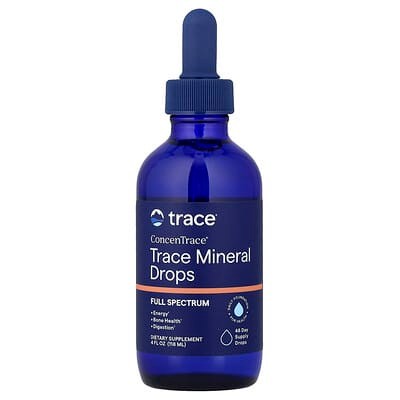
ConcenTrace Trace Mineral Drops

Goals
$35.99 $0.74 per serving


Product analysis
ConcenTrace Trace Mineral Drops may help fill a magnesium gap to support normal energy use and bone maintenance. The mineral forms are not specified, which makes their absorption difficult to judge.
AI assessment of the formula, label and price. How scoring works
Nutrient Quality20
All listed mineral forms are unspecified, leaving their absorption uncertain. The range of minerals does not establish a quality advantage for the sources used.
Ingredient Transparency63
Amounts are disclosed for the listed minerals, which helps compare servings. Their forms remain unspecified, limiting a closer comparison of the mineral sources.
Value For Money17
Value is mixed, with relatively costly sulfur and boron contributions and uncertain magnesium value. The price comparisons also differ in their underlying serving prices, so a firm conclusion about total value is difficult.
Customer Satisfaction80
Customer feedback is very favorable across several hundred ratings. That gives a useful picture of satisfaction without proving the drops’ health effects.
Product Focus60
Magnesium provides the clearest focus, mainly for normal energy use and bone maintenance when intake is low. The wider heart, stress and hormone aims have more limited or inconsistent support.
- Format
Liquid - Container
- 4 Liquid(s)
- Per serving
- $0.74
- Also available
 ConcenTrace Trace Mineral Drops$15.99
- Customer rating
- 4.8 · 593 ratings
Goals

Impact
Moderate effect
Magnesium · 250 mg
Magnesium at 250 mg provides the main heart-related contribution through electrolyte balance and vascular tone. Blood-pressure effects are generally modest and inconsistent, and no deficiency is assumed.
Potassium at 3 mg is a very small contribution. Selenium remains unresolved because the source claim lacks a matching ingredient record and amount.
How this product is rated for Heart Health
Ingredient fit48
Magnesium provides the main heart-related relevance within a trace-mineral mixture. Magnesium provides a substantial but partial exposure comparison; potassium is below the level counted.
Goal fit
Magnesium provides the main heart-related relevance within a trace-mineral mixture.
Dose adequacy
Magnesium provides a substantial but partial exposure comparison; potassium is below the level counted.
Pathways45
Electrolyte and vascular-tone balance is the strongest assessed route. Only electrolyte and vascular-tone balance reaches the saved coverage level.
Depth
Electrolyte and vascular-tone balance is the strongest assessed route.
Breadth
Only electrolyte and vascular-tone balance reaches the saved coverage level.
Evidence89
Magnesium provides the strongest saved evidence contribution at a counted amount; its scope does not imply cardiovascular-event prevention. The counted ingredient matches the accepted preparation category.
Evidence strength
Magnesium provides the strongest saved evidence contribution at a counted amount; its scope does not imply cardiovascular-event prevention.
Studied preparation
The counted ingredient matches the accepted preparation category.
Formulation logic100
The counted ingredients can contribute independently or have their required partner. The counted ingredient meets the saved minimum exposure comparison.
Partner coverage
The counted ingredients can contribute independently or have their required partner.
Conflicts
No configured ingredient conflict was identified in the saved assessment.
Effective doses
The counted ingredient meets the saved minimum exposure comparison.

Impact
Moderate effect
Magnesium · 250 mg
Magnesium may help with stress when magnesium levels are low, although lasting everyday relief remains uncertain. The relevant contribution here comes from magnesium rather than a confirmed zinc amount. Zinc's presence and quantity remain unresolved, so it can't provide a dependable additional reason to expect stress relief from these mineral drops.
How this product is rated for Stress Relief
Ingredient fit47
Magnesium provides the confirmed stress-related ingredient among several minerals. Zinc's presence and amount remain unresolved.
Goal fit
Several minerals have purposes beyond stress relief; magnesium provides the confirmed relevant active.
Dose adequacy
The selected serving provides 250 mg magnesium, below the 350 mg comparison amount; that comparison doesn't establish whether it will help.
Pathways20
Magnesium relates mainly to calming, with a smaller connection to stress responses.
Depth
The strongest relevant connection is calming, conditional on magnesium status.
Breadth
Magnesium's relevant connection is narrow, and unresolved zinc information adds no clear additional benefit.
Evidence76
Magnesium may help in low-magnesium circumstances; lasting everyday stress relief remains uncertain.
Evidence strength
Magnesium's stress-related benefit is conditional, especially when magnesium levels are low.
Studied preparation
The magnesium preparation can retain its nutritional role without implying a particular absorption advantage.
Formulation logic100
Magnesium can provide its individual role without a missing partner. No particular ingredient conflict is identified.
Partner coverage
Magnesium doesn't require another ingredient for its individual role.
Conflicts
No particular ingredient conflict is identified.
Effective doses
The serving contains 250 mg magnesium; this amount alone doesn't predict stress relief.

Impact
High effect
Magnesium · 250 mgBoron · 1 mg
Magnesium supplies a nutrient involved in normal energy metabolism and bone mineral balance. It can help fill a dietary gap, but a substantial supplemental amount does not establish improved health outcomes in someone with adequate intake. The 250 mg serving receives partial amount recognition. Claimed zinc, selenium, iron and iodine remain unresolved in the matching imported declarations.
How this product is rated for Everyday Health
Ingredient fit61
Magnesium is confirmed; several claimed minerals remain unresolved. Magnesium receives partial recognition; calcium's usable amount is unresolved and boron is below the counting threshold.
Goal fit
Magnesium is confirmed; several claimed minerals remain unresolved.
Dose adequacy
Magnesium receives partial recognition; calcium's usable amount is unresolved and boron is below the counting threshold.
Pathways50
Energy metabolism leads, with lower bone and mineral coverage.
Depth
Energy metabolism leads, with lower bone and mineral coverage.
Breadth
One nutrient-related pathway reaches the breadth threshold.
Evidence86
Magnesium drives the strongest recognized contribution. The supported contribution is nutrient availability; unresolved mineral claims cannot establish additional contributions.
Evidence strength
Magnesium drives the strongest recognized contribution. The supported contribution is nutrient availability; unresolved mineral claims cannot establish additional contributions.
Studied preparation
The counted nutrient declarations match the saved preparation criteria; no chemical form or delivery superiority is established.
Formulation logic88
No configured formulation conflict was matched. Magnesium meets the saved minimum threshold; calcium does not because its usable amount is unresolved.
Partner coverage
Recognized ingredients can stand alone or have their required partners; this does not establish an added combination benefit.
Conflicts
No configured formulation conflict was matched.
Effective doses
Magnesium meets the saved minimum threshold; calcium does not because its usable amount is unresolved.

Impact
Moderate effect
Magnesium · 250 mgPotassium · 3 mg
Magnesium at 250 mg provides the main support for normal energy metabolism. Potassium at 3 mg contributes little in the supplied comparison, while iodine and iron amounts are unresolved. The assessed support is mainly nutritional.
How this product is rated for Energy
Ingredient fit50
The formula mainly addresses broader nutritional needs, with a limited focus on energy. The counted amounts provide partial support, with smaller or unresolved amounts limiting some contributions.
Goal fit
The formula mainly addresses broader nutritional needs, with a limited focus on energy.
Dose adequacy
The counted amounts provide partial support, with smaller or unresolved amounts limiting some contributions.
Pathways0
The saved contribution is nutritional, without meaningful coverage of the specific alertness or performance mechanisms assessed. No specific energy mechanism reaches the saved coverage threshold.
Depth
The saved contribution is nutritional, without meaningful coverage of the specific alertness or performance mechanisms assessed.
Breadth
No specific energy mechanism reaches the saved coverage threshold.
Evidence88
Magnesium supplies the strongest relevant evidence at a counted amount, with benefits limited to the particular contexts and outcomes assessed. The preparations counted here match those recognized in the supplied evidence.
Evidence strength
Magnesium supplies the strongest relevant evidence at a counted amount, with benefits limited to the particular contexts and outcomes assessed.
Studied preparation
The preparations counted here match those recognized in the supplied evidence.
Formulation logic100
The counted ingredients can contribute independently or have their needed partner. No configured ingredient conflict was identified. All ingredients counted here reach a meaningful amount in the saved comparison.
Partner coverage
The counted ingredients can contribute independently or have their needed partner.
Conflicts
No configured ingredient conflict was identified.
Effective doses
All ingredients counted here reach a meaningful amount in the saved comparison.

Impact
Moderate effect
Potassium · 3 mgMagnesium · 250 mg
The saved facts list 250 mg magnesium and 3 mg potassium per serving; only magnesium reaches the amount used for cardiovascular contribution. A stored label note mentions selenium, but the ingredient inventory does not confirm its presence or amount, so it remains uncertain. The product covers only vascular tone and sodium balance, with several other minerals listed.
How this product is rated for Cardiovascular Support
Ingredient fit48
Magnesium supplies most of the goal-specific contribution; several other minerals fall outside this goal.
Goal fit
Magnesium is the one main contributor; boron, chloride, lithium, sulfur and the sodium check fall outside this goal.
Dose adequacy
The facts list 250 mg magnesium and 3 mg potassium per serving; selenium's presence and amount are unconfirmed.
Pathways43
Counted support is limited to vascular tone and sodium balance.
Depth
Vascular tone and sodium balance is the best-covered route, mainly through magnesium.
Breadth
Only one of three target pathways reaches the coverage threshold.
Evidence79
Magnesium provides the strongest evidence at an effective amount.
Evidence strength
Magnesium has the strongest effective-dose evidence here, below the goal's highest ceiling.
Studied preparation
Magnesium evidence includes studied preparations, though the saved facts do not identify its form.
Formulation logic100
The counted magnesium ingredient needs no partner, and no matched conflict is present.
Partner coverage
The counted magnesium ingredient works alone.
Conflicts
No conflict was matched to the listed ingredients.
Effective doses
Magnesium clears the dose cut-off; potassium and unconfirmed selenium do not.

Impact
High effect
Magnesium · 250 mgBoron · 1 mg
Magnesium findings depend on exercise conditions and a specific regimen, rather than establishing a general increase in free testosterone. Boron findings are small and inconsistent, with no established durable testosterone benefit. Zinc and selenium presence remains unresolved in the supplied facts.
How this product is rated for Testosterone Support
Ingredient fit51
The formula has limited focus on the ingredients recognized for this goal. Recognized amounts only partly meet comparison anchors, with unresolved amounts unable to contribute.
Goal fit
The formula has limited focus on the ingredients recognized for this goal.
Dose adequacy
Recognized amounts only partly meet comparison anchors, with unresolved amounts unable to contribute.
Pathways60
The strongest recorded coverage concerns free-testosterone availability, without proving that testosterone changes in users.
Depth
The strongest recorded coverage concerns free-testosterone availability, without proving that testosterone changes in users.
Breadth
One named pathway meets the supplied coverage criterion; coverage does not span the other main mechanisms.
Evidence74
Magnesium supplies the strongest recognized evidence contribution, with the population and outcome limits described above.
Evidence strength
Magnesium supplies the strongest recognized evidence contribution, with the population and outcome limits described above.
Studied preparation
The recognized preparations match those accepted in the saved comparison, without establishing generalized testosterone enhancement.
Formulation logic100
No configured ingredient conflict was recorded. All recognized ingredients meet the supplied minimum amount criterion, which is not a proven effective endocrine dose.
Partner coverage
No missing required partner reduced the recognized ingredients’ contributions.
Conflicts
No configured ingredient conflict was recorded.
Effective doses
All recognized ingredients meet the supplied minimum amount criterion, which is not a proven effective endocrine dose.

Impact
High effect
Magnesium · 250 mgBoron · 1 mg
Magnesium supplies a mineral needed for normal bone metabolism, with 250 mg per selected 2.5 mL serving offering intake-gap support. This does not establish routine fracture prevention. Calcium and silicon are declared only in trace amounts without individual quantities, so their contributions remain unresolved. Boron's mineral-related rationale does not establish a direct bone-density benefit.
How this product is rated for Bone Health
Ingredient fit57
Magnesium provides the clearest practical connection to bone nutrition; unknown calcium and silicon amounts limit the amount-based findings.
Goal fit
Several minerals relate to bone nutrition, while lithium and sulfur broaden the formula beyond this goal.
Dose adequacy
Magnesium has a declared amount; calcium and silicon lack quantities, limiting their assessed contribution.
Pathways65
The saved findings emphasize mineral supply and calcium regulation, principally through magnesium, with less support for other aspects of bone structure.
Depth
Mineral supply is the strongest finding, with magnesium providing the main quantified contribution.
Breadth
Mineral supply and calcium regulation are represented; collagen formation, bone-protein activation and remodeling receive no comparable contribution.
Evidence95
Magnesium leads the saved evidence finding, although its established role concerns normal nutrition rather than reliable fracture prevention.
Evidence strength
Magnesium leads this finding; its normal bone role does not establish extra benefit when intake is adequate.
Studied preparation
The saved preparation check is satisfied for the qualifying ingredients, without establishing clinical benefit from the complete formula.
Formulation logic82
The calcium contribution lacks its required partner in the saved findings, and unknown calcium and silicon amounts limit the amount check. No evaluated conflict was identified.
Partner coverage
Calcium lacks the partner required by the saved calculation, limiting that contribution.
Conflicts
No evaluated conflict was identified; the very-high-vitamin-D adjustment is inapplicable.
Effective doses
Magnesium and boron meet the saved amount criterion; calcium and silicon do not because their amounts are unknown.
Ingredients
| Ingredient | Amount per serving | Score |
|---|---|---|
Magnesium | 250 mg | |
Chloride | 650 mg | |
Sodium | 5 mg | |
Potassium | 3 mg | |
Sulfate | 40 mg | |
Lithium | 1.5 mg | |
Boron | 1 mg |
Chloride · 650 mg OverallScore54
A serving provides 650 mg of chloride. The saved details do not identify its salt source, which limits comparison by source.
How this ingredient is rated
Active Ingredient Quality & Bioavailability20
The specific chloride salt is not identified in the saved information.
Chloride source quality
The specific chloride salt is not identified in the saved information.
Dose, Safety & Label Transparency91
The chloride amount is 650 mg per serving; the source salt is not specified in the saved details.
Chloride amount per serving
A serving provides 650 mg of chloride.
Amount and source disclosure
The chloride amount is 650 mg per serving; the source salt is not specified in the saved details.
Value50
The whole-product serving costs about $0.76; that price is not allocated to chloride alone.
Price per serving
The listed whole-product serving costs about $0.76.
Sulfur · 40 mg OverallScore36
Each serving lists 40 mg of sulfate, while the elemental sulfur amount is not available in the saved facts. The whole-product price is about $0.76 per serving.
How this ingredient is rated
Active Ingredient Quality & Bioavailability40
The saved facts identify sulfate but not a specific sulfur carrier.
Sulfur Source & Chemical Form
Sulfate is listed, but the specific sulfur carrier is not identified in the saved facts.
Dose, Safety & Label Transparency40
The serving lists 40 mg of sulfate, but the amount of elemental sulfur is unknown.
Elemental Sulfur Potency
The saved facts do not establish the elemental sulfur amount; the sulfate quantity is not itself a sulfur quantity.
Quantitative Complex Disclosure
The listed amount is 40 mg of sulfate per serving, not a declared elemental sulfur amount.
Value20
The whole product costs about $0.76 per serving.
Price per Serving vs. Collection Median
The whole product costs about $0.76 per serving.
Lithium · 1.5 mg OverallScore60
A serving provides 1.5 mg of lithium, though the saved facts do not identify its chemical form. The whole-product serving costs about $0.76.
How this ingredient is rated
Active Ingredient Quality & Bioavailability30
The saved facts do not identify the lithium compound, so its chemical form cannot be compared.
Lithium Compound Optimization
The saved facts do not identify the lithium compound, so its chemical form cannot be compared.
Dose, Safety & Label Transparency100
The label specifies 1.5 mg of elemental lithium per serving.
Elemental Disclosure Precision
The label specifies 1.5 mg of elemental lithium per serving.
Dosage Appropriateness
A serving provides 1.5 mg of elemental lithium.
Value40
A whole-product serving costs about $0.76.
Cost Per Serving Efficiency
A whole-product serving costs about $0.76.
Alternative products
Report alternatives
Sources
Published studies used for the product analysis and the top-ranked studies for each ingredient and goal.
- [Comparative study of the urinary excretion of boron, calcium, magnesium and phosphorus in postmenopausal women with and without osteoporosis].
- Effect of dietary boron on mineral, estrogen, and testosterone metabolism in postmenopausal women.
- The relationship between boron and magnesium status and bone mineral density in the human: a review.
- Effects of boron supplementation on bone mineral density and dietary, blood, and urinary calcium, phosphorus, magnesium, and boron in female athletes.
- Metabolic responses of postmenopausal women to supplemental dietary boron and aluminum during usual and low magnesium intake: boron, calcium, and magnesium absorption and retention and blood mineral concentrations
- What is the impact of daily oral supplementation of vitamin D3 (cholecalciferol) plus calcium on the incidence of hip fracture in older people? A systematic review and meta-analysis.
- Calcium supplementation prevents seasonal bone loss and changes in biochemical markers of bone turnover in elderly New England women: a randomized placebo-controlled trial.
- The effects of calcium supplementation (milk powder or tablets) and exercise on bone density in postmenopausal women.
- The efficacy of calcium supplementation alone in elderly Thai women over a 2-year period: a randomized controlled trial.
- Calcium-enriched foods and bone mass growth in prepubertal girls: a randomized, double-blind, placebo-controlled trial.
- Association between Serum Magnesium and Fractures: A Systematic Review and Meta-Analysis of Observational Studies.
- Bioabsorbable Magnesium-Based Materials Potential and Safety in Bone Surgery: A Systematic Review.
- Vascularized bone grafting fixed by biodegradable magnesium screw for treating osteonecrosis of the femoral head.
- An update on magnesium and bone health.
- Sex-specific differences in the association of magnesium intake with femoral neck bone mineral density among older adults.
- Effect of potassium citrate on bone density, microarchitecture, and fracture risk in healthy older adults without osteoporosis: a randomized controlled trial.
- Long-term persistence of the urine calcium-lowering effect of potassium bicarbonate in postmenopausal women.
- Partial neutralization of the acidogenic Western diet with potassium citrate increases bone mass in postmenopausal women with osteopenia.
- Potassium citrate supplementation results in sustained improvement in calcium balance in older men and women.
- Effects of potassium chloride and potassium bicarbonate on endothelial function, cardiovascular risk factors, and bone turnover in mild hypertensives.