



Magnesium Supportive
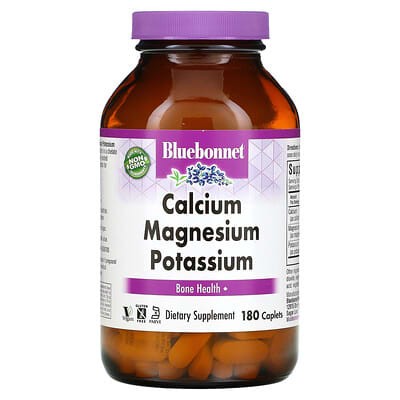
$24.76 $0.55 per serving
Product analysis
Bluebonnet Calcium Magnesium Potassium is a substantial mineral supplement for bone health, with 1,000 mg calcium, 400 mg magnesium and 99 mg potassium in four caplets. Calcium supplies bone mineral while magnesium supports normal bone metabolism, although such a large calcium serving may be absorbed less efficiently and the formula does not supply vitamin D to support calcium absorption.
AI assessment of the formula, label and price. How scoring works
Nutrient Quality81
The three minerals come from forms with favorable absorption or quality potential. Calcium citrate is a useful source, though the large serving may limit how efficiently the calcium is absorbed.
Ingredient Transparency100
All three minerals have clear amounts and named sources. The label makes the mineral balance easy to understand.
Value For Money87
The combination offers good value across all three minerals. It is especially economical for its substantial calcium and magnesium amounts.
Customer Satisfaction79
Customers rate the supplement favorably. The large number of reviews gives that feedback a substantial base.
Product Focus65
The mineral combination is most relevant to bone maintenance and filling nutritional gaps. Its broader potential uses are less directly supported.
- Format
Tablet - Container
- 180 Tablet(s)
- Per serving
- $0.55
- Customer rating
- 4.5 · 1,694 ratings
Goals
Impact
Highest effect
Magnesium · 400 mg
Calcium Magnesium Potassium is a substantial mineral option for filling dietary gaps. Its 400 mg of magnesium supports energy metabolism and bone and mineral functions. Calcium at 1000 mg adds a complementary contribution to bone mineral supply.

Impact
High effect
Magnesium · 400 mg
Calcium Magnesium Potassium offers focused electrolyte support, led by 400 mg magnesium per serving. Magnesium contributes to vascular-tone balance, while 99 mg potassium adds a smaller nutritional role whose blood-pressure relevance depends on baseline intake.
Potassium Supportive
Magnesium Supportive

Impact
High effect
Magnesium · 400 mgPotassium · 99 mg
Calcium Magnesium Potassium has a nutritional role when low mineral intake contributes to tiredness or weakness. The serving supplies 400 mg magnesium as aspartate for normal energy metabolism. Potassium aspartate supplies 99 mg potassium for normal electrolyte function, with energy-related value depending on an actual shortfall rather than a general stimulating effect.
Magnesium Supportive
Potassium Supportive

Impact
Highest effect
Magnesium · 400 mgCalcium · 1000 mg
Calcium Magnesium Potassium provides substantial mineral support for bone health, led by 1,000 mg of calcium and 400 mg of magnesium in four caplets. Calcium supplies mineral needed for normal bone mineralization, while magnesium supports bone metabolism. Vitamin D is absent, leaving the calcium without its absorption-support partner. Potassium at 99 mg is a smaller contribution, and its aspartate form does not match the citrate-specific bone evidence.
Calcium Supportive
Magnesium Supportive
Potassium Supportive

Impact
High effect
Magnesium · 400 mg
Calcium Magnesium Potassium offers a narrow, conditional stress-support role through magnesium. Its four-caplet serving supplies 400 mg magnesium as aspartate, supporting normal nerve function. The supplied stress benefit is most applicable to low-magnesium or selected clinical settings.
Magnesium Supportive

Impact
High effect
Potassium · 99 mgMagnesium · 400 mg
Calcium Magnesium Potassium offers mineral-based support for vascular function. Magnesium at 400 mg is its leading contributor, although findings for arterial stiffness and blood pressure are inconsistent. Potassium at 99 mg contributes to vascular tone and sodium balance, but the small amount limits its practical contribution.
Magnesium Supportive
Potassium Supportive
Ingredients
| Ingredient | Amount per serving | Score |
|---|---|---|
Calcium (Calcium Citrate) | 1000 mg | |
Magnesium (Magnesium Aspartate) | 400 mg | |
Potassium (Potassium Aspartate) | 99 mg |
Calcium (Calcium Citrate) · 1000 mg OverallScore71
Bluebonnet Calcium Magnesium Potassium is a mixed choice for calcium, with 1000 mg per serving. Calcium Citrate is the named calcium source. Absorption may be less efficient with this large serving. Good calcium value at $0.06 per 100 mg; $0.55 per serving pays for the full formula. A flow agent is listed.
Magnesium (Magnesium Aspartate) · 400 mg OverallScore75
Bluebonnet Calcium Magnesium Potassium is a useful magnesium choice, supplying 400 mg magnesium per serving. The form is Magnesium Aspartate. The serving also contains 1000 mg calcium. Magnesium is inexpensive at $0.14 per 100 mg; the serving costs $0.55 for the full formula.
Alternative products
Report alternatives
Sources
Published studies used for the product analysis and the top-ranked studies for each ingredient and goal.
- What is the impact of daily oral supplementation of vitamin D3 (cholecalciferol) plus calcium on the incidence of hip fracture in older people? A systematic review and meta-analysis.
- Calcium supplementation prevents seasonal bone loss and changes in biochemical markers of bone turnover in elderly New England women: a randomized placebo-controlled trial.
- The effects of calcium supplementation (milk powder or tablets) and exercise on bone density in postmenopausal women.
- The efficacy of calcium supplementation alone in elderly Thai women over a 2-year period: a randomized controlled trial.
- Calcium-enriched foods and bone mass growth in prepubertal girls: a randomized, double-blind, placebo-controlled trial.
- Association between Serum Magnesium and Fractures: A Systematic Review and Meta-Analysis of Observational Studies.
- Bioabsorbable Magnesium-Based Materials Potential and Safety in Bone Surgery: A Systematic Review.
- Vascularized bone grafting fixed by biodegradable magnesium screw for treating osteonecrosis of the femoral head.
- An update on magnesium and bone health.
- Sex-specific differences in the association of magnesium intake with femoral neck bone mineral density among older adults.
- Effect of potassium citrate on bone density, microarchitecture, and fracture risk in healthy older adults without osteoporosis: a randomized controlled trial.
- Long-term persistence of the urine calcium-lowering effect of potassium bicarbonate in postmenopausal women.
- Partial neutralization of the acidogenic Western diet with potassium citrate increases bone mass in postmenopausal women with osteopenia.
- Potassium citrate supplementation results in sustained improvement in calcium balance in older men and women.
- Effects of potassium chloride and potassium bicarbonate on endothelial function, cardiovascular risk factors, and bone turnover in mild hypertensives.
- Circulating and dietary magnesium and risk of cardiovascular disease: a systematic review and meta-analysis of prospective studies.
- Magnesium and the risk of cardiovascular events: a meta-analysis of prospective cohort studies.
- Quantitative Association Between Serum/Dietary Magnesium and Cardiovascular Disease/Coronary Heart Disease Risk: A Dose-Response Meta-analysis of Prospective Cohort Studies.
- Comparative Efficacy of Nutraceuticals on Endothelial Function: A Systematic Review and Network Meta-Analysis.
- Serum magnesium, mortality, and cardiovascular disease in chronic kidney disease and end-stage renal disease patients: a systematic review and meta-analysis.