

$14.97 $0.24 per serving


Product analysis
EFA Blend for Kids provides EPA and DHA, whose clearest connection here is the processing of blood fats. Several quantities and preparation details are missing, making the blend difficult to compare.
AI assessment of the formula, label and price. How scoring works
Nutrient Quality20
Most fat and oil forms are not disclosed, limiting a confident preparation-quality comparison. The identity of the unnamed component is also unclear, leaving part of the formula unresolved.
Ingredient Transparency43
Some ingredient amounts and nearly all forms are missing. EPA and DHA composition are described, but several other fat-composition details are not disclosed.
Value For Money41
EPA offers moderate value for its amount, while DHA offers weaker value. The value of the other fats and evening primrose oil cannot be established confidently.
Customer Satisfaction79
Customer ratings are very positive, based on a small body of feedback. The limited number of reviews makes that impression less settled.
Product Focus53
The clearest nutritional connection is EPA and DHA’s role in blood-fat metabolism. The mixed-oil formula adds complexity, and the serving information does not establish how often it is used.
- Format
Softgel - Container
- 120 Softgel(s)
- Per serving
- $0.24
- Customer rating
- 4.8 · 450 ratings
Goals

Impact
Moderate effect
Fish Oil · 582 mgVitamin E · 20 mg
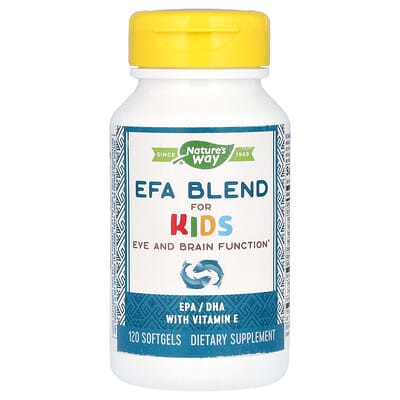
EFA Blend for Kids declares 168 mg EPA and 116 mg DHA per serving, carried in 582 mg fish oil. EPA leads the contribution for this goal, but the two actives cover only part of triglyceride metabolism, while the other target pathways receive no coverage. The facts do not state how often the product is taken.
How this product is rated for Cardiovascular Support
Ingredient fit52
EPA and DHA fit this goal, but their per-serving amounts provide only partial dose support; evening primrose oil and sodium are not tied to this goal.
Goal fit
Two credited omega-3 actives are balanced against unrelated primrose oil and sodium.
Dose adequacy
The declared EPA and DHA amounts provide only partial matches to their reference amounts.
Pathways13
EPA and DHA contribute to triglyceride metabolism, but coverage remains partial; other target routes receive no coverage.
Depth
Triglyceride metabolism is the only route with contribution, and its coverage is partial.
Breadth
None of the three target pathways reaches the coverage threshold.
Evidence83
EPA provides the strongest evidence signal at an effective amount, although its evidence ceiling is below the goal's highest. Only one active is counted in a studied preparation at an effective amount.
Evidence strength
EPA is the strongest supported active at an effective amount, but its ceiling is below the goal's highest.
Studied preparation
Only one credited ingredient is counted at an effective amount in a studied preparation.
Formulation logic100
The credited ingredients work alone or have their partners, no conflict matched, and EPA clears the effective-dose threshold.
Partner coverage
Every credited ingredient works alone or has its required partner.
Conflicts
No listed conflict matched this formula.
Effective doses
EPA clears the effective-dose threshold; DHA falls below it.
Ingredients
| Ingredient | Amount per serving | Score |
|---|---|---|
Calories | 10 Calorie(s) | |
Total Fat | 1 Gram(s) | |
Saturated Fat | 0 Gram(s) | |
Trans Fat | 0 Gram(s) | |
Polyunsaturated Fat | 0.5 Gram(s) | |
Monounsaturated Fat | 0 Gram(s) | |
Cholesterol | 5 mg | |
Vitamin E (D-Alpha-Tocopheryl Acetate) | 20 mg | |
Sodium | 5 mg | |
Fish Oil | 582 mg | |
Eicosapentaenoic Acid | 168 mg | |
Docosahexaenoic Acid | 116 mg | |
Evening Primose Oil | 280 mg |
EPA (Eicosapentaenoic Acid) · 168 mg OverallScore44
Each serving provides 168 mg of EPA and 116 mg of DHA, so EPA predominates. The whole product costs about $1.49 per 1,000 mg of EPA.
How this ingredient is rated
Active Ingredient Quality & Bioavailability50
The molecular form is unknown in the saved facts, and EPA makes up about 28.9% of the stated fish oil. Tocopherol is recorded.
Molecular Form and Bioavailability
The EPA molecular form is not established in the saved facts.
EPA Concentration Density
EPA makes up about 28.9% of the stated fish-oil amount per serving.
Oxidation Protection
Tocopherol is recorded as an antioxidant; its presence does not establish measured freshness.
Dose, Safety & Label Transparency36
Each serving provides 168 mg of EPA and 116 mg of DHA. A qualifying purification or testing claim is not established in the saved facts.
Absolute EPA Dose per Serving
Each serving provides 168 mg of EPA, a modest amount in this comparison.
EPA-Centric Ratio
Each serving has 168 mg of EPA and 116 mg of DHA; EPA predominates.
Purity and Contaminant Testing
The saved facts do not establish a purification claim or qualifying contaminant testing or certification.
Value50
The whole product costs about $1.49 per 1,000 mg of EPA, a moderate cost in this evaluation.
Price per Gram of EPA
The whole-product price is about $1.49 per 1,000 mg of EPA; the evaluation considers that moderate.
DHA · 116 mg OverallScore32
Fish Oil · 582 mg OverallScore27
Alternative products
Report alternatives
Sources
Published studies used for the product analysis and the top-ranked studies for each ingredient and goal.
- Marine Omega-3 Supplementation and Cardiovascular Disease: An Updated Meta-Analysis of 13 Randomized Controlled Trials Involving 127 477 Participants.
- Impact of omega-3 fatty acids on hypertriglyceridemia, lipidomics, and gut microbiome in patients with type 2 diabetes.
- A systematic review of fish-oil supplements for the prevention and treatment of hypertension.
- Effects of fish oil-derived fatty acids on suboptimal cardiovascular health: A multicenter, randomized, double-blind, placebo-controlled trial.
- Effect of High-Dose Marine Omega-3 Fatty Acids on Atherosclerosis: A Systematic Review and Meta-Analysis of Randomized Clinical Trials.
- Supplementation with vitamin E alone is associated with reduced myocardial infarction: a meta-analysis.
- Vitamin E ameliorates blood cholesterol level and alters gut microbiota composition: A randomized controlled trial.
- Effects of long-term vitamin E supplementation on cardiovascular events and cancer: a randomized controlled trial.
- Independent and combined associations of dietary antioxidant exposure with all-cause and cause-specific mortality in the general population.
- Tocotrienol rich fraction supplementation improved lipid profile and oxidative status in healthy older adults: A randomized controlled study.