
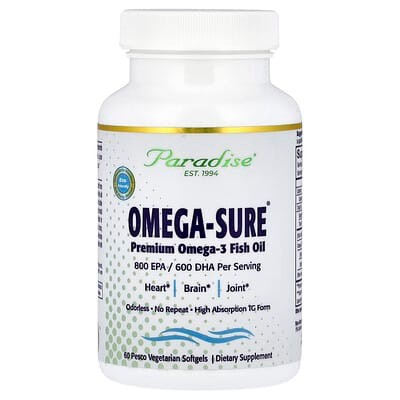

$22.63 $0.37 per serving


Product analysis
Omega Sure provides EPA and DHA at a competitive combined cost, with limited support for effects on blood-fat and inflammation markers.
AI assessment of the formula, label and price. How scoring works
Nutrient Quality21
The active fats are associated with a natural triglyceride oil, which has favorable absorption characteristics. Their individual forms are not separately identified, limiting a more detailed comparison.
Ingredient Transparency45
EPA and DHA amounts are clearly stated, but several other fat details are incomplete. Specific forms are mostly unspecified, and part of the oil composition remains uncertain.
Value For Money68
The combined EPA and DHA cost is favorable, with EPA offering the stronger individual value. DHA is more expensive relative to its amount.
Customer Satisfaction84
Customer satisfaction is high across a substantial review base. Ratings do not establish changes in blood fats, inflammation or skin health.
Product Focus69
EPA and DHA relate mainly to blood-fat and inflammation markers. The 400 mg EPA and 200 mg DHA serving does not match the much higher amounts used for blood-fat changes, and routine skin benefits remain uncertain.
- Format
Softgel - Container
- 60 Softgel(s)
- Per serving
- $0.37
- Also available
 Omega Sure$13.35
- Customer rating
- 4.7 · 1,596 ratings
Goals

Impact
High effect
Fish Oil · 1000 mg
The separately declared EPA and DHA connect this product mainly to triglyceride metabolism. Its 400 mg EPA and 200 mg DHA per serving receive partial amount recognition; the supplied trials used much higher daily amounts, so equivalent triglyceride changes cannot be assumed. The oil carrier does not add a separate benefit, and these findings do not establish cardiovascular-event prevention.
How this product is rated for Cardiovascular Support
Ingredient fit73
Declared EPA and DHA provide the main cardiovascular connection.
Goal fit
Declared EPA and DHA provide the main cardiovascular connection.
Dose adequacy
Both active amounts provide partial exposure; total oil weight is not substituted for them.
Pathways60
Triglyceride metabolism is the main area represented by the saved findings. The findings are concentrated in one area, with limited wider cardiovascular coverage.
Depth
Triglyceride metabolism is the main area represented by the saved findings.
Breadth
The findings are concentrated in one area, with limited wider cardiovascular coverage.
Evidence83
EPA provides the strongest eligible evidence finding; its recognized amount does not establish cardiovascular-event prevention.
Evidence strength
EPA provides the strongest eligible evidence finding; its recognized amount does not establish cardiovascular-event prevention.
Studied preparation
The saved findings recognize studied preparations among the included ingredients; the preparation match does not extend the population or outcome evidence.
Formulation logic100
No listed conflict was triggered by the supplied ingredient facts. The included ingredients meet the saved minimum amount comparison.
Partner coverage
No required partner is missing among the recognized ingredients; this does not establish an extra benefit from combining them.
Conflicts
No listed conflict was triggered by the supplied ingredient facts.
Effective doses
The included ingredients meet the saved minimum amount comparison; this does not establish a proven clinical dose.

Impact
Moderate effect
Fish Oil · 1000 mg
EPA and DHA may lower blood markers of inflammation, including CRP and certain inflammatory signalling proteins. The serving declares 400 mg EPA and 200 mg DHA, rather than leaving their amounts hidden within a fish-oil total. Marker changes don't necessarily mean you'll notice less pain or other symptoms, and a reliable everyday anti-inflammatory benefit is unclear.
How this product is rated for Inflammation
Ingredient fit58
EPA (eicosapentaenoic acid) explain the main ingredient connection. Their relevance depends on the specific benefit and serving amount, rather than the number of other ingredients.
Goal fit
EPA (eicosapentaenoic acid) provide the relevant connection to inflammation; other declared ingredients do not necessarily add a separate benefit.
Dose adequacy
EPA (eicosapentaenoic acid) 400 mg per selected serving. These are comparisons with ingredient-specific amounts, not guarantees of inflammation relief.
Pathways8
The main connection concerns fatty-acid signalling. Biological pathways do not predict how much relief someone will experience.
Depth
The strongest ingredient connection concerns fatty-acid signalling; this describes a biological route rather than a predictable symptom benefit.
Breadth
The ingredient connections concern fatty-acid signalling, with limited breadth beyond those routes.
Evidence70
EPA (eicosapentaenoic acid) has relevant but qualified inflammation findings. Changes in blood markers should not be treated as reliable symptom relief.
Evidence strength
EPA (eicosapentaenoic acid) has relevant inflammation context, but blood-marker changes do not guarantee a noticeable everyday benefit.
Studied preparation
The relevant ingredient forms match the forms behind their inflammation context; that does not remove limits on who may benefit.
Formulation logic100
The relevant ingredients can act without a required partner, and no particular conflict is identified. Amount comparisons do not prove that combining ingredients adds benefit.
Partner coverage
The relevant ingredients do not require an additional partner ingredient for their individual connection to this goal.
Conflicts
No particular ingredient conflict is identified for this goal.
Effective doses
EPA (eicosapentaenoic acid) 400 mg per serving provide the relevant amount comparisons; a comparison alone does not prove effectiveness.

Impact
High effect
Omega-3 · 100 mg
The omega-3 fatty acids relate to skin lipids, but the supplied oral UV-challenge findings used a specific purified EPA preparation. That evidence cannot establish a skin benefit from this generic omega-3 or fish-oil serving. The recorded amount comparison does not resolve differences in composition, preparation or the meaning of laboratory UV outcomes for routine skin care.
How this product is rated for Skin Health
Ingredient fit84
The relevant active is the main focus of the supplied ingredient findings. The relevant amounts only partially match the recorded exposure comparison, with unresolved amounts contributing nothing to that comparison.
Goal fit
The relevant active is the main focus of the supplied ingredient findings.
Dose adequacy
The relevant amounts only partially match the recorded exposure comparison, with unresolved amounts contributing nothing to that comparison.
Pathways41
The strongest recorded connection concerns epidermal barrier lipids; this describes the ingredient connection, not a demonstrated cosmetic result.
Depth
The strongest recorded connection concerns epidermal barrier lipids; this describes the ingredient connection, not a demonstrated cosmetic result.
Breadth
The recorded connection is concentrated in epidermal barrier lipids, with limited coverage of other tracked skin functions.
Evidence78
Specific purified EPA has human UV-challenge data, but that does not establish a generic omega-3 skin effect.
Evidence strength
Specific purified EPA has human UV-challenge data, but that does not establish a generic omega-3 skin effect.
Studied preparation
The recorded preparation comparison is satisfied, but preparation-specific study findings do not automatically transfer to every ingredient or finished product.
Formulation logic100
No required partner was missing and no defined conflict was identified. The relevant amounts meet the recorded minimum comparison; this is not proof of a clinically effective skin dose.
Partner coverage
No required partner was missing in the recorded findings; this does not establish an added combination benefit.
Conflicts
No defined ingredient conflict was identified in the supplied findings.
Effective doses
The relevant amounts meet the recorded minimum comparison; this is not proof of a clinically effective skin dose.
Ingredients
| Ingredient | Amount per serving | Score |
|---|---|---|
Calories | 9 Calorie(s) | |
Calories from Fat | 9 Calorie(s) | |
Total Fat | 1 Gram(s) | |
Saturated Fat | 0 Gram(s) | |
Trans Fat | 0 Gram(s) | |
Omega-3 Fish Oil Concentrate (Anchovy, Mackerel, Sardine) | 1000 mg | |
Omega-3 Fatty Acids | 700 mg | |
Eicosapentaenoic Acid | 400 mg | |
Docosahexaenoic Acid | 200 mg | |
Other Omega-3 Fatty Acids | 100 mg |
Omega-3 · 700 mg OverallScore86
Each serving provides 400 mg EPA and 200 mg DHA. The oil is identified as a triglyceride form.
How this ingredient is rated
Active Ingredient Quality & Bioavailability100
The oil is identified as a triglyceride form. A protective ingredient is recorded, though freshness was not measured in these facts.
Molecular Form & Absorption Potential
The oil is identified as a triglyceride form.
Source Purity & Oxidative Protection
A qualifying oil source and an antioxidant are recorded; that does not establish measured freshness or oxidation.
Dose, Safety & Label Transparency64
The serving lists 400 mg EPA and 200 mg DHA separately. Together they account for about 60% of the oil.
EPA & DHA Label Specificity
The serving lists 400 mg EPA and 200 mg DHA separately.
Active Ingredient Concentration
EPA and DHA together account for about 60% of the listed oil mass.
Third-Party Purity Verification
A testing or distillation claim is recorded, but an available analysis certificate is not established in the saved facts.
Value100
The whole-product price works out to about $0.63 per gram of EPA and DHA combined.
Price per 1000mg of EPA+DHA
The whole-product price works out to about $0.63 per gram of EPA and DHA combined.
EPA (Eicosapentaenoic Acid) · 400 mg OverallScore81
Each serving provides 400 mg of EPA in triglyceride form alongside 200 mg of DHA. The whole product costs about $0.94 per 1,000 mg of EPA.
How this ingredient is rated
Active Ingredient Quality & Bioavailability83
The oil is identified as triglycerides, and EPA makes up about 40% of the stated fish oil. Tocopherol is recorded.
Molecular Form and Bioavailability
The oil is identified as triglycerides, a form favored in the evaluation.
EPA Concentration Density
EPA makes up about 40% of the stated fish-oil amount per serving.
Oxidation Protection
Tocopherol is recorded as an antioxidant; its presence does not establish measured freshness.
Dose, Safety & Label Transparency80
Each serving provides 400 mg of EPA and 200 mg of DHA. A qualifying testing or certification claim is recorded.
Absolute EPA Dose per Serving
Each serving provides 400 mg of EPA, a mid-range amount in this comparison.
EPA-Centric Ratio
Each serving has 400 mg of EPA and 200 mg of DHA; EPA predominates.
Purity and Contaminant Testing
The saved evaluation records a contaminant-testing or certification claim; it does not independently verify the results.
Value80
The whole product costs about $0.94 per 1,000 mg of EPA, a relatively low cost in this evaluation.
Price per Gram of EPA
The whole-product price is about $0.94 per 1,000 mg of EPA; the evaluation considers that relatively low.
Fish Oil (Anchovy, Mackerel, Sardine) · 1000 mg OverallScore82
Each serving provides 600 mg of EPA and DHA combined from 1,000 mg of fish oil. The saved facts identify the oil as triglyceride form.
How this ingredient is rated
Active Ingredient Quality & Bioavailability86
The saved facts identify the oil as triglyceride form. A specific purification method and third-party testing are recorded as claims.
Omega-3 Molecular Form
The saved facts identify the oil as triglyceride form.
Purification & Filtration Method
The saved assessment records a specific purification-method claim; that claim is not independent proof of contaminant removal.
Third-Party Purity & Potency Verification
The saved assessment records a third-party testing claim without identifying the program.
Source & Sustainability
The assessment recognizes a named fish source, but the species is not specified in the saved facts.
Dose, Safety & Label Transparency78
Each serving has 600 mg EPA and DHA, about 60% of the stated fish oil. The saved facts record a qualifying antioxidant.
Total Active Omega-3 Dose (EPA + DHA)
Each serving supplies 600 mg of EPA and DHA combined, a mid-range amount in this assessment.
Omega-3 Potency & Concentration
The 600 mg of EPA and DHA represent about 60% of the 1,000 mg fish oil per serving.
EPA & DHA Individual Disclosure
EPA and DHA are separately stated as 400 mg and 200 mg per serving, respectively.
Oxidation Protection (Stabilizers)
A qualifying antioxidant is recorded in the saved facts; its presence does not establish measured freshness.
Value80
The whole-product serving price corresponds to about $0.63 per gram of EPA and DHA, a moderate cost in this comparison.
Cost Per Gram of Active EPA + DHA
The whole-product serving price corresponds to about $0.63 per gram of EPA and DHA, a moderate cost in this comparison.
Alternative products
Report alternatives
Sources
Published studies used for the product analysis and the top-ranked studies for each ingredient and goal.
- Marine Omega-3 Supplementation and Cardiovascular Disease: An Updated Meta-Analysis of 13 Randomized Controlled Trials Involving 127 477 Participants.
- Impact of omega-3 fatty acids on hypertriglyceridemia, lipidomics, and gut microbiome in patients with type 2 diabetes.
- A systematic review of fish-oil supplements for the prevention and treatment of hypertension.
- Effects of fish oil-derived fatty acids on suboptimal cardiovascular health: A multicenter, randomized, double-blind, placebo-controlled trial.
- Effect of High-Dose Marine Omega-3 Fatty Acids on Atherosclerosis: A Systematic Review and Meta-Analysis of Randomized Clinical Trials.
- Dose-dependent effects of fish oil on cardio-metabolic biomarkers in healthy middle-aged and elderly Chinese people: a double-blind randomized controlled trial.
- Eicosapentaenoic acid supplementation alleviates pruritus, enhances skin moisture, and mitigates depression in maintenance hemodialysis patients.
- Lowering effects of fish oil supplementation on proinflammatory markers in hypertension: results from a randomized controlled trial.
- The effects of ω-3 fish oil emulsion-based parenteral nutrition plus combination treatment for acute paraquat poisoning.
- Effects of Omega-3 Fatty Acid Intake in Patients Undergoing Dialysis: A Systematic Review and Meta-Analysis of Randomized Controlled Trials.
- Dietetic intervention in psoriatic arthritis: the DIETA trial.
- Omega-3 fatty acid supplement skin cancer prophylaxis in lung transplant recipients: A randomized, controlled pilot trial.
- Clinical and metabolic response to flaxseed oil omega-3 fatty acids supplementation in patients with diabetic foot ulcer: A randomized, double-blind, placebo-controlled trial.
- Treatment of hard-to-heal wounds in ischaemic lower extremities with a novel fish skin-derived matrix.
- Effect of eicosapentaenoic acid, an omega-3 polyunsaturated fatty acid, on UVR-related cancer risk in humans. An assessment of early genotoxic markers.