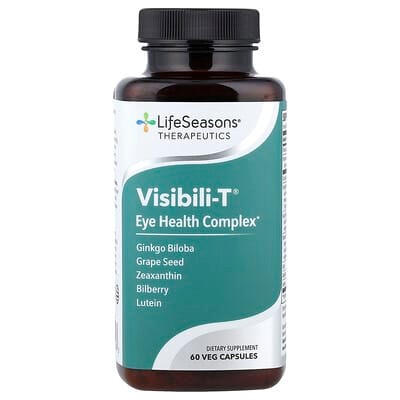
Visibili-T

Visibili-T

LifeSeasons4.5 (664 ratings)
Format:Capsule Quantity: 60 Capsule(s) · 30 servings
Goals
$38.99 $1.29 per serving

Product analysis

51 out of 100

Visibili-T contains lutein, which may help with selected aspects of contrast and glare. The ginkgo preparation is not fully identified, making its tentative attention benefits harder to predict.

AI assessment of the formula, label and price. How scoring works

Nutrient Quality34

Chromium is clearly identified as chromium polynicotinate, while several other forms are unspecified. Named plant compounds do not establish the quality of the full mixture.

Ingredient Transparency67

Amounts are stated throughout, and several plant components are named. Some forms and the ginkgo component breakdown remain unspecified.

Value For Money34

The cost is high for the vitamin A and lycopene provided, with limited value in the chromium comparison. Value for the other main ingredients remains uncertain.

Customer Satisfaction75

Customer feedback is very positive. A moderate number of ratings adds context without establishing eye or cognitive benefits.

Product Focus59

The clearest connection is lutein support for selected contrast and glare-related functions. Ginkgo findings for attention are inconsistent and do not establish sustained memory improvement.

Format
Capsule
Container
60 Capsule(s)
Per serving
$1.29
Customer rating
4.5 · 664 ratings
Report analysis

Goals

Impact
High effect
C Ingredient FitB+ PathwaysA+ EvidenceA Formulation Logic
Vitamin A · 5000 IU

Lutein contributes to macular pigment and may support selected contrast and glare-related aspects of vision. The supplied studies found limited visual-performance benefits rather than consistent improvements in visual acuity, and the serving amount does not establish a daily study regimen.

How this product is rated for Eye Health

Ingredient fit62

Declared lutein gives the formula a direct connection to limited visual-performance support.
Goal fit
The broader formula includes ingredients outside vision support, reducing its focus on this goal.
Dose adequacy
Vitamin A has unresolved amount information, limiting the amount assessment.

Pathways80

The strongest assigned contribution is macular pigment and blue-light filtering. Lutein supports the macular-pigment category.
Depth
The strongest assigned contribution concerns macular pigment and blue-light filtering, without itself establishing a clinical vision benefit.
Breadth
The assigned coverage reaches the comparison threshold for macular pigment and blue-light filtering, ocular microcirculation.

Evidence100

Lutein leads the saved evidence finding. Lutein evidence concerns selected contrast and glare outcomes, with limited acuity findings.
Evidence strength
Lutein leads the recognized evidence contribution, subject to its population and outcome limitations.
Studied preparation
The counted preparations receive recognition in the saved comparison; that does not establish results for this finished product.

Formulation logic92

Unresolved ingredient amounts limit the formulation assessment; no ingredient conflict or unmet partner requirement was identified.
Partner coverage
No unmet partner requirement was identified for the counted ingredients.
Conflicts
No ingredient conflict was identified in the supplied findings.
Effective doses
Vitamin A does not meet the saved amount threshold; the other counted ingredients do.
Study evidence
Ginkgo Supportive 11 studies
Lycopene Supportive 5 studies
Vitamin A Supportive 65 studies
Brain Health
Impact
Moderate effect
C- Ingredient FitD- PathwaysC- EvidenceA+ Formulation Logic

The 120 mg ginkgo amount is the relevant connection to cognition research. The supplied large long-term study did not show slower cognitive decline, so the ingredient offers a limited basis for routine brain-health expectations.

How this product is rated for Brain Health

Ingredient fit58

The saved findings identify 1 relevant ingredients and 8 other active ingredients (Carrot, Chromium, Grape, Lutein, Lycopene, Vitamin A, Zeaxanthin, bilberry). The saved findings show strong alignment of disclosed amounts with the comparison amounts.
Goal fit
The saved findings identify 1 relevant ingredients and 8 other active ingredients (Carrot, Chromium, Grape, Lutein, Lycopene, Vitamin A, Zeaxanthin, bilberry).
Dose adequacy
The saved findings show strong alignment of disclosed amounts with the comparison amounts.

Pathways43

The strongest identified area is Cerebral energy metabolism. 1 of 3 areas reach the saved coverage threshold: Cerebral energy metabolism.
Depth
The strongest identified area is Cerebral energy metabolism.
Breadth
1 of 3 areas reach the saved coverage threshold: Cerebral energy metabolism.

Evidence58

Ginkgo provides the strongest eligible evidence contribution in the saved findings. The saved findings match the eligible preparations to studied preparations.
Evidence strength
Ginkgo provides the strongest eligible evidence contribution in the saved findings.
Studied preparation
The saved findings match the eligible preparations to studied preparations.

Formulation logic100

The assessed ingredients can work alone or have their identified partner present. No matched ingredient conflict was recorded. 1 of 1 assessed ingredients reach the saved minimum comparison amount.
Partner coverage
The assessed ingredients can work alone or have their identified partner present.
Conflicts
No matched ingredient conflict was recorded.
Effective doses
1 of 1 assessed ingredients reach the saved minimum comparison amount.
Study evidence
Ginkgo Supportive 90 studies
Cognitive Support
Impact
Moderate effect
C- Ingredient FitD- PathwaysF EvidenceA+ Formulation Logic

Ginkgo at 120 mg has a limited connection to acute attention speed and cerebral blood flow. The preparation is unidentified, which limits how directly specific extract findings apply; sustained memory improvement is not established by those acute findings.

How this product is rated for Cognitive Support

Ingredient fit58

The saved assessment identifies 1 relevant ingredients and 8 other active ingredients. The formula is linked to 8 goals. The saved amount assessment is strong overall. Unknown individual amounts reduce confidence in the contribution.
Goal fit
The saved assessment identifies 1 relevant ingredients and 8 other active ingredients. The formula is linked to 8 goals.
Dose adequacy
The saved amount assessment is strong overall. Unknown individual amounts reduce confidence in the contribution.

Pathways40

Cerebral blood flow is the strongest represented mechanism, with meaningful coverage in the saved findings. 1 of the three assessed mechanism targets reaches the saved coverage threshold.
Depth
Cerebral blood flow is the strongest represented mechanism, with meaningful coverage in the saved findings.
Breadth
1 of the three assessed mechanism targets reaches the saved coverage threshold.

Evidence25

Ginkgo provides the strongest evidence among the ingredients meeting the saved amount threshold. Evidence remains limited to the outcomes and populations described for that ingredient. The saved assessment does not match Ginkgo to the studied preparations.
Evidence strength
Ginkgo provides the strongest evidence among the ingredients meeting the saved amount threshold. Evidence remains limited to the outcomes and populations described for that ingredient.
Studied preparation
The saved assessment does not match Ginkgo to the studied preparations.

Formulation logic100

The assessed ingredients can contribute alone or have their required partner present. No configured ingredient conflict was identified in the supplied assessment. 1 of 1 assessed ingredients meet the saved minimum amount threshold.
Partner coverage
The assessed ingredients can contribute alone or have their required partner present.
Conflicts
No configured ingredient conflict was identified in the supplied assessment.
Effective doses
1 of 1 assessed ingredients meet the saved minimum amount threshold.
Study evidence
Ginkgo Supportive 87 studies
Impact
Moderate effect
D Ingredient FitD PathwaysC+ EvidenceA- Formulation Logic
Lycopene · 2 mg

Lutein-containing carotenoids may help support skin responses to oxidative stress from UV exposure, with limited evidence from small trials involving skin tone, hydration and elasticity. The separately assessed carotenoid finding is the main skin contribution here; 2 mg lycopene is below the amounts used in the supplied skin trials. These findings do not imply sunscreen-like protection.

How this product is rated for Skin Health

Ingredient fit50

2 ingredients relate to the assessed skin goal, alongside 5 other actives, so the formula has a broader focus. The assessed amounts partly align with the saved dose comparisons.
Goal fit
2 ingredients relate to the assessed skin goal, alongside 5 other actives, so the formula has a broader focus.
Dose adequacy
The assessed amounts partly align with the saved dose comparisons.

Pathways45

The strongest saved connection is uv antioxidant defence, with partial support at the declared amounts. UV antioxidant support reaches the saved coverage threshold; the other skin pathways remain limited.
Depth
The strongest saved connection is uv antioxidant defence, with partial support at the declared amounts.
Breadth
UV antioxidant support reaches the saved coverage threshold; the other skin pathways remain limited.

Evidence67

Lutein, zeaxanthin and mixed carotenoids leads the saved evidence assessment among ingredients with sufficient assessed amounts. Evidence strength varies by ingredient and does not predict an individual benefit. The saved assessment identifies 1 ingredient preparations as matching its evidence criteria at sufficient assessed amounts.
Evidence strength
Lutein, zeaxanthin and mixed carotenoids leads the saved evidence assessment among ingredients with sufficient assessed amounts. Evidence strength varies by ingredient and does not predict an individual benefit.
Studied preparation
The saved assessment identifies 1 ingredient preparations as matching its evidence criteria at sufficient assessed amounts.

Formulation logic88

The assessed ingredients can contribute on their own or have their required partner present. 1 of 2 assessed ingredients meet the saved minimum amount threshold. Vitamin A fall below that threshold.
Partner coverage
The assessed ingredients can contribute on their own or have their required partner present.
Conflicts
No ingredient conflict was identified in the saved assessment.
Effective doses
1 of 2 assessed ingredients meet the saved minimum amount threshold. Vitamin A fall below that threshold.
Study evidence
Lycopene Supportive 20 studies
Vitamin A Supportive 106 studies
Mental Focus
Impact
Moderate effect
C- Ingredient FitD- PathwaysC EvidenceA+ Formulation Logic

Ginkgo at 120 mg provides the main relevance to mental focus. Its cognitive evidence includes selected acute findings but inconsistent attention benefits, so the contribution remains tentative.

How this product is rated for Mental Focus

Ingredient fit58

Ginkgo provides focus-related relevance within a formula largely aimed at other purposes. The 120 mg ginkgo amount reaches the saved exposure comparison level.
Goal fit
Ginkgo provides focus-related relevance within a formula largely aimed at other purposes.
Dose adequacy
The 120 mg ginkgo amount reaches the saved exposure comparison level.

Pathways44

Brain energy supply is the main assessed route. Only brain energy supply reaches the saved coverage level.
Depth
Brain energy supply is the main assessed route.
Breadth
Only brain energy supply reaches the saved coverage level.

Evidence62

Ginkgo provides the strongest saved evidence contribution at a counted amount; the scope and limitations of its evidence still apply. Ginkgo matches the preparation category accepted in the saved assessment.
Evidence strength
Ginkgo provides the strongest saved evidence contribution at a counted amount; the scope and limitations of its evidence still apply.
Studied preparation
Ginkgo matches the preparation category accepted in the saved assessment.

Formulation logic100

The counted ingredients can contribute independently or have their required partner. The counted ingredient meets the saved minimum exposure comparison.
Partner coverage
The counted ingredients can contribute independently or have their required partner.
Conflicts
No configured ingredient conflict was identified in the saved assessment.
Effective doses
The counted ingredient meets the saved minimum exposure comparison.
Study evidence
Ginkgo Supportive 28 studies

Ingredients

IngredientAmount per servingScore
Vitamin A (Beta-Carotene)
5000 IU 57
Chromium (Chromium Polynicotinate)
400 mcg 70
Carrot
150 mg
Ginkgo biloba leaf extract (Flavone Glycosides, Terpene Lactones)
120 mg 85
Grape seed extract (Polyphenols)
100 mg
Bilberry fruit extract (Anthocyanins)
50 mg
Lutein
20 mg
Zeaxanthin
3 mg
Lycopene
2 mg 70
Gluten Free Adults 18–50 Dairy Free Vegetarian
Report overview
B- Active Ingredient Quality & BioavailabilityA- Dose, Safety & Label TransparencyD- Value
Each serving supplies 400 mcg of chromium; its cost per 200 mcg is moderately high. It uses chromium polynicotinate. No branded chromium source is identified in the available information.
How this ingredient is rated

Active Ingredient Quality & Bioavailability70

It uses chromium polynicotinate. No branded chromium source is identified in the available information.
Chromium Chemical Form
It uses chromium polynicotinate.
Branded & Trademarked Sources
No branded chromium source is identified in the available information.

Dose, Safety & Label Transparency85

The serving lists 400 mcg of chromium. A separate compound weight is not available.
Elemental Chromium Dosage
Each serving supplies 400 mcg of chromium.
Label Transparency & Disclosure
The chromium amount is stated, but a separate source compound weight is not available.

Value40

The cost per 200 mcg of chromium is moderately high.
Price per 200 mcg Chromium
The cost per 200 mcg of chromium is moderately high.
D+ Active Ingredient Quality & BioavailabilityB+ Dose, Safety & Label TransparencyF Value
Each serving provides 5,000 IU of vitamin A. The cost for that amount is high. Vitamin A comes from beta-carotene.
How this ingredient is rated

Active Ingredient Quality & Bioavailability50

Vitamin A comes from beta-carotene.
Vitamin A Chemical Form & Source
Vitamin A comes from beta-carotene.

Dose, Safety & Label Transparency82

Each serving provides 5,000 IU of vitamin A. The vitamin A source is named as beta-carotene.
Dosage Efficacy & Safety Thresholds
Each serving provides 5,000 IU of vitamin A.
Label Transparency of Specific Forms
The vitamin A source is named as beta-carotene.

Value20

The cost is high for the amount of vitamin A provided.
Price per 5,000 IU Dose
The cost is high for the amount of vitamin A provided.
B- Composition And Label DisclosureA+ Composition And Label Disclosure
The serving supplies 120 mg of ginkgo. The source is Ginkgo Leaf Extract. The extract specifies 24% flavones and 6% terpenes. No ginkgolic acid limit is available, so its level is unclear. Value cannot be assessed from the available criteria.
How this ingredient is rated

Composition and Label Disclosure70

The extract specifies 24% flavones and 6% terpenes. No ginkgolic acid limit is available, so its level is unclear.
Marker and Preparation Disclosure
The extract specifies 24% flavones and 6% terpenes.
Declared Ginkgolic Acid Limit
No ginkgolic acid limit is available, so its level is unclear.

Composition and Label Disclosure100

The serving states 120 mg of ginkgo as Ginkgo Leaf Extract.
Individual Preparation Amount Disclosure
The serving states 120 mg of ginkgo and names Ginkgo Leaf Extract.

Commercial Price and Usability

Value was not assessed.
Report alternatives

Sources

Published studies used for the product analysis and the top-ranked studies for each ingredient and goal.

  1. Efficacy and adverse effects of ginkgo biloba for cognitive impairment and dementia: a systematic review and meta-analysis.
    Tan MS; Yu JT; Tan CC; Wang HF; Meng XF; Wang C; Jiang T; Zhu XC; Tan L · Journal of Alzheimer's disease : JAD · 2015
    Meta-analysis2,561 participants9 studies pooledBrain Health forGinkgo
  2. Efficacy of Ginkgo biloba extract EGb 761® in dementia with behavioural and psychological symptoms: A systematic review.
    von Gunten A; Schlaefke S; Überla K · The world journal of biological psychiatry : the official journal of the World Federation of Societies of Biological Psychiatry · 2017
    Meta-analysis1,628 participants4 studies pooledBrain Health Cognitive Support forGinkgo
  3. Ginkgo biloba extract EGb 761 is safe and effective in the treatment of mild dementia - a meta-analysis of patient subgroups in randomised controlled trials.
    Riepe M; Hoerr R; Schlaefke S · The world journal of biological psychiatry : the official journal of the World Federation of Societies of Biological Psychiatry · 2025
    Meta-analysis782 participants4 studies pooledBrain Health forGinkgo
  4. Ginkgo biloba extract EGb 761® improves cognition and overall condition after ischemic stroke: Results from a pilot randomized trial.
    Cui M; You T; Zhao Y; Liu R; Guan Y; Liu J; Liu X; Wang X; Dong Q · Frontiers in pharmacology · 2023
    Randomized trial201 participantsBrain Health forGinkgo
  5. Ginkgo biloba extract EGb 761® in dementia with neuropsychiatric features: a randomised, placebo-controlled trial to confirm the efficacy and safety of a daily dose of 240 mg.
    Herrschaft H; Nacu A; Likhachev S; Sholomov I; Hoerr R; Schlaefke S · Journal of psychiatric research · 2012
    Randomized trial410 participantsBrain Health forGinkgo
  6. Efficacy of ginkgo diterpene lactone meglumine on cognitive function in patients with acute ischemic stroke: a predefined exploratory analysis of a multicenter, double-blind, randomized controlled trial.
    Tian X; Xu Q; Xia X; Zhang Y; Meng X; Wang A · Journal of neurology · 2024
    Randomized trial3,163 participantsCognitive Support forGinkgo
  7. A placebo-controlled, double-blind, randomized trial of an extract of Ginkgo biloba for dementia. North American EGb Study Group.
    Le Bars PL; Katz MM; Berman N; Itil TM; Freedman AM; Schatzberg AF · JAMA · 1997
    Randomized trial309 participantsCognitive Support forGinkgo
  8. Alleviating neuropsychiatric symptoms in dementia: the effects of Ginkgo biloba extract EGb 761. Findings from a randomized controlled trial.
    Bachinskaya N; Hoerr R; Ihl R · Neuropsychiatric disease and treatment · 2011
    Randomized trial410 participantsCognitive Support forGinkgo
  9. Efficacy and safety of a once-daily formulation of Ginkgo biloba extract EGb 761 in dementia with neuropsychiatric features: a randomized controlled trial.
    Ihl R; Bachinskaya N; Korczyn AD; Vakhapova V; Tribanek M; Hoerr R; Napryeyenko O; GOTADAY Study Group · International journal of geriatric psychiatry · 2013
    Randomized trial410 participantsCognitive Support forGinkgo
  10. Effect of Ginkgo biloba extracts in the prevention of posterior capsule opacification after cataract surgery: A randomized clinical trial.
    Amiri AA; Jafari R; Amiri AA; Rad HA; Daneshvar F; Charati JY; Amiri AA · Oman journal of ophthalmology · 2025
    Randomized trial144 participantsEye Health forGinkgo
  11. Effect of Ginkgo biloba extract on preexisting visual field damage in normal tension glaucoma.
    Quaranta L; Bettelli S; Uva MG; Semeraro F; Turano R; Gandolfo E · Ophthalmology · 2003
    Randomized trial27 participantsEye Health forGinkgo
  12. [Ginkgo extract in impaired vision--treatment with special extract EGb 761 of impaired vision due to dry senile macular degeneration].
    Fies P; Dienel A · Wiener medizinische Wochenschrift (1946) · 2002
    Randomized trial99 participantsEye Health forGinkgo
  13. Short-term effects of Ginkgo biloba extract on peripapillary retinal blood flow in normal tension glaucoma.
    Park JW; Kwon HJ; Chung WS; Kim CY; Seong GJ · Korean journal of ophthalmology : KJO · 2012
    Randomized trial30 participantsEye Health forGinkgo
  14. [The course of color vision in early diabetic retinopathy treated with Ginkgo biloba extract. A preliminary double-blind versus placebo study].
    Lanthony P; Cosson JP · Journal francais d'ophtalmologie · 1989
    Randomized trial29 participantsEye Health forGinkgo
  15. The Associations of Plasma Carotenoids and Vitamins With Risk of Age-Related Macular Degeneration: Results From a Matched Case-Control Study in China and Meta-Analysis.
    Jiang H; Fan Y; Li J; Wang J; Kong L; Wang L; Li Z; Ma M; Shi X; Liu S; Shi J; Zhu H; Liu X; Ma L · Frontiers in nutrition · 2022
    Meta-analysis9 studies pooledEye Health forLycopene
  16. Serum carotenoids and risk of age-related macular degeneration in a chinese population sample.
    Zhou H; Zhao X; Johnson EJ; Lim A; Sun E; Yu J; Zhang Y; Liu X; Snellingen T; Shang F; Liu N · Investigative ophthalmology & visual science · 2011
    Case-control study263 participantsEye Health forLycopene
  17. Serum antioxidants and age-related macular degeneration in a population-based case-control study.
    Mares-Perlman JA; Brady WE; Klein R; Klein BE; Bowen P; Stacewicz-Sapuntzakis M; Palta M · Archives of ophthalmology (Chicago, Ill. : 1960) · 1995
    Case-control study334 participantsEye Health forLycopene
  18. Association between serum carotenoid concentrations and risk of major age-related eye diseases among middle-aged and older adults.
    Che S; Ma Y; Cao J · Frontiers in medicine · 2025
    Cross-sectional study1,478 participantsEye Health forLycopene
  19. Plasma antioxidant vitamins and carotenoids and age-related cataract
    Gale CR, Hall NF, Phillips DI, Martyn CN · Ophthalmology · 2001
    Cross-sectional study372 participantsEye Health forLycopene
  20. A randomized trial of vitamin A and vitamin E supplementation for retinitis pigmentosa.
    Berson EL; Rosner B; Sandberg MA; Hayes KC; Nicholson BW; Weigel-DiFranco C; Willett W · Archives of ophthalmology (Chicago, Ill. : 1960) · 1993
    Randomized trial601 participantsEye Health forVitamin A