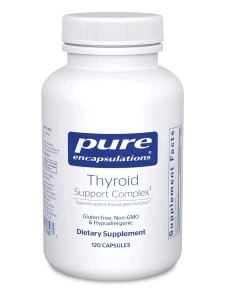
Thyroid Support Complex

Thyroid Support Complex

Pure Encapsulations4.7 (175 ratings)
Format:Capsule Quantity: 120 Capsule(s) · 60 servings
Goals
$66.50 $1.10 per serving

Product analysis

54 out of 100

Thyroid Support Complex combines nutrients and botanicals in a formula aimed at thyroid support. Several ingredients offer weak value, and missing composition detail makes the full combination harder to compare.

AI assessment of the formula, label and price. How scoring works

Nutrient Quality51

Iodine and zinc use favorable forms, while the selenium form has a more moderate assessment. Quality remains uncertain for many of the other ingredients.

Ingredient Transparency77

All amounts and most ingredient forms are disclosed. One missing form and incomplete composition detail still limit a complete comparison.

Value For Money29

Value is weak for several ingredients, particularly selenium, tyrosine and turmeric. The remaining uncertainties do not provide a firm reason to view the complete formula as good value.

Customer Satisfaction72

Customer feedback is very positive. The relatively limited review base describes satisfaction rather than establishing thyroid benefits.

Product Focus43

The formula combines many ingredients across a broad range of intended uses. Its alignment appears moderate, with the breadth making its purpose less concentrated.

Format
Capsule
Container
120 Capsule(s)
Per serving
$1.10
Customer rating
4.7 · 175 ratings
Report analysis

Goals

Impact
High effect
C+ Ingredient FitF PathwaysA+ EvidenceA+ Formulation Logic
Vitamin D · 5 mcgZinc · 20 mg

Iodine can help address a dietary deficiency that lowers thyroid hormone and heat production, without establishing a boost when iodine intake is adequate. Selenium and zinc support normal nutrient-dependent functions. Ashwagandha findings concern stress, cravings or body weight rather than a measured rise in energy expenditure, and its extract-specific results cannot be transferred to arbitrary preparations. The saved result gives it only a limited connection to metabolic hormones.

How this product is rated for Metabolism Support

Ingredient fit68

The ingredients receive recognition for their connection and amounts in the saved findings. Normal nutrient functions and comparison amounts do not establish a metabolic-rate increase.
Goal fit
Recognised ingredients share this formula with other actives, giving it a broader focus than metabolic rate alone.
Dose adequacy
The counted ingredients provide partial reference amounts overall; those comparisons do not establish proven thermogenic doses.

Pathways3

Only a limited connection to insulin-related processes and metabolic hormones is recorded; that does not establish thermogenesis.
Depth
Only a limited connection to insulin-related processes and metabolic hormones is recorded; that does not establish thermogenesis.
Breadth
None of the evaluated routes has substantial recorded coverage, so broad support for increased energy expenditure is absent.

Evidence98

Zinc leads the recorded evidence finding, but its normal metabolic role or other study outcomes do not establish thermogenesis.
Evidence strength
Zinc leads the recorded evidence finding, but its normal metabolic role or other study outcomes do not establish thermogenesis.
Studied preparation
Ashwagandha lacks a studied-preparation match; the other counted ingredients receive that recognition.

Formulation logic100

The counted ingredients have no missing required partners or identified conflicts among those evaluated. Their amounts meet the minimum comparison.
Partner coverage
No required ingredient partner is missing for the counted ingredients.
Conflicts
None of the evaluated conflicts was identified; the finding does not cover every possible interaction.
Effective doses
All counted ingredients meet the minimum amount comparison; that does not establish a proven thermogenic dose.
Study evidence
Iodine Mixed 17 studies
Selenium Mixed 28 studies
Vitamin D Supportive 65 studies
Zinc Supportive 12 studies
Impact
Moderate effect
C- Ingredient FitF PathwaysB+ EvidenceA+ Formulation Logic
Zinc · 20 mgVitamin D · 5 mcgAshwagandha · 400 mg

Zinc may help restore testosterone when low zinc levels are the cause of a reduction. That makes its role conditional on your nutrient intake, rather than a general way to raise hormones. Taking extra zinc when you already get enough isn't known to increase testosterone. The ashwagandha preparation isn't identified as a specific extract with direct hormone relevance, which limits expectations for that ingredient.

How this product is rated for Testosterone Support

Ingredient fit57

Zinc is relevant mainly when low intake affects testosterone. Other ingredients do not make that conditional benefit universal.
Goal fit
Zinc provides a conditional connection to testosterone through correcting low zinc levels.
Dose adequacy
Zinc 20 mg, Selenium 200 mcg, Vitamin D 5 mcg, Ashwagandha 400 mg per serving; these amounts don't by themselves predict a testosterone increase.

Pathways18

Connections to hormone processes do not tell you how much testosterone will change. Practical effects remain dependent on the ingredient and circumstances.
Depth
The ingredients relate to testosterone production or availability, with practical hormone effects remaining conditional or uncertain.
Breadth
Broad effects across testosterone-related processes are not identified.

Evidence84

Correcting low zinc provides the clearest hormone-related benefit here. This does not imply an increase when zinc intake is already adequate.
Evidence strength
Zinc is most relevant when low zinc has reduced testosterone; benefit above adequate intake is unclear.
Studied preparation
Ashwagandha preparation details limit direct transfer of hormone effects from specific preparations.

Formulation logic100

No required partner or particular ingredient conflict is identified. Declared amounts allow comparison without guaranteeing hormone benefits.
Partner coverage
No additional partner ingredient is required for the identified ingredient roles.
Conflicts
No particular ingredient conflict is identified for this goal.
Effective doses
Zinc 20 mg, Selenium 200 mcg, Vitamin D 5 mcg, Ashwagandha 400 mg per serving; these are ingredient amounts, not a promise of hormone benefit.
Study evidence
Selenium No effect 16 studies
Vitamin D Supportive 56 studies
Zinc Disputed 7 studies
Energy
Impact
Moderate effect
C Ingredient FitD PathwaysC EvidenceA+ Formulation Logic
Iodine · 150 mcgVitamin D · 5 mcg

Vitamin C can help fill a dietary gap associated with tiredness. Ashwagandha has stress-related research, but the supplied evidence offers limited support for a routine fatigue benefit; tyrosine and iodine also lack an unconditional energy benefit.

How this product is rated for Energy

Ingredient fit60

The saved findings consider 4 relevant ingredients alongside 6 other actives.
Goal fit
4 ingredients contribute to the saved finding, while 6 other actives and links to other goals broaden its focus.
Dose adequacy
The saved amount finding considers 4 ingredients against their individual references.

Pathways49

The main saved connection concerns stress-related fatigue resistance.
Depth
Stress-related fatigue resistance is the strongest saved area.
Breadth
Stress-related fatigue resistance is the only area reaching the saved coverage threshold.

Evidence64

Ashwagandha leads the saved evidence finding. The supplied references distinguish nutritional adequacy or limited fatigue findings from a general energy boost.
Evidence strength
Ashwagandha has the strongest saved evidence finding among ingredients meeting the amount reference.
Studied preparation
The saved assessment records preparation matches for part of the formula, but not for Iodine and tyrosine.

Formulation logic100

The saved checks account for required partners and record no matched conflict.
Partner coverage
Each counted ingredient can contribute independently under the saved assessment or has its required partner.
Conflicts
No configured ingredient conflict is recorded.
Effective doses
All 4 counted ingredients meet the saved minimum amount threshold.
Study evidence
Iodine Adverse 3 studies
Vitamin D Supportive 32 studies
Hair Health
Impact
High effect
C+ Ingredient FitC PathwaysA EvidenceA+ Formulation Logic
Vitamin D · 5 mcgZinc · 20 mgVitamin C · 150 mg

Zinc can help with shedding linked to low zinc intake. Ashwagandha has a preparation-specific hair-parameter finding, but this unidentified extract does not establish the studied KSM-66 preparation. Selenium and vitamin C contribute to antioxidant biology and normal collagen formation without proving routine regrowth. Iodine’s role in thyroid hormone synthesis does not establish hair-loss treatment, and the vitamin D amount receives no independent contribution.

How this product is rated for Hair Health

Ingredient fit69

The formula’s relevant nutrients contribute to the saved ingredient and amount findings. Their normal nutritional roles should be distinguished from a demonstrated increase in hair growth.
Goal fit
The relevant nutrients sit within a broader formula, so its focus extends beyond hair health.
Dose adequacy
The amounts make a partial contribution, with smaller or unresolved amounts limiting the saved comparison.

Pathways60

Copper accounts for a limited hair-fibre finding, without broad coverage of the specified mechanisms.
Depth
The strongest recorded contribution is to follicle antioxidant protection, reflecting nutrient roles rather than established regrowth.
Breadth
Antioxidant protection is the only substantially represented mechanism; other recorded contributions remain limited.

Evidence94

Zinc leads the saved evidence finding; its relevant hair role is correction of low intake or deficiency. Preparation matches do not establish benefit in nutrient-replete adults.
Evidence strength
Zinc provides the strongest saved support, chiefly relevant to low-intake or deficiency-related shedding.
Studied preparation
Most compared preparations match the saved references, but the ashwagandha extract and iodine do not match studied hair preparations.

Formulation logic100

The counted ingredients have no missing required partners or configured conflicts. Amount findings describe the saved comparison, without establishing synergy or a treatment regimen.
Partner coverage
No required partner is missing for the ingredients receiving a contribution; this does not demonstrate an added combination benefit.
Conflicts
No configured ingredient conflict was identified in the supplied findings.
Effective doses
The counted ingredients reach the saved minimum amount comparison, which is not a proven effective hair-treatment threshold.
Study evidence
Iodine No effect 1 study
Selenium Disputed 7 studies
Vitamin A Disputed 13 studies
Vitamin D Disputed 34 studies
Zinc Supportive 22 studies
Longevity
Impact
High effect
C Ingredient FitC- PathwaysB EvidenceA+ Formulation Logic
Vitamin D · 5 mcg

Vitamin C and the other declared nutrients support normal nutritional functions; additional benefit when intake is adequate is not established.

How this product is rated for Longevity

Ingredient fit61

Ashwagandha, Selenium and Vitamin C provide the main connections, although relevance depends on the specific preparation and serving amount.
Goal fit
Relevant nutrients sit within a broader formula containing ingredients directed at other goals.
Dose adequacy
The declared serving amounts provide uneven contributions; the amount comparison does not establish a proven anti-aging dose.

Pathways59

The saved findings concentrate on selected functional or antioxidant-related processes rather than broad preservation of aging-related function.
Depth
The strongest represented area is antioxidant defence. This describes ingredient roles rather than demonstrated slowing of aging.
Breadth
The represented areas meeting the comparison threshold are antioxidant defence.

Evidence79

The human findings concern narrow outcomes and particular preparations or populations, rather than human lifespan extension.
Evidence strength
Selenium supplies the leading evidence contribution, with benefits limited by the populations and outcomes studied.
Studied preparation
Preparation matching is incomplete for Ashwagandha; other qualifying ingredients match the saved preparation comparison.

Formulation logic100

The contributing ingredients meet the supplied partner requirements; the configured check identifies no conflict.
Partner coverage
The contributing ingredients can act independently or have the partners required by the supplied findings.
Conflicts
No configured ingredient conflict was identified; this is a limited interaction check.
Effective doses
All contributing ingredients meet the amount threshold used for this comparison, which is not a proven anti-aging dose.
Study evidence
Selenium Supportive 27 studies
Vitamin C Supportive 30 studies
Vitamin D Supportive 50 studies
Zinc Supportive 10 studies
Mood Support
Impact
Moderate effect
C- Ingredient FitF PathwaysD EvidenceA+ Formulation Logic
Vitamin D · 5 mcgAshwagandha · 400 mg

Ashwagandha may help with emotional strain linked to stress, although the specific extract affects what you can expect. The declared extract and its withanolide percentage don't identify a particular preparation with matching effects. Whether this version improves everyday mood is therefore uncertain; its amount alone doesn't resolve that uncertainty.

How this product is rated for Mood Support

Ingredient fit56

Ashwagandha may help with emotional strain linked to stress, although the specific extract affects what you can expect.
Goal fit
Ashwagandha may help with emotional strain linked to stress, although the specific extract affects what you can expect.
Dose adequacy
Turmeric 100 mg; Zinc 20 mg per serving. These amounts alone do not show how much mood benefit to expect.

Pathways16

The relevant ingredients relate mainly to nerve signalling; that role alone does not predict how your mood will change.
Depth
The relevant ingredients relate mainly to nerve signalling; that role alone does not predict how your mood will change.
Breadth
The relevant ingredients relate mainly to nerve signalling; that role alone does not predict how your mood will change.

Evidence48

Ashwagandha may help with emotional strain linked to stress, although the specific extract affects what you can expect. Some declared preparations do not identify a specific extract, so effects from other preparations cannot automatically be expected.
Evidence strength
Ashwagandha may help with emotional strain linked to stress, although the specific extract affects what you can expect.
Studied preparation
Some declared preparations do not identify a specific extract, so effects from other preparations cannot automatically be expected.

Formulation logic100

No particular ingredient conflict is identified in this combination.
Partner coverage
No required companion ingredient is missing for the relevant ingredients; this does not show an added benefit from combining them.
Conflicts
No particular ingredient conflict is identified in this combination.
Effective doses
Turmeric 100 mg; Zinc 20 mg per serving. Comparison amounts are not minimum effective doses or assurances of benefit.
Study evidence
Vitamin D Supportive 163 studies
Zinc Supportive 43 studies

Ingredients

IngredientAmount per servingScore
Vitamin A (Vitamin A Acetate)
750 mcg
Vitamin C (Ascorbic Acid)
150 mg
Vitamin D (Cholecalciferol, Vitamin D3)
5 mcg
Iodine (Potassium Iodide)
150 mcg 84
Zinc (Zinc Citrate)
20 mg 62
Selenium (Selenomethionine)
200 mcg 63
L-Tyrosine
500 mg 70
Ashwagandha (Withania somnifera) extract (Withanolides)
400 mg 85
Forskohlii (Coleus forskohlii) extract (Forskolin)
100 mg
Guggul (Commiphora mukul) extract (Guggulsterones)
150 mg
Turmeric (Curcuma longa) extract (Curcuminoids)
100 mg 66
Gluten Free Adults 18–50
Report overview
A+ Active Ingredient Quality & BioavailabilityA+ Dose, Safety & Label TransparencyF Value
Each serving provides 150 mcg of iodine as potassium iodide, an amount suited to daily support. The whole-product serving costs about $1.11.
How this ingredient is rated

Active Ingredient Quality & Bioavailability100

The iodine is supplied as potassium iodide, with no marine source recorded.
Iodine Form & Bioavailability
The iodine is supplied as potassium iodide, a disclosed chemical form.
Marine Source Purity & Sourcing
No marine source is recorded, so the seaweed-specific sourcing check does not apply.

Dose, Safety & Label Transparency100

The declared 150 mcg of iodine per serving suits daily support and falls below the upper intake limit.
Dosage Efficacy for Daily Support
150 mcg per serving is an amount suited to daily iodine support.
Dosage Safety & Upper Limits
The 150 mcg serving is below the upper intake limit used in the evaluation.
Elemental Iodine Transparency
The iodine amount is declared as 150 mcg per serving.

Value20

A whole-product serving costs about $1.11.
Price Per Effective Serving
The whole-product serving costs about $1.11.
D+ Active Ingredient Quality & BioavailabilityA+ Dose, Safety & Label TransparencyF Value
Each serving supplies 200 mcg of selenium as selenomethionine. The saved facts do not specify its L-isomer.
How this ingredient is rated

Active Ingredient Quality & Bioavailability53

The selenium is identified as selenomethionine, but the L-isomer is not specified in the saved facts.
Selenium Chemical Form
Selenomethionine is the identified selenium form.
Form Transparency & Isomer Specificity
The generic selenomethionine name is identified, but the L-isomer is not specified in the saved facts.

Dose, Safety & Label Transparency100

A serving contains 200 mcg of selenium.
Dosage Efficacy Sweet Spot
A serving supplies 200 mcg of selenium.
Safety Margin & UL Adherence
The recorded serving amount does not exceed the limit used in the evaluation.

Value10

The whole-product price works out to roughly $1.11 per 200 mcg of selenium.
Price per 200 mcg Serving
The whole-product price works out to roughly $1.11 per 200 mcg of selenium.
B+ Active Ingredient Quality & BioavailabilityC Dose, Safety & Label TransparencyF Value
+8
Each serving provides 20 mg zinc at a high cost per serving. That amount may support zinc maintenance. The zinc comes as zinc citrate. The available information does not say how much copper it contains, so the zinc-to-copper balance is unclear.
How this ingredient is rated

Active Ingredient Quality & Bioavailability80

The zinc comes as zinc citrate.
Zinc Form Bioavailability
The zinc comes as zinc citrate.

Dose, Safety & Label Transparency61

20 mg may support zinc maintenance. The available information does not say how much copper it contains, so the zinc-to-copper balance is unclear.
Elemental Dose Transparency
The zinc amount is clearly stated.
Zinc Dosage Safety & Effectiveness
20 mg may support zinc maintenance.
Zinc-to-Copper Mineral Balance
The available information does not say how much copper it contains, so the zinc-to-copper balance is unclear.

Value30

The cost per serving is high.
Price Per Serving Efficiency
The cost per serving is high.
Report alternatives

Sources

Published studies used for the product analysis and the top-ranked studies for each ingredient and goal.

  1. Acute and Repeated Ashwagandha Supplementation Improves Markers of Cognitive Function and Mood.
    Leonard M; Dickerson B; Estes L; Gonzalez DE; Jenkins V; Johnson S; Xing D; Yoo C; Ko J; Purpura M; Jäger R; Faries M; Kephart W; Sowinski R; Rasmussen CJ; Kreider RB · Nutrients · 2024
    Randomized trial59 participantsBrain Health Cognitive Support Energy forAshwagandha
  2. Effect of ashwagandha (Withania somnifera) extract with Sominone (Somin-On™) to improve memory in adults with mild cognitive impairment: A randomized, double-blind, placebo-controlled study.
    Rai HP; Mishra DN · Journal of psychopharmacology (Oxford, England) · 2025
    Randomized trial40 participantsBrain Health Cognitive Support forAshwagandha
  3. Efficacy of Withania somnifera supplementation on adult's cognition and mood.
    Remenapp A; Coyle K; Orange T; Lynch T; Hooper D; Hooper S; Conway K; Hausenblas HA · Journal of Ayurveda and integrative medicine · 2022
    Randomized trial60 participantsBrain Health Cognitive Support Productivity Boost forAshwagandha
  4. A clinical assessment of the therapeutic effects of Ashwagandha root extract on cognitive performance, sleep, and fatigue in children aged 6-12 years.
    Saxena A; Lopresti A; Sharif M; Elon N; Suri R; Langade DK · Frontiers in nutrition · 2026
    Randomized trial85 participantsBrain Health forAshwagandha
  5. Efficacy and Safety of Ashwagandha Root Extract on Cognitive Functions in Healthy, Stressed Adults: A Randomized, Double-Blind, Placebo-Controlled Study.
    Gopukumar K; Thanawala S; Somepalli V; Rao TSS; Thamatam VB; Chauhan S · Evidence-based complementary and alternative medicine : eCAM · 2022
    Randomized trial130 participantsBrain Health Sleep Support Stress Relief forAshwagandha
  6. Combined L-carnosine and L-tyrosine supplementation as an ergogenic strategy for physical and cognitive performance under fatigue in professional football players.
    Bilgin S; Bozyılan E; Buzdağlı Y; Karaç Öcal Y; Gürkan O; Toktaş S; İnan H; Egil İ; Yarayan YE · Frontiers in nutrition · 2026
    Randomized trial24 participantsBrain Health forTyrosine
  7. Effect of tyrosine supplementation on clinical and healthy populations under stress or cognitive demands--A review.
    Jongkees BJ; Hommel B; Kühn S; Colzato LS · Journal of psychiatric research · 2016
    Narrative reviewBrain Health forTyrosine
  8. Influence of nutritional tyrosine on cognition and functional connectivity in healthy old humans.
    Hensel C; Becker M; Düzel S; Demuth I; Norman K; Steinhagen-Thiessen E; Gallinat J; Lindenberger U; Kühn S · NeuroImage · 2019
    Cross-sectional study286 participantsBrain Health forTyrosine
  9. Dietary Tyrosine Intake (FFQ) Is Associated with Locus Coeruleus, Attention and Grey Matter Maintenance: An MRI Structural Study on 398 Healthy Individuals of the Berlin Aging Study-II.
    Plini ERG; Melnychuk MC; Harkin A; Dahl MJ; McAuslan M; Kühn S; Boyle RT; Whelan R; Andrews R; Düzel S; Drewelies J; Wagner GG; Lindenberger U; Norman K; Robertson IH; Dockree PM · The journal of nutrition, health & aging · 2023
    Cross-sectional study398 participantsBrain Health forTyrosine
  10. Baseline-dependent effect of dopamine's precursor L-tyrosine on working memory gating but not updating.
    Jongkees BJ · Cognitive, affective & behavioral neuroscience · 2021
    Randomized trial45 participantsBrain Health forTyrosine
  11. Vitamin D and brain health: an observational and Mendelian randomization study.
    Navale SS; Mulugeta A; Zhou A; Llewellyn DJ; Hyppönen E · The American journal of clinical nutrition · 2022
    Cohort study427,690 participantsBrain Health forVitamin D
  12. The association between vitamin D and cognition: a systematic review.
    van der Schaft J; Koek HL; Dijkstra E; Verhaar HJ; van der Schouw YT; Emmelot-Vonk MH · Ageing research reviews · 2014
    Systematic review28 studies pooledBrain Health forVitamin D
  13. Vitamin D Status and Rates of Cognitive Decline in a Multiethnic Cohort of Older Adults.
    Miller JW; Harvey DJ; Beckett LA; Green R; Farias ST; Reed BR; Olichney JM; Mungas DM; DeCarli C · JAMA neurology · 2016
    Cohort study382 participantsBrain Health forVitamin D
  14. Vitamin D insufficiency and cognitive impairment in Asians: a multi-ethnic population-based study and meta-analysis.
    Annweiler C; Milea D; Whitson HE; Cheng CY; Wong TY; Ikram MK; Lamoureux EL; Sabanayagam C · Journal of internal medicine · 2017
    Meta-analysis2,273 participants7 studies pooledBrain Health forVitamin D
  15. Vitamin D status predicts new brain magnetic resonance imaging activity in multiple sclerosis.
    Mowry EM; Waubant E; McCulloch CE; Okuda DT; Evangelista AA; Lincoln RR; Gourraud PA; Brenneman D; Owen MC; Qualley P; Bucci M; Hauser SL; Pelletier D · Annals of neurology · 2012
    Cohort study469 participantsBrain Health forVitamin D
  16. Efficacy of Zinc Supplement in Minimal hepatic Encephalopathy: A prospective, Randomized Controlled Study (Zinc-MHE Trial).
    Janyajirawong R; Vilaichone RK; Sethasine S · Asian Pacific journal of cancer prevention : APJCP · 2021
    Randomized trial69 participantsBrain Health Cognitive Support forZinc
  17. A preliminary report: effects of zinc and micronutrient repletion on growth and neuropsychological function of urban Chinese children.
    Penland JG; Sandstead HH; Alcock NW; Dayal HH; Chen XC; Li JS; Zhao F; Yang JJ · Journal of the American College of Nutrition · 1997
    Randomized trial372 participantsBrain Health Cognitive Support forZinc
  18. Association between zinc deficiency and cognitive decline in community-dwelling older adults.
    Marchetti MF; Silva GMD; Freiria CN; Borim FSA; Brito TRP; Milanski M; Corona LP · Ciencia & saude coletiva · 2022
    Cross-sectional study591 participantsBrain Health forZinc
  19. Zinc status, psychological and nutritional assessment in old people recruited in five European countries: Zincage study.
    Marcellini F; Giuli C; Papa R; Gagliardi C; Dedoussis G; Herbein G; Fulop T; Monti D; Rink L; Jajte J; Mocchegiani E · Biogerontology · 2007
    Cross-sectional study853 participantsBrain Health forZinc
  20. Zinc alleviates stroke development through autophagy-mediated modulation of immune microenvironment.
    Qiu Z; Liu X; Li J; Yin H; Luo J; Lin Z; Rexiati M; Abulaiti A; Yasen A; Xing L; Aili D; Meng B; Li X; You Z; He J; Huang C; Qian Z; Chen J · Frontiers in immunology · 2025
    OtherBrain Health forZinc