
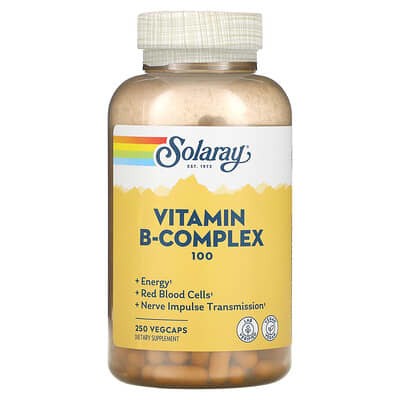
Nutrient quality
High amounts provide depth across the B-vitamin family. Very high B6 and niacinamide with basic forms make the formula unbalanced for routine use.
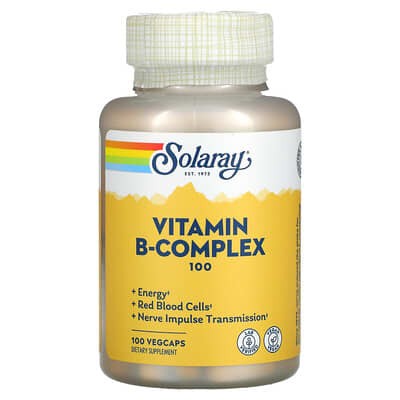
.
 iHerb iHerb | $ 23.99 | |
 Vitacost Vitacost | $ 23.99 | |
 Amazon Amazon | $ 23.20 | |
 Pure Formulas Pure Formulas | $ 23.99 |
Thiamine, riboflavin, niacinamide, vitamin B6, folate, vitamin B12, biotin, and pantothenic acid create broad support for normal energy metabolism. Most core B vitamins are supplied at 100 mg or a similarly high multiple of daily needs, so the formula is better described as high potency than balanced maintenance nutrition.
Pyridoxine hydrochloride and cyanocobalamin are conventional forms that require conversion before use. Choline at 40 mg is only a small addition, and PABA and inositol provide limited practical depth beside the main B vitamins.
Folate at 680 mcg DFE is clearly stated and provides substantial coverage. The simple serving and complete disclosure support ease of use, but the dose pattern is more aggressive than most adults need every day.
High amounts provide depth across the B-vitamin family. Very high B6 and niacinamide with basic forms make the formula unbalanced for routine use.
.Most active amounts are stated without a hidden blend. Repeated vitamin labels, generic folate, missing directions, and absent excipients reduce precision.
.The aggregate satisfaction signal is strong and supported by extensive volume. Missing review details prevent assessment of recurring complaints or purpose fit.
.Broad potency offers moderate value at the serving cost. Aggressive doses and basic forms make safer active-form products more competitive.
.
A complete B-complex supports carbohydrate metabolism, cellular energy production, and nervous-system function. It may help fatigue caused by inadequate B-vitamin intake, but it does not provide an acute stimulant or a well-supported adaptogen.
All amounts are disclosed, though cyanocobalamin, pyridoxine, thiamine mononitrate, and other conventional forms are less refined than active alternatives. The very high pyridoxine amount creates a meaningful neuropathy risk with long-term daily use, especially alongside other vitamin B6 products.

B vitamins support cellular energy metabolism, but they do not meaningfully raise metabolic rate in people whose needs are already met.
The 100 mg B-vitamin pattern is substantial, yet no caffeine, green tea, carnitine, chromium, iodine, or CoQ10 is included. Basic pyridoxine and cyanocobalamin forms limit quality and do not add a targeted metabolic mechanism.
| Ingredient | Amount per serving |
|---|---|
Thiamine (Thiamine Mononitrate, Vitamin B1) | 100 mg |
Riboflavin (Vitamin B2) | 100 mg |
Niacin (Niacinamide, Vitamin B3) | 100 mg |
Vitamin B6 (Pyridoxine Hydrochloride) | 100 mg |
Folate | 680 mcg DFE |
Vitamin B12 (Cyanocobalamin) | 100 mcg |
Biotin | 100 mcg |
Pantothenic Acid (Calcium D-Pantothenate) | 100 mg |
Choline (Choline Bitartrate) | 40 mg |
Para-Aminobenzoic Acid | 100 mg |
Inositol | 100 mg |
Clearly identified PABA delivers a robust standalone-range dose. Immediate release is appropriate at this amount, while missing excipient details leave additive cleanliness uncertain. The one-capsule serving is convenient, and the normalized PABA cost offers good value.
Thiamine mononitrate supplies a standard form at a clearly listed 100 mg dose. The conventional capsule reaches the high-potency range without a premium absorption form. Its low serving cost makes the dose highly economical within a B-complex.
Niacinamide is identified at 100 mg, a useful amount for general B-complex use and within the preferred range for that form. The added generic Vitamin B3 wording introduces some label ambiguity, while the capsule has no special release mechanism. The serving cost provides moderate value for a standard niacin formula.
Published studies used for the product analysis and the top-ranked studies for each ingredient and goal.