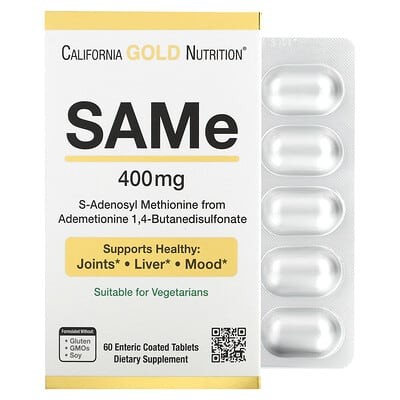
SAMe 400 mg

SAMe 400 mg

California Gold Nutrition4.7 (1,773 ratings)
Format:Tablet Quantity: 60 Tablet(s) · 60 servings
Goals
$50.43 $0.84 per serving

About this product

One enteric-coated tablet provides 400 mg of S-adenosylmethionine, a full commonly used amount. The coating is useful because it supports passage through the stomach before release.

SAMe has a focused role in methylation and neurotransmitter pathways and may also support joint comfort. It is better aligned with mood support than everyday stress relief, and it offers only narrow coverage for detoxification.

The label does not identify a stabilized salt, clarify net active SAMe, or state moisture-protective packaging. Those quality uncertainties matter because SAMe is stability-sensitive, while serotonergic interactions and mood activation make the product unsuitable for unsupervised use by some people.

Who is it for
  • Adults seeking a full SAMe serving
  • People focused on mood or joint support
  • Users who have reviewed medication and mood-history risks
Best for
  • Mood-focused SAMe use
  • Targeted joint-comfort support
  • One-tablet methylation support

Pros

  • Full 400 mg serving
  • Enteric-coated delivery
  • One tablet per serving
  • Relevant to mood, joint, and methylation pathways

Cons

  • Stabilized SAMe salt is not identified
  • Net active amount is unclear
  • Moisture-protective packaging is not stated
  • Less directly suited to everyday stress relief

Warnings

  • SAMe may trigger agitation or mania in people with bipolar disorder.
  • SAMe can raise serotonin-related risk with SSRIs, SNRIs, MAO inhibitors, and other serotonergic medicines; clinician-guided use is important.

Product analysis

75 out of 100
A 400 mg enteric-coated tablet provides a meaningful SAMe amount with broad goal relevance. Stability disclosure remains incomplete, and serotonergic medication or bipolar concerns require careful screening.

AI assessment of the formula, label and price. How scoring works

Nutrient quality87

A substantial SAMe amount and enteric coating support useful intestinal delivery. Missing salt stabilization and a relatively aggressive starting amount reduce general suitability.

.
Ingredient transparency73

The active amount is disclosed without a hidden blend. Salt form, net active SAMe, intake directions, excipients, and protective packaging are unclear.

.
Customer satisfaction69

The supplied average rating is strong and comes from a substantial rating pool. No firsthand experiences or recurring complaint details were provided, so consistency remains uncertain.

.
Value for money69

Enteric delivery and a full amount provide moderate value despite a high serving cost. Missing salt stabilization and packaging details weaken competitiveness.

.
Format
Tablet
Container
60 Tablet(s)
Per serving
$0.84
Customer rating
4.7 · 1,773 ratings
Report analysis

Goals

Mood Support
Impact
Moderate effect
B- Ingredient FitF PathwaysC+ EvidenceA+ Formulation Logic
SAMe · 400 mg

SAMe may help with depressive symptoms in some treatment settings, especially as an addition to an antidepressant when symptoms persist. That doesn't imply a routine mood benefit for otherwise healthy users. The serving provides 400 mg, while the relevant depression context used larger daily amounts; the serving alone doesn't tell you how it would fit that treatment context.

How this product is rated for Mood Support

Ingredient fit75

SAMe give the main mood-related ingredient connections.
Goal fit
SAMe connect with mood-related functions.
Dose adequacy
SAMe 400 mg.

Pathways11

The ingredients relate most directly to monoamine signalling. This describes their roles, not a promise of a particular emotional effect.
Depth
The closest ingredient connection is monoamine signalling.
Breadth
Different biological roles do not guarantee broader or stronger mood benefits.

Evidence67

The ingredient has a possible mood connection, with limits on how broadly its benefits apply.
Evidence strength
The ingredient has a possible mood connection, with limits on how broadly its benefits apply.
Studied preparation
The declared ingredient identity is usable, but this alone does not ensure a mood benefit.

Formulation logic100

No required partner is missing and no particular ingredient conflict is identified. Serving amounts and preparation identity still matter for interpreting individual effects.
Partner coverage
No missing required ingredient partner is identified.
Conflicts
No particular ingredient conflict is identified in this combination.
Effective doses
Declared serving amounts can be compared with ingredient-specific amounts; they do not determine a daily regimen.
Study evidence
SAMe Disputed 20 studies
Joint Health
Impact
High effect
B- Ingredient FitF PathwaysB+ EvidenceA+ Formulation Logic
SAMe · 400 mg

SAMe may offer limited relief of osteoarthritis symptoms, rather than prevent joint problems or repair cartilage. The 400 mg serving is below the 1200 mg daily amount associated with the more relevant symptom context. Active SAMe content also doesn't confirm the same coating, stability or absorption, so the serving amount alone can't predict how much relief you might get.

How this product is rated for Joint Health

Ingredient fit75

SAMe provide the main joint-related ingredients. Their amounts and preparation affect how the symptom context applies.
Goal fit
SAMe provide the relevant connection to joint symptoms; this does not imply prevention or structural repair.
Dose adequacy
The serving contains 400 mg active SAMe, compared with a 1200 mg daily amount in the relevant osteoarthritis context.

Pathways15

The strongest ingredient connection concerns cartilage-related processes, with a more limited inflammation connection. This does not imply that damaged joints will be rebuilt.
Depth
The main ingredient connection concerns cartilage-related processes, with a more limited inflammation connection.
Breadth
The ingredient has a focused joint-symptom connection; it does not supply all forms of joint support.

Evidence81

SAMe may provide limited osteoarthritis symptom relief; drug equivalence and structural repair cannot be assumed.
Evidence strength
SAMe may provide limited osteoarthritis symptom relief; drug equivalence and structural repair cannot be assumed.
Studied preparation
The active SAMe declaration does not confirm equivalent coating, stability or absorption.

Formulation logic100

The relevant ingredients do not need an additional missing partner, and no particular conflict is identified.
Partner coverage
The relevant ingredients can contribute without an additional missing partner.
Conflicts
No particular ingredient conflict is identified.
Effective doses
The serving contains 400 mg active SAMe, compared with a 1200 mg daily amount in the relevant osteoarthritis context.
Study evidence
SAMe Supportive 9 studies
Stress Relief
Impact
High effect
B- Ingredient FitF PathwaysC+ EvidenceA+ Formulation Logic
SAMe · 400 mg

Whether SAMe helps you feel less stressed is unclear. Its connection to this goal comes from its role in mood and metabolism, which doesn't by itself mean taking it will make you calmer. The 400 mg serving provides a known amount, but that amount alone can't resolve the uncertainty about everyday stress relief.

How this product is rated for Stress Relief

Ingredient fit75

SAMe has an indirect connection through mood and metabolism.
Goal fit
SAMe has an indirect connection through mood and metabolism.
Dose adequacy
SAMe 400 mg per serving; amounts alone do not guarantee benefit.

Pathways17

The connection is mainly to mood-related processes, rather than a confirmed calming effect.
Depth
The connection is mainly to mood-related processes, rather than a confirmed calming effect.
Breadth
The ingredients have specific connections to stress-related processes; these do not guarantee broad relief.

Evidence65

SAMe’s mood and metabolic roles do not confirm an everyday stress benefit.
Evidence strength
SAMe’s mood and metabolic roles do not confirm an everyday stress benefit.
Studied preparation
The declared ingredients are compatible with the preparation context, without a guarantee of the same benefit.

Formulation logic100

The relevant ingredients require no additional partner identified here. No particular ingredient conflict was identified.
Partner coverage
No additional ingredient partner is required for the relevant ingredients.
Conflicts
No particular ingredient conflict is identified.
Effective doses
The relevant ingredient amounts are known; this does not make their possible benefits certain.
Study evidence
SAMe Not classified

No linked studies yet.

Detoxification
Impact
Highest effect
A Ingredient FitC- PathwaysA- EvidenceA+ Formulation Logic
SAMe · 400 mg

Whether SAMe helps your body remove everyday toxins is unclear. Its liver-related effects in people with alcoholic liver disease don't translate directly to general use, and the declared 400 mg serving doesn't resolve that limitation. The amount refers to SAMe itself; its source salt shouldn't be added as another dose.

How this product is rated for Detoxification

Ingredient fit95

SAMe provides a focused ingredient choice, but its amount doesn't demonstrate routine toxin removal.
Goal fit
SAMe is the sole ingredient relevant here, though its connection to routine toxin removal remains uncertain.
Dose adequacy
One label serving declares SAMe: 400 mg. These amounts alone don't predict routine toxin clearance.

Pathways59

The ingredient has a narrow liver-related connection; broader toxin removal remains uncertain.
Depth
SAMe relates to methyl-group supply, but that connection doesn't show faster removal of unspecified toxins.
Breadth
Only a narrow liver-related or methyl-group connection is present; it doesn't imply broad toxin removal.

Evidence86

The liver-related context is specific to particular preparations and circumstances, limiting what can be expected for everyday toxin removal.
Evidence strength
SAMe's liver-related context doesn't directly predict routine toxin removal in general users.
Studied preparation
The declared preparation doesn't make disease-specific liver effects transferable to everyday toxin removal.

Formulation logic100

No missing required partner or particular ingredient conflict is identified. The declared amounts don't by themselves demonstrate a cleansing effect.
Partner coverage
No required ingredient partner is missing among the relevant ingredients.
Conflicts
No particular ingredient conflict is identified for this goal.
Effective doses
One label serving declares SAMe: 400 mg. These amounts alone don't predict routine toxin clearance.
Study evidence
SAMe Supportive 30 studies

Ingredients

IngredientAmount per servingScore
S-Adenosylmethionine
400 mg 96
Gluten Free Adults 18–50 Dairy Free Women Vegetarian
Report overview
SAMe · 400 mg OverallScore96
A+ Active Ingredient Quality & BioavailabilityA+ Dose, Safety & Label TransparencyB+ Value
SAMe 400 mg lists a named 1,4-butanedisulfonate salt and states a 400 mg serving. The saved facts indicate a net SAMe amount is distinguished, and they identify individually sealed foil blisters and enteric coating. The cost for a 400 mg comparison amount is near the collection median.
How this ingredient is rated

Active Ingredient Quality & Bioavailability100

A named stabilized salt is listed, and individually sealed foil blister packs are identified.
Stabilized Salt Form
The ingredient list names ademetionine 1,4-butanedisulfonate, a stabilized salt form.
Packaging Integrity
The facts identify individually sealed foil blisters, which help limit exposure to air and moisture.

Dose, Safety & Label Transparency100

The serving lists 400 mg of SAMe, and the saved facts indicate the net amount is distinguished from the salt complex.
Active Dosage Strength
It lists 400 mg of SAMe per serving.
Net SAMe Yield Transparency
The facts indicate the label distinguishes net SAMe from salt weight.

Value80

The cost for a 400 mg comparison amount is close to the collection median.
Price Per 400mg Active Dose
The normalized cost for a 400 mg comparison amount is close to the collection median.
Loading alternative details
Report alternatives

Sources

Published studies used for the product analysis and the top-ranked studies for each ingredient and goal.

  1. Efficacy and acceptability of S-adenosyl-L-methionine (SAMe) for depressed patients: A systematic review and meta- analysis.
    Limveeraprajak N; Nakhawatchana S; Visukamol A; Siripakkaphant C; Suttajit S; Srisurapanont M · Progress in neuro-psychopharmacology & biological psychiatry · 2024
    Meta-analysis2,183 participants23 studies pooledMood Support forSAMe
  2. S-Adenosylmethionine (SAMe) as an adjuvant therapy for patients with depression: An updated systematic review and meta-analysis.
    Peng TR; Cheng HY; Wu TW · General hospital psychiatry · 2024
    Meta-analysis1,522 participants14 studies pooledMood Support forSAMe
  3. Efficacy and tolerability of oral and intramuscular S-adenosyl-L-methionine 1,4-butanedisulfonate (SAMe) in the treatment of major depression: comparison with imipramine in 2 multicenter studies.
    Delle Chiaie R; Pancheri P; Scapicchio P · The American journal of clinical nutrition · 2002
    Randomized trial576 participantsMood Support forSAMe
  4. Adjunctive Nutraceuticals for Depression: A Systematic Review and Meta-Analyses.
    Sarris J; Murphy J; Mischoulon D; Papakostas GI; Fava M; Berk M; Ng CH · The American journal of psychiatry · 2017
    Meta-analysisMood Support forSAMe
  5. S-adenosylmethionine (SAMe) as treatment for depression: a systematic review.
    Williams AL; Girard C; Jui D; Sabina A; Katz DL · Clinical and investigative medicine. Medecine clinique et experimentale · 2005
    Meta-analysisMood Support forSAMe
  6. Italian double-blind multicenter study comparing S-adenosylmethionine, naproxen, and placebo in the treatment of degenerative joint disease.
    Caruso I; Pietrogrande V · The American journal of medicine · 1988
    Clinical trial734 participantsJoint Health forSAMe
  7. S-adenosyl methionine (SAMe) versus celecoxib for the treatment of osteoarthritis symptoms: a double-blind cross-over trial. [ISRCTN36233495].
    Najm WI; Reinsch S; Hoehler F; Tobis JS; Harvey PW · BMC musculoskeletal disorders · 2004
    Randomized trial61 participantsJoint Health forSAMe
  8. S-Adenosylmethionine for osteoarthritis of the knee or hip.
    Rutjes AW; Nüesch E; Reichenbach S; Jüni P · The Cochrane database of systematic reviews · 2010
    Meta-analysis656 participants4 studies pooledJoint Health forSAMe
  9. Safety and efficacy of S-adenosylmethionine (SAMe) for osteoarthritis.
    Soeken KL; Lee WL; Bausell RB; Agelli M; Berman BM · The Journal of family practice · 2002
    Meta-analysis11 studies pooledJoint Health forSAMe
  10. A long-term (two years) clinical trial with S-adenosylmethionine for the treatment of osteoarthritis.
    König B · The American journal of medicine · 1988
    Single-arm trial108 participantsJoint Health forSAMe
  11. A double-blind trial of ademetionine vs naproxen in activated gonarthrosis.
    Domljan Z; Vrhovac B; Dürrigl T; Pucar I · International journal of clinical pharmacology, therapy, and toxicology · 1989
    Non-randomized trial20 participantsJoint Health forSAMe
  12. S-adenosyl-L-methionine for the treatment of chronic liver disease: a systematic review and meta-analysis.
    Guo T; Chang L; Xiao Y; Liu Q · PloS one · 2015
    Meta-analysis705 participants11 studies pooledDetoxification forSAMe
  13. Early treatment efficacy of S-adenosylmethionine in patients with intrahepatic cholestasis: A systematic review.
    Noureddin M; Sander-Struckmeier S; Mato JM · World journal of hepatology · 2020
    Systematic review9 studies pooledDetoxification forSAMe
  14. S-adenosyl-L-methionine treatment for alcoholic liver disease: a double-blinded, randomized, placebo-controlled trial.
    Medici V; Virata MC; Peerson JM; Stabler SP; French SW; Gregory JF; Albanese A; Bowlus CL; Devaraj S; Panacek EA; Richards JR; Halsted CH · Alcoholism, clinical and experimental research · 2012
    Randomized trial37 participantsDetoxification forSAMe
  15. Open-label study of ademetionine for the treatment of intrahepatic cholestasis associated with alcoholic liver disease.
    Ivashkin VT; Maevskaya MV; Kobalava ZD; Uspenskiy YP; Fominih JA; Rozanov AV; Tolkacheva VV; Sotnikova TI; Alikhanov BA; Gorbacheva IA; Ershova OB; Znakhyrenko AA; Sokolov KA; Sander-Struckmeier S · Minerva gastroenterologica e dietologica · 2019
    Single-arm trial72 participantsDetoxification forSAMe
  16. S-adenosylmethionine in alcoholic liver cirrhosis: a randomized, placebo-controlled, double-blind, multicenter clinical trial.
    Mato JM; Cámara J; Fernández de Paz J; Caballería L; Coll S; Caballero A; García-Buey L; Beltrán J; Benita V; Caballería J; Solà R; Moreno-Otero R; Barrao F; Martín-Duce A; Correa JA; Parés A; Barrao E; García-Magaz I; Puerta JL; Moreno J; Boissard G; Ortiz P; Rodés J · Journal of hepatology · 1999
    Randomized trial123 participantsDetoxification forSAMe
  17. Beneficial effects of S-adenosyl-L-methionine on post-hepatectomy residual liver function: a prospective, randomized, controlled clinical trial.
    Su ZR; Cui ZL; Ma JL; Li JS; Ge YS; Yu JH; Pan JH; Xu GL; Jia WD · Hepato-gastroenterology · 2014
    Randomized trial79 participantsDetoxification forSAMe
  18. Ursodeoxycholic acid and S-adenosylmethionine in the treatment of intrahepatic cholestasis of pregnancy: a multi-centered randomized controlled trial.
    Zhang L; Liu XH; Qi HB; Li Z; Fu XD; Chen L; Shao Y · European review for medical and pharmacological sciences · 2016
    Randomized trial120 participantsDetoxification forSAMe
  19. Protective effect of S-adenosylmethionine on hepatic ischemia-reperfusion injury during hepatectomy in HCC patients with chronic HBV infection.
    Liu GY; Wang W; Jia WD; Xu GL; Ma JL; Ge YS; Yu JH; Sun QK; Meng FL · World journal of surgical oncology · 2014
    Non-randomized trial81 participantsDetoxification forSAMe
  20. Double-blind multicentre study of the activity of S-adenosylmethionine in hip and knee osteoarthritis.
    Glorioso S; Todesco S; Mazzi A; Marcolongo R; Giordano M; Colombo B; Cherie-Ligniere G; Mattara L; Leardini G; Passeri M · International journal of clinical pharmacology research · 1985
    Randomized trial150 participantsJoint Health forSAMe
  21. Exploring the mechanisms behind S-adenosylmethionine (SAMe) in the treatment of osteoarthritis.
    Hosea Blewett HJ · Critical reviews in food science and nutrition · 2008
    Narrative reviewJoint Health forSAMe
  22. A double-blind, randomized parallel-group, efficacy and safety study of intramuscular S-adenosyl-L-methionine 1,4-butanedisulphonate (SAMe) versus imipramine in patients with major depressive disorder.
    Pancheri P; Scapicchio P; Chiaie RD · The international journal of neuropsychopharmacology · 2004
    Randomized trial293 participantsMood Support forSAMe
  23. Preliminary results of a randomized controlled trial carried out with a fixed combination of S-adenosyl-L-methionine and betaine versus amitriptyline in patients with mild depression.
    Di Pierro F; Settembre R · International journal of general medicine · 2015
    Randomized trial64 participantsMood Support forSAMe
  24. S-adenosylmethionine blood levels in major depression: changes with drug treatment.
    Bell KM; Potkin SG; Carreon D; Plon L · Acta neurologica Scandinavica. Supplementum · 1994
    Randomized trial26 participantsMood Support forSAMe